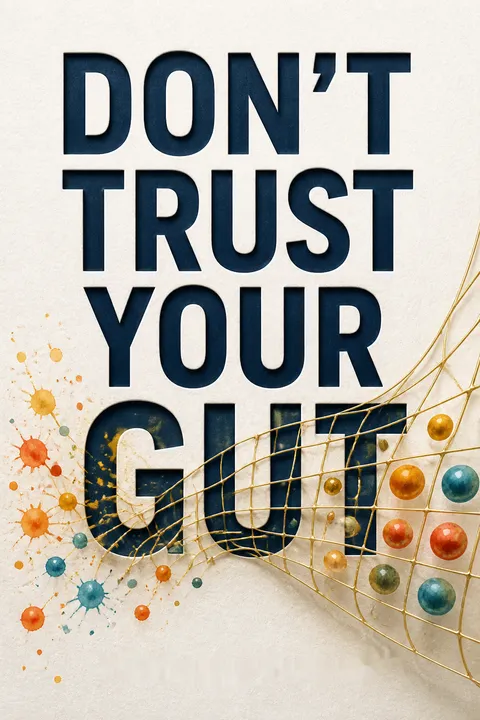


Key Takeaways
Use data to challenge your gut, not to outsource your life.
Evidence corrects intuition. The book applies a Moneyball lesson to personal choices: large datasets can reveal patterns that anecdotes and instinct miss. Baseball analysts found teams overvalued bunting and stealing while undervaluing players who drew walks. In another example, researchers analyzed nearly 100,000 livestream sales pitches and found that restrained emotion predicted better sales than exuberant displays, even outperforming free shipping as a predictor.
But data is no oracle. The strongest studies answer specific questions, such as which sales behaviors correlate with purchases or which neighborhoods improve average outcomes. They do not deliver a universal script for an individual life. Use evidence to revise a mistaken assumption, then decide what outcome matters and whether the finding applies to the situation at hand.
The useful distinction is between using data to choose means and using it to choose ends. Evidence can show which tactics sell more, but it cannot decide whether maximizing sales is worth the trade-off. The book's examples are most persuasive when the measured outcome is clear and the result overturns a confident assumption. Their limits matter just as much: a pattern in a large sample can still be irrelevant to a particular person, especially when the dataset measures clicks, income, or ratings rather than fulfillment.
Don't confuse dating-market popularity with long-term relationship value.
Desire and happiness diverge. Online dating data show that looks, height, income, occupation, and other visible traits affect who receives attention. For instance, conventional attractiveness explained a substantial share of success on one dating site. Yet a machine-learning study combining 43 studies and 11,196 couples found that many highly sought traits, including attractiveness, height, and similarity, barely helped predict relationship happiness.
Character matters more. A person's own life satisfaction, emotional security, conscientiousness, and willingness to grow were more informative about relationship quality than the partner's measured traits. The person's prior well-being was roughly four times as predictive as the combined characteristics of the partner. The implication is not to ignore attraction, but to stop treating popularity as evidence that someone will make a good life partner.
This finding separates two questions that dating culture routinely collapses: whom people pursue and with whom they thrive. App behavior records attention, not wisdom, and a desirable profile is not a validated forecast of a satisfying partnership. The research also resists a simple matchmaking algorithm: the couple-level data could not reliably identify which pairs would be happy. That uncertainty encourages attention to the relationship as it is experienced, rather than confidence in a checklist of supposedly perfect traits.
Relax over daily parenting choices, but choose your child's surroundings carefully.
Most choices have modest effects. Adoption studies comparing children raised in different homes suggest that parents influence adult outcomes less than conventional advice implies. One estimate found that a one-standard-deviation improvement in a child's family environment might raise adult income by about 26 percent. That is meaningful, but it is not a magic lever that turns every ordinary outcome into exceptional success. Studies of choices such as breastfeeding, television exposure, and chess lessons have also found limited or uncertain long-term effects.
Place and people matter. Tax records tracking childhood moves suggest that neighborhoods can shift adult outcomes, sometimes raising income by about 12 to 13 percent. Neighborhoods with more college graduates, stable households, and civic participation tended to offer better prospects. Exposure to adult role models also mattered, including women inventors for girls and Black fathers for Black boys.
The practical strength of this argument is prioritization. Parents cannot optimize thousands of small decisions, and treating every choice as decisive invites anxiety and guilt. Neighborhood research offers a more structural view: children learn from the adults and institutions around them, not only from instruction at home. These are average effects, however, not a verdict on an individual family. Parenting studies can understate the value of care, security, and protection even when those qualities do not translate neatly into income or test scores.
Choose sports where your body and the scholarship odds give you a chance.
Genetics differ by sport. Using twin prevalence as a rough proxy, the author estimates that genetic factors account for about 75 percent of variation in basketball ability, compared with roughly 25 percent in baseball and football. Height is one obvious advantage: a man over seven feet tall has vastly better odds of reaching the NBA than one under six feet. The estimates are approximate, but the differences between sports are striking.
Opportunity differs too. Scholarship odds can favor less popular sports. In the figures assembled in the book, female high-school rowers faced about two competitors per college scholarship, while female cross-country runners faced about 57. Male fencing also had better scholarship odds than lacrosse. Such comparisons should include cost and access: some sports require club teams, equipment, or facilities that are not widely available.
This is a useful alternative to the simplistic message that effort can overcome every physical constraint. A sport is both a competition and a market with its own entry costs, talent distribution, and number of available places. Twin estimates help compare broad patterns, but they are not precise personal forecasts, and scholarship ratios say nothing about whether a student will enjoy the sport. The sensible use of these numbers is to widen the menu of options, not to declare a child's ceiling.
Build wealth by owning a defensible business, not chasing a glamorous one.
Ownership beats salary more often. Among the top 0.1 percent of earners studied, only about one in five received most of their income from wages, while 84 percent had at least some business income. A former football player who built a fast-food franchise fortune became far wealthier than a star who earned millions playing the sport. The business, not the celebrity career, was the asset.
The field still matters. Real estate, investing, auto dealerships, independent creative work, market research, and wholesale middlemen appeared among the author's strongest paths to wealth. These businesses share ways to protect profits from price wars, such as legal barriers, specialized knowledge, local relationships, or a devoted audience. Sexy ventures such as record shops and toy stores often failed quickly. Creative-business success estimates also suffer from selection bias because many struggling artists never register a business.
The book's deeper point is not simply to become an owner. It is to understand why a business can keep what it earns. In ordinary competitive markets, new rivals can undercut prices until profits shrink. A durable advantage, whether a local relationship or specialized knowledge, changes that equation. Still, the listed industries are not a reliable shopping list for aspiring founders. Regulation, capital, geography, and existing gatekeepers shape access, while tax records describe past winners rather than guarantee future returns.
Master a field before founding; the typical successful founder is forty-two.
Experience beats the prodigy story. A study of 2.7 million U.S. founders found that the average founder was 41.9 years old, not a teenage wunderkind. Older founders were more likely to build successful companies, with a sixty-year-old founder estimated to have about three times the chance of creating a valuable business as a thirty-year-old founder. The pattern also held in technology.
Insider knowledge helps. Founders with experience in the same industry were roughly twice as likely to build an exceptional business as founders without that background. Tony Fadell began Nest in his early forties after years at General Magic, Philips, and Apple. Those jobs supplied industry knowledge, management practice, contacts, and capital. This does not mean every employee should become an entrepreneur. It does challenge the idea that youth, inexperience, or a string of failures is usually an advantage.
The media selects for vivid exceptions: young founders make better headlines than patient specialists. Representative datasets correct that storytelling distortion. The result also offers a more realistic account of innovation: expertise can reveal a problem worth solving and provide the means to solve it. Age itself is not a business strategy, and the study reports associations across founders, not a guaranteed payoff for waiting. Its strongest practical lesson is to build relevant skill and credibility before taking a large risk.
Search beyond familiar gatekeepers to give your work more chances to be discovered.
Spread the work around. Researchers studying the careers of nearly 500,000 painters found that artists who presented work in a wide range of galleries were about six times more likely to have long, successful careers than those who repeatedly returned to the same few venues. Some lesser-known galleries unexpectedly helped artists break through, but their value was difficult to predict in advance.
Bruce Springsteen made a similar bet. As a young musician playing around the Jersey Shore, he recognized that staying in his home area meant few influential listeners would encounter his work. He traveled widely and took opportunities far from home, eventually reaching the contacts that led to a record deal. The practical lesson applies to fields where quality is hard to judge: if the right audience has not found the work, change where it appears.
When performance is difficult to assess, access and visibility can shape who gets a chance. Broad exposure increases the number of people who might recognize value, while repeating the same pitch to the same gatekeepers mostly reproduces the same odds. Travel is only one version of the strategy; the underlying question is whether a person's work reaches genuinely different audiences. Wider circulation still cannot make weak work strong, but it can prevent promising work from remaining unseen.
Put more work and more applications into circulation instead of pre-rejecting yourself.
Quantity creates more openings. The psychologist Dean Simonton found that highly regarded artists often produced a great deal of work. Their output gave them more chances to make something audiences embraced. This matters because creators may misjudge their own results: Beethoven, Woody Allen, and Bruce Springsteen each doubted work that others later valued highly.
The same logic applies elsewhere. In online dating research, even people ranked among the least desirable received replies from some of the most desirable. Repeated attempts raised the chance of hearing yes. A survey of academic job searches found that applicants sent about 15 applications for each offer, and sending more applications was associated with more interviews and offers. More attempts do not guarantee success, and indiscriminate volume can waste effort. The point is to avoid letting an untested prediction of rejection make the decision.
This is a behavioral answer to uncertainty: when people cannot reliably forecast which work, application, or invitation will succeed, they should create more opportunities for feedback. It also counters a common error in self-assessment, where anticipated rejection is treated as established fact. Quantity is not a substitute for craft, fit, or respectful communication. It is a way to reduce dependence on one fragile opportunity and to let real responses, rather than private speculation, inform the next move.
Test how you present yourself; small changes can reshape first impressions.
Faces affect opportunity. In studies of U.S. elections, the candidate most often judged to look competent won about 72 percent of Senate races and 67 percent of House races. In a military study, perceived facial dominance predicted how far West Point graduates rose in rank. These judgments are quick, powerful, and not reliable measures of actual ability.
Presentation can change perception. People rated different photographs of the same person differently, even when the images varied only slightly. The author tested more than 100 digitally altered versions of his own face. In his sample, glasses raised perceived competence by about 0.8 points on a ten-point scale, and a beard by about 0.35. The result suggests experimenting with lighting, clothing, hair, or glasses and asking for outside feedback rather than assuming appearance is fixed.
The advice is practical, but the underlying finding is ethically uncomfortable: institutions often use appearance as a shortcut for qualities they should assess directly. Testing presentation can help someone navigate that bias, yet it does not make the bias fair or make perceived competence equivalent to competence. The author's experiment is also personal and limited to one outcome, one face, and one sample of raters. Its value is methodological: make small, reversible tests instead of treating self-criticism as objective evidence.
Schedule effortful activities that reliably lift mood more than lounging does.
Comfort can mislead. The Mappiness project collected more than three million smartphone reports about people's activities and moods. Its activity rankings placed intimacy first, followed by activities such as attending performances, visiting museums, exercising, and gardening. Passive options such as television, internet browsing, and relaxing tended to deliver less happiness than people expected. In a separate survey, people especially underestimated museums, exercise, gardening, and shopping.
Start before motivation arrives. Many rewarding activities require leaving the couch, making plans, or tolerating a little effort at the outset. The data suggests that people often misjudge these activities by imagining the hassle more vividly than the enjoyment. These rankings are averages, not universal rules, and the Mappiness sample depended on people responding to phone prompts. Still, the findings give a useful nudge: try the activity before deciding that passive rest is the more enjoyable option.
The gap between anticipated and experienced enjoyment helps explain why free time can disappear into low-effort routines that do not feel especially good. A small scheduled commitment can bypass the forecast made from the couch. The evidence is strongest as a prompt for personal experimentation, not a universal ranking of leisure: one person's restorative quiet may be another's dull afternoon. Tracking mood after a few activities can reveal whether the population average matches an individual's experience.
Reduce recurring happiness drains instead of expecting bigger wins to compensate.
Work is a major drain. In the Mappiness rankings, working was among the least enjoyable ordinary activities. Yet working with friends added enough happiness to transform the experience substantially; working from home and listening to music also helped. A separate experiment found that people paid to deactivate Facebook for four weeks became happier and spent more time with friends and family.
Even victories can disappoint. A study of soccer fans found that a team's loss lowered happiness about twice as much as a win raised it. Supporting a stronger team did not solve the imbalance because fans expected more from it. The evidence points toward practical safeguards: work alongside people one likes when possible, limit social-media use, and enjoy sports without tying every result to personal well-being.
The important unit here is not the dramatic event but the repeated exposure. A mildly unpleasant commute, lonely workday, or endless feed can accumulate because it occupies so much time. Changing the social conditions of work may be more realistic than simply quitting, while limiting a platform can reclaim time for chosen relationships. Sports fandom adds a useful warning about asymmetry: emotional investment can magnify losses without making wins equally satisfying. These patterns invite redesign, not self-blame.
Analysis
The book's central contribution is a shift in what counts as useful life advice. Instead of treating memorable stories, confident experts, or personal intuition as representative, it compares those impressions with larger datasets and asks what actually predicts outcomes. Its most powerful findings come from contrasts: desired partners versus satisfying partners, parental decisions versus neighborhoods, young founders in media versus founders in tax and business records, and anticipated pleasure versus reported experience.
The evidence is not uniform. Some chapters draw on large observational datasets, while others use natural experiments, randomized interventions, or the author's own small test. These methods support different levels of confidence. The adoption and sibling-mover studies offer stronger causal leverage than a simple correlation between traits and success, while the personal appearance experiment is best read as an illustration of method rather than general proof. Sample selection also matters: dating apps, smartphone responders, registered businesses, and artists who survive long enough to be counted each represent particular slices of life.
The book is most convincing when it distinguishes prediction from value. A model may predict clicks, income, career advancement, or reported mood without establishing what people ought to pursue. Dating desirability is not relationship quality. Wealth is not happiness. A face judged competent is not necessarily competent. Data can reveal that society rewards a biased shortcut, but cannot make the shortcut just. The author occasionally draws practical advice from average effects that are smaller or less certain than the prose suggests, so readers should retain the uncertainty attached to the underlying studies.
The best use of the book is neither blind faith in algorithms nor reflexive defense of intuition. It is disciplined skepticism in both directions. Ask what outcome was measured, who was counted, whether the evidence is causal, and whether that outcome matches the life being sought. Then use data to expose hidden trade-offs and test assumptions, while leaving moral judgment and personal meaning to human beings.
Review Summary
Don't Trust Your Gut receives mixed reviews. Readers appreciate its data-driven approach to self-help and find it entertaining and thought-provoking. Many praise the author's writing style and humor. However, critics argue that the book oversimplifies complex issues, makes broad generalizations, and lacks depth in data analysis. Some question the practical applicability of the advice given. While some readers find valuable insights, others feel the book falls short of its potential, particularly in addressing ethical considerations and diverse perspectives.
People Also Read








Glossary
Dataism
Trust in dataA worldview in which data and computational analysis become important authorities for understanding people and making decisions. The book contrasts this approach with earlier reliance on religious doctrine and later reliance on personal feelings. It presents data as a way to correct cognitive biases, not as a complete moral system or a guarantee that algorithms know what people should value.
Mappiness
Smartphone mood researchA research project that used smartphone prompts to collect reports about users' activities, companions, and momentary happiness. Across tens of thousands of participants, it gathered more than three million observations. Researchers used these reports to compare mood across activities and settings, creating an unusually detailed record of everyday well-being.
Irrelevant Eight
Weak partner predictorsThe author's label for eight partner traits that showed little ability to predict reported relationship happiness in a large study of couples: race or ethnicity, religious affiliation, height, occupation, physical attractiveness, previous marital status, sexual tastes, and similarity to oneself. The label does not mean these traits never matter to individuals. It means they were weak predictors in the analyzed data.
SuperMetros
Cities aiding child outcomesThe author's shorthand for metropolitan areas where children, on average, appeared to gain an advantage in adult outcomes from growing up there. Using tax records and childhood moves, researchers identified places including Seattle, Minneapolis, Salt Lake City, Reading, and Madison as having especially positive estimated effects. The ranking is an average, not a guarantee for every child or neighborhood.
The Big Six
Wealth-building business fieldsThe author's grouping of business fields that appeared unusually likely to produce very wealthy owners in tax data: real estate, investing, auto dealerships, independent creative work, market research, and wholesale middlemen. These fields can protect profits through local knowledge, regulation, specialized information, or distinctive brands. The list describes observed patterns, not a promise that entering any one field will create wealth.
Mona Lisa Effect
Chance reshapes reputationThe idea that unpredictable events can dramatically alter the success of work whose quality is difficult to judge. The book uses the theft of the Mona Lisa in 1911 as an example: intense publicity helped turn a respected painting into a global attraction. The effect emphasizes how luck and attention can influence reputation independently of a work's intrinsic qualities.
Da Vinci Effect
Fame compounds demandThe tendency for an artist's existing reputation to increase the perceived value and demand for that artist's work. The book illustrates the effect with a painting whose price rose enormously after experts attributed it to Leonardo da Vinci. Recognition can become self-reinforcing: prestigious credentials attract institutions and buyers, which create further recognition.
Springsteen's Rule
Search widely for discoveryThe book's name for the strategy of taking work to a wide range of venues and audiences rather than repeatedly presenting it in familiar places. Research on painters found that artists who exhibited across many galleries were more likely to build lasting careers. Bruce Springsteen's early travel to seek audiences provides a parallel example of actively increasing the chances of discovery.
Picasso's Rule
Produce more attemptsThe principle that producing more work increases the chance of creating something that succeeds, especially when creators cannot accurately judge in advance which work audiences will value. The book points to highly prolific artists and examples of creators who nearly withheld celebrated work. Quantity does not ensure quality, but it creates more opportunities for success and feedback.
Data-Driven Answer to Life
A data-based happiness recipeThe author's playful summary of findings from smartphone happiness research: well-being is associated with intimacy, time with a loved person, pleasant weather, and beautiful natural surroundings. It condenses average patterns into a memorable image rather than a literal prescription. The underlying studies suggest that daily activities, companions, and environments can shape momentary mood.
FAQ
1. What’s "Don’t Trust Your Gut" by Seth Stephens-Davidowitz about?
- Data-driven life decisions: The book explores how Big Data and analytics can help individuals make better choices in relationships, careers, parenting, and happiness, challenging the reliability of gut instincts.
- Debunking common myths: Stephens-Davidowitz uses large-scale data to reveal that many widely held beliefs about success, happiness, and human behavior are often wrong.
- Practical applications: Through real-world examples and research, the author demonstrates how data can guide us to better outcomes in everyday life.
2. Why should I read "Don’t Trust Your Gut" by Seth Stephens-Davidowitz?
- Challenge your intuition: The book shows that gut feelings are frequently misleading due to cognitive biases, and that data offers a more reliable guide for important life decisions.
- Actionable, evidence-based advice: Readers gain practical strategies for improving dating, parenting, career choices, and happiness, all grounded in rigorous data analysis.
- Broad relevance: Whether you’re single, a parent, an entrepreneur, or simply curious about human behavior, the book’s insights are widely applicable.
3. What are the key takeaways from "Don’t Trust Your Gut" by Seth Stephens-Davidowitz?
- Intuition is often flawed: Relying on gut feelings can lead to suboptimal or biased decisions in major life areas.
- Data reveals hidden truths: Large datasets uncover surprising insights that challenge conventional wisdom, from what makes relationships work to how happiness is achieved.
- Practical, counterintuitive strategies: The book offers actionable advice that may feel wrong but is supported by data, such as being more extreme in self-presentation or focusing on neighborhood over parenting style.
4. What are the best quotes from "Don’t Trust Your Gut" by Seth Stephens-Davidowitz and what do they mean?
- “Moneyball for your life.” This quote encapsulates the book’s central idea: applying data analytics, as in baseball’s Moneyball revolution, to personal life decisions.
- “We date all wrong.” The author highlights how people often prioritize the wrong traits in dating, focusing on superficial qualities rather than those that predict long-term happiness.
- “Luck is not just random.” The book argues that while luck plays a role in success, data can help us recognize and capitalize on opportunities, making luck more predictable.
5. How does "Don’t Trust Your Gut" by Seth Stephens-Davidowitz use data to challenge common beliefs about relationships and dating?
- Traits that matter less: Data shows that demographics, preferences, and even shared values have little power in predicting relationship happiness.
- Personality and mindset: The strongest predictors of romantic happiness are a partner’s life satisfaction, secure attachment style, conscientiousness, and growth mindset.
- Similarity over opposites: Contrary to the “opposites attract” myth, people are generally happier with partners similar to themselves in values and personality.
6. What does "Don’t Trust Your Gut" by Seth Stephens-Davidowitz reveal about parenting and the impact of neighborhoods?
- Limited parental influence: Studies of adoptees and twins suggest that parenting style has a surprisingly small effect on children’s long-term outcomes.
- Neighborhood’s outsized role: Growing up in a high-opportunity neighborhood can increase a child’s future income by 12-25%, independent of family background.
- Role models matter: Exposure to successful adult role models in the community, especially those sharing a child’s race or gender, significantly boosts children’s chances of success.
7. What are the "infield shifts of life" and how do they apply in "Don’t Trust Your Gut" by Seth Stephens-Davidowitz?
- Counterintuitive strategies: Borrowing from baseball’s data-driven defensive shifts, the book highlights life decisions that may feel wrong but are supported by data.
- Examples in dating and sales: Being an extreme version of yourself can attract more interest in dating, and salespeople with less enthusiasm (a poker face) often outperform those who smile broadly.
- Embracing the odd: The book encourages readers to adopt strategies that go against intuition but are proven effective by data.
8. How does "Don’t Trust Your Gut" by Seth Stephens-Davidowitz explain the role of luck in success, and how can you "hack" it?
- Luck is significant but not everything: Both successful and average people experience similar numbers of lucky breaks; the difference is in recognizing and leveraging them.
- Persistence and exposure: Presenting your work or ideas widely and consistently increases the odds of stumbling upon success.
- Patterns of luck: Data reveals that networking, adaptability, and diversifying opportunities help create more “luck” rather than waiting for it passively.
9. What does "Don’t Trust Your Gut" by Seth Stephens-Davidowitz say about career success and entrepreneurship?
- Age and experience matter: The average successful entrepreneur is about 42 years old, and prior industry experience doubles the chances of success.
- Business ownership dominates wealth: Most wealthy Americans earn their fortunes from owning businesses, especially in fields with less competition and more legal protections.
- Debunking myths: The book challenges the idea that youth, outsider status, or being a marginal employee are advantages in entrepreneurship.
10. How does "Don’t Trust Your Gut" by Seth Stephens-Davidowitz address the impact of appearance and self-presentation on success?
- Appearance influences perception: Facial features and grooming strongly affect how others perceive competence, trustworthiness, and dominance, impacting outcomes in politics and business.
- Change is possible: Small adjustments in lighting, expression, or grooming can significantly alter perceptions, showing that appearance is not fixed.
- Data-driven makeovers: The author demonstrates how AI tools and rapid market research can help individuals find their most favorable look.
11. What are the major "traps" of modern life that reduce happiness, according to "Don’t Trust Your Gut" by Seth Stephens-Davidowitz?
- Work and social media: Work is often the most miserable activity, especially when done alone, and excessive social media use lowers happiness.
- Sports and alcohol: Sports fandom causes more pain from losses than pleasure from wins, and alcohol only boosts mood when making unpleasant activities more bearable.
- Nature deficit: Spending time in natural, scenic environments significantly increases happiness, even when simply having a view of nature indoors.
12. What is the "data-driven answer to life" and the happiness formula in "Don’t Trust Your Gut" by Seth Stephens-Davidowitz?
- Happiness is measurable: Using smartphone apps, researchers collected millions of real-time happiness reports linked to activities and environments.
- Key happiness factors: Sex, socializing, and being in nature rank highest for momentary happiness, while work, commuting, and social media rank lowest.
- Formula for happiness: The book concludes that social connections, meaningful activities, and environment are the most reliable, data-backed ingredients for a happy life.
About the Author
Other books by Seth Stephens-Davidowitz
Download PDF
Download EPUB
.epub digital book format is ideal for reading ebooks on phones, tablets, and e-readers.








