

Key Takeaways
Manage your vulnerability, not just the danger outside the door
Risk has two ingredients. A threat becomes a risk when it meets a vulnerability: a virus matters differently to a prepared hospital than to one without enough protective equipment. The authors express this relationship as threat multiplied by vulnerability. That shifts attention from predicting every hazard to improving the ability to withstand it. They call this capacity a Risk Immune System, which detects danger, assesses exposure, responds, and learns from the result.
Preparation beats prophecy. In 2019, the Crimson Contagion exercise exposed weaknesses in pandemic coordination and supplies. The warnings were not adequately acted upon before COVID-19 tested those systems for real. The book also illustrates how sequential risks compound: if ten necessary steps each had a hypothetical 90 percent chance of success, the whole operation would have roughly a 35 percent chance. Readiness matters more than a reassuring headline probability.
The immune-system analogy makes resilience intuitive: defense is not a wall that prevents every threat, but a capacity to recognize and respond. It also connects to safety engineering, where accidents often emerge from several small failures lining up rather than one spectacular mistake. The analogy has limits, however. Institutions do not have a single biological boundary, and some vulnerabilities are imposed by poverty, law, or political choices beyond an individual team's reach. Calling risk manageable should therefore clarify responsibility, not imply that every harmed person or organization simply failed to prepare.
Tune ten linked organizational controls instead of hunting for one magic fix
Risk is a system problem. The book identifies ten adjustable dimensions that shape an organization's response: how information travels, what story the group believes about itself, how work and authority are arranged, which tools are used, whose perspectives count, which assumptions distort judgment, whether people act, when they act, how they change course, and how leaders coordinate the whole.
The dials interact. A team can have excellent technology but poor communication, or skilled people whose structure prevents them from sharing what they know. In the Mojave Desert, McChrystal's unit built formidable defenses but failed to close the gaps before an exercise attack. No single blunder explained the defeat. Several ordinary weaknesses combined, showing why risk control is not a checklist of independent strengths. The point is to adjust the mix to the situation.
This systems view is more realistic than searching for a single root cause. In complex systems, reliability often depends on the quality of interfaces: handoffs, feedback loops, and clear authority. Yet ten dimensions can become a cumbersome dashboard if leaders treat them as a scoring ritual. A useful assessment asks how one factor changes another in a specific situation. The framework is most valuable as a way to generate sharper questions, not as a universal formula that promises to rank every danger precisely.
Make information accurate, understandable, and actionable before danger arrives
Transmission is not understanding. Effective communication requires a working channel, willingness to share, a reliable and timely message, and a recipient who can interpret it. A failure at any point can make information useless or misleading. Before 9/11, intelligence agencies held numerous warnings about al-Qaeda, but relevant pieces were not combined into a compelling picture of a domestic attack. The President's Daily Brief mentioned Bin Laden repeatedly, yet those references formed only a small fraction of its many entries.
Noise buries signals. Even true information can lose force when it competes with too many other updates or lacks context. In a different example, a hijacker's radio message accidentally revealed that there were multiple planes involved. The detail mattered because listeners could interpret it as evidence of a broader attack. Communication is therefore not simply volume. It is the disciplined movement of meaningful information to people able to act on it.
The chapter's strongest insight resembles a problem in information theory: a signal must survive transmission and be decoded in context. Organizations often invest in more channels when their real weakness is synthesis, trust, or attention. A practical implication is to distinguish receipt from comprehension: asking a recipient to explain what they heard can expose misunderstandings that delivery confirmations conceal. Still, no communication system can eliminate ambiguity. Good systems make uncertainty visible instead of converting incomplete reports into unwarranted certainty.
Make your stated values match your incentives, authority, and everyday behavior
Stories shape conduct. An organization's narrative is the account of who it is and what its work means. Google's public commitment to avoid harmful conduct helped attract employees who expected its decisions to reflect that principle. When the company took on Project Maven, a military artificial intelligence contract, many employees saw a conflict between its stated identity and its actions. The dispute damaged trust and led some employees to leave.
Structure gives values power. A declared priority means little if the people responsible for protecting it lack influence. Lehman Brothers had a chief risk officer, but she was excluded from key executive discussions as risky financial decisions expanded. A title on an organization chart could not compensate for missing authority. A credible organization must align its language with the decisions it rewards and give responsibility real access to decision-makers.
Narrative functions like an informal constitution: it helps people interpret ambiguous choices and decide what conduct belongs. Organizational research on incentives reinforces the point that formal values compete with what gets rewarded, promoted, and ignored. A slogan can clarify identity, but vague ideals can also create expectations leaders never intended to meet. The answer is not to avoid values; it is to define their scope, invite challenge, and make decision rights consistent with the promises being made.
Keep human judgment in automated decisions with catastrophic consequences
Automation can create dependence. In 1983, Soviet officer Stanislav Petrov received a computer warning that American missiles were incoming. The system reported five launches, but that pattern seemed strategically implausible, ground radar had not confirmed it, and the satellite system was new. Petrov delayed reporting an attack. The warning proved false: sunlight reflecting off clouds had been misread as missile launches.
Speed narrows judgment. Technology can detect, analyze, and communicate faster than people, but a fast system can also compress the time available to question its output. Petrov's experience shows why organizations must decide in advance whether a person is merely relaying a machine's conclusion or is expected to assess it. Human review is not automatically superior, and automation can reduce error. The crucial design question is where independent confirmation and meaningful human authority remain possible.
This is a classic human-factors problem: automation can improve consistency while encouraging operators to defer to a system they do not fully understand. The strongest design does not frame people and machines as rivals. Machines can monitor patterns at scale; people can question whether the pattern makes sense and whether the underlying data are trustworthy. That balance depends on training and authority. A nominal human veto is useless if the interface hides uncertainty or workplace culture punishes anyone who slows the process.
Invite disagreement before a confident group mistakes consensus for proof
Similarity can hide blind spots. The Bay of Pigs invasion plan rested on assumptions about Cuban resistance and the weakness of Fidel Castro's forces. President Kennedy's advisers did not provide a forceful, shared challenge to the plan, and the invasion failed. Afterward, Kennedy created a broader advisory group during the Cuban Missile Crisis and allowed competing options to be examined, including a naval blockade rather than immediate air strikes.
Difference must be used. Diversity includes experience, expertise, and willingness to question a proposal, not only visible demographic variety. The book's account of Theranos makes the point from another angle: a board rich in prominent public figures but short on relevant medical and scientific expertise failed to scrutinize the company's claims effectively. A group gains little from difference if members cannot speak candidly or if leaders ignore dissent.
Research on group decision-making supports the value of dissent when it is treated as useful evidence rather than disloyalty. A newcomer may notice a contradiction that experts have normalized, while experts remain essential for judging technical claims. The goal is not to give every opinion equal weight; it is to make the reasoning testable. Diversity without psychological safety can become decoration, while skepticism without expertise can become noise. Leaders need procedures that surface challenges and then evaluate them on their merits.
Break inertia, but time the move to the problem rather than your comfort
Delay has consequences. Blockbuster rejected an early chance to buy Netflix, betting that customers would continue preferring its stores. Its later online response was costly and could not stop its decline. During the COVID-19 crisis, the book contrasts Taiwan's early preparation with the United States' slower adoption of distancing measures. One Columbia University analysis cited by the authors estimated that acting a week earlier could have prevented 36,000 deaths by early May 2020.
Fast is not always right. Hurricane Katrina showed the danger of late evacuation decisions and delayed transportation. At the other extreme, Ferrari won the 1998 Hungarian Grand Prix with a strategy that included an extra pit stop. The stop cost time, but lighter fuel loads and better track position made the overall plan faster. Effective action requires judging both when to begin and how long execution will take.
The key distinction is between speed and timing. In decision science, waiting can be valuable when new information is likely to change a choice, but delay becomes costly when threats grow faster than information improves. A good organization makes that trade-off explicit instead of treating caution as inherently wise or boldness as inherently brave. The pandemic figures are modeled estimates, not direct counts of lives that would certainly have been saved. Even so, they illustrate how small delays can cascade when harm spreads exponentially.
Build the willingness and ability to change before old strengths become liabilities
Adaptation needs two parts. Dick Fosbury struggled with conventional high-jump methods, then developed a backward technique that worked because safer landing surfaces made it viable. His approach went from an odd experiment to the standard technique. He had both the willingness to depart from convention and the practical ability to do so.
Past success can trap. Record companies resisted digital music because it threatened the profitable album model. Nokia, after losing its lead in mobile phones, survived by shifting toward network infrastructure, a business it had once treated as peripheral. These examples differ: some organizations recognize change early, while others adapt only under pressure. Efficiency helps repeat a known process, but it can leave an organization brittle when customers, competitors, or conditions change.
Adaptability is not change for its own sake. It is a capacity to notice when the environment has invalidated a once-effective routine and to test a different response. That resembles evolutionary thinking, but organizations can deliberately learn within a single generation rather than waiting for selection across generations. The hard part is often incentive design: people who benefit from the existing system can rationally resist a shift that protects the institution but threatens their roles. Leaders need small experiments and honest feedback to make change less speculative.
Rehearse the whole system, then assign someone to learn from failure
Leadership connects the controls. Boston's COVID-19 response included a daily Crisis Response Forum that linked city departments and outside partners. Mayor Marty Walsh's team used the meetings to share updates, coordinate resources, identify unfinished work, and assign tasks. The forum helped people who rarely worked together respond as one operating team. Leadership mattered not because one person solved everything, but because someone maintained direction and accountability.
Practice exposes weak links. The book recommends several ways to build readiness: review assumptions, map risks and gaps, discuss scenarios at a tabletop, test plans in a live simulation, invite an outside team to find weaknesses, and conduct an after-action review. The point is not to predict the exact crisis. It is to discover who must communicate, decide, and act, then assign owners to fix problems revealed by practice.
This approach resembles high-reliability practice: teams rehearse coordination, learn from near misses, and make responsibilities explicit before conditions become chaotic. Simulations are especially useful when they test interfaces between departments, not just each department's individual competence. Yet exercises can create false confidence if leaders stage only familiar scenarios or fail to fund the fixes they uncover. Learning requires a visible chain from observation to decision to assigned action. Without that chain, rehearsal becomes theater.
Analysis
The book's central move is to relocate risk management from forecasting alone to the design of response capacity. That is persuasive because complex failures rarely arise from a single unknown hazard. They emerge when information, incentives, authority, technology, and timing interact badly. The pandemic exercise, the failed invasion of Cuba, Petrov's warning system, and Boston's crisis meetings make this practical rather than abstract: each case shows a threat meeting a particular institutional weakness.
The framework is strongest as a diagnostic lens. Its ten dimensions encourage leaders to inspect interfaces and dependencies that conventional probability models can overlook. It also resists the comforting fiction that a risk register or designated risk officer automatically makes an organization safe. Authority, attention, and incentives determine whether warnings influence decisions.
There is a tension in the book's claim that the greatest risk is often the organization itself. Internal weakness is actionable, but external conditions are not always controllable, and not every failure reflects negligence. The language of control can overstate what leaders can change, especially when budgets, political mandates, or unequal exposure constrain choices. A useful application distinguishes controllable design choices from residual uncertainty, then makes the latter explicit rather than assigning blame.
The framework also benefits from being paired with quantitative analysis, not substituted for it. Probability estimates, stress tests, and forecasts can identify trends and compare options, even when they cannot deliver certainty. Conversely, the ten dimensions should not become another compliance checklist. Their value lies in prompting specific questions: who receives the warning, who can challenge it, who has authority to act, and how will the organization know whether its response worked? The practical thesis is compelling: preparedness is a social and organizational capability, built through clear responsibility, diverse scrutiny, rehearsal, and learning. It does not eliminate uncertainty. It makes uncertainty less likely to become surprise, paralysis, or preventable harm.
Review Summary
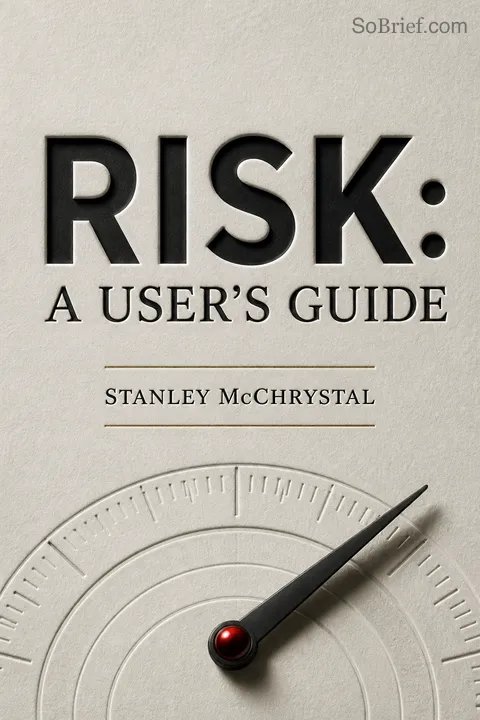
Risk: A User's Guide received mixed reviews. Some praised its practical framework for risk management and engaging historical examples, while others found it lacking in depth and originality. Critics noted the book's reliance on obvious concepts and questionable COVID-19 examples. Supporters appreciated McChrystal's emphasis on proactive risk mitigation and organizational resilience. Overall, readers found the book accessible but divided on its value, with some preferring McChrystal's earlier works.
People Also Read




Glossary
Risk Immune System
Organizational threat responseMcChrystal's analogy for an individual or organization's capacity to detect threats, assess its vulnerability, respond, and learn. Like a biological immune system, it is not a guarantee against harm. Its effectiveness depends on how well people, processes, technology, and leadership work together.
Risk Control Factors
Ten adjustable risk dimensionsThe book's name for ten aspects of organizational life that shape responses to risk: information exchange, shared identity, organizational design, technology, differing perspectives, bias, action, timing, adaptability, and leadership. They are treated as connected controls to calibrate for a situation, not as isolated strengths or a fixed score.
Detect-Assess-Respond-Learn
Four-part response cycleThe four functions of a healthy Risk Immune System. It first notices a potential threat, then judges how that threat intersects with the organization's vulnerabilities, acts to avoid or reduce harm, and uses the experience to improve future responses. The sequence describes a recurring process, not a promise that every threat can be prevented.
Groupthink
Consensus that suppresses dissentA group decision-making failure in which pressure for unity discourages members from voicing doubts or examining alternatives. The result can feel like strong agreement even when individuals privately question the plan. The book uses the Bay of Pigs planning process to show how consensus can conceal weak assumptions and incomplete analysis.
Fusion cells
Cross-agency working groupsTeams that bring together people and information from different organizations or specialties to build a shared understanding and coordinate action. In the book's military examples, they combine intelligence, personnel, and capabilities that separate agencies might otherwise hold apart. The model can also be used in civilian crisis response.
Assumptions Check
Test a plan's premisesA facilitated exercise that identifies the explicit and hidden assumptions beneath a plan, then examines whether each is reasonable and what happens if it proves false. The aim is not to prove uncertain assumptions correct. It is to make them visible, test their importance, and revise plans when their failure would be consequential.
Risk Review
Inventory threats and vulnerabilitiesA recurring examination of the hazards facing an organization and the internal weaknesses that could make those hazards harmful. A review considers where a risk comes from, its likelihood and consequences, indicators of its arrival, and possible mitigations. It should inform real decisions and resources, not end as a document filed away.
Red Teaming
Search for plan weaknessesAn exercise in which an independent or outside group examines how a plan, organization, or system could fail. Red team members challenge assumptions, look for blind spots, and consider how an opponent or unexpected event could exploit vulnerabilities. The practice works best when focused on a defined problem and followed by corrective action.
Pre-Mortem
Imagine a plan has failedA structured discussion held before an action, in which participants imagine that the plan has gone badly and identify plausible reasons why. It gives people permission to raise doubts that might otherwise seem disloyal or overly pessimistic. The concerns can be used to adjust the plan while changes are still possible.
After-Action Review
Learn from completed workA facilitated review of a completed event that builds a shared account of what happened, examines what worked and what did not, and assigns owners to improvements. It is distinct from an immediate hot wash, which captures urgent observations soon after an event. A useful review produces concrete follow-up, whether the event succeeded or failed.
FAQ
What's Risk: A User's Guide about?
- Understanding Risk Management: The book introduces a new framework for managing risk, focusing on controllable factors rather than just probabilities.
- Ten Dimensions of Control: McChrystal and Butrico outline ten dimensions—communication, narrative, structure, technology, diversity, bias, action, timing, adaptability, and leadership—that can be adjusted to manage risk effectively.
- Real-World Examples: It uses historical and contemporary examples, such as military operations and business scenarios, to demonstrate how these dimensions can be applied to anticipate and respond to risks.
Why should I read Risk: A User's Guide?
- Unique Perspective: The book offers a fresh approach to risk management, emphasizing control and adaptability over traditional probability-based methods.
- Actionable Insights: Readers gain practical tools and exercises to enhance their Risk Immune Systems, improving their ability to navigate uncertainty.
- Timely Relevance: With current global challenges, the book provides relevant strategies for managing risks in personal and professional contexts.
What are the key takeaways of Risk: A User's Guide?
- Risk Immune System Concept: The authors propose that everyone has a "Risk Immune System" that can be strengthened by adjusting the ten dimensions of control.
- Focus on Internal Factors: The book emphasizes that the greatest risks often come from within organizations, leading to better decision-making.
- Adaptability is Crucial: The ability to adapt to changing circumstances is essential for effective risk management, with examples illustrating how flexibility can lead to success.
What are the best quotes from Risk: A User's Guide and what do they mean?
- “The greatest risk to us is us.”: Highlights the idea that internal biases and organizational flaws often pose greater threats than external factors.
- “We may not be able to see the future, but we can improve our resistance and build a strong defense against what we know—and what we don’t.”: Reflects the book's core message that proactive measures can enhance resilience.
- “Diversity isn’t a nice-to-do, it’s a need-to-do.”: Emphasizes the importance of diverse perspectives in decision-making processes to mitigate biases.
How does Risk: A User's Guide define a "Risk Immune System"?
- Holistic Framework: The Risk Immune System is a metaphor for how individuals and organizations can detect, assess, and respond to risks effectively.
- Ten Dimensions of Control: It operates through the ten dimensions of control, which can be adjusted to strengthen the system and improve risk management.
- Proactive Management: By maintaining a healthy Risk Immune System, organizations can better anticipate and mitigate risks, enhancing their overall resilience.
What role does communication play in risk management according to Risk: A User's Guide?
- Lifeblood of the System: Communication is essential for effective risk management; without it, organizations struggle to respond to threats.
- Four Key Tests: Effective communication must transmit information, be willing to share it, ensure message quality, and be understood by recipients.
- Interconnectedness: Communication influences and is influenced by other dimensions of control, such as narrative, structure, and leadership.
How does Risk: A User's Guide address the concept of adaptability?
- Willingness and Ability: Adaptability is defined as both the willingness and ability to change in response to new information or circumstances.
- Examples of Success: The book uses examples like Dick Fosbury's high-jump technique to illustrate how adaptability can lead to success.
- Organizational Culture: Organizations must foster a culture that encourages adaptability, allowing teams to pivot and respond to emerging risks effectively.
What specific methods does McChrystal recommend for managing risk?
- Risk Alignment Checks: Assess how different parts of an organization view risks to ensure a coordinated response and identify disconnects.
- After-Action Reviews: Conduct post-event analyses to learn from experiences and improve future responses.
- Red Team Exercises: Involve external parties to challenge plans and identify vulnerabilities, providing invaluable external perspectives.
How can organizations improve their risk management practices based on insights from Risk: A User's Guide?
- Implement Fusion Cells: Create fusion cells that bring together diverse perspectives and expertise to enhance risk identification and response.
- Conduct Assumptions Checks: Regularly review and challenge underlying assumptions to avoid biases and improve decision-making.
- Foster a Culture of Adaptability: Encourage a mindset that embraces change and innovation to remain agile and responsive to evolving risks.
What role does leadership play in risk management according to McChrystal?
- Facilitating Adaptability: Leaders create a culture that embraces change and encourages adaptability.
- Communication and Clarity: Ensure effective communication flows throughout the organization, setting clear expectations.
- Accountability and Responsibility: Assign clear responsibilities for risk management tasks to avoid confusion and ensure accountability.
What are some common biases that affect decision-making as discussed in Risk: A User's Guide?
- Confirmation Bias: Leads individuals to favor information that supports their existing beliefs, potentially overlooking critical data.
- Groupthink: Tendency for teams to conform to a consensus view, stifling dissenting opinions and limiting alternative solutions.
- Ingroup Bias: Causes individuals to favor those within their own group, leading to a lack of diversity in perspectives.
How does McChrystal suggest organizations learn from past experiences?
- Conduct After-Action Reviews: Analyze past events to identify lessons learned and improve future responses.
- Implement Pre-Mortems: Anticipate potential failures before they occur to mitigate risks effectively.
- Encourage Open Dialogue: Foster a culture of open communication to share insights and concerns, gaining valuable perspectives.
About the Author
Other books by Stanley McChrystal


Download PDF
Download EPUB
.epub digital book format is ideal for reading ebooks on phones, tablets, and e-readers.








