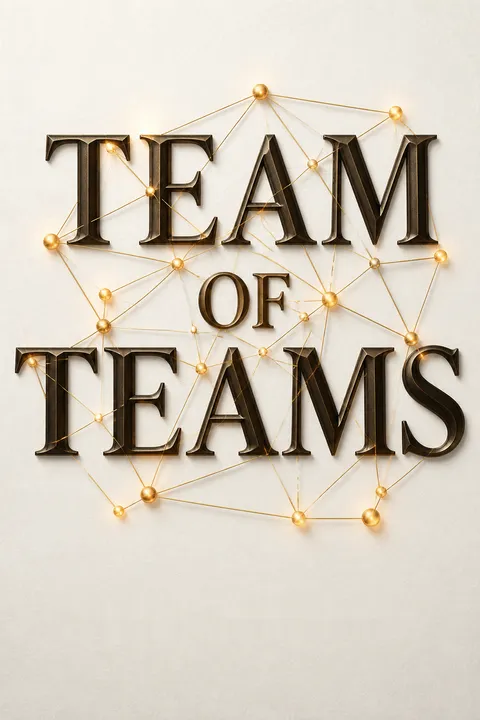


Key Takeaways
When a nimble network beats your elite force, redesign the organization.
The failure was systemic. In 2004, a coordinated bombing in Baghdad killed 35 children and wounded Americans and Iraqis. The U.S. Task Force had elite operators, superior equipment, and disciplined procedures, yet could not keep pace with Al Qaeda in Iraq. The enemy was not invincible. It was organized to adapt: its cells shifted tactics, shared information, and continued operating after leaders were captured or killed.
Management became the battlefield. The Task Force concluded that it could not solve a networked threat simply by improving raids or adding resources. It had to change how its own people worked together, moving toward rapid information sharing and decisions made closer to events. Its aim was a team of teams: an organization large enough to coordinate at scale, but connected enough to adjust quickly.
The episode illustrates a core idea in organizational theory: performance depends on fit between an organization and its environment, not on credentials alone. A force optimized for planned, repeatable missions can be outmatched by a less capable opponent whose structure better suits a shifting contest. The analogy also has limits. Military units need command authority, security, and disciplined procedures for good reasons. The useful question is not whether hierarchy is bad, but where it prevents people with relevant information from responding in time.
Treat interconnected problems as complex, even when you have mountains of data.
More parts are not the same. A complicated machine has many components, but their relationships are stable enough to map and predict. A complex system has many interdependent actors whose interactions can produce surprising outcomes. In 2010, Tunisian street vendor Mohamed Bouazizi set himself on fire in protest. Videos of the aftermath spread, protests grew, and governments across the region were shaken. Authorities had more personal data than ever, but could not foresee the chain reaction.
Small differences can cascade. Meteorologist Edward Lorenz found that tiny changes in starting data could produce sharply different weather simulations. The same principle helps explain why a raid, rumor, or online post may have little effect one day and enormous consequences another. Data can reveal patterns and explain events, but it cannot reliably predict every specific outcome in a fast, connected system.
This distinction changes the purpose of analysis. In a stable process, better measurement can improve forecasts and optimization. In a volatile network, information is still useful, but mainly for orientation and response rather than certainty. That resembles modern cybersecurity, where defenders cannot enumerate every attack in advance and must also detect, contain, and recover. Complexity should not become an excuse to abandon forecasting altogether: short-range predictions and clear probabilities remain valuable. The mistake is treating them as guarantees.
Trade some efficiency for resilience when the environment can change the task.
Efficiency assumes a destination. Frederick Winslow Taylor improved factory output by timing work and prescribing standardized steps. At Bethlehem Steel, his system cut steel far faster than the prevailing method. Such efficiency is powerful when the task stays stable. It becomes a liability when the desired output or surrounding conditions change faster than the system can adjust.
Resilience prepares for surprise. The Netherlands built impressive sea barriers after a devastating 1953 flood, but later floods arrived from rivers behind the defenses. Its Room for the River approach made space for water instead of relying only on higher walls. The Task Force faced a similar choice: its precise, efficient process worked for known missions, but not for an insurgency that continually changed its methods. Resilience means retaining the ability to absorb disruption and reconfigure, not merely strengthening a fixed design.
The contrast resembles the difference between a tightly optimized supply chain and one with buffers or alternate routes. Buffers can look wasteful on a calm day, yet preserve function when a supplier fails or demand surges. The book’s argument is strongest where change is genuinely hard to predict and disruption is costly. It should not be read as a case for slack everywhere. Repetitive, stable work can benefit greatly from standardization. The management challenge is to identify which parts need reliability and which need room to adapt.
Train teams to improvise together, not merely execute perfect procedures.
Trust lets people adjust. On United Flight 173 in 1978, the captain focused on a landing-gear problem while fuel warnings from the crew went unheeded. The plane ran out of fuel and crashed, killing ten people. By contrast, the crew of US Airways Flight 1549 worked together after birds disabled both engines at low altitude, landing in the Hudson River with everyone surviving. Crew Resource Management, or CRM, trains flight crews to communicate across rank and contribute to shared decisions.
Small units build the same capacity. Navy SEAL training is not only a test of individual fitness. Trainees rely on fixed partners and boat crews, so one person’s choices affect the group. Shared hardship builds familiarity, trust, and commitment to a common mission. Those qualities let a team adjust when the plan no longer matches reality.
The aviation examples show why safety is not simply a matter of adding more checklists. Procedures catch known hazards, while speaking up and coordination help crews handle the unanticipated. This aligns with the broader study of high-reliability organizations, where teams rehearse both standardized actions and open communication about emerging problems. Trust, however, is not a substitute for competence or clear roles. A team can be close-knit and still make poor decisions if members lack expertise, useful feedback, or permission to challenge a mistaken consensus.
Scale trust through team-to-team links, not one enormous group.
Teams lose cohesion as they grow. A squad can build close relationships through repeated work together, but a force of thousands cannot rely on everyone knowing everyone. The Task Force found that its small teams were capable and adaptive, yet the teams themselves remained divided by silos. The result was a command of teams: capable groups connected mainly through their bosses, with weak relationships across the gaps between them.
Connect the teams instead. The goal was a team of teams, where each unit had working relationships with other units and understood the shared mission. This approach did not require every person to know thousands of colleagues. It required enough links between groups to move context, questions, and help across the organization. The Task Force called breakdowns at these interfaces blinks. Unopened evidence bags, delayed for days before analysts could use them, showed how costly a blink could be.
This is a network-design problem as much as a cultural one. Strong local teams create competence; connections between them make that competence available across the larger system. The approach resembles modular engineering, where components retain specialized functions but use well-maintained interfaces to work together. Those links need deliberate care: too few create bottlenecks, while too many can swamp people with coordination demands. A practical test is whether teams can quickly find a counterpart, explain what they need, and understand the other group’s constraints.
Share context across the whole system, not just information upward.
Shared consciousness means common understanding. It is an organization-wide awareness of the situation, the mission, and how different teams’ work affects one another. The Task Force built it through open workspaces, broad access to operational information, and a daily Operations and Intelligence briefing. The meeting linked people in the field with analysts and partner agencies, letting them discuss evidence and decisions together rather than passing summaries through a long chain.
Context speeds coordination. NASA used a similar approach during Apollo. Engineers working on separate rocket components needed to understand how their work interacted, because a part that functioned alone could fail when integrated into the full vehicle. By connecting teams and sharing updates rapidly, NASA reduced the interface failures that had plagued earlier efforts. For the Task Force, the briefing eventually drew thousands of participants and helped turn isolated reports into shared, actionable understanding.
A shared picture is not the same as sending everyone every message. Its value comes from helping people interpret information in relation to the whole system and act on it. That distinction matters in any organization facing information overload: volume can rise while understanding falls. Regular forums can also reveal incompatible assumptions before they become failures. Transparency still needs boundaries for privacy, security, and sensitive work. The strongest design shares enough context for coordination while keeping access proportional to real risks.
Build trust across silos before you need cooperation under pressure.
Cooperation is a repeated choice. The Prisoner’s Dilemma describes two people who can cooperate for a better shared result, yet may betray each other because they fear being exploited. The Task Force’s units and partner agencies faced a similar problem: sharing intelligence or valuable equipment could help the wider mission, but each group worried that others would not reciprocate.
Relationships changed the calculation. The Task Force embedded people in other units and placed strong liaison officers in partner agencies. One SEAL officer, initially given little access at an embassy, built trust by helping with mundane tasks before the relationship became useful during a security crisis. Familiarity made later cooperation less like a risky trade and more like work between trusted colleagues. Units also became more willing to share surveillance assets when they could see why another team needed them.
Repeated interaction makes cooperation more credible because people learn whether promises are kept and whether help is returned. That is the social foundation behind reciprocal strategies in game theory. The story also suggests that relationship-building is operational work, not a decorative extra. Yet trust should not depend on personal charm alone. Shared rules, reliable records, and accountability protect collaboration when personnel change or when goodwill is misplaced. Durable cooperation needs both human connection and institutional safeguards.
Push authority to informed teams before approval delays erase the opportunity.
Visibility can tempt leaders to control. The book calls this pattern the Perry Principle: as communication makes distant activity easier to observe, leaders often pull more decisions toward themselves. In Iraq, senior approval could delay a strike even when people on the ground had better information and the opportunity was fleeting. The commander began explaining his decision logic and allowing qualified subordinates to act within it.
Context makes delegation safer. This was empowered execution: authority moves to the people closest to the problem, while they remain connected to the wider mission. The Task Force’s raid pace rose from 18 a month in 2004 to 300 a month by 2006, with little increase in people or funding. The change was not simply permission to act. It followed a major effort to give teams the information and relationships needed to use judgment well.
The principle resembles subsidiarity: decisions belong at the lowest level capable of making them well. It can reduce delay and improve decisions because local teams see details that remote leaders cannot. But decentralization without context, competence, and clear ethical limits is just uncontrolled variation. The useful management question is not how much authority to delegate in general, but which decisions can safely move closer to action, what constraints remain, and how the organization learns from the results.
Keep tending adaptability, because success decays when leadership stops.
Leaders cultivate conditions. McChrystal contrasts a chess player, who tries to direct every move, with a gardener, who shapes and maintains an environment where others can act intelligently. For a team of teams, that means setting priorities, keeping information moving, supporting cooperation, and modeling the candor expected from others. The leader stays aware of events but resists taking over decisions that capable teams can make.
Transformation needs upkeep. The Task Force’s shared systems and relationships helped it coordinate the hunt for Abu Musab al-Zarqawi, but the book warns against treating success as permanent. In 2014, ISIS captured Mosul and Iraqi defenses collapsed. The lesson is not that the Task Force’s earlier gains were imaginary, but that organizational fitness, like physical fitness, deteriorates without continued attention. Adaptability is an ongoing leadership responsibility, not a reorganization that can be completed once.
The gardening image usefully shifts leadership from personal heroics to stewardship of conditions: norms, access, incentives, and attention. It also captures why culture cannot be installed by memo and left alone. A limitation is that stewardship can sound gentler than it is. Leaders still make hard choices about priorities, resources, standards, and whose voices count. The metaphor works best when it includes that power openly, while keeping the central discipline: build capacity in the organization rather than making every important decision personally.
Analysis
Team of Teams argues that organizational design must match the tempo and interdependence of the problem. Its narrative gives that claim force: a highly trained U.S. Task Force repeatedly executes excellent individual tasks yet loses ground to a comparatively weak adversary whose network adapts quickly. The proposed answer is not simply decentralization. It is a coupled design: shared consciousness gives people broad context and cross-team trust, while empowered execution lets them use that context without waiting for distant approval. Leadership shifts from directing each action toward sustaining the conditions for good local judgment.
The book’s most useful distinction is between problems that are complicated and can be decomposed, and problems that are complex because interactions make outcomes hard to predict. That distinction explains why efficiency can become a trap. It does not, however, imply that planning, measurement, hierarchy, or standard procedures have become obsolete. Stable and safety-critical processes still benefit from them. The practical task is to preserve reliability where the work is repeatable while creating room to learn and adapt where it is not.
The Task Force case is vivid but not a controlled experiment. Its operational gains occurred amid changing conditions, new technology, and many simultaneous developments, so the narrative cannot isolate management as the sole cause. Nor does transparency automatically produce understanding: it can create overload, expose sensitive information, or amplify groupthink. The argument is strongest when read as a design principle, not a universal recipe. Organizations should improve the flow of relevant context, build relationships across interfaces, and delegate decisions only where competence and accountability support it.
The final implication is demanding. Adaptability is not a permissive culture in which everyone does anything. It is a disciplined system that makes local initiative compatible with shared purpose. Its success depends on recurring maintenance: leaders must keep the network connected, ensure that authority follows understanding, and revise structures as the environment changes. The book’s lasting contribution is to make management itself visible as a strategic capability, not a neutral administrative layer.
Review Summary
Team of Teams receives mostly positive reviews for its insights on organizational dynamics and leadership. Readers appreciate McChrystal's approach to adapting military structures for complex environments, emphasizing shared consciousness and decentralized decision-making. Many find the book well-written and engaging, with relevant anecdotes and practical examples. Some criticize its repetitiveness and length, while others praise its applicability to business settings. Overall, reviewers commend the book for its valuable lessons on creating agile, resilient organizations in today's rapidly changing world.
People Also Read







Glossary
Complexity
Interdependence that defeats predictionA condition in which many elements interact closely enough that small changes can produce unpredictable results. Unlike a complicated but stable mechanism, a complex system cannot be reliably understood by examining each part separately. In this book, faster communication and greater interdependence make organizations and their environments complex over shorter periods of time.
Resilience
Capacity to absorb disruptionThe ability of a system to withstand disturbance while retaining its basic function, and to reorganize when necessary. Resilience differs from robustness: robustness strengthens a system against anticipated threats, while resilience helps it adjust to threats that were not anticipated. The book uses ecological and flood-management examples to show how resilience can require flexibility and redundancy.
Team of Teams
Connected teams sharing one missionAn organization in which relationships between constituent teams resemble the trusting, collaborative relationships within a strong small team. It does not require everyone to know everyone. Instead, teams build links, share context, and align around the larger mission, allowing specialized groups to coordinate and adapt across organizational boundaries.
Shared consciousness
Organization-wide situational understandingA common, continually refreshed understanding of the environment, the organization’s activities, and how one team’s work affects others. It is built through transparency, communication, and relationships across teams. Shared consciousness gives people context for sound decisions and helps a large organization coordinate without routing every action through a central leader.
Empowered execution
Decisions made near the actionA management approach that gives individuals and teams authority to act at the level closest to a problem. It relies on shared context, clear purpose, trust, and appropriate limits, rather than unrestricted autonomy. In the Task Force, it reduced approval delays and let people with immediate knowledge make time-sensitive decisions.
F3EA
Targeting and intelligence cycleThe Task Force’s operational sequence: Find a target, Fix its location, Finish the operation, Exploit what is discovered, and Analyze the resulting information. The cycle links intelligence gathering and military action. It is useful for organizing repeated operations, but the book argues that improving its individual steps cannot fix delays and information failures between teams.
MECE
Nonoverlapping, exhaustive categoriesAn acronym for mutually exclusive and collectively exhaustive. A MECE structure divides a subject into categories that do not overlap but together include every element. The book uses the term to describe tidy organizational charts and specialized silos, then contrasts them with teams whose overlapping relationships and responsibilities can support adaptation.
Perry Principle
Visibility pulls control upwardThe tendency for leaders to centralize authority when improved communications make distant operations visible. The book names this pattern after Commodore Matthew Perry, whose remote expedition required broad discretion because communication with Washington was difficult. Modern leaders can observe more, but that visibility can encourage micromanagement and slow local action.
blinks
Breakdowns between teamsGaps at the boundaries between teams where information, context, or coordination fails to pass effectively. A blink may be caused by organizational silos, distance, incompatible processes, or mistrust. The Task Force used the term for interface failures that prevented useful intelligence from reaching the people who could act on it in time.
FAQ
What's Team of Teams about?
- Adaptability Focus: Team of Teams by Stanley McChrystal emphasizes the need for organizations to adapt to complex and rapidly changing environments. It draws from McChrystal's military experiences, particularly in Iraq.
- Military Insights: The book uses real-life military scenarios to illustrate the importance of evolving from traditional command structures to more flexible, team-oriented approaches.
- Team of Teams Concept: It introduces the idea of creating a "team of teams," where small, adaptable units work together seamlessly, sharing information and resources to respond to threats more effectively.
Why should I read Team of Teams?
- Modern Relevance: The insights are applicable to various sectors, including business and healthcare, offering a framework for leaders to foster adaptability and resilience.
- Practical Strategies: Readers gain actionable advice on breaking down silos and enhancing collaboration within organizations, empowering teams to make real-time decisions.
- Inspiring Leadership Lessons: McChrystal’s experiences provide valuable lessons on leadership, trust, and the importance of a shared mission, offering a unique perspective on leading in challenging environments.
What are the key takeaways of Team of Teams?
- Adaptability Over Efficiency: Organizations must prioritize adaptability over mere efficiency to succeed in complex environments.
- Trust and Purpose: Building trust and a shared sense of purpose among team members is crucial for effective collaboration and mission success.
- Networked Structure: The "team of teams" approach highlights the need for organizations to function as interconnected networks rather than rigid hierarchies.
What are the best quotes from Team of Teams and what do they mean?
- “It takes a network to defeat a network.”: This quote emphasizes the need for collaborative, networked approaches to tackle modern challenges.
- “We do these things, not because they are easy, but because they are hard.”: Reflects the spirit of perseverance and the willingness to tackle difficult challenges for growth.
- “The common denominator of the professionals with whom I served was an almost mystical devotion to mission accomplishment.”: Highlights the importance of a shared mission and collective dedication for success.
How does Team of Teams define complexity?
- Complexity vs. Complicated: Distinguishes between systems that are predictable and those with numerous interdependent variables, making prediction difficult.
- Interconnectedness and Speed: Complexity arises from increased interconnectedness and rapid change, where small actions can have large, unpredictable consequences.
- Need for Adaptability: Organizations must adapt quickly to changing circumstances, as traditional management approaches are insufficient for navigating complexity.
What is the "team of teams" approach in Team of Teams?
- Collaborative Structure: Involves creating a network of small, autonomous teams working towards a common goal, allowing for flexibility and responsiveness.
- Shared Consciousness: Emphasizes the importance of all teams having access to relevant information and understanding the broader context of their actions.
- Empowered Execution: Team members are empowered to act based on their understanding of the situation, fostering innovation and adaptability.
How does Team of Teams suggest organizations can improve communication?
- Increase Transparency: Advocates for transparency within organizations to ensure all team members have access to necessary information, facilitating collaboration.
- Break Down Silos: Emphasizes breaking down silos between departments to enhance communication and improve response to complex challenges.
- Encourage Open Dialogue: Leaders should promote an environment where team members feel comfortable sharing ideas and feedback to enhance trust and collaboration.
What role does leadership play in the Team of Teams framework?
- Facilitator of Collaboration: Leaders create an environment conducive to collaboration and adaptability, empowering team members to make decisions.
- Building Trust: Effective leaders focus on building trust among team members, essential for fostering a cohesive team environment.
- Adapting Leadership Style: Leaders must adapt their style to fit complex environments, moving away from command-and-control to a more decentralized model.
How does Team of Teams address the concept of resilience?
- Capacity to Absorb Disturbance: Resilience is the ability to absorb disturbances while maintaining core functions, crucial for organizational adaptability.
- Building Resilient Systems: Organizations should focus on creating systems that can withstand shocks, fostering a culture of adaptability and learning from failures.
- Learning from Experience: Continuous learning and improvement enhance resilience, with organizations embracing experimentation and adaptation.
How did the Task Force transform according to Team of Teams?
- From Silos to Networks: The Task Force shifted from a hierarchical structure to a networked approach, improving communication and collaboration.
- Integration of Intelligence and Operations: Facilitated a cohesive strategy, enabling rapid decision-making and execution against AQI.
- Cultural Change: Trust, transparency, and shared purpose became central, empowering individuals to take initiative and act decisively.
What is empowered execution in Team of Teams?
- Decentralized Authority: Refers to delegating decision-making authority to individuals at all levels, allowing for faster responses to challenges.
- Trust in Competence: Leaders trust their teams to make sound decisions based on expertise and situational awareness.
- Real-Time Decision Making: Enables teams to act quickly based on real-time information, crucial in fast-paced environments.
What are the implications of Team of Teams for future leadership?
- Evolving Leadership Roles: Leaders must adapt to a decentralized and collaborative approach, focusing on nurturing team dynamics and trust.
- Emphasis on Contextual Awareness: Creating shared consciousness ensures all members have the information needed for informed decisions.
- Gardener vs. Chess Master: Leaders should cultivate an environment where teams can thrive, enabling adaptability and resilience.
About the Author
Other books by Stanley McChrystal

Download PDF
Download EPUB
.epub digital book format is ideal for reading ebooks on phones, tablets, and e-readers.








