

Key Takeaways
Turn your network into shared leverage by helping people reach what they need.
Connection creates opportunity. Judy Robinett began as a shy social worker in small-town Idaho, then learned that career progress often depends on who can help you solve a problem. Her definition of power connecting is building useful links among people and resources, so everyone involved can achieve more. One introduction brought an entrepreneur struggling to commercialize a contraceptive device into contact with influential advocates and a potential corporate buyer. The company was eventually sold, rewarding its investors as well as advancing the product.
Start with the other person. The aim is not to collect impressive names and call in favors. It is to learn what people need, contribute something useful, and build relationships before a crucial request arises. Access, information, introductions, and practical help can all be valuable contributions.
What's compelling is the shift from networking as personal extraction to connection as shared problem-solving. The best relationships create options neither person could produce alone, a logic also visible in collaborative science and open-source work. Robinett's approach is most persuasive when help is genuinely matched to another person's needs, rather than offered as a disguised investment expected to pay back. That distinction matters: reciprocity can sustain trust, but keeping score can make generosity feel like a sales tactic. A useful test is whether the connection would still feel worthwhile if no favor ever came back.
Give your closest 155 relationships different roles, instead of treating every contact alike.
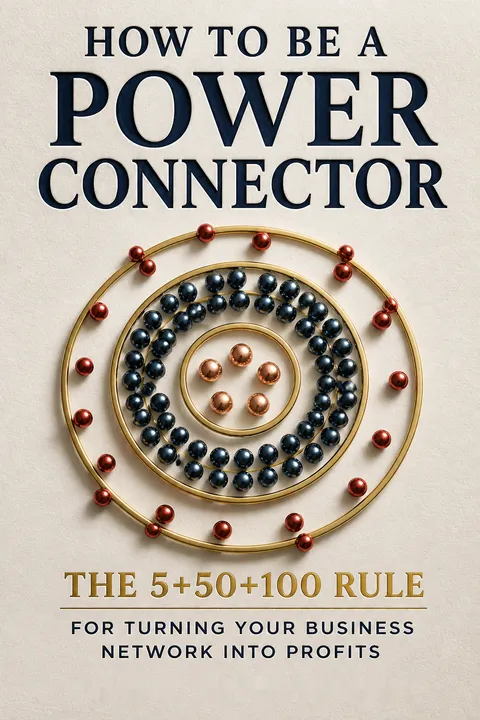
Organize by attention. Robinett's 5+50+100 Power Circles are a practical way to focus relationship maintenance. The Top 5 are the closest people, contacted frequently. The Key 50 are important relationships that merit regular care. The Vital 100 are useful, promising, or personally meaningful contacts to revisit at least monthly. The model reflects Robin Dunbar's estimate that people can maintain roughly 150 stable social relationships, though Robinett allows a little room beyond that number.
Choose deliberately. A contact list is not the same as a functioning network. Robinett recommends identifying who belongs in each circle, what each relationship offers, and where connections are thin. In practice, circles change as people move, goals shift, and relationships deepen or fade. The point is not to hit a quota, but to give limited attention a sensible structure.
The circles turn an abstract idea, that relationships need maintenance, into a scheduling decision. This resembles portfolio management: attention is scarce, and different assets call for different levels of oversight. But the number 150 should be treated as a planning prompt, not a biological rule that dictates the correct size of anyone's social world. Caregiving, culture, work, and personality all shape how many relationships can be sustained. The model is useful when it reduces neglect, less useful if it encourages ranking people solely by their potential economic return.
Use acquaintances to cross into worlds your closest friends cannot reach.
Weak ties carry new information. Robinett uses the term weak links for acquaintances and less-frequent contacts, as distinct from close friends, family, and trusted colleagues. Sociologist Mark Granovetter's study of job changers found that five out of six learned of openings through people they knew only casually. Such contacts can bridge groups that otherwise rarely exchange information. Robinett calls a potentially consequential acquaintance a consequential stranger.
Build breadth, not just closeness. A network made only of people with similar backgrounds can reinforce shared assumptions. Robinett points to research linking more diverse business networks with greater innovation. Seek connections across professions, locations, generations, and interests, while preserving close relationships for trust and support. Acquaintances may not be the people to confide in, but they can introduce a fresh perspective or a route into a new circle.
This is a powerful distinction between emotional support and informational reach. Strong ties often provide reliability, while weaker ties can supply novelty because they inhabit different parts of a social landscape. The two functions are complementary, not competing. Diversity alone, however, does not guarantee useful exchange: people need enough trust and shared purpose to listen across differences. A practical implication is to make curiosity habitual, especially with people outside one's professional silo, rather than assuming a large online contact count automatically creates meaningful bridges.
Find the ecosystem that controls your goal before choosing where to network.
Get into the right room. An ecosystem is Robinett's term for a connected community organized around a shared field or interest, where members exchange knowledge, access, resources, and opportunities. A film project needs relationships in entertainment, not just among investors; a local infrastructure problem may require city officials, not a governor. Robinett entered Boise's business community by volunteering on a United Way finance committee. The work built budgeting experience, brought her alongside local executives, and helped her move into a private-sector job.
Learn its rules. Identify the people and organizations relevant to a specific goal, then learn how that world works. Ecosystems may be tied to a place, and one well-connected contact is rarely enough. Enter through committees, associations, events, or introductions, and contribute before asking for access. One entrepreneur placed potential buyers on an advisory board, then sold his drug-development company for $45 million after three years.
The ecosystem idea explains why effort can fail even when someone is sociable and persistent: the network may be active but irrelevant to the objective. It also highlights that access is partly geographic and institutional, not merely a matter of personal confidence. Still, insider access is not a substitute for a good product, sound judgment, or fair processes. Networks can transmit opportunity, but they can also preserve exclusion. The strongest use of this model is to understand a field's pathways and contribute to it, not to mistake proximity to influential people for competence.
Make strangers comfortable by being curious, useful, and genuinely yourself.
Replace the pitch with a conversation. Robinett recommends preparing a share, a value-add, and an ask. The share is a brief, authentic account of who you are and what energizes you, rather than a rehearsed sales pitch. A value-add might be useful information, an introduction, a thoughtful suggestion, or simply close listening. An ask should be clear, modest, and appropriate to the person and the relationship. Robinett learned to approach strangers by practicing in ordinary settings and found that many people welcomed a friendly opening.
Build rapport before requesting help. Ask questions, listen carefully, notice common ground, and offer assistance. Before leaving, ask what might help the other person, what advice they have, and who else might be useful to meet. The foundation is that people should come to know you, like you, and trust you. Trust takes more than a single pleasant conversation.
This advice translates social anxiety into specific behaviors that can be practiced: direct attention outward, ask a genuine question, and listen to the answer. That is more actionable than exhorting someone to become charismatic. The emphasis on being authentic also protects against the brittle quality of scripted networking. Yet not every stranger wants conversation, and respect includes noticing disinterest rather than treating every encounter as an opportunity to optimize. The best version of openness is inviting, not intrusive, and makes room for the other person's choice.
Follow up within a day, then maintain relationships on a dependable schedule.
Make reliability visible. Robinett argues that a prompt, personal follow-up helps distinguish a real connection from a forgotten business card. Within 24 hours, send a brief note that recalls the conversation and offers something relevant, such as an article, an introduction, or a useful resource. Record where you met, what matters to the person, and any promise made. Then assess whether the relationship belongs in a close circle, a broader circle, or a casual contact file.
Use a repeatable rhythm. Robinett suggests responding to messages promptly, staying especially close to the Top 5, checking in with the Key 50 weekly, and contacting the Vital 100 monthly. People outside those circles can receive a quarterly update. These intervals are a framework, not a demand to send empty messages. Each touch should show attention, share something useful, or provide a genuine update that lets others know what you are working toward.
A follow-up system is a small piece of infrastructure for trust. It frees memory from having to carry every promise and helps prevent relationships from becoming active only when a favor is needed. In organizational psychology, dependable follow-through functions as a signal of conscientiousness, not merely good manners. The caution is that response speed is an imperfect measure of care: people have different workloads, access needs, and communication norms. The durable principle is to keep commitments and communicate clearly when a delay is unavoidable.
Give generously, but make requests small, specific, and fair to both sides.
Offer value without keeping score. Robinett advises contributing before asking, and giving in ways suited to the recipient's real needs. A small favor, such as useful advice or a thoughtful introduction, can be a better beginning than a dramatic request. She recommends making several meaningful contributions before asking for substantial help, while recognizing that a healthy relationship includes both giving and receiving. One-sided generosity can create exhaustion; one-sided taking erodes trust.
Ask with judgment. A good request fits the person, the ecosystem, and the stage of the relationship. Make it specific, explain why it matters, and keep its size manageable. An early request for a short conversation is more reasonable than asking a stranger to fund a company. If the answer is no, thank the person and ask for ideas or another possible contact. Screen relationships for integrity and mutual respect before sharing access to trusted contacts.
This balances two truths that are often separated: generosity builds social trust, and boundaries keep generosity sustainable. The social-exchange perspective helps explain why even small helpful acts can invite cooperation, but an expectation of repayment can turn a relationship into a ledger. Robinett's emphasis on fit and proportion is therefore crucial. Another safeguard is to ask consent before making an introduction or offering advice. Help is most valuable when it respects the recipient's agency and does not spend someone else's reputation without permission.
Connect two people only when the match creates real value for both.
Think beyond one-to-one networking. Robinett's specialized term triangulation means connecting two people in a way that benefits both, while the connector makes the introduction. For example, a contact seeking a conference speaker can be introduced to someone looking for exposure and new investment opportunities. The organizer fills a need, the speaker gains a platform, and the connector strengthens two relationships. Such introductions can create value without requiring the connector to remain in the middle.
Map the network. A relationship map records who knows whom, through which organizations or fields, and what resources they might offer. Before introducing people, consider what each wants, why the connection makes sense, and whether both parties are likely to welcome it. Make the introduction clearly, then follow up and keep the original connector informed. A careless introduction can damage trust; a well-matched one can open a path neither person could easily find alone.
The connector's distinct contribution is not simply possessing contacts, but recognizing a useful fit across them. This resembles brokerage in network science, where a bridge between separate groups can help information and collaboration travel. The ethical burden rises with that position: an introduction spends some of the trust others have placed in the connector. A thoughtful match should therefore be based on mutual relevance, not on status display. Asking both parties before connecting them protects time, privacy, and the credibility that makes future introductions possible.
Choose conferences for access, prepare names, and meet beyond your usual crowd.
Use digital tools to open doors. Robinett presents LinkedIn as a way to find second- and third-degree contacts, request introductions, and learn about people before approaching them. Email can carry a personal note and a useful resource; Twitter can help engage with experts and share relevant material. These channels widen reach, but they do not by themselves create trust. Online contact works best when it is specific, personal, and followed by real interaction where possible.
Treat events as planned opportunities. Choose a conference because the people or ecosystem fit a goal. Research speakers and attendees, contact promising connections beforehand, and arrive ready with a question and a concise introduction. During the event, seek organizers and people outside the familiar group. Afterward, follow up promptly with a reason to continue the conversation. Robinett's rule of thumb is that a room of ten or more people may already contain someone who can help solve the problem at hand.
The strongest point is that tools and events are channels, not relationship substitutes. A platform can reveal paths through a network, while a conference creates unplanned contact among people who might not otherwise meet. Both require deliberate selection; endless online activity can become a busier version of collecting business cards. The advice to leave one's usual crowd is especially valuable because familiarity can quietly reproduce professional silos. At the same time, not everyone has equal access to travel or exclusive events, so local groups and online communities can serve as meaningful entry points.
Women should seek sponsors, ask upward, and use their networks to open doors.
Relationships do not erase structural barriers. In the book's 2013 snapshot, women held 16.6 percent of corporate board seats and 4.2 percent of CEO positions in the United States. Robinett argues that women often receive mentorship, which offers advice, but may lack sponsorship, where a senior person actively advocates for advancement. She also describes how women can be penalized for self-promotion, making it harder to ask for pay, authority, or opportunity.
Turn connection into advocacy. Women can build peer networks across industries and backgrounds, seek relationships with senior leaders, and state their goals plainly. Established women can introduce emerging colleagues to influential contacts and support their advancement. The book also urges women to advocate for themselves with warmth and firmness, rather than relying only on helping others. These are strategic responses to workplace patterns, not claims that every man or woman behaves the same way.
The most useful distinction here is between a mentor who advises and a sponsor who uses influence to advocate. It makes career support more concrete and helps explain why good advice alone may not change access to leadership. The historical figures in the book also show how professional norms can penalize women for behavior that is rewarded in men. Gender patterns should not be treated as fixed traits: workplaces shape which behaviors feel safe and profitable. Individual networking can help, but organizations still bear responsibility for fair sponsorship and advancement.
Analysis
Robinett's central claim is that networks are not static inventories of names. They are living systems of trust, information, and access that gain strength when their members help one another. Her strongest contribution is practical translation. The 5+50+100 circles make attention manageable; the ecosystem lens directs effort toward relevant communities; and the introduction practices turn a broad ideal of generosity into observable behavior. Her own story, from an anxious outsider in Idaho to an investor and business connector, gives the argument a human arc rather than presenting access as an inherited privilege alone.
The book also offers a useful correction to transactional networking. Its focus on shared benefit, appropriate requests, and follow-through recognizes that people are not resources to be mined. Yet the language of strategic assets and influence can pull against that ethic. Relationships should not be judged only by what they can provide, and trust cannot be reduced to a predictable return on favors. The book is strongest when it treats usefulness as care and weakest when it suggests that broad access is equally available to everyone through better technique. Geography, money, discrimination, and institutional gatekeeping still determine who can enter many rooms. The system is best read as a toolkit, not a universal operating law. Dunbar's approximate social limit is a useful prompt for prioritization, not a fixed quota; prescribed contact schedules need to fit real lives. Likewise, weak ties create reach only when people have enough credibility and shared context to act on an introduction. The enduring insight is simpler than the machinery: build relationships before a crisis, learn what matters to others, keep promises, and connect people with care. This approach can improve business outcomes, but its deeper value is the kind of community it makes possible, one where access circulates rather than remaining hoarded.
Review Summary
How to Be a Power Connector received mostly positive reviews, with readers praising its practical advice on strategic networking. Many found the 5+50+100 system helpful for managing relationships. Reviewers appreciated the emphasis on adding value and connecting others. Some criticized the book for being repetitive or too focused on high-level networking. Introverts found it challenging but useful. Overall, readers felt inspired to improve their networking skills and saw potential for career advancement through implementing the book's strategies.
People Also Read







Glossary
Power connector
Mutual-benefit network builderA person who deliberately builds trustworthy relationships and links people to information, opportunities, resources, and one another. A power connector adds value before asking for help, follows through on commitments, and considers whether introductions benefit all parties. The role depends less on possessing a large contact list than on being trusted to make useful connections.
Strategic relationship
Mutual professional supportA professional connection developed with attention to what each person can contribute to the other. Contributions may include knowledge, introductions, access, opportunities, or other support. Robinett distinguishes this from merely knowing someone or treating a relationship as a bank of favors. Trust, respect, shared values, and reciprocal benefit are essential to making the connection durable.
5+50+100 Power Circles
Three tiers of key relationshipsRobinett's model for organizing a core network of roughly 155 people by relationship depth and maintenance needs. The Top 5 are closest relationships, the Key 50 are important contacts to nurture regularly, and the Vital 100 are broader relationships to revisit routinely. It is a prioritization system, not a rule that every person must maintain exactly this number.
Ecosystem
Community around a shared fieldA web of people and organizations linked by a common interest, profession, or goal, through which knowledge, access, resources, and opportunities circulate. Business, finance, government, community, and professional fields each have distinct ecosystems. Understanding an ecosystem means learning where its participants gather, how decisions are made, and what forms of contribution are valued.
Consequential strangers
Acquaintances with unexpected reachRobinett's term for people who are not close friends but may connect someone to important information, resources, or opportunities. Such acquaintances can bridge otherwise separate social groups. The term captures the practical value of weak ties: a casual contact may know someone or something that a person's closest circle cannot provide.
Critical resource map
Goal-linked resource inventoryA planning tool Robinett abbreviates as CRM. It begins with a specific goal and identifies the people, opportunities, knowledge, and funding needed to achieve it. The map distinguishes resources already available through a person's network from those still missing, helping identify which relationships or ecosystems should be developed.
Triangulation
Mutually useful introductionRobinett's term for introducing two people whose goals, needs, or resources align, so both can benefit. The connector creates value by recognizing the match, making a careful introduction, and protecting the trust of everyone involved. A good triangulation is not simply an exchange of contact details; it has a clear reason and a plausible benefit for both people.
Three Golden Questions
Prompts for useful next stepsRobinett's conversation technique for discovering how people can help one another and extend a network. The questions invite the other person to identify what assistance they need, what advice or ideas they can offer, and whom else it would be useful to meet. The method turns a conversation toward reciprocal contribution and possible connections beyond the two people present.
Strength of Weak Ties
Acquaintances bridge separate groupsA network theory associated with sociologist Mark Granovetter's research on how people hear about opportunities. Weak ties are acquaintances or casual contacts, rather than close friends. Because they often move in different circles, they can carry information across groups that strong ties do not reach. Robinett applies this idea to career opportunities, business resources, and network diversity.
FAQ
What's How to Be a Power Connector about?
- Focus on Networking: The book emphasizes the importance of building high-value, strategic relationships in both business and personal life. It provides a systematic approach to networking that goes beyond mere contact collection.
- Power Connector Mindset: Judy Robinett introduces the concept of the "Power Connector," someone who connects people for mutual benefit and success. This mindset is essential for leveraging networks effectively.
- 4 Phases of Power Connecting: The book outlines a four-phase system: Prepare to Power Connect, Target, Connect and Engage, and Reconnect, Assess, and Activate. Each phase includes specific steps to maximize networking efforts.
Why should I read How to Be a Power Connector?
- Practical Strategies: The book offers actionable strategies for building and maintaining a robust network, making it a valuable resource for entrepreneurs and professionals alike.
- Real-Life Examples: Judy shares personal experiences and those of others to illustrate the principles of power connecting, making the concepts relatable and easier to implement.
- Comprehensive Framework: The 5+50+100 rule provides a clear framework for organizing and prioritizing connections, focusing on quality over quantity.
What are the key takeaways of How to Be a Power Connector?
- Value First Approach: The book stresses the importance of adding value to your connections before asking for anything in return, building trust and strengthening relationships.
- Diverse Ecosystems: Robinett emphasizes connecting with individuals from various ecosystems—family, friends, career, government, and more—to enhance opportunities and resources.
- Power Circles: The 5+50+100 model categorizes connections into three groups: Top 5, Key 50, and Vital 100, helping manage and nurture relationships effectively.
What is the 5+50+100 rule in How to Be a Power Connector?
- Categorization of Connections: Organize your network into three concentric circles: Top 5 closest connections, 50 key relationships, and 100 vital contacts, prioritizing networking efforts.
- Focus on Quality: By limiting focus to these specific groups, you ensure nurturing high-quality relationships that provide mutual benefits, encouraging deeper engagement with fewer people.
- Regular Engagement: The model encourages regular communication with your Top 5 and Key 50, while maintaining a lighter touch with your Vital 100, keeping your network active and engaged.
How does Judy Robinett define a "Power Connector" in How to Be a Power Connector?
- Bridge Builder: A Power Connector is someone who connects individuals across different networks, facilitating valuable relationships and acting as a bridge between people who can benefit from knowing each other.
- Generosity and Support: They focus on adding value and supporting others without expecting immediate returns, fostering trust and strengthening their network.
- Strategic Relationships: Power Connectors understand the importance of strategic relationships and actively work to cultivate them, leveraging connections for mutual success.
What are some effective strategies for connecting with others in How to Be a Power Connector?
- Research and Prepare: Before reaching out, gather information about the person you want to connect with, tailoring your approach based on their interests and background.
- Craft Your Share: Develop a personal narrative that includes who you are, what you do, and what you’re passionate about, creating a genuine connection and making you memorable.
- Add Value First: Always look for ways to provide value to your connections before asking for anything, such as sharing information, making introductions, or offering assistance.
What are the common mistakes people make in networking according to How to Be a Power Connector?
- Wrong Places: Many people network in environments that do not align with their goals, wasting time and energy. It’s crucial to identify the right ecosystems for your needs.
- Lack of Strategy: Failing to have a clear plan for networking can lead to ineffective connections. A strategic approach is necessary to build meaningful relationships.
- Ignoring Value: People often focus on what they can gain from connections rather than what they can offer, weakening relationships over time.
What is the importance of ecosystems in How to Be a Power Connector?
- Web of Connections: Ecosystems are networks of individuals linked by common interests, providing access to knowledge, resources, and opportunities. Understanding these ecosystems is vital for effective networking.
- Diverse Access: Engaging with multiple ecosystems allows you to tap into a broader range of resources and connections, enhancing your ability to achieve your goals.
- Strategic Entry: Knowing how to navigate different ecosystems can open doors that would otherwise remain closed, making it essential to identify key players and understand the dynamics within each ecosystem.
How can I effectively follow up after meeting someone, according to How to Be a Power Connector?
- Immediate Reconnection: Send a personalized follow-up email or LinkedIn request within 24 hours of meeting someone, showing your interest and commitment to building the relationship.
- Add Value in Follow-Up: Include something of value in your follow-up, such as an article or a resource related to your conversation, demonstrating thoughtfulness and genuine interest.
- Keep the Introducer in the Loop: If someone introduced you to the new contact, inform the introducer about the outcome of your meeting, strengthening your relationship with both parties.
What are the best quotes from How to Be a Power Connector and what do they mean?
- “Skill is fine, and genius is splendid, but the right contacts are more valuable than either.” This quote emphasizes the importance of networking and relationships in achieving success, suggesting that connections can lead to opportunities that skills alone cannot.
- “Forget the MBA. Learn to network.” Highlights the idea that practical networking skills are more valuable than formal education in many business contexts, directly impacting career and business success.
- “The more connection, the more abundance.” Reflects the belief that strong networks lead to greater opportunities and resources, underscoring the idea that relationships can amplify success in various aspects of life.
How can I overcome shyness and self-consciousness in networking as suggested in How to Be a Power Connector?
- Shift Focus: Instead of worrying about how you are perceived, focus on the other person and what you can learn from them, alleviating self-consciousness and making interactions feel more natural.
- Practice Makes Perfect: Engage with strangers in low-pressure situations to build confidence, starting small by initiating conversations in everyday settings like coffee shops or waiting rooms.
- Embrace Authenticity: Be genuine in your interactions, sharing your true self to create a more comfortable atmosphere and encourage others to open up as well.
How can I create intrigue during initial meetings, as suggested in How to Be a Power Connector?
- Be Brief and Engaging: Keep your introduction concise but engaging, sharing a compelling fact or story that piques interest without overwhelming with information.
- Ask Thoughtful Questions: Initiate the conversation by asking open-ended questions that encourage the other person to share more about themselves, showing interest and establishing rapport.
- Leave Them Wanting More: Create enough intrigue that the other person wants to continue the conversation or meet again, focusing on building a connection rather than impressing them with everything you know.
Download PDF
Download EPUB
.epub digital book format is ideal for reading ebooks on phones, tablets, and e-readers.








