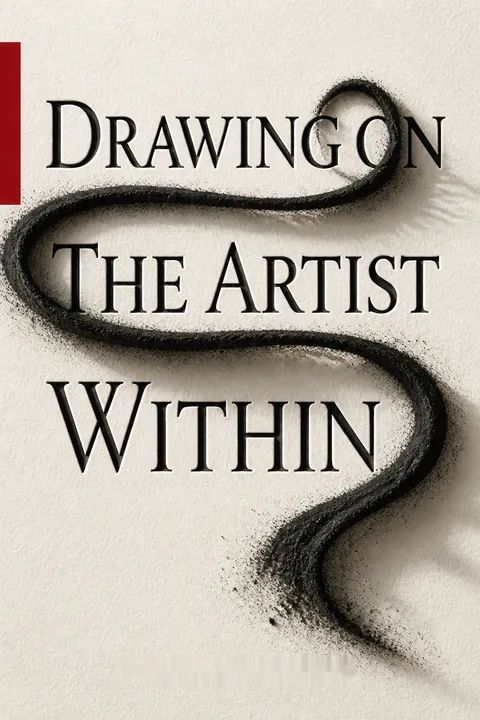


Key Takeaways
Learn to draw by learning to see, not by waiting for talent
Skill, not a secret gift. Betty Edwards argues that drawing improves when people learn specific ways to perceive, rather than waiting for an inborn artistic talent to emerge. In her college classes, students who began convinced they could not draw produced markedly better work after about twelve weeks of instruction. She compares drawing with reading: most people need teaching to become literate, yet drawing is often treated as a mysterious gift that instruction might somehow spoil.
Train perception deliberately. The goal is not necessarily to become a professional artist. Drawing practice develops attention to shapes, spaces, and relationships that ordinary looking can miss. Edwards proposes that this visual practice can strengthen creative thinking by giving people another way to examine experience, alongside words and analysis.
The book’s strongest practical move is to make drawing teachable by breaking it into perceptual skills. That resembles expert training in many fields: musicians learn to hear distinctions novices miss, and naturalists learn to notice patterns in a landscape. The broader claim, that drawing practice transfers to creativity in general, is plausible but less firmly established by the classroom examples alone. Improved drawing demonstrates improved visual skill; showing durable gains in unrelated problem solving would require separate evidence. The distinction does not weaken the invitation to learn. It clarifies what the exercises directly teach, and what readers can test for themselves.
Find the question that makes the problem worth investigating
Begin by noticing. Edwards presents creativity as a five-stage process: First Insight, Saturation, Incubation, Illumination, and Verification. First Insight means discovering or formulating the question, not merely answering one already supplied. The next stage, Saturation, gathers relevant information. Incubation describes a period in which the problem is set aside; Illumination is the emerging insight; Verification tests and develops it.
Questions create direction. The stages can vary in duration, and a project may cycle through them more than once. Edwards stresses that the initial question organizes the search: without it, research can become an accumulation of facts with no useful center. Einstein and psychologist Max Wertheimer are cited to support the idea that reframing a problem can matter as much as solving it.
This sequence is useful because it distinguishes problem framing from information gathering. In design and scientific inquiry, a question determines which observations count as relevant, so a small change in framing can open a different search space. The five stages are best treated as a working map rather than a universal timetable. Creative work often loops, stalls, or begins with a practical constraint rather than a sudden question. Edwards allows for variation, and the framework is most valuable when it prompts a diagnostic question: is the difficulty a lack of information, a poor frame, or a premature attempt to conclude?
Turn a familiar image around to loosen the grip of labels
Interrupt recognition. Edwards found that beginners who struggled to copy a drawing right-side up could succeed when the image was turned upside down. The unfamiliar orientation made it harder to name the subject, so students attended to lines, angles, and spaces instead of drawing their stored symbol for a face or figure. Turning the image back revealed how accurately they had copied it.
Let details speak first. The same principle appears in the story of sewing-machine inventor Elias Howe. Faced with the problem of how a machine could move a threaded needle through cloth, Howe dreamed of spears with holes near their points. The image suggested changing the needle’s design so its eye sat near the point. A shift in viewpoint made a previously overlooked possibility visible.
Upside-down drawing is a concrete form of defamiliarization: a familiar object is made strange enough to invite fresh attention. Similar moves appear in design practice, where people reverse a process or change the user’s viewpoint to expose hidden assumptions. The method is particularly strong for visual tasks because it changes what the eye can readily categorize. It is not a universal problem-solving shortcut, however. Reversing a question cannot replace technical knowledge, and Howe’s dream is an illustrative account, not proof that dreams reliably solve design problems. The useful lesson is to alter the representation when the familiar one keeps producing the same answer.
Put private hunches on paper before language tidies them away
Make thought visible. Edwards treats drawing as a parallel language: marks can organize visual information without forcing it into a sentence first. In one exercise, students divide a page into sections labeled with feelings such as anger, joy, or calm, then represent each using only lines and shapes. A later exercise asks them to depict a person or a troubling situation in abstract marks, without recognizable objects or words.
Read, then tag. The drawing places a private impression outside the mind, where its parts and relationships can be examined. A short written note can then preserve an insight, but Edwards warns that words cannot fully reproduce the drawing’s complexity. The visual image and its verbal description work as complementary records, rather than substitutes for each other.
The method anticipates what researchers call external cognition: diagrams and sketches can hold relationships in view so working memory does not have to carry every element at once. This can be especially helpful when a problem is emotionally charged or difficult to describe. Yet a drawing is not a transparent window into an unconscious truth. It reflects the maker’s choices, context, and current interpretation. Its value is less that it reveals an objective hidden message than that it gives someone a new object to question. The best practice is to treat the image as a prompt for inquiry, then check any interpretation against experience.
Read visual analogies as clues, never as objective diagnoses
Patterns can carry meaning. Edwards observed recurring structures in students’ abstract drawings: anger often appeared as dark, jagged marks, while peacefulness frequently produced horizontal forms. Depression was often placed low in the frame. In one set of 83 drawings about human energy, 47 used variations of an expanding form and 22 used rising triangular structures. A second group of 80 showed similar proportions.
Similarity leaves room for difference. Edwards argues that these patterns suggest a shared visual vocabulary, while each drawing remains particular to its maker. A student’s drawing of a relationship problem, for example, may prompt a question about isolation or conflict that the person had not yet put into words. The interpretation belongs first to the person who made the drawing, not to an outside reader claiming certainty.
The repeated forms are intriguing because they suggest that spatial metaphors can feel intuitive: people commonly associate being down with low mood, for instance. But the book’s classroom observations do not establish a universal visual grammar. Shared language, culture, classroom instructions, and exposure to similar conventions could also shape the patterns. This is why Edwards’s strongest use of the drawings is exploratory, not diagnostic. A student can ask what a mark means to them and whether that reading fits their life. An evaluator should not infer personality or mental health from a sketch. The distinction preserves the exercise’s value while avoiding false certainty.
Train your eye to map edges, spaces, ratios, and light
Build a visual toolkit. Edwards identifies five skills for drawing what is seen: perceiving edges, negative spaces, relationships and proportions, lights and shadows, and the Gestalt, or the whole configuration that makes a subject distinct. Negative space is the area around or between objects, treated as a shape rather than as empty background. A hand can be easier to draw by matching the shapes between its fingers than by drawing the fingers from memory.
Practice different kinds of attention. Gesture drawing uses rapid sketches to catch broad movement and edges. Pure Contour Drawing slows the hand while the eyes trace a small area, such as the wrinkles in a palm. These exercises train different tempos of observation. Together, the five skills help parts fit into a coherent whole.
This is the book’s most concrete instructional contribution: it converts a vague command to look carefully into distinct operations. The shift from an object to the space around it is especially powerful because it sidesteps familiar labels and makes proportion easier to compare. The toolkit also illustrates a general principle of perception: attention can be trained by changing what counts as the target. These five skills are not a complete theory of visual intelligence, and some artistic decisions involve intention, material, and cultural meaning beyond accurate observation. As a foundation for seeing and drawing from life, however, the list is clear and usable.
Add a glitch when your brain insists reality must look familiar
Question automatic perception. Edwards uses the word glitch for a deliberate interruption that helps expose information the mind’s expectations tend to suppress. A student drawing an American flag initially represented its stripes as straight and uniform. On closer inspection, the curved flag made them appear to cross and change width. Another student drew a cup with a flat bottom even though the visible edge was curved, because the idea of a cup sitting flat overruled what she saw.
Compare instead of guessing. Edwards’s technique of sighting means checking angles and proportions against stable reference points. A pencil held at arm’s length can serve as a quick measuring aid; a transparent grid can help establish a fixed viewpoint. The comparison makes it harder to quietly replace visible evidence with what an object is supposed to look like.
The examples capture a central fact of perception: the brain does not simply record sensory input, it interprets it through expectations that are usually useful. Contemporary accounts often describe perception as an interaction between incoming signals and prior predictions, though the book’s division of this work into separate hemispheric modes is too neat by current standards. Measurement tools can interrupt an assumption, but they also impose a frame: a chosen viewpoint, reference line, or scale. Good observation therefore combines instruments with judgment. The point is not to distrust perception altogether, but to notice when a reliable everyday shortcut is distorting the task at hand.
Research deeply, then stop forcing the answer
Fill the mind before stepping away. In Saturation, the problem solver gathers information and examines it from multiple angles. Edwards adapts drawing strategies to this search: define the problem’s boundaries, notice the spaces around it, compare the parts, identify what is visible or obscure, and try to grasp the whole situation. She recommends retaining notes and drawings that connect facts with visual patterns.
Give attention a second job. Incubation begins when active investigation reaches a limit and the problem is deliberately set aside. Edwards describes telling her mind to find a name for the abstract drawings she used in teaching. After months without a solution, the phrase Analog Drawings came to her while she was driving and thinking about something else. The story illustrates her claim that background processing can continue when conscious effort pauses.
The combination of sustained preparation and temporary disengagement is more credible than the romantic idea that inspiration arrives without work. Incubation can help when continued effort is stuck in a narrow approach, while a break allows attention to loosen. It is not a guarantee, and the example of Edwards’s phrase is a personal report rather than a controlled test. Nor is all inactivity productive: useful incubation depends on having first acquired relevant knowledge and keeping the question meaningful. A practical reading is to alternate focused work with genuine breaks, then return and assess what changed rather than assuming the first passing thought is the answer.
Test the flash of insight, and preserve its inner coherence
Make the idea answer to reality. Verification is the stage in which an insight is tested, developed, and made useful to others. Edwards emphasizes that this can be brief or painstaking. Marie Curie’s work to isolate a small quantity of radium salts from eight tons of pitchblende illustrates how a promising idea may demand years of labor before it is established.
Use beauty as a check. Edwards draws on Thomas Aquinas’s three qualities of beauty: wholeness, harmony, and radiance. Applied to a project, these mean that it should form a coherent whole, that its parts should fit together, and that its central idea should be clear. The aesthetic test is not decoration. It is a way to ask whether the finished work retains the elegance and unity of the original insight.
The distinction between a flash and its verification protects creativity from becoming mere confidence. An idea may feel compelling because it resolves tension, but experiments, prototypes, or criticism determine whether it works beyond the moment of discovery. The aesthetic criteria offer a useful complementary test: coherence can expose a solution that is technically possible but poorly integrated. Still, elegance cannot certify truth. A simple theory can be wrong, and a beautiful design can cause harm. The strongest approach pairs the search for wholeness and fit with external evidence, practical consequences, and scrutiny from people who were not involved in producing the insight.
Analysis
Drawing on the Artist Within is both a drawing course and an argument about how people think. Its distinctive strategy is to make an abstract claim about creativity bodily testable: turn a picture upside down, trace a hand slowly, draw the spaces between fingers, and observe how attention changes. These small experiments give the book its narrative momentum. Edwards begins with students who believe they lack talent, then builds from drawing exercises toward a proposed account of creative inquiry. Drawing matters not just as a product but as a way to make perception inspectable.
The strongest and most durable contribution is pedagogical. Instead of treating realistic drawing as mysterious, Edwards separates it into learnable acts of attention: edges, spaces, proportions, light, and whole-form coherence. The same move has broader relevance to education. A skill often looks innate when its component operations remain invisible; instruction reveals the steps and gives beginners a route into practice. Her abstract drawings also offer a practical method for getting a vague concern out of the head and into a form that can be reconsidered.
The book’s account of the brain requires more caution. Its L-mode and R-mode language gave readers a memorable way to distinguish sequential verbal analysis from global visual processing, and Edwards herself notes that functions do not divide cleanly by hemisphere. Contemporary neuroscience generally describes complex cognition as coordinated activity across distributed networks, not a contest between two self-contained mental operators. The metaphor remains useful as a description of contrasting styles of attention, but it should not be mistaken for a literal neural switch.
Likewise, the five-stage creative process is best read as a flexible heuristic. The book’s anecdotes illuminate how preparation, uncertainty, insight, and testing can interact, but they do not prove that every creative act follows one sequence or that drawing instruction reliably improves creativity in every domain. The book is most persuasive when it invites readers to experiment, and less so when it turns a compelling classroom method into a general theory of the brain. Its central practical insight survives that distinction: changing how one looks can change what becomes available to think about.
Review Summary
Drawing on the Artist Within receives mostly positive reviews, with readers praising its insights into creativity and self-expression. Many find it helpful for improving their artistic skills, regardless of experience level. The book is commended for dispelling myths about innate artistic talent and providing practical exercises. Some readers prefer Edwards' previous book, but overall, it's seen as a valuable resource for understanding the creative process and developing drawing abilities. Critics note it can be slow-paced and overly theoretical for some tastes.
People Also Read

Glossary
L-mode
verbal-analytic thinkingEdwards’s label for a style of thinking characterized by language, sequence, analysis, categorization, and explicit rules. She associates it mainly with functions commonly linked to the left hemisphere, while noting that the location of functions varies and that the two modes cooperate. The term is best understood as a description of a thinking style, not a complete account of brain anatomy.
R-mode
visual-relational thinkingEdwards’s label for a style of thinking that processes visual and spatial information, notices relationships, and apprehends patterns or wholes. She associates it mainly with functions commonly linked to the right hemisphere, while acknowledging that the division is not absolute. In her account, drawing exercises help people give this perceptual style more deliberate use.
Five stages of creativity
a model of creative workEdwards’s framework comprises First Insight, Saturation, Incubation, Illumination, and Verification. It begins with finding or framing a question, proceeds through gathering information and setting the problem aside, then moves through insight and testing. The stages can take different amounts of time, and a project may repeat the cycle rather than progress neatly from beginning to end.
Analog drawings
marks that represent inner thoughtAbstract drawings made with lines, shapes, and spatial arrangements to represent a feeling, person, or problem without depicting recognizable objects. Edwards uses them to externalize perceptions that may be hard to express directly in words. The maker then studies the image and may attach a brief verbal note to preserve an interpretation.
Problem Analog
a drawn view of a problemA type of analog drawing in which a person represents a troubling or unresolved situation using abstract marks inside a chosen boundary. The drawing is intended to make the problem available for inspection, not to solve it by itself. Its maker can examine placement, empty areas, and relationships, then write down questions or possible interpretations.
negative spaces
shapes around or between objectsIn drawing, negative spaces are bounded areas around or between objects, treated as shapes in their own right rather than as irrelevant background. Because a space and the object beside it share edges, accurately drawing the space can help accurately describe the object. Edwards extends this idea into problem analysis by asking readers to examine what surrounds a problem.
sighting
comparing visual relationshipsA drawing method for estimating angles and proportions by comparing parts with stable reference points. The artist may use a transparent grid or hold a pencil at arm’s length to compare one line or dimension with another. The method helps counter assumptions about how a subject ought to look by making relative size and direction easier to inspect.
picture plane
a flat viewing referenceThe imagined or actual flat plane between an artist and the scene being drawn. Edwards describes it as aligned with the eyes and perpendicular to the viewer’s line of sight. A grid or marked window can make this plane visible, helping the artist treat a three-dimensional scene as a flat arrangement of shapes and relationships.
Pure Contour Drawing
slow drawing without lookingAn exercise in which the drawer looks closely at a subject, such as the wrinkles in a hand, while drawing without looking at the paper. The pencil moves slowly as the eyes trace edges and details. Edwards presents the exercise as a way to interrupt quick naming and encourage sustained attention to what is actually visible.
Gesture drawing
rapid sketches of visual structureA practice of making a series of very quick drawings, often one minute each, from images or models. The aim is to record broad edges, movement, and relationships rather than polished details. Edwards uses the speed and repetition to discourage slow, verbal planning and to encourage direct visual attention.
light logic
reading light and shadow shapesEdwards’s term for perceiving and drawing the particular shapes created by light, highlights, reflected light, and shadows on a surface. Those shapes vary with the object and lighting arrangement. Rendering them accurately can suggest three-dimensional form, while leaving selected areas incomplete allows viewers to infer features that are not explicitly drawn.
glitch
a perceptual interruptionA deliberate device or altered condition that disrupts automatic expectations and exposes information that might otherwise be overlooked. Edwards’s examples include turning an image upside down, using a grid, or comparing sizes with a reference. A glitch is not the solution itself; it is a way to make assumptions visible and reconsiderable.
FAQ
What's Drawing on the Artist Within about?
- Exploration of Creativity: The book explores how visual perception and drawing can enhance creativity, suggesting that learning to draw can improve creative thinking.
- Dual Brain Function: It discusses the roles of the left (L-mode) and right (R-mode) hemispheres of the brain in processing information and creativity.
- Practical Exercises: Betty Edwards provides exercises to develop drawing skills and enhance creative thinking.
Why should I read Drawing on the Artist Within?
- Enhance Creative Skills: Ideal for unlocking creative potential, regardless of artistic background or experience.
- Unique Perspective: Offers a fresh view on creativity, arguing that drawing improves cognitive function and problem-solving.
- Accessible to All: Exercises are designed for all skill levels, making it valuable for beginners and experienced artists.
What are the key takeaways of Drawing on the Artist Within?
- Visual Language Importance: Emphasizes the significance of visual language in understanding and expressing complex thoughts.
- Five Basic Skills: Identifies five fundamental perceptual skills necessary for drawing and creative thinking.
- Integration of Thought: Highlights the importance of integrating visual and verbal thinking for true creativity.
What are the best quotes from Drawing on the Artist Within and what do they mean?
- “The mind in creation is as a fading coal…”: Highlights the transient nature of creativity and the internal processes that ignite it.
- “If you can teach a person how to see, that person will be able to draw.”: Suggests that drawing is about perception, and anyone can learn by improving observational skills.
- “Drawing is the time-bound activity of seeing.”: Emphasizes drawing as a process for deeper understanding and insight into the world.
What are the five basic skills of seeing mentioned in Drawing on the Artist Within?
- Perceiving Edges: Recognizing where one object ends and another begins, crucial for accurate representation.
- Negative Spaces: Understanding spaces around and between objects to enhance composition.
- Relationships and Proportions: Understanding size and position relationships for realistic drawings.
How does Drawing on the Artist Within connect drawing to creativity?
- Drawing as a Cognitive Tool: Argues that drawing accesses creative brain parts, allowing new insights and ideas.
- Visual Perception and Insight: Encourages a different way of seeing, leading to moments of insight and inspiration.
- Practice Enhances Creativity: Regular drawing practice improves artistic skills and fosters creative problem-solving.
What exercises are included in Drawing on the Artist Within?
- Analog Drawings: Create drawings representing emotions or concepts to make subconscious thoughts visible.
- Upside-Down Drawing: Draw images upside down to engage the visual processing part of the brain.
- Portrait Analogs: Draw portraits based on perceptions of character, promoting deeper understanding.
How does Drawing on the Artist Within address the concept of intuition in drawing?
- Intuition as Insight: Discusses intuition's crucial role in drawing, allowing deeper understanding and creativity.
- Visual Language of Intuition: Suggests drawing can express intuitive thoughts difficult to articulate verbally.
- Encouraging Intuitive Thinking: Exercises foster intuitive thinking, helping readers trust instincts and perceptions.
What is the significance of turning drawings upside down in Drawing on the Artist Within?
- Cognitive Shift: Encourages a shift from L-mode to R-mode thinking, enhancing creativity.
- New Perspectives: Allows individuals to see work from different angles, revealing overlooked insights.
- Reducing Anxiety: Viewing drawings upside down alleviates judgment pressure, promoting exploration.
How does Drawing on the Artist Within suggest improving one’s drawing skills?
- Practice and Observation: Emphasizes learning to draw by practicing perceptual skills and improving observation.
- Engaging with Visual Language: Encourages engaging with drawing's visual language to enhance skills and creativity.
- Removing Fear of Talent: Challenges the notion that drawing requires innate talent, asserting anyone can develop skills.
How does Drawing on the Artist Within define the creative process?
- Stages of Creativity: Outlines four stages: First Insight, Saturation, Incubation, and Illumination.
- Saturation Stage: Involves gathering information and exploring various angles and perspectives.
- Incubation and Illumination: Highlights the importance of stepping back for subconscious processing and insights.
How can I apply the concepts from Drawing on the Artist Within to other areas of my life?
- Enhanced Observation Skills: Techniques improve detail observation, leading to greater awareness and understanding.
- Creative Problem Solving: Creative process stages can be applied to problem-solving in various fields.
- Increased Confidence: Developing drawing skills can boost confidence, encouraging risk-taking and exploration.
Download PDF
Download EPUB
.epub digital book format is ideal for reading ebooks on phones, tablets, and e-readers.








