

Key Takeaways
Start each study session with the hardest task that can change your results.
Find the consequential task. Tracy calls the most important task you are tempted to avoid your frog. For a student, it might be beginning a major paper, preparing for a difficult exam, or completing a project worth a substantial part of the grade. The frog is not simply the most unpleasant item. It is the important task with the greatest potential effect on results.
Begin before bargaining. Choose that task at the start of a study session, then work on it before easy chores or messages take over. If two important tasks compete, start with the more difficult one. Students may not control their morning schedule, so the practical rule is to tackle the frog at the beginning of the first available study period.
The strength of this advice is its attack on avoidance disguised as productivity. Tidying notes can feel useful while protecting a student from the harder work that would reveal what they do not yet understand. Starting with the consequential task also creates information early: a confusing assignment can prompt a question to the teacher while there is still time to get help. The limit is that difficulty alone is not a reliable priority signal. A high-value task may be urgent, but sleep, health, and obligations to others can also deserve precedence. The useful test is importance, not sheer unpleasantness.
Treat responsibility as control over your next move, not blame for every outcome.
Own your response. Tracy presents responsibility as a shift from waiting for parents, teachers, or circumstances to manage schoolwork toward deciding how to respond. A student cannot control a class requirement or another person's behavior, but can choose to ask for clarification, change study location, or plan around a deadline. The aim is agency, not pretending every situation is fair.
Build confidence through action. The book links self-esteem to living by chosen values and taking constructive steps beyond familiar routines. Its practical exercises include imagining what one would pursue without fear of failure and identifying values that can guide choices. Each kept commitment offers evidence that a student can rely on their own decisions, rather than needing confidence to arrive before action begins.
This distinction resembles a useful idea in psychology: people often cope better when they focus effort on what they can influence rather than spending it on what they cannot control. The book makes that idea concrete for a student deciding whether to seek help, adjust a schedule, or continue after a poor result. Its emphasis on action can make confidence less mysterious. Still, responsibility should not become self-blame. A student facing inadequate resources, illness, or unfair treatment may need support or institutional change, not just a more positive attitude. Agency includes asking for help and naming real barriers.
Write a clear destination, then make today's work visibly point toward it.
Make the goal usable. Tracy's Three P Formula means writing a goal in the present tense, positively, and personally. Instead of a vague wish to do better in school, a student might write that they can explain a specific concept or have achieved a stated grade by a realistic date. A concrete target gives daily choices a direction and makes progress easier to assess.
Connect the goal to a plan. The book recommends writing goals down, setting deadlines, listing the steps, arranging them in sequence, and acting on the first step. Tracy also describes asking students to write ten goals for the next six months and reviewing them afterward. He reports that participants often say they achieved most of them, but the exercise is an anecdotal illustration, not proof that writing alone produces success.
A written goal can act as an attention filter: it helps a student notice which opportunities and tasks are relevant, and it makes an intention easier to discuss with a teacher or adviser. The strongest version combines ambition with a credible next step, since a distant outcome without a route can feel like a fantasy. The book's positive, present-tense wording may help some students picture success, but wording is not magic. A goal also needs feedback and revision when circumstances change. The measure of a useful goal is whether it guides behavior, not whether it sounds motivating.
Plan on paper, and match the work to the time available.
Move decisions out of your head. Tracy recommends keeping a master list, then making term, monthly, weekly, and daily lists from it. For a project, write down the steps, put them in order, and assign deadlines or intermediate checkpoints. He argues that a short planning session can prevent much greater waste from confusion and rework. A visible paper list can be easier to consult than a task buried in an app.
Fit the task to the block. Long, uninterrupted sessions suit demanding work such as a research paper or lab report. Short periods are better for reviewing notes, practicing formulas, or revisiting vocabulary. A student with forty-five minutes between classes can choose a compact review task rather than spend most of the period trying to orient to a large project.
Planning is most valuable when it reduces decision friction without turning into an elaborate hobby. A list translates a vague burden into observable actions, while time blocks acknowledge that different work has different setup costs. This fits the broader idea of prospective memory: external reminders help people remember intentions at the moment they need them. However, estimates are imperfect, and schedules can be disrupted by caregiving, work, or school demands. Building in slack is more humane and realistic than treating every missed block as a character flaw.
Spend your best effort on the few assignments with the greatest consequences.
Rank by impact. The 80/20 Rule, also known as the Pareto Principle, is Tracy's reminder that a minority of activities may account for most results. In school, it does not mean ignoring required work. It means allocating attention in proportion to importance. The book contrasts a major lab report worth 30 percent of a grade with daily journal exercises that together count for 10 percent. Overinvesting in small tasks can leave too little time for the project that matters more.
Look beyond the next hour. Ask what happens if a task is completed well, completed late, or skipped. A course that feels irrelevant may still affect a transcript or future options. The same reasoning applies to extracurriculars: identify commitments that genuinely support a student's aims, rather than assuming every available activity belongs on the schedule.
The principle is a useful defense against busyness, especially for students whose calendars reward visible participation more than thoughtful prioritization. Consequence-based ranking also clarifies why an uncomfortable task can deserve attention even when it offers no immediate pleasure. The 80/20 ratio should be treated as a heuristic, not a mathematical guarantee: school grading systems and learning goals vary, and low-weight practice can build skills needed for high-stakes work. Prioritization is not permission to neglect basics. It is a way to prevent low-impact polish from crowding out essential learning.
Shrink an intimidating assignment until beginning feels manageable.
Cut the task into pieces. The Salami Slice method means dividing a large project into planned steps and completing one piece at a time. A paper might begin with choosing a question, then gathering sources, outlining, drafting, and revising. The Swiss cheese method instead means working on one accessible portion for a set time, even if the whole sequence is not yet clear. Both approaches lower the barrier to starting, but one maps the work while the other creates an opening.
Use the next visible marker. Tracy recalls crossing a featureless stretch of the Sahara by steering between oil drums placed along the route. His mile marker technique applies the same logic to uncertain projects: identify the next action you can see, take it, and use what you learn to find the next. It is particularly helpful when the full assignment still feels unclear.
Breaking work down changes the psychological scale of a task and creates feedback sooner. A small draft section can expose a weak argument before a student has invested hours polishing it. The distinction between planned slices and a timed burst is also practical: the first suits projects with known stages, while the second can help when uncertainty itself is paralyzing. There is a caveat. Small steps should lead toward the real objective, not become a new form of avoidance. A student can spend a week color-coding an outline without writing the paper.
Test what you remember before reviewing, then study the gaps.
Retrieve before rereading. Tracy advises students to begin a study session by writing down what they can recall from a lesson or assignment, then compare that attempt with their notes. This reveals missing knowledge instead of letting familiar pages create the illusion of mastery. The specialized term metacognition means noticing what one knows and does not know, then using that judgment to guide further study.
Correct mistakes deliberately. The book's four-step study routine is to identify what seems known, identify what is uncertain, look up the uncertain material, and check the supposedly known material for errors. It also discusses the hypercorrection effect, the finding that correcting an error can make the corrected fact especially memorable. Students can use quizzes, practice problems, or explaining a concept from memory to discover where more work is needed.
This is one of the book's most educationally specific recommendations. It changes studying from exposure to information into a test of whether knowledge can actually be retrieved. That distinction matters because recognizing a page is easier than producing an answer without it. Error correction can also be productive when mistakes are followed by clear feedback, rather than treated as evidence of inability. The caution is that a cold self-test can feel discouraging if students interpret gaps as fixed limits. The book's framing of gaps as targets for learning helps preserve the diagnostic value of a wrong answer.
Protect focused work from alerts, and make devices follow your schedule.
Reduce the interruptions. Tracy argues that notifications invite repeated attention shifts, while students often mistake switching between homework and messages for multitasking. He cites a claim that returning to a task after an internet interruption can take about fifteen minutes. His proposed safeguards include silencing alerts, closing irrelevant programs, putting the phone away, and checking messages at chosen times instead of whenever they arrive.
Use tools with intention. Technology can also support learning through calendars, task lists, instructional resources, and communication with teachers or classmates. The book recommends sticking with a productivity app long enough to judge whether it works, rather than repeatedly searching for a perfect one. Where someone must remain reachable for emergencies, a separate, restricted communication channel can preserve access without making every message urgent.
The key insight is not that screens are inherently harmful, but that default settings often transfer control of attention to whoever sends the next alert. Removing notifications creates a boundary between choosing to communicate and being summoned. This is especially valuable for homework that requires holding several ideas in mind. Yet a blanket digital detox is not equally feasible for every student, and online tools can be essential for coursework, accessibility, or family responsibilities. A workable system distinguishes urgent contact from ordinary messages and protects focus without pretending students can simply opt out of digital life.
Find the bottleneck skill or condition slowing your progress, then address it directly.
Locate the constraint. Tracy uses the idea of a key constraint for the factor that sets the pace of progress toward a goal. It could be a weak research skill, an unsuitable study space, too many activities, or confusion about one concept. Improving everything at once is inefficient if one bottleneck is holding the whole task back. Ask what is preventing the next meaningful step, and seek specific feedback if the answer is unclear.
Inspect the important results. Key result areas are the few outcomes a student most needs to achieve, such as academic performance, managing assignments, relationships with teachers, and meaningful activities outside class. The book recommends evaluating one's own work against its requirements before submitting it. If a paper's research is weak while its writing is strong, better prose alone will not fix the core problem.
Constraint analysis connects productivity to diagnosis: before increasing effort, determine which part of the process is limiting results. That can prevent a student from rewriting an entire experiment when the actual issue is interpreting the data. Self-assessment against a rubric similarly turns vague dissatisfaction into a skill target. The book suggests that most constraints are internal, but that claim should not obscure external barriers such as inaccessible instruction or insufficient time. An effective diagnosis considers both personal skills and the environment, then identifies an action that is realistically available.
Drop low-value commitments deliberately, because every yes spends a finite hour.
Choose what to postpone. Creative procrastination is the intentional decision to delay or eliminate lower-value tasks so that important work receives enough time. Tracy notes that everyone leaves something undone; the meaningful choice is what gets deferred. Students may not be able to refuse required assignments, but they can decline an optional club, reduce a social commitment, or stop polishing work beyond what the task warrants.
Check the cost of keeping it. The book's zero-based thinking question asks whether, knowing what one knows now, one would choose to begin an activity again. If not, the activity may be a candidate for ending or postponing. This makes prioritization concrete: adding a new responsibility requires either available time or a decision about what will be removed.
This closing principle gives prioritization a necessary second half. A schedule cannot be improved only by adding efficiency; it also needs subtraction. Thinking in terms of opportunity cost makes the hidden price of each commitment visible, particularly for students tempted to collect activities as proof of ambition. Still, low-value is not always the same as immediately measurable. Rest, friendship, and exploration can matter even when they do not advance a transcript or career plan. The strongest use of this method is to remove commitments that no longer fit, not to turn every hour into an investment calculation.
Analysis
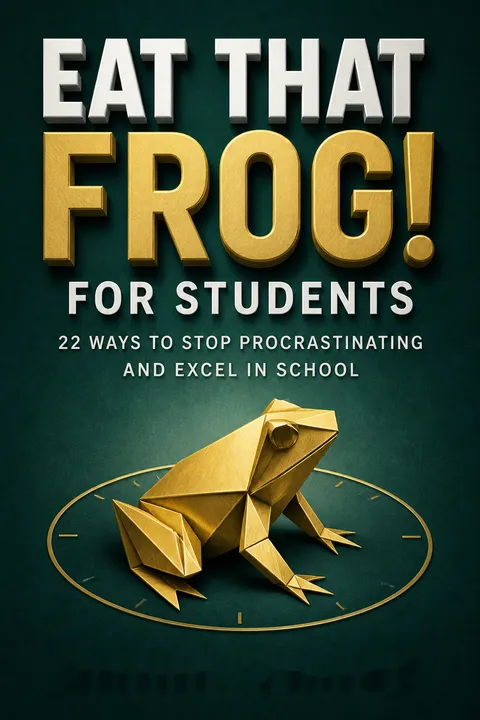
Eat That Frog! for Students is a practical productivity manual organized around a single behavioral question: what is the most valuable next action, and why is it being delayed? Its memorable frog metaphor gathers a large collection of tactics into a usable decision rule. The book moves from personal agency and goals to planning, task breakdown, study methods, attention management, and the deliberate rejection of low-value commitments. That sequence matters. It frames productivity not as speed alone, but as choosing a direction, creating a route, and protecting the attention needed to follow it.
Its clearest educational contribution is the advice to test recall before reviewing. That turns study from passive familiarity into a diagnosis of what a learner can actually explain or solve. Its practical advice on matching work to time blocks is similarly grounded in student life: a short study period can support review, while a paper needs more uninterrupted time. The book also recognizes that technology can be both an extraordinary learning resource and a persistent competitor for attention.
The approach is strongest when it treats discipline as a set of design choices: write a list, clarify the assignment, silence notifications, seek feedback, and begin with a manageable step. It is less convincing when motivational claims are presented as universal laws or when responsibility is made to sound like complete personal control. Students differ in health, disability, finances, family obligations, and access to support. A productivity system that ignores those conditions can turn structural difficulty into personal guilt.
A balanced reading keeps the book's useful agency while rejecting perfectionism. The aim is not to complete every task, maximize every grade, or remain relentlessly urgent. It is to identify meaningful priorities, learn from feedback, and make deliberate tradeoffs. In that form, the central metaphor works less like a command to grind and more like a compass: choose the important task that fits the real situation, then take the next workable step.
Review Summary
Eat That Frog! for Students receives mostly positive reviews, with readers praising its practical advice on time management and productivity. Many wish they had read it earlier in their academic careers. The book offers simple, actionable steps to overcome procrastination and achieve goals. Some readers find the content repetitive or basic, but most appreciate its straightforward approach. The book's focus on personal responsibility and empowering students to make better choices is highlighted. Overall, it's recommended for high school and college students looking to improve their study habits and time management skills.
People Also Read









Glossary
Eat That Frog
Start the most important taskA productivity technique for selecting the most consequential task one is likely to avoid and beginning it before lower-value work. For students, the relevant moment is usually the start of a study session, not necessarily the start of the day. The metaphor emphasizes priority and action, not choosing a task merely because it is unpleasant.
Three P Formula
Phrase goals positively and personallyA way of writing goals so they are present-tense, positive, and personal. Instead of describing something one hopes to stop doing, the goal describes a desired outcome as something the writer can do or has achieved. The book pairs this wording with a specific target and a realistic timeframe.
Salami Slice
Divide a project into stepsA task-starting method that breaks a large project into defined pieces, then focuses on completing one piece at a time. The student first maps the steps, such as researching, outlining, drafting, and revising a paper. Its purpose is to make a daunting assignment feel workable without losing sight of the whole.
Swiss cheese
Work briefly on any partA method for starting an intimidating task by working on an accessible part for a set period, even when the entire project has not been planned. Unlike the Salami Slice method, it does not require dividing the task into a full sequence first. A brief work period can create momentum and make continued effort easier.
mile marker technique
Take the next visible stepA motivational approach for large or uncertain tasks whose full scope is not yet clear. Rather than wait until every stage can be planned, identify the next action that is visible and take it. New information from that action helps reveal what to do next, much like following markers across an otherwise featureless route.
Creative procrastination
Delay low-value work deliberatelyThe intentional choice to postpone, reduce, or abandon lower-value activities so that important responsibilities receive enough time. The term contrasts with unconscious procrastination, which often delays consequential work. It asks students to decide what not to do, including optional activities that no longer justify their time.
Key result areas
Essential outcomes to protectThe small set of results that most strongly determines success in a role or project. For a student, these may include academic performance, timely completion of work, effective use of a schedule, relationships with teachers, and selected activities beyond class. The idea directs attention to outcomes rather than simply counting tasks.
Metacognition
Awareness of what you knowThe process of judging what one understands, what remains uncertain, and what evidence is needed to check that judgment. In the book's study advice, students try to recall material, compare their recall with notes, investigate gaps, and verify what they thought they knew. This makes self-assessment a guide for further study.
Hypercorrection effect
Corrected errors can stickA learning effect described in the book in which correcting an incorrect answer can strengthen later learning of the right answer. It supports treating mistakes as information rather than simply as failure. The practical use is to identify an error, get accurate correction, and revisit the material to confirm understanding.
Law of Forced Efficiency
Prioritize when time is limitedTracy's principle that available time will not cover every task, but it can be directed toward the most important one. It encourages students to accept that some work will remain unfinished and to protect the responsibilities with the greatest consequences. It is a prioritization rule, not a claim that every urgent task can always be completed.
FAQ
What's "Eat That Frog! for Students" about?
- Focus on Procrastination: "Eat That Frog! for Students" by Brian Tracy is a guide specifically tailored for students to overcome procrastination and enhance productivity.
- 22 Strategies: The book presents 22 practical strategies to help students manage their time effectively and achieve academic success.
- Metaphor of Eating a Frog: The central metaphor of "eating a frog" represents tackling the most challenging and important task first to maximize productivity.
- Student-Centric Approach: It addresses the unique challenges students face, such as balancing academics with extracurricular activities and personal responsibilities.
Why should I read "Eat That Frog! for Students"?
- Practical Advice: The book offers actionable steps that students can implement immediately to improve their time management and productivity.
- Tailored for Students: It specifically addresses the pressures and challenges faced by students, making it highly relevant for those in high school, college, or graduate school.
- Proven Techniques: Brian Tracy draws on decades of experience in time management, providing strategies that have been tested and proven effective.
- Long-Term Benefits: By adopting the techniques in the book, students can develop habits that will benefit them throughout their academic and professional lives.
What are the key takeaways of "Eat That Frog! for Students"?
- Prioritize Tasks: Focus on the most important and challenging tasks first to maximize productivity and effectiveness.
- Set Clear Goals: Establish clear, written goals using the Three P Formula: present, positive, and personal.
- Manage Time Effectively: Use strategies like planning every day in advance and applying the 80/20 rule to focus on high-impact activities.
- Develop Self-Discipline: Cultivate habits of self-discipline and personal responsibility to achieve academic and personal success.
What is the "Eat That Frog" method in the book?
- Tackle the Hardest Task: The "Eat That Frog" method involves identifying and completing the most challenging and important task first.
- Boost Productivity: By addressing the biggest task early, students can increase their productivity and reduce procrastination.
- Psychological Benefit: Completing a difficult task first provides a sense of accomplishment and motivation to tackle other tasks.
- Daily Practice: The method encourages making this approach a daily habit to consistently improve time management skills.
How does Brian Tracy suggest students manage their time?
- Plan in Advance: Tracy emphasizes the importance of planning each day in advance to save time and increase efficiency.
- Use Lists: Create different lists for daily, weekly, and monthly tasks to stay organized and focused.
- Prioritize Tasks: Apply the 80/20 rule to identify tasks that will have the greatest impact on academic success.
- Schedule Study Blocks: Allocate specific time blocks for studying and completing assignments to maintain focus and productivity.
What are the Three Pillars of Success according to the book?
- Self-Esteem: Building unshakable confidence and self-esteem is crucial for achieving success and overcoming challenges.
- Personal Responsibility: Taking complete responsibility for one's actions and decisions is essential for personal and academic growth.
- Goal Orientation: Being relentlessly focused on setting and achieving clear goals is a key component of success.
How does the book address studying subjects of little interest?
- Consider Consequences: Understand the long-term benefits of doing well in all subjects, even those of little interest.
- Motivate Yourself: Use self-motivation techniques to find value and purpose in studying less interesting subjects.
- Break Tasks Down: Use methods like the "salami slice" or "Swiss cheese" techniques to make studying manageable.
- Focus on Results: Concentrate on the key result areas that will have the most significant impact on academic performance.
What are some of the best quotes from "Eat That Frog! for Students" and what do they mean?
- "Eat That Frog!": This quote encapsulates the book's central idea of tackling the most challenging task first to boost productivity.
- "Proper Prior Planning Prevents Poor Performance": Emphasizes the importance of planning and preparation in achieving success.
- "You cannot teach a man anything; you can only help him find it within himself": Highlights the importance of self-discovery and personal responsibility in learning.
- "The key to success is action": Stresses the importance of taking immediate and decisive action to achieve goals.
How does Brian Tracy suggest dealing with stress in the book?
- Prepare Thoroughly: Proper preparation and planning can significantly reduce stress and anxiety.
- Focus Attention: Eliminate distractions and focus on one task at a time to improve efficiency and reduce stress.
- Manage Technology: Use technology wisely to avoid becoming overwhelmed by notifications and digital distractions.
- Practice Creative Procrastination: Intentionally delay low-value tasks to focus on high-impact activities, reducing stress from overwhelming to-do lists.
What role does technology play in "Eat That Frog! for Students"?
- Terrible Master: Tracy warns that technology can be a major source of distraction and stress if not managed properly.
- Wonderful Servant: When used strategically, technology can enhance productivity and learning.
- Manage Notifications: Turn off unnecessary notifications to maintain focus and control over digital distractions.
- Use Learning Tools: Leverage online resources and educational tools to supplement learning and improve academic performance.
How can students apply the 80/20 Rule in their studies?
- Identify High-Impact Tasks: Focus on the 20% of tasks that will yield 80% of the results in academic performance.
- Prioritize Assignments: Spend more time on major projects and exams that significantly impact grades.
- Limit Low-Value Activities: Reduce time spent on tasks that contribute little to overall success.
- Enhance Efficiency: Use the rule to streamline study habits and focus on activities that drive the most progress.
What is the significance of setting goals in "Eat That Frog! for Students"?
- Clarity and Direction: Setting clear, written goals provides students with a sense of direction and purpose.
- Motivation and Focus: Goals motivate students to take action and stay focused on their priorities.
- Three P Formula: Goals should be present, positive, and personal to be most effective.
- Measure Progress: Regularly reviewing and adjusting goals helps students track their progress and stay on course.
About the Author
Other books by Brian Tracy






Download PDF
Download EPUB
.epub digital book format is ideal for reading ebooks on phones, tablets, and e-readers.








