

Key Takeaways
Find a reason to rise, even if it is small and changes with you
Purpose can be ordinary. Ikigai is a reason life feels worthwhile, often expressed in the work, relationships, or daily pleasures that make getting up feel natural. The book’s authors travel to Ogimi, an Okinawan village known for its many older residents, expecting to find a secret formula. Instead, they meet elders who garden, meet friends, volunteer, and celebrate birthdays. Their purpose is woven into everyday life, not reserved for a single grand calling.
Keep searching patiently. The book presents ikigai as something discovered through curiosity and experience, not invented by filling in a career-planning diagram. It can also change over a lifetime. Cooking for family or helping a neighbor may matter as much as a celebrated profession. The useful question is not only what gives life meaning in theory, but what reliably draws a person into meaningful action.
The concept works best when it lowers the pressure to discover one perfect destiny. A purpose can be a commitment renewed through ordinary acts, which makes it more accessible and less vulnerable to career changes or aging. The Ogimi portraits give this claim human texture: meaning appears in gardens and friendships, not just heroic achievement. A caution follows from the same example. The village’s way of life is shaped by its specific community and circumstances, so its practices are inspiration, not a universal recipe.
Keep doing useful work after your job ends
Activity sustains identity. The book argues against treating retirement as a sudden exit from everything that gives life structure. Many Japanese elders continue the tasks they value for as long as their health permits. In Ogimi, people tend gardens, help with local projects, and participate in clubs. Their activity is not necessarily paid employment. It provides routine, contribution, and a reason to remain engaged with other people.
Purpose can evolve. The examples of older artists make the point in a different setting. Hokusai described his artistic understanding as continuing to deepen with age; painter Carmen Herrera sold her first canvas at eighty-nine. Their stories do not prove that everyone should work indefinitely. They show that age alone need not end a person’s creative or useful life. The practical lesson is to protect some valued role, craft, or contribution as circumstances change.
This section challenges a narrow equation between work and employment. Contribution can continue after a paycheck stops, and that distinction matters for anyone whose identity has become tied to a job title. The strongest version of the argument is not that rest is bad, but that forced idleness can sever routines and relationships that support a sense of agency. It also needs a humane limit: illness, caregiving, and financial necessity shape people’s choices. Continuing to contribute should be an invitation, not a moral test.
Treat friendship as infrastructure, not a pleasant extra
Belonging is built in. In Okinawa, a moai is a close-knit group whose members meet regularly and support one another. The practice began as a way for neighbors to share help during difficult times. Some groups pool contributions, use funds for activities, and assist a member facing financial trouble. In Ogimi, the authors find that residents belong to neighborhood associations and treat one another as extended family.
Make connection routine. Interviewees describe daily conversations, tea with neighbors, group singing, games, and shared celebrations as central pleasures. The point is not simply to have a large contact list. It is to create reliable, repeated contact and reciprocal help. Friendship becomes part of the structure of a day, much like gardening or a morning walk, rather than something postponed until there is spare time.
The moai is compelling because it turns care from a vague virtue into a social arrangement. Regular meetings and mutual assistance make support more dependable than occasional goodwill. The idea also clarifies why community can be both emotional and practical: companionship matters, but so does knowing someone can help when life becomes difficult. The model should not be romanticized as frictionless. Close groups can exclude outsiders or impose obligations. Its value depends on reciprocity, flexibility, and room for people to participate in ways their circumstances allow.
Design work for immersion: clear aims, stretch, and fewer interruptions
Flow needs the right challenge. Psychologist Mihaly Csikszentmihalyi’s term flow describes deep involvement in an activity, when attention is concentrated and time seems to pass unnoticed. The book presents seven conditions, including knowing what to do, receiving feedback, facing a meaningful challenge, and having skills suited to it. A task that is too easy tends to bore; one far beyond a person’s ability can frustrate. The productive zone lies just beyond comfortable competence.
Protect concentration. The authors recommend setting a concrete objective, then giving full attention to the work rather than obsessing over the distant result. They warn that frequent task-switching fragments focus. A writer, for example, may spend a work session producing a small amount of text instead of continually checking messages and thinking about the finished book. Even routine chores can become absorbing when approached with care and a personal sequence.
Flow offers a useful design lens: disengagement may signal that a task lacks clarity, feedback, challenge, or uninterrupted attention, rather than proving that the work is inherently meaningless. The book’s account of an artisan carefully sorting brush bristles shows how absorption can exist in precise, repetitive labor. Yet flow is not a complete theory of good work. Some necessary tasks remain dull, and some absorbing work can be exploitative or exhausting. The state is valuable, but purpose, fairness, and recovery still matter.
Eat varied, mostly plant-based meals, and stop before stuffed
Variety beats a magic ingredient. The Okinawan diet described in the book centers on vegetables, tofu, sweet potatoes, legumes, grains, and fish eaten several times a week. A study cited by the authors found that local centenarians regularly ate about 206 different foods and averaged eighteen kinds each day. The book also emphasizes lower consumption of sugar and salt than in the rest of Japan, rather than crediting longevity to one special food.
Use portion cues. Hara hachi bu is the practice of stopping when nearly full, rather than continuing until uncomfortably stuffed. Okinawans traditionally serve food on several small plates, a pattern that supports varied, modest portions. The authors cite an average daily intake of about 1,785 calories in Okinawa, while noting that reduced intake is not a license for poor nutrition. Their central advice is moderation with adequate nourishment, not starvation or a rigid calorie target.
The practical strength here is the combination of variety and restraint. It shifts attention away from a supposedly miraculous ingredient and toward a recurring pattern of meals and portions. That is a more transferable lesson than trying to reproduce a regional menu exactly. The evidence presented, however, cannot isolate diet from the many other features of Okinawan life, including activity and social ties. Nor does one calorie figure suit every person. The sound principle is a nourishing pattern, not copying a number without context.
Move throughout the day; don't outsource motion to the gym
Everyday movement adds up. Ogimi’s older residents walk, tend vegetable gardens, visit neighbors, and play gateball, a low-impact team game using mallets and balls. They are not portrayed as pursuing intense training plans. Their activity is folded into ordinary life, which keeps movement frequent and social. The book contrasts this pattern with long stretches of sitting and recommends simple changes such as walking, taking stairs, playing with children or pets, and joining group activities.
Choose a sustainable practice. The authors also introduce radio taiso, a short group warm-up using basic stretches and joint movements, alongside yoga, tai chi, and qigong. These practices coordinate movement and breathing, and can be adapted to different abilities. The point is not that a particular routine guarantees longevity. It is to find a gentle, repeatable form of movement that keeps the body engaged and fits naturally into the day.
The emphasis on ordinary movement makes the advice less dependent on motivation, equipment, or athletic identity. Gardening and walking also combine physical activity with practical purpose, nature, or company, so movement serves several parts of life at once. The book’s examples suggest a useful design question: how can a day require more small movements without turning exercise into another demanding project? The advice still needs adaptation for disability, pain, and health conditions. Accessibility matters more than reproducing a centenarian’s routine.
Train attention, then alternate challenge with genuine recovery
Keep mind and body engaged. The book links curiosity, learning, social interaction, and trying unfamiliar activities with an active mind. Neuroscientist Shlomo Breznitz argues that familiar routines let the brain operate automatically, while new information asks it to form fresh connections. The authors recommend learning, playing games, and talking with others rather than retreating into monotonous habits. They also describe sleep as essential to restoration and present mindfulness, breathing, and meditation as ways to notice stress before it runs unchecked.
Distinguish useful strain from overload. Citing a long-term study by Howard Friedman, the book argues that people facing manageable challenges and taking their work seriously may fare better than those who withdraw into complete ease. But it also describes chronic stress as damaging, associated in cited studies with immune reactions and shortened telomeres. The distinction is between effort that engages a person and sustained alarm that leaves no room to recover.
This is a more nuanced account of vitality than simply urging people to stay busy. Novelty can interrupt mental autopilot, while challenge can create engagement, but the same pressure becomes harmful when it is constant and uncontrollable. The key distinction is not effort versus relaxation, but chosen, bounded effort versus chronic strain. A life can contain both stimulation and stillness. The book’s advice is most persuasive when attention, learning, sleep, and stress management are treated as mutually supporting parts of a life, not isolated longevity hacks.
Accept the feeling, choose the next useful action
Meaning can orient action. Viktor Frankl’s logotherapy helps people identify what makes life worth continuing and acting for. In one example, a grieving doctor could not escape despair after his wife’s death. Frankl asked him to consider how his wife would have suffered had he died first; the doctor found meaning in bearing the grief she had been spared. The point is not that pain disappears, but that a person may find a way to carry it.
Do not wait to feel ready. Japanese psychiatrist Shoma Morita’s therapy teaches people to accept emotions rather than trying to force them away, then attend to what needs doing. Feelings are treated as changeable experiences, while action remains partly within a person’s control. This approach cautions against making emotional comfort a prerequisite for living. Its three guiding questions include what action is needed now and what purpose gives that action direction.
These approaches offer a useful counterweight to the belief that difficult emotions must be solved before life can resume. Frankl’s example shows how a painful fact can be given a humane interpretation without being denied. Morita’s emphasis on action similarly loosens the grip of self-monitoring. Still, meaning is not a substitute for practical or clinical support when suffering is severe. The value lies in restoring agency where possible, while recognizing that accepting distress does not mean accepting preventable harm.
Use imperfection and small risks to become less brittle
Expect change without surrendering. Wabi-sabi is an appreciation of what is imperfect, incomplete, and temporary. Its companion idea, ichi-go ichi-e, treats each encounter as unrepeatable, encouraging attention to the present rather than fantasies of permanence. The book connects these ideas to resilience: setbacks are unavoidable, so attention is better spent on what can be changed than on what cannot.
Build room to adapt. The authors borrow Nassim Nicholas Taleb’s term antifragility for things that can benefit from disruption, not merely withstand it. Their practical suggestions include cultivating several skills or sources of income, maintaining friendships beyond one relationship, and taking small risks without endangering everything. Ogimi residents’ gardens provide one example of a secondary occupation. The aim is not to welcome every hardship, but to avoid depending on one fragile support.
The distinction between resilience and antifragility sharpens the question from how to survive disruption to whether a system can learn or gain options from it. In personal life, that means preserving alternatives before they are urgently needed. The advice to diversify relationships, skills, and interests is especially useful because it does not require predicting which setback will arrive. But adversity is not automatically beneficial, and hardship can overwhelm rather than strengthen. The constructive claim is modest: preparation and reflection can improve the odds of adapting.
Analysis
Ikigai combines a cultural introduction, practical health advice, therapeutic ideas, and portraits of people who remain engaged late in life. Its central proposition is strongest when read as a pattern rather than a causal formula: a worthwhile daily purpose is supported by relationships, routine, movement, modest eating, and sustained attention. The Ogimi interviews give that pattern memorable form. Elders garden, visit, sing, help neighbors, and celebrate together. Their lives make purpose look less like an abstract answer and more like repeated participation in a community.
The book’s breadth is also its central limitation. It places longevity statistics beside anecdotes and suggests that ikigai may help explain the exceptional health of Okinawans. But the stories cannot establish which factor causes longer life, or how much each practice contributes. Diet, healthcare, geography, social organization, and historical conditions are intertwined. Some claims about antioxidants, calorie restriction, and specific foods are presented more confidently than the evidence summarized in the text warrants. Readers should treat the prescriptions as broad lifestyle ideas, not medical guarantees.
The most useful synthesis is therefore not that purpose makes people immortal, but that meaningful activity can organize a life in ways that make beneficial habits easier to sustain. A garden creates movement and food; a moai creates company and support; a craft creates challenge and concentration. This interdependence is more compelling than any single longevity secret. The book also offers an important counterbalance to relentless productivity: staying engaged need not mean rushing. Its elders are busy without seeming frantic, and their purpose is often modest. That distinction preserves the human value of ikigai while avoiding the trap of turning every hour into a performance metric.
Review Summary
Ikigai receives mixed reviews, with an average rating of 3.72 out of 5. Some readers find it insightful and inspiring, praising its exploration of Japanese lifestyle concepts and longevity. However, others criticize it for lacking depth, rehashing common self-help ideas, and straying from its titular concept. Many reviewers appreciate the book's emphasis on finding purpose, maintaining a balanced lifestyle, and fostering community connections. Critics argue that the advice may be impractical for some and that the book oversimplifies complex issues.
People Also Read





Glossary
ikigai
reason life feels worthwhileA Japanese term combining ideas of life and worth. In this book, ikigai means a personal reason to get up each morning and engage with life. It may come from work, relationships, craft, service, or simple daily commitments, and can change over time rather than remaining one fixed mission.
moai
supportive group of friendsAn informal, close-knit group whose members share interests and look out for one another. In Okinawa, moai groups can meet for activities and provide emotional or practical support, including financial assistance. The book presents them as a durable structure of belonging rather than merely a circle of casual acquaintances.
yuimaaru
community cooperationAn Okinawan principle of mutual help and recognition of connection among people. In the book’s account of Ogimi, residents cooperate on tasks such as harvesting, building, and local projects. This reciprocal participation helps individuals feel useful and included in community life.
flow
deep involvement in an activityA state of concentrated absorption in which a person is fully engaged in a task and less aware of time or distraction. The book associates flow with activities that provide a clear aim, feedback, meaningful challenge, and a good fit between difficulty and skill. It can occur in work, sport, art, or everyday tasks.
microflow
absorption in routine tasksA small-scale form of flow created by bringing attention, skill, or a personal sequence to ordinary activities. The book illustrates it with an elevator operator who turns a repetitive job into a carefully performed interaction, and with people who take pleasure in chores. The idea is to make unavoidable tasks more engaging.
logotherapy
therapy focused on meaningA therapeutic approach developed by Viktor Frankl that helps people identify meaning and purpose as a basis for responding to difficulty. In the book, the approach treats the search for a reason to live and act as a central human need. A purpose can guide action without necessarily removing grief or hardship.
Morita therapy
accept feelings, act purposefullyA Japanese therapeutic approach developed by Shoma Morita. It teaches people to allow emotions to arise rather than trying to eliminate or control them, while directing attention toward necessary action and daily purpose. The book describes its central lesson as accepting inner experience without letting it dictate every behavior.
hara hachi bu
stop eating before fullAn Okinawan eating practice that encourages stopping when nearly satisfied instead of continuing until completely full. The book connects it to modest portions and the traditional presentation of food on several small plates. It is offered as a cue for moderation, not as a precise measurement or a call to undernourish oneself.
wabi-sabi
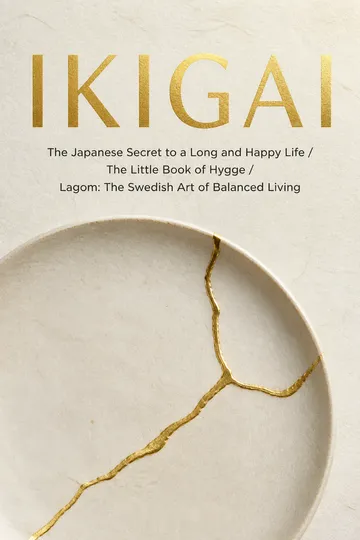
beauty in imperfectionA Japanese aesthetic and philosophical idea that finds beauty in things that are imperfect, incomplete, and temporary. The book uses examples such as an irregular or cracked teacup to illustrate acceptance of change and natural irregularity. Applied to life, the concept encourages appreciation without demanding permanence or perfection.
ichi-go ichi-e
this moment will not recurA Japanese expression used to emphasize that each meeting or moment is unique and cannot be repeated in precisely the same way. The book connects it to tea gatherings, meditation, and martial arts, where attention to the present matters. It encourages people to notice the particular value of an encounter while it is happening.
antifragility
gaining from disruptionA term used by Nassim Nicholas Taleb for systems that can improve through certain shocks or disorder, rather than merely resisting damage. The book applies it to personal life through maintaining options, taking limited risks, and avoiding dependence on a single source of security. It distinguishes adapting and gaining capacity from simply returning to the former state.
FAQ
What's "Ikigai: The Japanese Secret to a Long and Happy Life" about?
- Exploration of Ikigai: The book delves into the Japanese concept of ikigai, which translates to "a reason for being" or "the happiness of always being busy." It explores how finding one's ikigai can lead to a longer and more fulfilling life.
- Cultural Insights: It provides insights into Japanese culture, particularly the lifestyle of Okinawa's centenarians, who are known for their longevity and happiness.
- Practical Guidance: The authors offer practical advice on how to discover and nurture your own ikigai, emphasizing the importance of purpose, community, and a balanced lifestyle.
- Holistic Approach: The book combines elements of psychology, philosophy, and health to present a holistic approach to living a meaningful life.
Why should I read "Ikigai: The Japanese Secret to a Long and Happy Life"?
- Life Purpose: It helps readers find their life purpose, which can lead to greater satisfaction and happiness.
- Longevity Tips: The book provides tips and secrets from some of the world's longest-living people, offering insights into how to live a longer, healthier life.
- Cultural Appreciation: Readers gain a deeper understanding of Japanese culture and its approach to life, which can be both enlightening and inspiring.
- Practical Advice: The book is filled with actionable advice that can be easily integrated into daily life to improve well-being.
What are the key takeaways of "Ikigai: The Japanese Secret to a Long and Happy Life"?
- Find Your Ikigai: Discovering your ikigai, or life purpose, is crucial for a fulfilling life. It gives you a reason to get up in the morning and keeps you motivated.
- Stay Active: Physical activity is essential for longevity. The book emphasizes the importance of gentle movements and staying active throughout life.
- Community and Relationships: Building strong social connections and being part of a community are vital for happiness and longevity.
- Mindful Living: Practicing mindfulness and living in the present moment can reduce stress and enhance life satisfaction.
How does "Ikigai: The Japanese Secret to a Long and Happy Life" define ikigai?
- Reason for Being: Ikigai is described as a reason to jump out of bed each morning, a purpose that gives life meaning and direction.
- Intersection of Elements: It is often depicted as the intersection of what you love, what you are good at, what the world needs, and what you can be paid for.
- Personal and Unique: Each person's ikigai is unique and requires a patient search to uncover, often hidden deep within.
- Continuous Journey: Finding and nurturing your ikigai is a lifelong journey that evolves as you grow and change.
What are the antiaging secrets mentioned in "Ikigai: The Japanese Secret to a Long and Happy Life"?
- Balanced Diet: The book highlights the importance of a balanced diet rich in vegetables, fruits, and lean proteins, as practiced by Okinawans.
- Moderate Caloric Intake: It emphasizes the practice of hara hachi bu, or eating until you are 80% full, to promote longevity.
- Regular Movement: Engaging in regular, gentle physical activities like walking, gardening, or traditional exercises such as tai chi and yoga.
- Stress Reduction: Techniques for reducing stress, such as mindfulness, meditation, and maintaining a positive outlook, are crucial for a long life.
How does "Ikigai: The Japanese Secret to a Long and Happy Life" relate to logotherapy?
- Purpose-Driven Life: The book connects ikigai with Viktor Frankl's logotherapy, which focuses on finding meaning and purpose in life as a way to overcome challenges.
- Existential Fulfillment: Both concepts emphasize the importance of having a reason to live, which can lead to greater resilience and happiness.
- Therapeutic Approach: Logotherapy is presented as a method to help individuals discover their ikigai by addressing existential frustration and guiding them toward a meaningful life.
- Complementary Philosophies: The book illustrates how ikigai and logotherapy can work together to enhance personal well-being and life satisfaction.
What is the role of community in "Ikigai: The Japanese Secret to a Long and Happy Life"?
- Social Connections: The book stresses the importance of nurturing friendships and being part of a community for emotional and physical health.
- Moai Groups: It introduces the concept of moai, informal groups of people with common interests who support each other, as practiced in Okinawa.
- Shared Activities: Engaging in communal activities, celebrations, and volunteer work is highlighted as a way to foster a sense of belonging and purpose.
- Emotional Support: Strong social ties provide emotional support, reduce stress, and contribute to a longer, happier life.
What are the best quotes from "Ikigai: The Japanese Secret to a Long and Happy Life" and what do they mean?
- "Only staying active will make you want to live a hundred years." This Japanese proverb emphasizes the importance of staying active and engaged in life to promote longevity.
- "Happiness is always determined by your heart." This quote suggests that true happiness comes from within and is influenced by one's mindset and attitude.
- "The secret to a long life is not to worry." This advice from an Okinawan centenarian highlights the importance of maintaining a positive outlook and reducing stress for a long life.
- "The older, the stronger." This phrase from the Ogimi Federation of Senior Citizen Clubs reflects the belief that age brings strength and wisdom, rather than weakness.
How does "Ikigai: The Japanese Secret to a Long and Happy Life" suggest finding flow in daily activities?
- Engage in Enjoyable Tasks: The book encourages finding activities that you enjoy and that fully engage your attention, leading to a state of flow.
- Set Clear Goals: Having clear objectives for your tasks can help you focus and achieve flow more easily.
- Balance Challenge and Skill: Choose activities that are challenging but within your skill level to maintain interest and avoid boredom.
- Minimize Distractions: Create an environment free from distractions to help you concentrate and immerse yourself in the task at hand.
What is the significance of the Okinawan diet in "Ikigai: The Japanese Secret to a Long and Happy Life"?
- Nutrient-Rich Foods: The Okinawan diet is rich in vegetables, fruits, and lean proteins, providing essential nutrients for health and longevity.
- Low Caloric Intake: Okinawans practice hara hachi bu, eating until they are 80% full, which helps maintain a healthy weight and reduces the risk of chronic diseases.
- Variety and Balance: The diet includes a wide variety of foods, ensuring a balanced intake of nutrients and promoting overall well-being.
- Antioxidant-Rich: Foods like tofu, miso, and green tea are high in antioxidants, which help combat aging and support a long, healthy life.
How does "Ikigai: The Japanese Secret to a Long and Happy Life" address resilience and wabi-sabi?
- Embrace Imperfection: The book introduces wabi-sabi, the appreciation of the beauty in imperfection, as a way to cultivate resilience and acceptance.
- Focus on the Present: It emphasizes living in the moment and appreciating the transient nature of life, which can help reduce stress and increase happiness.
- Adaptability: Resilience is portrayed as the ability to adapt to change and overcome challenges, maintaining focus on what truly matters.
- Antifragility: The concept of antifragility is discussed, encouraging readers to grow stronger through adversity and embrace life's uncertainties.
What are the ten rules of ikigai according to "Ikigai: The Japanese Secret to a Long and Happy Life"?
- Stay Active: Keep doing things you love and find meaningful, even after retirement.
- Take It Slow: Avoid rushing through life; savor each moment and experience.
- Don't Fill Your Stomach: Practice moderation in eating, following the 80% rule.
- Surround Yourself with Good Friends: Cultivate strong social connections for support and happiness.
- Get in Shape: Engage in regular physical activity to maintain health and vitality.
- Smile: Maintain a cheerful attitude to foster positivity and attract good relationships.
- Reconnect with Nature: Spend time in nature to recharge and find peace.
- Give Thanks: Practice gratitude daily to enhance your sense of well-being.
- Live in the Moment: Focus on the present and let go of past regrets and future worries.
- Follow Your Ikigai: Pursue your passions and purpose to lead a fulfilling life.
About the Author
Other books by Héctor García


Download PDF
Download EPUB
.epub digital book format is ideal for reading ebooks on phones, tablets, and e-readers.








