

Key Takeaways
Treat leadership as a learnable practice, not an inherited personality
Traits are clues, not destiny. Adair challenges the idea that leadership belongs only to people born with an exceptional personality. Trait lists vary widely: a 1940 review of 20 leadership studies found that only 5 percent of listed traits appeared in three or more studies. That makes a fixed checklist a shaky guide to selecting or developing leaders. Qualities still matter, but they can be strengthened through deliberate practice and judged in context.
Experience needs a map. The book pairs leadership principles with incidents from work and history, asking readers to test ideas against their own experience. Its aim is not to hand out a bag of tricks. It is to help a leader notice what a situation requires, practise the right actions, and learn from their effects.
The useful shift is from sorting people into leaders and nonleaders toward asking what capacities a role demands and how they can grow. This aligns with skill-based approaches to expertise: repeated practice matters most when people receive feedback and can connect action to outcome. Yet development is not limitless. Temperament, opportunity, and domain knowledge affect what a person can do and where they thrive. A realistic model avoids both fatalism, which excuses poor preparation, and the opposite myth that any person can become effective in any role.
Keep task, team, and individual needs in view at once
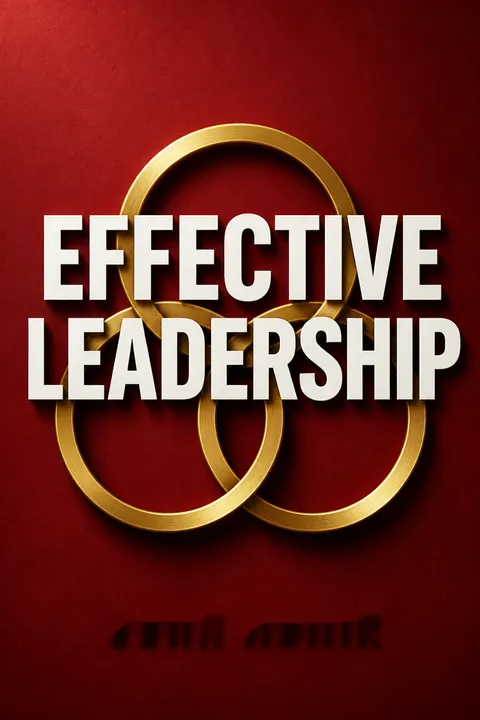
Leadership is a balancing act. The Three Circles model organizes a leader's responsibility around three overlapping needs: accomplish the common task, maintain the team, and enable each individual to contribute and develop. These needs affect one another. A team that cannot meet its task may lose cohesion; conflict inside a team can damage performance; a neglected employee may withdraw effort and connection.
One circle cannot replace another. Adair illustrates this with Polymotors, an engineering firm where sales and production leaders blamed each other and stopped communicating. Morale fell, employees left, and the business failed. The framework asks leaders to diagnose the whole system, not treat low performance as a single isolated problem. Improving one area can strengthen the others, while neglecting one can undermine all three.
This model is a practical form of systems thinking: it makes interdependence visible without requiring an elaborate dashboard. It also guards against a common managerial distortion, treating output as the only meaningful measure of health. A team can hit a target through exhaustion or damaged trust, so short-term achievement may conceal future costs. The circles are a diagnostic lens, not a formula that assigns equal weight to every need. In an emergency, the task may dominate; in a fractured team, restoring trust may be the most urgent route back to performance.
Earn authority through competence, character, and the situation's demands
Authority has several roots. Adair distinguishes authority from position, personality, and knowledge. A job title can authorize decisions, but people also respond to personal influence and to relevant expertise. Strong leadership draws on all three rather than relying on rank alone. Technical knowledge matters especially early in a career, while communication, decision making, and leadership become increasingly important as responsibility widens.
Fit changes with the work. A skilled tax specialist named Michael was promoted to lead an accounts department during a recession, but technical mastery did not prepare him to address low morale and broader people problems. Adair also describes an industrial plant moving from a crisis-filled start-up to stable operation, where a different kind of manager suited the new phase. Leaders need deep knowledge of their field and flexibility as conditions change.
The three sources of authority resemble a useful distinction between formal power, relational credibility, and epistemic authority, meaning credibility grounded in knowing the work. Their balance matters because each can fail alone: rank without trust breeds compliance, charm without competence is fragile, and expertise without coordination can become narrow. The situational argument is especially valuable when promotion is mistaken for proof of readiness. Still, changing conditions do not always require replacing a leader. Support, role redesign, or learning may help someone adapt, depending on the demands and available time.
Make work meaningful by clarifying purpose, aims, and objectives
Move from why to what. Adair separates three levels of a task. Purpose is the broad reason a group exists. Aims give that purpose direction, while objectives specify concrete results with limits and deadlines. The distinctions help teams see both the meaning of their work and the finish line they must reach. Leaders should also connect the specific job to the wider purpose, so instructions do not sound like arbitrary chores.
A factory makes the levels clear. Windlesham Ltd makes bath plugs, its purpose. It aims to make the best plugs and increase its share of the world market from 35 percent to 60 percent within three years. A section's objective for one week is to produce 30,000 plugs for a new town in Saudi Arabia. If the team cannot say how success will be recognized, the objective needs sharpening.
This hierarchy connects meaning with execution. Broad purpose can sustain commitment, but it is too vague to coordinate daily work; measurable objectives coordinate effort, but can become hollow when detached from purpose. The distinction also helps reveal goal displacement, when a target becomes more important than the value it was meant to serve. There is a further discipline here: objectives should be specific enough to guide action without pretending that every valuable outcome is easily counted. Good leaders use measures as instruments, not as substitutes for judgment.
Plan with the people doing the work, and leave room to adapt
A plan is a tested route. Planning means working out how a group can move from its current position to its intended result. Adair urges leaders to explore alternatives, check facts, and ask what, why, when, how, where, and who. Consultation matters because the people carrying out a plan often have relevant knowledge and are more committed when they help shape it. The leader still guides the process and decides how much participation time and circumstances allow.
Expect the unexpected. A marketing director's plan for launching a more effective paint stripper failed when an agency interpreted the instruction to deliver a commercial as soon as possible as permission to wait another month. Clear responsibilities and deadlines would have prevented the confusion. Even a clear plan cannot predict everything, so leaders should consider plausible problems and prepare fallback options rather than build only for the best case.
Participation can improve both the information available and the willingness to act on a decision. It is not a ritual of asking for opinions after the outcome is settled. The appropriate level depends on urgency, expertise, and who must implement the choice. Contingency planning adds a different discipline: it treats uncertainty as normal, not as evidence that planning failed. The danger lies in planning so extensively that action stalls, or in treating a forecast as certainty. A useful plan creates direction and room to revise it when reality supplies new information.
Brief clearly, then control lightly and evaluate honestly
Make expectations visible. A briefing should leave people knowing the objective, the plan, their own role, and the standard of performance. In the film Twelve O'Clock High, a new commander addresses a demoralized bomber group, names its poor results, and sets a clear expectation for improvement. Adair uses the scene to show that briefings also shape morale and shared standards, not just distribute instructions.
Guide without taking over. Once work begins, leaders compare progress with the plan, coordinate people, and intervene when needed. Their aim is to help the team regulate its own work, not hover over every action. After a project, an honest review can identify what succeeded, what failed, and what to change. Feedback should improve future performance, not turn a group review into a public trial of one person.
The sequence of briefing, monitoring, and review resembles a feedback-control system: define a target, observe performance, correct drift, and update the next attempt. Human teams, unlike machines, also interpret how correction is delivered. A light touch can preserve initiative, while silence in the face of danger or confusion is not restraint but neglect. Reviews work best when they distinguish learning from blame and address individual shortcomings privately unless a shared standard is at stake. The framework's strength is its emphasis on timely feedback, not paperwork for its own sake.
Motivate by knowing people, showing progress, and recognizing contribution
Motivation has an inner and an outer side. People bring their own needs and values to work, but leaders influence the conditions in which those motives can become effort. Adair's proposed 50-50 rule is a rough way to express that balance, not a precise measurement. His practical advice includes showing enthusiasm, learning what matters to each person, setting demanding but reachable targets, making progress visible, creating a constructive climate, rewarding fairly, and giving recognition.
Do not confuse conditions with purpose. Drawing on Frederick Herzberg, the book distinguishes factors that can prevent dissatisfaction, such as pay and working conditions, from aspects of work that can provide deeper satisfaction, such as achievement and responsibility. Adair cautions that the division is not absolute: money can also signal recognition. A leader should therefore avoid assuming that one reward, or one theory, explains every person's effort.
The strongest contribution is the insistence that motivation is relational and individual, not a lever operated by a generic incentive scheme. This fits with self-determination theory, which emphasizes autonomy, competence, and belonging as conditions that support sustained engagement. The book's 50-50 language is memorable, but should not be treated as an empirical constant: the balance varies across people, jobs, and circumstances. Fair pay and safe conditions remain foundational. Recognition and purpose cannot compensate for an exploitative workplace, though they can make worthwhile work more sustaining.
Build structures that distribute responsibility instead of bottlenecking decisions
Structure should serve the purpose. As teams grow, leaders need smaller working units, capable subleaders, and clear channels for passing information in both directions. Adair suggests that a leader's direct team often works best with roughly 5 to 15 people, while recognizing that the task affects the right size. He recounts how Jethro advised Moses to appoint leaders over smaller units, allowing routine matters to be handled lower down and difficult cases to reach Moses.
Delegation is not abandonment. To delegate is to define the result, give someone the authority to act, and remain available for support. Abdication means dropping responsibility and leaving the subordinate alone if problems arise. Effective delegation frees a leader to focus on broader work while giving others experience. It requires people who are selected, trained, and trusted, and it accepts that the work may be done differently while still meeting the agreed standard.
This is an argument for designing decision rights, not simply drawing boxes on an organization chart. Clear delegation reduces bottlenecks and creates local knowledge where problems occur. It also develops capability by giving people consequential work, rather than treating them as instruments who only execute instructions. Yet decentralization without information, resources, or accountability can produce fragmentation. The critical design question is not how much authority to push downward in the abstract, but which decisions belong closest to the relevant knowledge and which require coordination across the whole organization.
Make your conduct the standard people can trust
Character is visible in action. Adair names qualities that effective leaders commonly need: enthusiasm, integrity, demandingness balanced by fairness, warmth, humanity, and humility. These qualities matter differently across professions, but leaders should model the standards they expect from their teams. Integrity builds trust; humility makes it possible to admit mistakes and hear challenge; fairness prevents high standards from becoming favoritism or harshness.
People watch what leaders do. During a winter storm on a fishing trawler, a mate ordered deckhands to climb a dangerous mast to repair a light. When they refused, the skipper prepared to do the job himself. Several crew members immediately volunteered. The contrast shows why example can carry more force than command. A leader's conduct teaches the group what is expected, especially when the work is difficult or the leader shares its risks.
Example functions as an informal rule system: people infer what is truly valued from the behavior that receives attention, protection, or reward. This helps explain why a leader's small choices can have effects beyond their immediate task. The skipper earns cooperation by demonstrating shared exposure, not by demanding loyalty from safety. Still, leading by example does not mean personally doing every job or glorifying sacrifice. At senior levels, the relevant example may be sound judgment, accountability, or restraint. The test is whether conduct makes standards credible and the work more responsible.
Develop leaders through practice, feedback, and increasingly broad responsibility
Growth needs more than a course. Adair argues that leadership develops through the interaction of ideas and experience: observe leaders, practise, seek feedback, and reflect on mistakes. He also asks organizations to support that process through selection, training, mentoring, varied career experience, useful structures, and a culture that welcomes leadership at every level. Individuals must take responsibility for their growth, while organizations provide opportunities and honest assessment.
There are practical precedents. The British Army's War Officer Selection Board used group exercises to observe how candidates handled tasks, cohesion, and pressure. Adair also describes work with ICI, where leadership development across its divisions accompanied a period in which the company moved from a 48 percent profit decline in 1988 to profits of one billion pounds five years later. The story suggests organizational value, not proof that one program alone caused the turnaround.
The development argument is strongest when it treats leadership as a relationship between individual effort and institutional opportunity. A course can supply concepts, but real responsibility exposes gaps that classroom exercises cannot fully reproduce. Mentors and candid feedback help convert experience into learning rather than mere repetition. The ICI story is compelling but cannot isolate leadership development from other changes in strategy, markets, or operations. That caution strengthens rather than weakens the practical point: organizations should evaluate development by observed changes in behavior and results, not by attendance or enthusiasm alone.
Analysis
Adair's central achievement is to unite three partial explanations of leadership. Personal qualities matter, but they do not operate independently of the situation; situational expertise matters, but it does not replace the work of leading people; and group needs matter, but they require someone to notice and coordinate them. The Three Circles model turns this synthesis into a usable diagnostic: a leader can ask whether the task is clear, whether the team can work together, and whether individuals can make a worthwhile contribution. Its usefulness lies less in scientific precision than in directing attention toward interdependence.
The practical chapters then translate that model into observable work: define purpose and objectives, plan, brief, monitor, evaluate, motivate, organize, and model standards. This is a distinctive strength. Leadership becomes less mysterious without being reduced to a personality test or a rigid script. The approach also accommodates differences in urgency and expertise. A crisis can justify concentrated authority; a complex problem may benefit from broader consultation. Flexibility is not inconsistency when the underlying purpose and standards remain clear.
Some claims deserve careful handling. The proposed 50-50 balance between inner and external motivation is explicitly approximate, and should not be mistaken for a measured law. The book's military cases illuminate decisions under pressure, but military command does not map neatly onto workplaces where participation, psychological safety, and long-term learning carry different costs and benefits. Likewise, the ICI turnaround is evidence of a notable development effort occurring alongside recovery, not a controlled demonstration of causality.
The enduring lesson is therefore not that one model can solve every leadership problem. It is that leaders can learn to diagnose before prescribing, connect daily work to purpose, and accept accountability for both performance and people. The framework becomes most credible when used as a guide for inquiry, tested against context, and revised through honest feedback.
Review Summary
Effective Leadership by John Adair receives mixed reviews, with an overall rating of 3.82 out of 5. Some readers praise it as the best leadership book they've read, appreciating its insights and practical approach. They find it valuable for personal development and management practices. Others criticize its traditional leadership style and formulaic approach. Despite this, many readers find the book easy to read and useful for gaining new perspectives on leadership, particularly for junior managers and those seeking to improve their leadership skills.
Glossary
Three Circles model
Balances three group needsA leadership framework representing three connected needs in any working group: completing the common task, maintaining a cohesive team, and enabling individual members to contribute and develop. The overlapping circles show that action in one area can strengthen or damage the others, so leaders should diagnose the whole group rather than focus on output alone.
Action Centred Leadership
Leadership through shared functionsThe practical leadership approach associated with Adair's Three Circles model. It organizes a leader's work around achieving the task, maintaining the team, and developing individuals, using functions such as planning, briefing, controlling, evaluating, motivating, organizing, and setting an example. It emphasizes simple, practical, participative learning rather than a fixed leadership style or a set of rhetorical tricks.
group personality
A team's shared characterThe distinctive ethos and identity that a working group develops over time. Its habits, expectations, relationships, and collective memories make it different from other groups, even when those groups have similar jobs or belong to the same organization. Leaders can influence this character, particularly while a group is forming, but they need to understand its existing norms before assuming that a practice will transfer.
generic role of leader
Core work of leadingThe set of responsibilities that recur across leadership situations: helping a group achieve its task, maintaining its capacity to work together, and enabling individuals to contribute and grow. The specific actions vary by profession, authority, and urgency, but the underlying responsibilities remain recognizable. The leader may share the work with others, while remaining accountable for the whole.
representative qualities
Traits expected in a fieldQualities a leader should display because they are valued or required in the working group or profession. A nursing leader, for example, should embody care and respect, while a leader in a technical field needs credible understanding of that work. These qualities are distinct from broader qualities such as integrity and humility, which Adair argues are relevant across many kinds of leadership.
War Officer Selection Board
Practical leadership assessmentA British Army selection process introduced in 1942 to assess candidates for leadership roles. Candidates led small groups through practical tasks, allowing observers to assess task performance, group cohesion, and stability under pressure. Interviews and tests supplemented the exercises. Adair presents the approach as an important predecessor of later assessment centres because it evaluated behavior in a group setting rather than relying on interviews alone.
Pygmalion effect
Expectations shape performanceThe idea that the way a person is treated, and the expectations communicated to them, can influence how they behave and develop. Adair uses George Bernard Shaw's Pygmalion to illustrate how one person's belief in another's potential may help elicit stronger performance. The concept does not mean that expectations alone overcome every constraint; it highlights how leadership behavior can become part of the conditions that shape contribution.
About the Author
Other books by John Adair

Download PDF
Download EPUB
.epub digital book format is ideal for reading ebooks on phones, tablets, and e-readers.








