

Key Takeaways
Listen for motion, not light, to discover what the universe hides.
A different cosmic signal. Light reveals the temperature, composition, and condition of celestial objects. Gravitational waves instead carry information about how massive bodies move: a star collapsing, neutron stars circling, or black holes merging. They are disturbances in space-time itself, and unlike light, they can pass through intervening matter with little obstruction.
A new kind of astronomy. The book follows LIGO, a pair of observatories with long, perpendicular arms designed to register tiny changes as a wave passes Earth. Calling the result a cosmic sound is a metaphor: the waves travel through space, not as audible sound through air. Their measured patterns can be translated into tones, giving astronomers a new way to interpret the sky.
What's striking is that the new instrument extends more than human sight. It changes which physical properties count as observable. Astronomy has repeatedly advanced by finding ways to detect signals beyond ordinary vision, but gravitational-wave observations are especially different because they track motion rather than emitted light. The musical analogy makes that shift memorable, provided it is not taken literally: space is not filled with sound. The signal becomes audible only after measurement and translation, much as data from other instruments becomes an image or graph.
Replace the fixed cosmic stage with a geometry shaped by matter.
Newton's useful framework. Newton treated space as a fixed arena and time as a universal clock. That picture produces excellent predictions for familiar, slow-moving systems, but it leaves gravity's mechanism unexplained. Earlier mathematicians, especially Riemann, showed that geometry need not be flat, creating mathematical tools that Einstein could use.
Einstein's changed picture. General relativity joins space and time into space-time, whose geometry responds to matter and energy. Planets follow paths shaped by that geometry, rather than being pulled by an invisible tether. Mercury's orbit supplied a key example: its closest point to the Sun shifts by about 43 arcseconds per century beyond what known planetary effects explain, a discrepancy Einstein's theory accounts for.
The conceptual move resembles a broader lesson in science: a framework can be remarkably useful without being the final description of reality. Newtonian mechanics remains effective in ordinary conditions, while relativity becomes essential for stronger gravity, high speeds, or precise systems such as satellite navigation. The familiar image of a ball denting a rubber sheet helps explain curvature, but it can mislead by suggesting space-time bends into some external space. A good scientific analogy clarifies one feature while leaving others unresolved.
Test a theory's strangest predictions, not its elegance alone.
Predictions invite risk. Einstein's theory predicted that gravity bends light and slows clocks in strong gravitational fields. In 1919, Arthur Eddington's eclipse expedition compared star positions near the Sun with earlier photographs. The measurements were rough, but they favored Einstein's prediction over Newtonian gravity and helped make the theory famous.
Precision changed the verdict's strength. Later tests used radio signals, spacecraft, and atomic clocks. Radar signals passing close to the Sun took slightly longer to return, as relativity predicted. A spaceborne clock also ran faster than its ground-based counterpart. Such corrections matter in the Global Positioning System: without accounting for relativistic timing, its satellite clocks would drift out of sync and location readings would become unreliable.
What's powerful here is the movement from a striking public test to repeated, more precise measurements using different technologies. Independent methods make a theory harder to protect with an ad hoc explanation. At the same time, successful tests do not prove a theory permanently correct. They show that it survives particular attempts to expose its limits. This distinction keeps admiration for Einstein's mathematics from becoming reverence: elegance can motivate a hypothesis, but observation determines how much trust it earns.
A disputed detection can still build the instruments a field needs.
Weber took the first leap. In the 1960s, Joseph Weber built heavy aluminum bars fitted with sensors, reasoning that a passing gravitational wave might make a bar vibrate like a struck bell. He reported coincident signals in widely separated detectors, including events he associated with the Milky Way's center. Other researchers could not reproduce the findings, and concerns arose about calibration, noise, and data analysis.
The claim failed to settle the question. Weber's detections were never accepted as confirmed gravitational waves. Yet his experiments inspired researchers around the world to build detectors, test competing designs, and improve measurement methods. His work helped turn an abstract prediction into an experimental discipline, even as the community rejected his interpretation of the signals.
This episode shows why scientific progress cannot be reduced either to heroic discovery or to simple error correction. Weber's persistence generated instruments, expertise, and a research community; his confidence also illustrates how difficult it is to separate a faint signal from expected noise. Reproducibility matters because independent groups can reveal hidden assumptions in an experiment. But replication is not effortless: a failed repeat may reflect different equipment or technique. Trust grows from transparent methods, shared standards, and tests that can distinguish these possibilities.
Turn a cosmic clock into a laboratory for gravity.
A pulsar became a precision clock. Russell Hulse and Joseph Taylor found PSR 1913+16, a rapidly pulsing neutron star orbiting another compact object roughly every 7 hours and 45 minutes. Its pulses arrived with such regularity that tiny changes in the orbit could be tracked. The system offered a natural test of relativity far beyond the solar system.
The orbit revealed energy loss. The two stars gradually spiral closer, and their orbital period shortens by about 75 millionths of a second each year. General relativity predicts that the lost energy should leave as gravitational waves. The measured decay matched that prediction to within about a third of a percent. Hulse and Taylor received the 1993 Nobel Prize for this work, indirect evidence that the waves exist, not a direct detection of one.
The system is a striking example of a natural experiment: no laboratory could assemble two neutron stars, but their regular pulses supply a clock against which theory can be tested. Its power comes from repeated measurement over time, not a dramatic single observation. The distinction between indirect evidence and direct detection is essential. The binary's changing orbit supports the gravitational-wave account of energy loss, while a detector registering a passing wave would answer a different question about the signal itself.
To detect the almost immeasurable, engineer away ordinary noise.
LIGO measures a minute difference. Its laser is split into two beams sent along perpendicular arms, each about 4 kilometers long. Mirrors send the light back and forth many times before the beams are recombined. If a gravitational wave passes, one arm is stretched as the other is compressed, changing the combined light pattern. LIGO aims to measure a fractional length change around 10 to the minus 21.
The environment is part of the experiment. LIGO's arms are evacuated to limit interference from air, while suspended mirrors and isolation systems reduce ground motion. The two observatories, in Washington and Louisiana, are separated by about 1,900 miles. Comparing their records helps researchers distinguish a cosmic signal from local disturbances such as traffic, construction, or seismic motion.
The engineering lesson is that sensitivity is not simply a matter of building a longer ruler. Every component can introduce noise, from mirror vibrations to environmental changes, and each has to be understood well enough that a candidate signal is credible. This resembles precision measurement in many fields: the instrument is not a neutral window but part of the evidence. Independent detectors add a powerful check, although shared disturbances and imperfect models still require careful analysis.
Make ambitious science earn trust through shared verification and governance.
A telescope required a new institution. LIGO was not a small laboratory experiment scaled up mechanically. Its construction cost hundreds of millions of dollars, depended on major engineering teams, and required the National Science Foundation and Congress to support a project without guaranteed detections. Critics argued that the technology was premature and the money might be better spent on established astronomy.
Management shaped the science. Researchers had to coordinate schedules, budgets, technical decisions, and data practices across institutions. Conflicts among early leaders reflected the strain of moving from independent laboratory work to a large facility. The project also faced a question of credibility: how should multiple observatories compare results before announcing a discovery? Shared standards and worldwide checks could prevent a repeat of the controversy surrounding Weber's claims.
The book makes scientific infrastructure part of the story of knowledge, not just a backdrop. In a large experiment, project management affects what can be built, which uncertainties are tested, and whether other researchers can evaluate the result. Openness and coordination therefore have epistemic value. Still, collective review can create its own costs: lengthy consensus processes may delay useful findings. Strong governance needs both independent scrutiny and a clear route for publishing evidence whose confidence is carefully described.
Read rising chirps as fingerprints of colliding compact stars.
Different events leave different patterns. As two neutron stars or black holes orbit closer, they move faster and emit gravitational waves at rising frequencies. A detector could register this growing signal as a chirp. The pattern can reveal properties such as the objects' masses and the final stages of their orbit. A black-hole merger would be especially important because the wave signal could provide direct evidence for objects that ordinary light cannot escape.
Other sources have other rhythms. A supernova may produce a brief burst if its collapsing core is uneven, while a rapidly spinning, lumpy neutron star could generate a more regular signal. The book also considers the possibility of a background of ancient waves from the early universe. These sources are not equally certain, and the expected signal depends on how the astrophysical event unfolds.
Waveform analysis turns a detector output into a physical inference, much as a musical phrase can carry information about the instrument that produced it. The analogy is useful because distinct motions generate distinct patterns, but the interpretation depends on theoretical models and instrument calibration. Searching against predicted templates can make weak signals detectable, yet unexpected sources may not match familiar patterns. A robust observatory therefore needs both targeted searches and methods open to signals its designers did not anticipate.
Use space interferometry to track giant black holes and primordial waves.
Space reaches a slower register. Ground-based observatories are limited by seismic motion and work best over a higher range of frequencies. The proposed LISA mission would place three spacecraft in a triangular formation, with sides about 3 million miles long, following Earth around the Sun. Lasers exchanged between the spacecraft would measure changes across this enormous baseline.
Its targets differ from LIGO's. LISA was designed to detect lower-frequency waves, including signals from massive black holes orbiting and merging in distant galaxies. It could also examine waves from the early universe, which may pass through matter that blocks electromagnetic light. Those primordial signals remain a possibility, not a guaranteed observation. LISA and ground-based detectors would cover different parts of the gravitational-wave spectrum.
The proposed space mission expresses a general principle of instrument design: a new band of measurement can reveal phenomena inaccessible to existing tools. Its long baseline and freedom from ground vibration suit signals that terrestrial observatories cannot easily capture. The contrast also makes uncertainty visible. Some sources, such as compact stellar binaries, are strongly motivated; primordial waves are a more speculative prize. Separating likely observations from ambitious possibilities helps keep scientific excitement persuasive rather than inflated.
Analysis
This book is both a history of ideas and a chronicle of experimental ambition. Its central narrative begins with a change in what space means: Newton's fixed arena gives way to Einstein's dynamic space-time, shaped by matter and capable of carrying waves. The story then shifts from mathematics to evidence, following the long effort to make an extraordinarily subtle prediction measurable.
Its strongest organizing distinction is between three levels of confidence. General relativity offers a coherent account of gravity. Tests involving Mercury, starlight, clocks, and radar have repeatedly supported that account. The Hulse-Taylor binary supplies indirect evidence for gravitational radiation through the decay of its orbit. Direct detection, the book's central unfinished task, requires a separate kind of instrument and a standard of evidence strong enough to distinguish a cosmic signal from local noise. Keeping these levels distinct prevents the theory's success from being mistaken for a completed observation.
The human stories clarify why evidence is not produced by equations alone. Weber's disputed claims show how difficult it is to interpret weak signals and why replication can become contentious. LIGO's development shows a different challenge: ambitious science demands governance, funding, engineering, and collaboration as well as insight. The result is a useful account of science as a social practice without reducing scientific truth to social agreement. Collaboration helps test claims, but nature remains the final constraint.
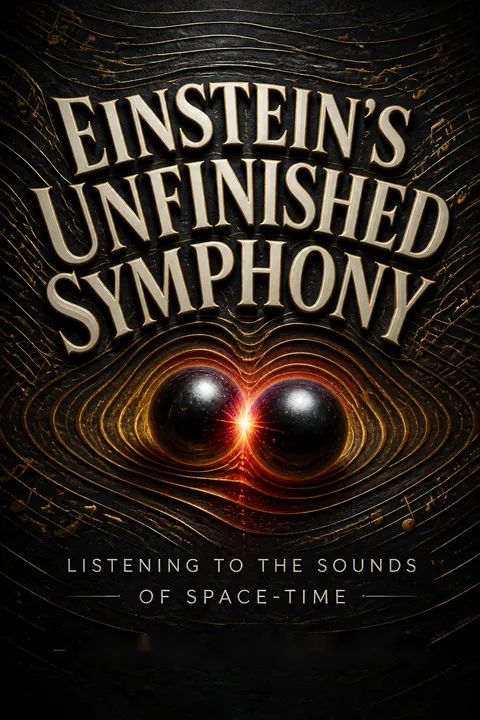
The book's musical language offers a memorable map of the subject. Different sources produce distinct patterns, and those patterns may eventually reveal motion hidden from ordinary telescopes. Yet the metaphor should not obscure the technical reality: gravitational waves do not make audible sound in space. They are measured and converted into a form people can hear. The book was published in 2000, so its account of LIGO, VIRGO, and LISA is a forecast of work then underway, not a report on what those projects ultimately achieved. Its lasting value lies in explaining why the search mattered and what new kind of evidence it sought.
Review Summary
Einstein's Unfinished Symphony receives mostly positive reviews, with readers praising its clear writing, historical context, and scientific depth. Many appreciate the book's focus on gravitational wave research and detector development. Some readers find it overly detailed or outdated, as it was written before the first gravitational wave detection. Others note its accessibility for non-experts and its insights into the scientists involved. The book is commended for its exploration of the long search for gravitational waves and the technology behind their detection.
Glossary
space-time
joined space and timeThe four-dimensional framework combining three dimensions of space with time. In Einstein's general theory of relativity, its geometry is affected by matter and energy. Objects and light follow paths through this geometry, and changes in it can propagate as gravitational waves.
gravitational waves
ripples in space-timeDisturbances in space-time produced by changing distributions of mass and energy, especially the rapid, asymmetric motions of massive objects. They travel at the speed of light and interact weakly with matter, allowing them to carry information from events that may be obscured to ordinary telescopes.
strain
fractional length changeA measure of how much a gravitational wave changes a length relative to the original length. A strain of 10 to the minus 21 means that each unit of distance changes by one part in 10 to the power of 21. Gravitational-wave detectors use strain to describe the scale of a signal.
resonant bar antenna
vibrating metal detectorA massive solid bar designed to vibrate when a gravitational wave with a suitable frequency passes through it. Sensors convert the bar's tiny oscillations into electrical signals. Because the bar responds most strongly near its natural resonant frequency, it can detect only a relatively narrow band of waves.
laser interferometer
split-beam distance detectorAn instrument that divides laser light into two beams traveling along perpendicular arms, reflects them between mirrors, and then recombines them. A change in the relative arm lengths alters the combined light pattern. Gravitational-wave observatories use this method to detect minute differences in distance.
Hulse-Taylor binary
relativistic pulsar systemThe binary system PSR 1913+16, discovered by Russell Hulse and studied by Joseph Taylor. One member is a pulsar, whose regular radio pulses act as a precise clock. The system's shrinking orbit matches the energy loss predicted from gravitational radiation, providing important indirect evidence for the waves.
LIGO
ground-based wave observatoryThe Laser Interferometer Gravitational-Wave Observatory, a project developed by Caltech and MIT. Its widely separated sites in Washington state and Louisiana use laser interferometers with long perpendicular arms. Comparing the sites' measurements helps distinguish a passing gravitational wave from local disturbances.
LISA
space-based wave observatoryThe Laser Interferometer Space Antenna, proposed as a three-spacecraft gravitational-wave detector orbiting the Sun in a triangular formation. Lasers exchanged across million-mile-scale distances would measure changes in separation. Its intended low-frequency range complements ground-based observatories and includes massive black-hole systems.
frame dragging
rotation twists space-timeAn effect predicted by general relativity in which a rotating mass influences the surrounding space-time, drawing its local geometry into rotation. The effect is expected to be extremely small around Earth but much stronger near rapidly rotating, massive objects such as black holes.
About the Author
Other books by Marcia Bartusiak

Download PDF
Download EPUB
.epub digital book format is ideal for reading ebooks on phones, tablets, and e-readers.








