


Key Takeaways
A 24-year-old superstar courted a ninth-grader and called it destiny
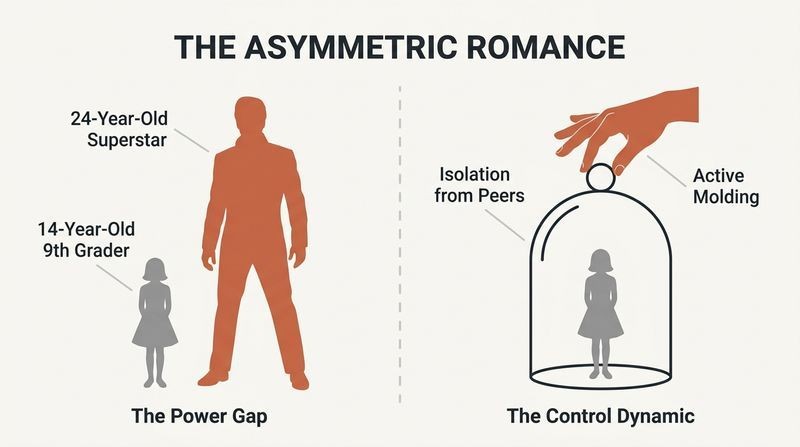
The romance began with a staggering power gap. In 1959, Priscilla Beaulieu was a shy 14-year-old Air Force daughter living in Wiesbaden, Germany, when a mutual acquaintance brought her to meet Elvis Presley, then a 24-year-old soldier and the most famous entertainer alive. He laughed when she admitted she was in ninth grade, calling her "just a baby," then began singing directly to her.
He pursued anyway, charming her parents. Elvis wore his Army uniform to win over her military father, promising chaperones and honorable intentions. What looks like a fairy tale on the surface was a relationship in which an adult man selected an adolescent, isolated her from peers, and spent years shaping her before marriage. Priscilla narrates it as the great love of her life while unflinchingly recording the imbalance.
What's striking is how the memoir holds two truths at once: genuine tenderness and a textbook grooming dynamic. Modern developmental psychology would flag the asymmetry immediately, an adult with global fame, money, and authority bonding with a child still forming her identity. The book's enduring value is that it does not sanitize this. Priscilla lets readers feel both the intoxication and the cost. Historians of celebrity note that fame creates a distortion field where normal boundaries dissolve; adoring parents, awed institutions, and the star's own isolation all conspire to make the inappropriate feel inevitable, even romantic.
When you let someone design you, you slowly erase yourself

Elvis remade Priscilla into his living doll. He dyed her brown hair jet black to match his, piled it high, and demanded heavy black eyeliner because her eyes were "too plain naturally." He picked her clothes (solids only, no prints, high collars for her "long, skinny neck"), sent her to his dentist for white porcelain fillings, corrected her posture, and had her walk with a book on her head. When she cut her hair without permission, he exploded.
She absorbed his tastes wholesale. His insecurities became hers, his opinions became hers, his enemies became hers. She quit modeling and abandoned college dreams because he wanted her available the instant he called. She describes it as Pygmalion: he was the sculptor, she the clay, and her "sole ambition was to please him."
This is the memoir's psychological core, and it echoes what attachment researchers call self-silencing, the suppression of one's own preferences to preserve a relationship. Studies link chronic self-silencing to depression and, notably, to the stress-related ulcer Priscilla developed. The tragedy is subtle: she was not brutalized into compliance but seduced into it, each small concession feeling like devotion. The Pygmalion myth ends with the statue coming alive and loving its maker, but Ovid never asked what the statue wanted. A relationship that requires one partner to vanish is not intimacy; it is authorship.
Threatening to send her home was his leash, not a real exit

Elvis controlled through the fear of banishment. Whenever Priscilla grew too curious, jealous, or assertive, he would rage that she was "too demanding" and start hurling her clothes into a suitcase, ordering Joe to book a flight home. Once, during filming of Spinout, he did this over her wanting to visit the set. She packed in tears, and just as she reached the door, he pulled her into his arms and said, "Now do you understand? You need someone to put you in your place."
She only later saw the technique. The blowups were manufactured to reset the hierarchy. Because leaving would have meant admitting her parents were right to worry, she always apologized, absorbing blame that was never hers. His anger operated on the whole entourage the same way: explode, then reconcile.
This dynamic maps precisely onto what clinicians call intermittent reinforcement, the same mechanism that makes slot machines addictive. Unpredictable punishment followed by unpredictable warmth bonds people more tightly than consistent kindness, because the nervous system fixates on winning back the reward. The staged reconciliation ("you need this") is a control script that reframes domination as care. Priscilla's retrospective clarity is valuable precisely because in the moment she experienced it as love. Naming the pattern is the first defense against it, whether the controller is a spouse, a boss, or a charismatic leader.
He put her on a pedestal to keep her, not to honor her
Elvis refused to consummate the relationship for years. From Germany through her teens, he insisted sex be "saved" for the right, "sacred" moment, telling her that mastering desire meant mastering all desires. He kept her "untouched" while, by her own discovery of hidden letters, maintaining a serious girlfriend back home (Anita) and romancing costars in Hollywood.
The pedestal was a cage. He confided he had "never been able to make love to a woman who'd had a child," a belief rooted in his fusion of love with his idealized mother. After Lisa Marie was born, he stopped touching Priscilla for months, and she wrote in her diary that she was beginning to doubt her own womanhood. The idealization that once felt flattering became a wall.
The Madonna-whore split, Freud's term for men who cannot desire the women they revere, gets a vivid case study here. Elvis's inability to sexualize a mother figure was so literal that his wife's motherhood extinguished his desire. What the memoir shows better than any textbook is the whiplash: the same behavior that reads as chivalrous restraint at 16 reads as rejection at 22. Placing a partner on a pedestal denies them full humanity, permitting neither flaw nor appetite. Reverence and intimacy are not the same thing, and a relationship built on the former often starves the latter.
Pills entered their life as helpers and became the household air
Drug use arrived disguised as practical kindness. Elvis first handed the exhausted 14-year-old Dexedrine to help her stay awake at school, learned in the Army, framed as "safe." In Las Vegas she took amphetamines to keep his nocturnal hours and sleeping pills to crash. "Two Placidyls for him and one for me." He nearly overdosed her by giving her two 500-milligram Placidyls at Graceland, knocking her unconscious for two days.
He believed he was an expert, not an addict. He kept a medical dictionary on his nightstand, quoted ingredients and FDA approvals, and insisted he could never become dependent. That false confidence, plus a family history of compulsive worry and insomnia, meant no one could challenge him. His escalating reliance on chemicals tracked his career frustration and his growing distance from reality.
The normalization here is the lesson. Addiction rarely announces itself; it accretes through reasonable-sounding steps, each ratified by an authority the user trusts, in this case Elvis's pharmacological "expertise." His encyclopedic knowledge functioned as denial, a phenomenon addiction specialists see constantly: intellectual mastery of a substance mistaken for control over it. The prescription framing mattered too. These were doctor-sanctioned pills, which made them feel categorically different from the street drugs he despised. That cultural blind spot, legal equals safe, remains central to today's opioid crisis, making this 1985 account eerily contemporary.
His mother's death removed the only person who kept him grounded
Gladys was Elvis's moral compass and greatest love. She died in 1958 at 42, and Priscilla identifies this as the wound underneath everything. Gladys had shielded him from sports, criticism, even reality, pasting only favorable clippings into his scrapbooks. He phoned her daily, slept in her room during illness, and vetted girlfriends against her ideal.
Without her, he had no brakes. Priscilla writes that Gladys was "the force that kept him in line," reminding him of right and wrong and the dangers of fame. After her death he was perpetually in conflict between his Christian upbringing and Hollywood temptation, searching through metaphysical books, gurus, and eventually drugs for a replacement anchor he never found. He often said he would die before 40, as Gladys nearly did, unwilling to outlive his father.
Grief scholarship distinguishes between losing a person and losing a structure. Gladys was both, a beloved parent and the external conscience that a fame-warped life could not generate internally. Fame is a solvent for accountability: everyone around a star has financial incentive to agree with him. Gladys, needing nothing, could say no. Her removal left a vacuum that yes-men, gurus, and pharmacology rushed to fill but could not. The memoir quietly suggests that behind the swagger was a man frozen at the moment of his mother's death, forever seeking her approval and her boundaries in women, books, and applause.
Comfort made him surrender his art to a manager he feared
Elvis knew his films were garbage and made them anyway. By the mid-1960s he was Hollywood's highest-paid actor, locked into three formulaic beach musicals a year with songs he called worthless. He dreamed of serious roles like his idols Brando and Dean, but Colonel Parker's logic (his two dramatic films had flopped, the musicals made millions) always won.
His fatal flaw was avoidance. In his personal life Elvis said exactly what he felt, but he would not confront the Colonel, signing contracts without reading them and ceding all business decisions. When RCA pushed his voice forward in mixes against his artistic wishes, he grumbled but yielded. The lavish lifestyle he had built also trapped him: he needed the income the bad films generated. His talent stayed caged until the 1968 TV special finally let him rebel.
This is a masterclass in the golden-handcuffs problem. Elvis had the leverage to demand better material but not the psychological freedom, because his identity and spending were fused to the machine that diminished him. Behavioral economists call this the sunk-cost and status-quo trap, amplified by a dependent relationship with an authority figure. There is also a poignant irony: a man who could electrify stadiums could not have one honest conversation with his manager. Genius in one domain guarantees nothing in another. The 1968 comeback proves the talent never left; only the courage was missing, and courage, unlike talent, can atrophy from disuse.
Nightly stadium worship made ordinary family love feel unbearable
The crowd became his real marriage. After his 1969 Vegas comeback and relentless touring (three weeks straight, two shows on weekends, the first sold-out Houston Astrodome run), Elvis grew addicted to mass adoration. Priscilla writes that when the marquee came down and the phones stopped, he could not readjust to being a father and husband in a quiet house.
Home could not compete. He lingered in Vegas for days after closings, retreated to Palm Springs with the guys, and eventually banned wives from the road because spouses distracted his employees. Priscilla realized "the impossibility of replacing the crowd's adoration became a real-life nightmare." The higher his professional high, the deeper his domestic boredom, and the more he leaned on stimulants to manufacture excitement offstage.
Neuroscience offers a blunt explanation: the dopamine surge of thousands screaming your name recalibrates the brain's reward baseline, making ordinary pleasures register as flat. Elite performers, athletes, and politicians describe identical post-triumph crashes. The tragedy compounds when someone chases the peak chemically rather than accepting the trough. What the memoir captures is the collateral damage to those offstage, a wife and daughter who could offer love but never applause of that magnitude. It reframes celebrity not as enviable but as a kind of sensory addiction that quietly starves the private relationships most people build their happiness on.
She reclaimed herself through dance and karate, then walked out
Priscilla built an identity outside his shadow. Starved of intimacy and stuck at home while Elvis toured, she took private jazz and ballet lessons, eventually performing anonymously with a company, then immersed herself in karate and Tae Kwan Do. For the first time she was creating, being validated for her own abilities, and making friends who accepted her, not "Mrs. Elvis Presley."
The transformation was total. Off came the false eyelashes, jet-black dye, heavy makeup, and flashy clothes, the whole persona Elvis had constructed. She began voicing opinions and refusing to laugh at jokes she found unfunny. After an affair with karate instructor Mike Stone, she told Elvis in his Vegas suite: "You've lost me to a life of my own. I'm finding myself for the first time." They divorced in 1973, sharing custody of Lisa Marie.
The arc here is a genuine individuation story, Jung's term for becoming a distinct self rather than a reflection of others. Notably, her liberation came not through therapy or confrontation but through embodied mastery: disciplines where the body's competence could not be faked, flattered, or dressed up. Martial arts in particular gave her something the marriage forbade, permission to feel and express anger. There is a quiet feminist point too: her freedom required economic and creative agency Elvis had actively withheld (no job, no college). Identity, the memoir suggests, is not found by introspection alone but forged through work that is unmistakably one's own.
Surround yourself with yes-men and you lose touch with reality
Elvis's giving created a court of dependents. He kept an entourage, the "regulars," on salary, lent them thousands never repaid, gifted Cadillacs and Mercedes on whims, and put relatives who had once mocked him on the payroll. When bored, he bought the half-million-dollar Circle G ranch, then trailers, trucks, and tools for everyone, hemorrhaging a million dollars in months while Vernon begged him to stop.
No one could tell him the truth. In his final years he wore costumes adding 35 pounds of fake stones and fringe, forgot lyrics, and played to the band instead of the crowd. A friend gently compared him to a Liberace act, but Elvis had long declared he wanted "only positive reviews." Cushioned by paid loyalty and unconditional fan love, he had no mirror honest enough to save him.
Priscilla's closing diagnosis (Elvis was "a victim, destroyed by the very people who catered to his every want") describes what organizational psychologists call the CEO-isolation or courtier problem. When everyone's livelihood depends on your approval, candor disappears and the powerful person drifts into a consensual hallucination. His mother once played the role of truth-teller; her replacements were all on payroll. The lesson generalizes far beyond fame: anyone who removes every source of friction and disagreement from their life also removes every early-warning system. Loving critics are more protective than adoring fans, and far rarer.
Analysis
Published in 1985, eight years after Elvis's death, Priscilla Presley's memoir occupies an unusual position in celebrity literature: it is simultaneously a devotional love letter and, perhaps unintentionally, one of the most detailed firsthand accounts of coercive control and identity erasure ever written by a public figure. The narrative frame (opening with the phone call announcing his death, then flashing back to their meeting) signals that this is elegy, not exposé. Yet the specifics she chooses to record (the age gap, the pills, the clothing edicts, the banishment threats, the withheld intimacy) construct a portrait sharper and more damning than her adoring commentary admits.
The book's tension is its greatest asset. Priscilla never fully reconciles the tender Elvis (vulnerable, funny, spiritually searching, generous to strangers) with the controlling one, and this refusal to resolve the contradiction is more honest than a tidier verdict would be. Real love and real harm coexisted, which is precisely what makes such relationships so hard to leave and so easy to romanticize decades later.
Read today, the memoir functions as an accidental primer on grooming, intermittent reinforcement, self-silencing, and the corrosive effects of fame on accountability. Its psychological insights, especially the link between Gladys's death and Elvis's unmoored decline, anticipate contemporary understanding of attachment and grief. Its weaknesses are structural: Priscilla's ongoing loyalty softens her analysis, and the reader must sometimes infer the darker implications she declines to state.
What elevates the book above kiss-and-tell is her own arc from clay to sculptor of her own life. Her escape through dance and martial arts offers the redemptive counter-narrative: identity is recoverable, but only through work that belongs unmistakably to oneself. The final lesson is quietly universal. Beware any love that requires your disappearance, and beware any life that removes every honest mirror.
Review Summary
Elvis and Me receives mixed reviews, with readers divided on Priscilla's portrayal of her relationship with Elvis. Many praise the intimate details and insider perspective, while others criticize the lack of critical reflection on the age gap and power dynamics. The audiobook narrated by Priscilla herself is highly recommended. Readers appreciate the honest portrayal of Elvis's flaws but are disturbed by the grooming aspects. The book is seen as a valuable historical document, offering unique insights into Elvis's life and personality.
People Also Read



Glossary
Sattnin (also Nungen, Little One)
Elvis's baby-talk pet namesTerms of endearment Elvis used with Priscilla and intimates, part of a private baby-talk vocabulary he inherited from his mother Gladys (feet were "sooties," milk "butch," love "yuv"). "Nungen" meant "young one." He often switched to third-person address in tender moments. The language signaled emotional intimacy and the childlike, dependent register central to their bond.
The regulars (Memphis Mafia)
Elvis's paid inner circleThe entourage of friends, cousins, and employees Elvis kept on salary who lived, traveled, played, and slept according to his schedule. They protected him, entertained him, and depended on him financially, which meant few could offer honest criticism. Priscilla portrays them as both genuine family and a courtier system that insulated Elvis from reality.
Circle G
Elvis's impulse-bought Mississippi ranchA 160-acre ranch near Horn Lake, Mississippi, Elvis bought around 1967 for roughly half a million dollars, christened "Circle G" for Graceland. He outfitted every family with trailers and trucks, spending close to a million dollars in months. Priscilla dreamed of it as a private retreat; it became a costly symbol of his compulsive, boundary-less generosity and boredom.
The pedestal principle
Idealizing a woman to avoid intimacyPriscilla's description of Elvis's pattern of "saving" the women he respected, refusing full sexual intimacy to keep them pure and idealized, rooted in his fusion of love with his mother. The same reverence that flattered her as a teenager became emotional distance after she became a mother, when he could no longer desire her.
Download PDF
Download EPUB
.epub digital book format is ideal for reading ebooks on phones, tablets, and e-readers.








