

Key Takeaways
Manners keep changing; three principles never do
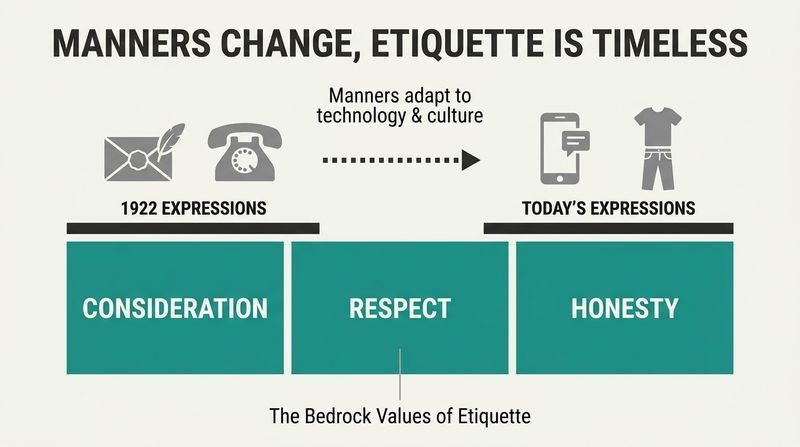
Etiquette is the philosophy, manners are the practice. Emily Post defined etiquette in 1922 as a code of behavior rooted in consideration and thoughtfulness. The word traces to Versailles, where a gardener posted little signs (etiquettes, or "tickets") instructing visitors to stay off the grass. Etiquette itself is timeless; manners are its ever-shifting expression. The chaperones and dinner-table ashtrays of earlier editions gave way to smartphone and social media guidance.
Everything rests on three bedrock values:
1. Consideration: awareness of how a situation affects everyone present
2. Respect: valuing people regardless of race, creed, or background
3. Honesty: sincerity, which is the true basis of tact
Casualness does not equal rudeness. It is just as easy to be polite in jeans at a barbecue as in a tuxedo at a wedding.
What's striking is how this reframes etiquette from a rigid rulebook into a flexible operating system. The claim that principles are universal while manners are local echoes moral philosophy's distinction between values and norms. Critics reasonably note that historical etiquette often encoded class hierarchy, a charge Post preempts by insisting good manners cost nothing and belong to everyone. The framing also anticipates cross-cultural work by anthropologists: gestures and greetings vary wildly, yet the underlying signal (I acknowledge your worth) is near-universal. The genius here is durability. Rules expire; consideration, respect, and honesty do not.
Five "magic words" defuse tension and cost nothing

The words we learned as children still work as adults. Please, thank you, you're welcome, excuse me, and I'm sorry are effortless yet transformative. Please converts a command into a request. Thank you signals that a favor was appreciated rather than expected. Excuse me announces that a bump or interruption was unintentional, calming a situation before it escalates.
Accept gratitude, don't deflect it. The book argues that responding to thanks with "it was nothing" or "no problem" quietly tells the giver you placed no value on what you did. Saying "you're welcome" or "my pleasure" accepts credit graciously and encourages the thank-you habit in others. A sincere "I'm sorry" can defuse genuine anger, because most people find it hard to stay furious with someone who takes responsibility and offers to make amends.
These are what linguists call politeness markers, and Brown and Levinson's politeness theory explains their power: they protect "face," the public self-image both parties want preserved. The book's quiet crusade against "no problem" is debatable. Sociolinguists note that younger speakers hear it as warmly casual, not dismissive, so the interpretation is generational rather than absolute. Still, the deeper point holds: small verbal rituals carry outsized social weight because they are low-cost signals of goodwill. In game-theory terms, they are cheap yet credible, which is exactly why their absence gets noticed far more than their presence.
Say no clearly, because equivocating only invites pressure

A vague no is an open door. The book treats declining gracefully as a core adult skill grounded in honesty. Its method: pause and weigh your limits (time, money, interest) before answering, pair the no with a positive note ("No, but thanks for thinking of me"), and give an honest reason only when it genuinely helps. Crucially, avoid hedging phrases like "I probably shouldn't" or "I don't think I can," which signal indecision and prolong the negotiation.
Recognize the pressure tactics. Post names three traps: flattery ("your pies are so good, could you make five?"), bullying ("everyone else is helping"), and making it your problem ("I'm so swamped, could you just..."). The flip side matters too: when someone tells you no, respect it. Interrogating each excuse to extract a yes is both insensitive and rude.
This aligns neatly with modern assertiveness training and boundary research, which finds that clear, unapologetic refusals reduce follow-up pressure precisely because they close the negotiation. Behavioral economics adds a wrinkle: ambiguity is an invitation to bargain, so a fuzzy no functions like an opening bid. The book's insight that honesty underpins a good no is subtle. A truthful, definite refusal actually respects the other person more than a soft lie, because it spares them false hope and repeated asking. The naming of flattery, bullying, and burden-shifting as recognizable scripts is a practical gift.
The only real introduction crime is failing to make one
Forget the fork; make the introduction. The book insists that mispronouncing a name, botching the order, or using the wrong title are trivial, forgivable slips. The genuine discourtesy is leaving people standing together unintroduced. The ordering convention: name the person you wish to honor first (an elder, a client, a senior official, a woman), then present the other person to them.
Rescue yourself and others smoothly. When someone forgets to introduce you, fill the gap yourself during a pause: "Hi, I don't think we've met, I'm Andrea Stein." When you blank on a name, apologize quickly rather than skipping the introduction entirely. The handshake completes the ritual: a firm grip (about the pressure needed to open a refrigerator door), two or three shakes, eye contact, and a smile.
The reframing here is liberating for the socially anxious. People freeze at introductions fearing they will get the protocol wrong, and the book's response is that the protocol matters far less than the gesture. This tracks with research on social friction: unintroduced third parties feel invisible and excluded, a small wound that lingers. The refrigerator-door metaphor for grip strength is a rare piece of usable calibration in a domain usually described in vague terms. One useful extension: repeating a person's name aloud when introduced ("Nice to meet you, Liz") doubles as a memory aid, exploiting the encoding benefit of active rehearsal.
Table manners exist to prevent ugliness, not to trap you
Eating is social, so the rules serve pleasantness. Emily Post summed it up: the point of table manners is to avoid ugliness. Utensils are laid outside-in, so you simply work from the outermost fork or spoon inward as courses arrive. A memory trick for the basic setting is FOrKS: Fork, O for the plate, Knife, Spoon, left to right. Blade of the knife always faces the plate.
Two correct styles, one goal. American (zigzag) style cuts, then switches the fork to the dominant hand tines-up. Continental style keeps the fork in the left hand, tines down. Both are equally proper. The stakes are real: job candidates have been passed over for chewing with their mouths open or gripping the fork like a shovel, because a shared meal is a stealth test of finesse. When unsure, watch the host and follow.
The signaling perspective clarifies why dining etiquette carries such weight in hiring: table behavior is hard to fake under pressure, making it a costly and therefore credible signal of self-control and attentiveness. Anthropologists would add that commensality, eating together, is among humanity's oldest bonding rituals, so violations register as social threats disproportionate to their actual harm. The book's most humane move is decoupling correctness from anxiety. By declaring both American and Continental styles equally valid and instructing the unsure to simply mirror the host, it converts a rigid test into a solvable observation problem. Ugliness-avoidance, not arbitrary fussiness, is the organizing logic.
Sort every topic into three tiers before you open your mouth
A conversational safety system. The book offers a simple triage for deciding what to discuss and where. Tier 1 is small talk: sports, weather, food, music, movies, pop culture, safe almost anywhere with almost anyone. Tier 2 is controversial territory: politics, religion, and sex, where opinions run deep and assumptions about shared views are risky. Tier 3 is personal information: family details, health, and finances, reserved for people you trust.
Listening beats performing. Good conversation is a two-way volley, not a monologue. The book urges emptying your mind of your next line and truly attending to what is being said, using small verbal cues ("I see," "really?") to show you are tracking. When a Tier 2 debate overheats, the graceful exit is to acknowledge the disagreement and change the subject rather than fighting for the last word.
The three-tier model is essentially a risk-assessment heuristic, and its value is that it makes an intuitive social skill teachable. Communication research consistently finds that skilled conversationalists are distinguished less by wit than by listening quality and topic sensitivity, which the framework operationalizes. The tiers also map loosely onto self-disclosure theory: relationships deepen as people move carefully from Tier 1 to Tier 3, and mistiming that progression (oversharing early) is a classic rapport-killer. One limitation worth noting: in some cultures and close friendships, vigorous debate about Tier 2 topics is itself a bonding ritual, so the model is a default, not a universal law.
Screens embolden a rudeness you'd never risk face-to-face
The electronic brick wall. The book names a specific hazard of digital life: communicating through a screen strips away tone of voice, facial expression, and body language, so recipients cannot tell whether a message is joking, sincere, or hostile. Worse, the barrier emboldens people to write things they would never say in person. It damages communication three ways: a false sense of anonymity, disinhibited rudeness, and atrophied social skills from replacing in-person contact.
Nothing digital is private or erasable. Once you hit send, the message is beyond recall. Emails get forwarded, posts get screenshotted, and words come back to hurt friendships and careers. The prescription is deliberate friction: use send-delay features, wait twenty-four hours before firing off an angry message, and tear down your own brick wall by choosing to meet or call instead of typing.
This maps precisely onto what psychologist John Suler termed the online disinhibition effect, where anonymity, invisibility, and asynchronicity loosen normal social restraints. The book's framing predates much of today's outrage-driven social media yet diagnoses its mechanics accurately. The permanence point deserves emphasis: unlike spoken words that fade, digital messages have perfect memory and infinite reach, inverting the old assumption that talk is more consequential than casual writing. A constructive extension: the send-delay and twenty-four-hour rules are behavioral commitment devices, inserting a cooling-off buffer between impulse and irreversible action, the same logic behind waiting periods in other high-stakes decisions.
Tipping runs on simple percentages but never replaces a thank-you
A few numbers cover most situations. The book reduces tipping to workable defaults: 15-20% of the cost of a service, $2 for the first effort and a dollar for each additional (bags, coats), and for holiday tipping, roughly 15% or the value of one instance of service. Tip on the pretax amount, tip discreetly, and when in doubt, ask in advance.
Money and gratitude travel together. A tip is never a substitute for treating the person with respect or saying thank you. The book candidly flags the flaw in American restaurant tipping: waitstaff are paid below minimum wage and depend on tips, so mandatory tipping stops functioning as a reward for good service and instead shifts the burden of fair pay from owners to patrons. Even for poor service, the guidance is to leave at least 15% and take the complaint to a manager, since pooled tips mean others would be unfairly penalized.
The book is unusually honest for an etiquette guide in admitting that tipping is economically broken, not just socially awkward. Economists have long argued that tipping poorly correlates with service quality and instead tracks factors like weather, race, and attractiveness, undermining its stated purpose. That the guidance says to tip regardless of service quality quietly concedes tipping is really a wage subsidy dressed as discretion. The enduring insight is decoupling the money from the manners: a generous tip delivered dismissively still stings, while genuine thanks plus a fair tip honors the person. The percentages are a floor for thinking, not a moral ceiling.
Reply to invitations fast and return hospitality within months
RSVP is an obligation, not a suggestion. The abbreviation comes from the French for "please reply," and the book treats a prompt response (ideally within a day or two) as basic courtesy. Waiting until the last minute implies you were holding out for a better offer. Once you accept, you are committed. Downgrading a yes to a no is acceptable only for real reasons: illness, a death, an unavoidable conflict. Canceling because something better came along is a fast route off everyone's guest list.
Hospitality is a loop, not a gift. Private social events in someone's home create a gentle obligation to reciprocate, though not to replicate. A lavish dinner can be returned with a restaurant meal or theater tickets if you are not a confident cook. The aim is not tit-for-tat matching but spending social time together within a few months, so the relationship keeps circulating.
This is the reciprocity norm, which sociologist Alvin Gouldner identified as a near-universal feature of human societies and Robert Cialdini catalogued as a powerful driver of behavior. The book's nuance is important: reciprocity here is about maintaining relational balance, not settling debts, which is why matching the scale of a party misses the point. The prompt-RSVP rule also solves a real coordination problem for hosts planning catering and seating, so tardiness imposes concrete costs, not just vague rudeness. In an age of flaky digital "maybe" responses, the insistence that acceptance is a binding commitment feels almost radical, and increasingly necessary.
Handwritten notes get saved; emails get deleted
Effort is the message. The book's memorable line is that people delete emails but save notes, letters, and invitations. A handwritten thank-you is warm, tangible, and evidence of the time taken to choose the card, write, address, and mail it. That physical effort is precisely what makes it meaningful.
Some occasions demand ink on paper. Verbal thanks suffice when you open a gift in the giver's presence, but written notes are required for:
1. Wedding gifts (within three months, even if thanked in person)
2. Shower gifts
3. Gifts received while ill
4. Condolence notes, flowers, or donations
5. Overnight stays as a houseguest
The two non-negotiables are sincerity and promptness. A note that arrives more than a week after a party loses its fizz, and the best notes read like a conversation, mentioning the specific gift and the giver rather than a one-size-fits-all template.
The staying power of the handwritten note is a case study in costly signaling: precisely because texting is frictionless, the deliberate friction of pen, paper, and postage signals that the recipient was worth the trouble. Behavioral research on gratitude expression finds that recipients consistently underestimate how much a thank-you note will be appreciated, meaning most people write too few. The book's insistence on specificity (name the gift, picture its use) also exploits a psychological truth: generic praise reads as obligation, while concrete detail proves genuine attention. The medium is not just the message here, the medium is a large part of the meaning.
Answering rudeness with rudeness only raises the stakes
Size up before you speak. When someone is inconsiderate, the book counsels a quick assessment rather than a reflex. Is the offender an aggressive stranger? Then not responding beats becoming the target of someone's rage. Is your point worth making? Correcting a small error affecting you ("Excuse me, I think you're in my seat") is fine, but policing a stranger's general behavior is not your job.
Keep your tone neutral and pick your battles. If you do speak up, stay pleasant and specific. Never discipline other people's children; talk to the parent instead. Ask whether it is worth blowing your stack over the person with fifteen items in the twelve-item line, then often let it go. Humor and a friendly demeanor defuse more than confrontation does. Responding in kind is itself rude and risks escalation, because you never know who is on the other end.
This is de-escalation psychology in miniature, and it aligns with conflict-resolution research showing that matching hostility triggers a reciprocal spiral, while a calm, specific response interrupts it. The book's willingness to say some battles are not worth fighting is quietly wise: cognitive load and stress research suggest that treating every minor slight as a grievance is corrosive to well-being, so selective disengagement is self-protective, not cowardly. The prohibition on correcting strangers' children is especially practical, redirecting energy to the one person with actual authority. The underlying lesson generalizes far beyond etiquette: in most conflicts, your only reliable control is over your own reaction.
Analysis
Emily Post's Etiquette is a genre unto itself: a sprawling reference work (nearly 289,000 words) that functions less as an argument than as an encyclopedia of American social life, updated across nineteen editions since 1922. This nineteenth edition, carried forward by Post's great-great-grandchildren, is best understood not as a set of arbitrary rules but as a single thesis with thousands of worked examples. The thesis: manners are the perishable surface of an imperishable core, and that core is consideration, respect, and honesty.
What makes the book hard to summarize is precisely what makes it valuable. It is exhaustive by design, covering handshakes, funerals, tipping, texting, weddings, and workplace conflict with equal seriousness. Any short adaptation must resist drowning in specifics and instead surface the transferable principles the specifics illustrate. The recurring move throughout is decoupling: separating the timeless why from the disposable how, separating money from gratitude, separating the gesture from the perfect execution. This is what rescues the book from fussiness. Again and again it tells the anxious reader that getting the form slightly wrong matters far less than showing up with goodwill.
The modern relevance is sharpest in its treatment of digital life. The "electronic brick wall" concept anticipated much of what psychology now calls the online disinhibition effect, and its warnings about permanence and forwarding read as prescient rather than quaint. The book is also unusually candid about its own limits, conceding that American restaurant tipping is structurally broken.
Its blind spot is the one etiquette guides always risk: the assumption of a shared cultural baseline. Norms around eye contact, touch, and directness vary enormously, and while the book gestures at this in its travel chapters, its defaults remain broadly Western. Read as a philosophy of treating people well rather than a rulebook, however, it largely transcends that limitation. The enduring takeaway is that civility is not decoration; it is the glue that makes shared life bearable.
Review Summary
Emily Post's Etiquette receives high praise for its comprehensive coverage of social situations and timeless advice on consideration, respect, and honesty. Readers appreciate its practical guidance on everything from daily interactions to formal events. Many find it fascinating as a historical document, offering insights into early 20th-century society. While some content is outdated, the core principles of kindness and thoughtfulness remain relevant. Critics note its length and occasional impracticality, but most agree it's a valuable resource for anyone seeking to improve their manners and social skills.
People Also Read





FAQ
What's Emily Post's Etiquette: Manners for Today about?
- Comprehensive Guide: Emily Post's Etiquette: Manners for Today by Peggy Post is a modern guide to etiquette, covering a wide range of topics from everyday manners to formal dining and workplace behavior.
- Core Philosophy: The book emphasizes respect, consideration, and honesty as the foundation of good manners, adapting to the evolving social landscape.
- Cultural Relevance: It addresses contemporary issues such as social media etiquette and the importance of civility in a diverse society, making it relevant for today’s readers.
Why should I read Emily Post's Etiquette: Manners for Today?
- Timeless Principles: The book offers timeless principles of etiquette that are applicable in various social situations, helping readers navigate interactions with confidence.
- Practical Advice: It provides practical advice on handling everyday situations, from dining out to communicating online, making it a useful resource for all ages.
- Enhances Social Skills: Reading this book can enhance your social skills, improve your relationships, and help you create a more pleasant environment for yourself and others.
What are the key takeaways of Emily Post's Etiquette: Manners for Today?
- Manners Evolve: While manners may change over time, the underlying principles of etiquette—consideration, respect, and honesty—remain constant.
- Importance of Communication: Effective communication, both in person and online, is emphasized as a vital aspect of modern etiquette.
- Civility Matters: Civility and courtesy are essential for maintaining harmonious relationships in an increasingly complex world.
What are the best quotes from Emily Post's Etiquette: Manners for Today and what do they mean?
- Foundation of Social Structure: “Etiquette is the foundation upon which social structure is built.” This underscores the idea that good manners facilitate smooth interactions and relationships.
- Social Confidence: “Knowing which fork to use will give you social confidence.” Understanding basic etiquette can enhance one’s confidence in social settings.
- Critical Civility: “Civility becomes all the more critical to our success.” This highlights the importance of maintaining civility in our interactions, especially in a diverse society.
How does Emily Post's Etiquette: Manners for Today address modern communication?
- Digital Etiquette: The book includes a section on online communication, discussing how to navigate social media interactions and maintain professionalism in digital correspondence.
- Respectful Engagement: It emphasizes the need for respectful engagement in all forms of communication, highlighting that tone and intent can easily be misinterpreted online.
- Managing Conflicts: Strategies for managing conflicts in digital spaces are provided, encouraging readers to approach disagreements with civility and understanding.
What advice does Emily Post's Etiquette: Manners for Today give about dining out?
- Making Reservations: The book advises making reservations when dining out, especially as a host, to ensure a smooth experience for all guests.
- Table Manners: It details proper table manners, including how to handle utensils, when to begin eating, and how to engage in conversation during the meal.
- Handling Mistakes: Guidance on addressing issues that may arise during dining, such as sending back a dish or dealing with spills, is provided, emphasizing calm and polite communication.
How does Emily Post's Etiquette: Manners for Today suggest handling neighborly relations?
- Welcoming New Neighbors: The book encourages welcoming new neighbors with a friendly introduction and possibly a small gift, fostering a sense of community.
- Respecting Boundaries: It emphasizes the importance of respecting neighbors' boundaries and being considerate of their privacy and preferences.
- Resolving Conflicts: Strategies for addressing conflicts with neighbors are provided, advocating for direct and respectful communication to resolve issues amicably.
What does Emily Post's Etiquette: Manners for Today say about workplace etiquette?
- Professional Conduct: The book outlines the importance of maintaining professionalism in the workplace, including appropriate dress, communication, and behavior.
- Building Relationships: It emphasizes the significance of building positive relationships with colleagues through respect, consideration, and effective communication.
- Handling Conflicts: Advice on managing workplace conflicts is provided, encouraging open dialogue and a focus on solutions rather than blame.
How should I respond to invitations as a guest according to Emily Post's Etiquette: Manners for Today?
- Prompt Replies: Always respond to invitations promptly, ideally within a day or two, showing respect for the host’s planning.
- Clarify Attendance: If unsure about availability, communicate that rather than leaving the host in the dark, and confirm as soon as possible.
- Respect Host’s Wishes: Honor any specific guidelines in the invitation, such as “no children” or “no plus ones,” to maintain a good relationship.
What etiquette should I follow when sharing a meal with others as per Emily Post's Etiquette: Manners for Today?
- Table Manners: Use proper table manners, such as chewing with your mouth closed and not speaking with food in your mouth.
- Engage in Conversation: Participate in conversations at the table, ensuring to include everyone in the discussion.
- Be Mindful of Dietary Restrictions: If hosting, inquire about guests’ dietary restrictions and accommodate them as best as you can.
How does Emily Post's Etiquette: Manners for Today address cultural differences in etiquette?
- Cultural Sensitivity: The book emphasizes the importance of being aware of and respectful toward different cultural customs and practices.
- Adaptability: It teaches that etiquette should be adapted based on the cultural context of the event or gathering.
- Learning and Respect: Encourages readers to learn about the traditions of others, promoting respect and understanding.
What role does gratitude play in Emily Post's Etiquette: Manners for Today?
- Foundation of Good Manners: Gratitude is presented as a core principle of good manners, essential for building and maintaining relationships.
- Acknowledgment of Efforts: Highlights the importance of acknowledging the efforts of others, whether through gifts or assistance.
- Cultivating Positive Relationships: Practicing gratitude can lead to stronger, more positive relationships, contributing to a respectful and harmonious social environment.

Download PDF
Download EPUB
.epub digital book format is ideal for reading ebooks on phones, tablets, and e-readers.








