


Key Takeaways
Etiquette equals manners plus principles, not silverware and snobbery
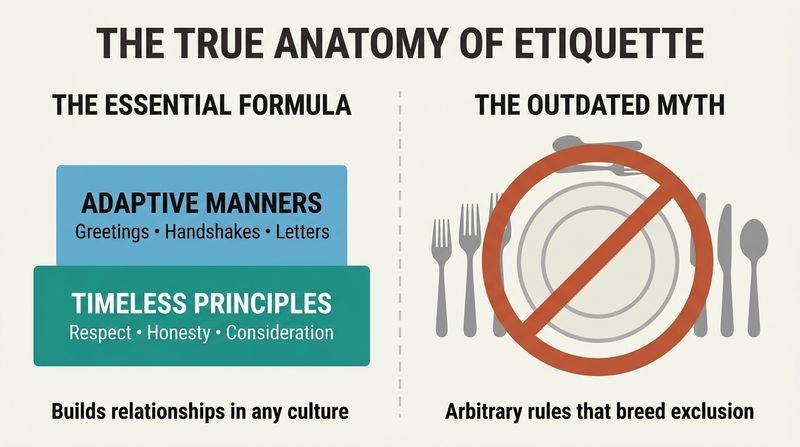
The core equation reframes everything. The Post family, now in its fifth generation carrying Emily's 1922 book, insists etiquette is not a rigid code of finger bowls and footmen. It is the sum of two parts: manners (specific behaviors that change over time and vary by culture) plus principles (the timeless foundation). Manners are the handshake, the bow, the thank-you note. Principles are the three constants: consideration, respect, and honesty.
Principles rescue you when you don't know the rule. When you face an unfamiliar situation with no manner to copy, the three principles guide you. Think before you act, make choices that build relationships, and be sincere. A greeting expressed through a kiss, bow, or handshake differs by geography, but the sentiment of welcome is universal.
What's striking is how this reframing democratizes a subject long weaponized by class. By decoupling the changeable surface (manners) from the durable core (principles), the Posts make etiquette portable across cultures and eras, echoing anthropologist Erving Goffman's insight that social rituals exist to protect each person's dignity, or "face," in interaction. The equation resembles the distinction between values and behaviors in organizational psychology. One caution: the framing risks circularity, since "consideration" and "respect" can be defined only by the very manners they supposedly transcend. Still, the move usefully shifts etiquette from memorization toward judgment, from obedience toward empathy.
When you don't know the manner, run the three-principle test
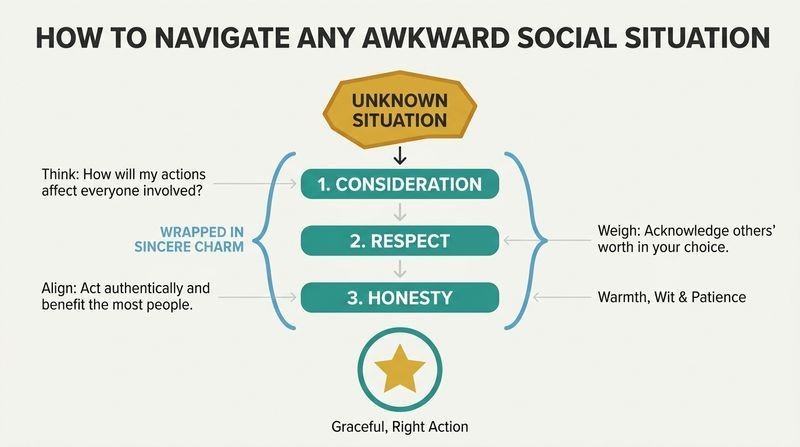
A decision algorithm for any awkward moment. Faced with an unfamiliar social situation, the Posts offer a repeatable process rather than a lookup table. First, consideration: think about everyone involved and how your action affects them. Second, respect: acknowledge people's worth by weighing your potential impact. Third, honesty: choose the path you feel authentically good about that benefits the most people.
Charm binds it together. The Posts add that any action grounded in these principles becomes smoother when wrapped in sincere warmth, wit, and patience, not the false charm used to manipulate. They also stress there is often more than one right answer. Etiquette asks you to think and adjust in real time, not to recite fixed rules. This is why their business programs compress the principles into three goals: think first, build relationships, be sincere.
This is essentially a heuristic for moral improvisation, and it maps neatly onto decision frameworks outside etiquette. It resembles the physician's triage logic or the ethicist's stakeholder analysis, both of which ask "who is affected and how" before acting. The emphasis on "more than one right thing" is quietly radical for a genre notorious for absolutism. It aligns with situational ethics and with modern research on moral flexibility showing rigid rule-followers often behave worse socially than adaptive reasoners. The weak point: under time pressure or emotional load, humans default to habit, not deliberation, which is precisely why the Posts elsewhere stress rehearsal and repetition until courtesy becomes automatic.
The rudest act is deliberately ignoring someone's greeting

The cut direct is etiquette's cardinal sin. In Emily's day, refusing to acknowledge a greeting, meeting a "Hi" with no eye contact and no words, had a name: the cut direct. It was an intentional, gasp-worthy snub designed to erase someone's existence. Even when crossing paths with someone you dislike, the Posts insist you take the high road. A simple "Hi, Kat" costs nothing.
Greetings are the baseline of shared humanity. A greeting signals you mean no harm, a function reaching back to when acknowledgment meant safety. No one is above giving one, and no one is below receiving one. This extends to store clerks and service workers: walking past a cashier's friendly "How are you?" without response is genuinely rude. A smile, the Posts note quoting Emily, brings more friends than a ready wit brings enemies.
The cut direct endures because acknowledgment is a primal social currency. Psychologist Kipling Williams's decades of research on ostracism show that being ignored activates the same neural regions as physical pain, and even a brief non-acknowledgment by a stranger measurably lowers mood and sense of belonging. The Posts intuited what neuroscience later confirmed: being unseen hurts. What's practically useful here is the reframe of greetings as low-cost, high-yield. In economic terms, a nod is a near-zero-cost signal with outsized returns in social capital. The subtler point, that you greet even adversaries, treats civility as unconditional infrastructure rather than a reward for likability.
Ask before hugging, and honor whatever answer comes back
Consent applies to gestures, not just words. The Posts single out the hug as etiquette's most fraught greeting. A person who barrels into a non-hugger's outstretched handshake declaring "I'm a hugger!" is being aggressive and inconsiderate, not affectionate. Because a hug presses one body against another, an unwanted one can feel like a genuine violation, which is why hugs are best avoided entirely in business settings.
The fix is a two-second question. Simply ask "Hug?" If the answer is yes, embrace away. If it is a handshake, a high five, or "not today," you deliver the alternative gesture with equal warmth. The same consent logic governs the whole toolkit of contact: handshakes can be declined for health, culture, or ability, and you simply roll with it, using words and a nod instead.
This section reads as remarkably prescient given how consent culture has since reshaped social norms around touch. The Posts ground it not in ideology but in embodied experience: touch is intimate, so it requires permission. This dovetails with proxemics, anthropologist Edward Hall's study of personal space, and with trauma-informed practice, which recognizes that unexpected contact can trigger outsized distress in people whose histories are invisible to you. The elegance is in making consent frictionless, one syllable, rather than a solemn negotiation. A useful extension: the principle scales to photography, borrowing belongings, and even conversational topics. The underlying rule is that intimacy, of any kind, should be offered and accepted, never imposed.
Sort every topic into three tiers before you speak
A conversational map for reading the room. The Posts sort subjects into three tiers to help you calibrate what to say where. Tier I topics are low-stakes and safe almost anywhere: weather, entertainment, sports, hobbies, shared experiences. Tier II topics stir strong feelings: religion, money, sex, politics. They are not forbidden, but you test the waters and ask permission before diving deep. Tier III topics are private, reserved for intimates: family matters, health, personal finances, anything shared in confidence.
Money deliberately straddles two tiers. The Posts make a pointed argument that treating money as strictly private (Tier III) harms people by blocking the information that builds financial literacy and equality. They nudge it toward Tier II, encouraging tactful conversation: "Would you be comfortable discussing salaries in this market?" beats "What do you make?"
The tier system is a practical taxonomy that resembles risk stratification in other fields. What elevates this section is the money argument, which breaks from centuries of taboo. Research in behavioral economics and labor studies supports it: pay secrecy demonstrably perpetuates gender and racial wage gaps, and salary transparency laws now spreading across jurisdictions rest on exactly this logic. The Posts are ahead of the etiquette curve in reframing financial silence as a mechanism of inequality rather than mere politeness. The framework's limitation is cultural relativity, since what counts as Tier I small talk in one society (asking someone's age, salary, or marital status) is perfectly ordinary in another.
Kill the word "if" in every apology you make
One word invalidates the whole apology. "I'm sorry if I hurt you" quietly denies that harm occurred, casting doubt on the other person's experience. The Posts call this a form of gaslighting embedded inside an apology. The fix is to drop the conditional entirely: "I'm sorry I hurt you." Let the injured party dismiss the offense if they choose, rather than dismissing it for them.
Also banish the excuse-making "but." "I'm sorry, but I've heard you tell that story before" turns contrition into self-defense. A good apology takes responsibility, requests forgiveness rather than expecting it, and skips the reasons. The Posts contrast good versus lackluster versions directly: "I'm sorry I missed the deadline" lands, while "I'm sorry I may have missed the deadline" evaporates. Gaslighting more broadly, disputing someone's lived experience with "that's not what happened," is flagged as rude even when unintentional.
The linguistics here are sharp and well supported. Conditional and passive constructions ("if," "any," "may have") function as what sociolinguists call face-saving hedges, but they save the apologizer's face at the victim's expense. The Posts' banning of "but" anticipates the popular "but erases everything before it" maxim. Organizational research on effective apologies, notably by Roy Lewicki, identifies acknowledgment of responsibility as the single most powerful component of trust repair, exactly what "if" and "but" undermine. One nuance worth adding: over-apologizing dilutes the currency, and the Posts note this too, warning that reflexive "sorry" for everything signals an overactive sense of responsibility and drains the word of meaning.
Not grossing out others is the one unbreakable dining rule
Grossness is the litmus test for table manners. Strip away the forks and courses and the entire elaborate system reduces to one durable purpose: we gather to enjoy food and each other without disgusting anyone. The number-one deal breaker, the thing first dates, in-laws, and clients will silently write you off for, is chewing with your mouth open or talking with food visible. If you can breathe while chewing with lips closed, it is mandatory.
The rest is navigational logic. Utensils are used outside-in, one course at a time. Forks left, knives and spoons right, bread plate top-left, drinks top-right (remembered as "b" and "d" made with your hands, or BMW: bread, meal, water). Wait for the host to lift their fork. Taste before seasoning, since salting first silently insults the cook. Scoop soup away from you.
Reducing an intimidating system to a single principle, do not disgust others, is a masterstroke of cognitive economy. It converts dozens of rules into one testable question. Anthropologist Margaret Visser, whom the Posts cite, argued that table manners originated to manage the latent violence of people gathered with knives around scarce food, which is why blades still face inward. The disgust framing also connects to Paul Rozin's research showing disgust evolved as a contamination-avoidance system later co-opted for social and moral judgment. That is why poor table manners trigger such disproportionate revulsion: they hijack an ancient pathogen-avoidance circuit. The practical liberation is that when unsure which fork, you already know the only rule that matters.
Fight rudeness with self-assessment, never with judgment of others
Etiquette is a mirror, not a magnifying glass. The Posts argue that the instant you use etiquette to judge or critique others, it stops working as a guide and manners become useless. Its power is as a tool for self-assessment. Since most rude behavior is unintentional, the effective response is not to cast blame but to cultivate awareness of your own impact.
Agency and gratitude neutralize incivility. When someone slights you, the deflating instinct is "Why bother?" The Posts counter with an internal reframe: "I can and will choose to act with consideration, and I'm grateful for the chance." Can a slight become motivation to never treat others the same way? They admit it sounds Pollyanna, then insist it is not, because holding yourself to the standard you wish to see is genuinely hard. This is why they call etiquette a practice you continually do, not knowledge you possess.
This is the book's most philosophically mature move, and it inverts etiquette's historical function as a class-sorting weapon. The framing echoes Stoic ethics, particularly Epictetus's dichotomy of control: you govern your conduct, not others'. It also aligns with cognitive behavioral therapy's insight that reframing the meaning of a provocation changes the emotional response. Modern research on "civility spirals" by Christine Porath shows rudeness is contagious, spreading through workplaces like a virus, which makes the Posts' refusal to retaliate not just noble but epidemiologically sound. The one tension: pure self-focus can tip into permitting genuinely harmful behavior, which is why the hosting chapter carves out an exception for offensive conduct that must be confronted directly.
Make specific offers to the grieving, never "let me know"
"Let me know if you need anything" secretly burdens the sufferer. It forces the grieving person to identify their need, imagine what you can provide, and then ask. The Posts urge concrete offers instead: "I'm going to the store tomorrow, what can I grab you?" or "Can I take the kids to the movies this week?" These require only a yes or no.
Match their language and resist silver linings. If someone says "lost" rather than "died," you say "lost" too. Avoid "he's in a better place," "it was time," or "everything happens for a reason" unless the bereaved says it first. Listening is the single most valuable thing you can offer. The Posts also flag lesser-known griefs, especially pregnancy loss, where partners are wrongly excluded from support, and warn against "next time it'll happen."
The critique of "let me know if you need anything" is validated by grief researchers and hospice practitioners, who note that decision fatigue and executive dysfunction spike during acute grief, making open-ended offers nearly impossible to act on. Specific, low-friction help bypasses that paralysis. The instruction to mirror the mourner's own language reflects clinical rapport-building used in therapy, where matching diction signals attunement without imposing an interpretation. The prohibition on silver linings aligns with research on "toxic positivity," which shows premature reframing invalidates emotion and impedes processing. The Posts' inclusion of pregnancy loss and partner grief addresses documented gaps in social support that leave many mourners isolated by silence.
Say thank you twice: at the door and again within 48 hours
The double thank-you is the guest's signature move. A good guest thanks the host warmly while leaving, then follows up within roughly two days with a second, more reflective expression by note, call, or text. Why twice? The doorway goodbye covers basic politeness, but the follow-up gives you a moment to register how much effort went into cleaning, cooking, and hosting. The extra recognition is always appreciated, even when the host isn't looking for it.
Reciprocity keeps friendships balanced. The Posts revive Emily's principle that social invitations should be returned. You need not match someone's budget or culinary skill, but the friend who only ever accepts and never hosts leaves others wondering about their investment. A single cocktail party can efficiently repay many separate dinner invitations at once.
The double thank-you exploits a well-documented feature of gratitude: its effects compound with specificity and delay. Research by Sara Algoe on the "find-remind-and-bind" theory shows expressions of gratitude strengthen relationships most when they name concrete efforts, exactly what the reflective follow-up enables. The reciprocity principle echoes Robert Cialdini's identification of reciprocity as a foundational rule of social influence, and anthropologist Marcel Mauss's classic argument that gift exchange, including hospitality, creates the very bonds that hold societies together. The handwritten note's staying power in a digital age is notable: its cost in time is precisely what encodes its sincerity, an honest signal in economic terms because it cannot be faked cheaply.
A tip is gratitude, never a bribe, so keep the eye contact
The biggest tipping mistake is forgetting the gratitude. The Posts insist a tip is a thank-you for service rendered, not a payment to secure better treatment. This is why you tip the valet when retrieving your car, not when handing over the keys. Flashing a large bill to a maitre d' for a better table, the movie cliche, is in real life an insult. The smooth tipper keeps small bills ready, makes no show of it, and looks the recipient in the eye with a genuine "thank you."
Restaurant tipping is the one non-negotiable. Because servers earn a sub-minimum wage premised on tips, 15% is the floor even for poor service, with complaints directed to management instead of the tip. Everyday jars and counter screens, by contrast, are discretionary, and no one should feel pressured by a suggested 30%.
The distinction between tip-as-gratitude and tip-as-bribe carries real economic weight. Tipping's timing (after service) makes it, in game-theory terms, a puzzle: rational actors would never tip a server they'll never see again, yet most people do, revealing that tipping is driven by internalized social norms and gratitude rather than incentive. The Posts' honesty about American restaurant tipping propping up a broken wage structure is refreshingly candid, and they note the experiments with service-included pricing that some restaurants now run. What the framework underplays is tipping's documented susceptibility to bias, since research shows gratuities correlate with server attractiveness and race, a fairness problem gratitude alone cannot solve.
Online behavior is public, permanent, and part of your character
The screen is not a shield. The Posts treat digital conduct as fully public life, not a private backstage. Anything posted can be screenshotted, forwarded, or resurface long after deletion, so the filter is simple: share only what you'd be comfortable having your employer, coach, parent, or child see. The same three principles apply, and when a message drifts toward the uncivil, the move is to not hit send.
Practical rules for the feed. Get consent before posting photos of others, especially children. Check sources against two credible references before sharing statistics, since misinformation spreads fast. Don't hijack someone's post to talk about yourself. Treat trolls, who seek attention through disruption, by starving them of engagement. Direct messages carry no guarantee of a reply, so use email or listed contacts to reach businesses first.
Framing online conduct as public and permanent counters the persistent "online disinhibition effect" that psychologist John Suler identified, whereby anonymity and physical distance loosen the restraints people observe face to face. The Posts' "would your boss see this" filter is a practical application of what philosophers call the publicity principle, testing an action by imagining it fully exposed. The source-checking advice is unusually forward for an etiquette book, treating misinformation as a courtesy failure rather than merely a factual one, which aligns with research showing false news spreads faster than truth on social platforms. The consent-before-posting norm around children's images anticipates growing legal and ethical debates about "sharenting" and a child's right to control their own digital footprint.
Analysis
This is the twentieth edition of a reference work first published in 1922, updated by Emily Post's great-great-grandchildren for the book's centennial. Its central achievement is a reframing that rescues etiquette from its own reputation. By defining etiquette as manners (changeable behaviors) plus principles (consideration, respect, honesty), the Posts convert a class-coded rulebook into a portable ethics of everyday interaction. The genius is separating the surface from the substance: forks and titles evolve, but the sentiment of welcome is universal.
The book's method is exhaustive coverage anchored by a few load-bearing ideas. Nearly every chapter, from greetings to grief to group texts, resolves back to the three principles and to a single test: does this build the relationship or damage it? This gives an otherwise encyclopedic text a spine. The recurring cast of archetypes (the delightful Mr. D. Lightful, the oblivious Ms. Rem Arkably-Awful, the know-it-all Mr. Noah Tall) inherited and updated from Emily's originals makes abstractions memorable, a storytelling technique modern behavioral science would endorse.
What distinguishes this edition intellectually is its willingness to break with tradition where tradition causes harm: nudging money-talk out of taboo to fight wage inequality, mandating consent for hugs and photos, respecting pronouns and nonbinary titles, treating pregnancy loss as legitimate grief, and admitting American restaurant tipping subsidizes broken wages.
The limitation is inherent to the genre. The book is prescriptive breadth over analytical depth, and its cultural frame is firmly North American, occasionally universalizing norms (personal-space distances, small-talk topics) that vary globally. Its authority rests on the Post brand and accumulated observation rather than empirical research. Yet as a practical operating system for reducing friction between humans, its diagnostic simplicity, when unsure, be considerate, respectful, and honest, is both durable and quietly profound.
Review Summary
Emily Post's Etiquette, The Centennial Edition receives mostly positive reviews, with readers praising its updated information, balanced presentation, and modern relevance. Many appreciate its comprehensive coverage of social situations and its emphasis on kindness and respect. Some readers find it particularly helpful for social anxiety. Criticisms include occasional out-of-touch language and perceived "woke" content. Overall, reviewers consider it a valuable reference for navigating contemporary social interactions, with many recommending it as an essential household resource.
People Also Read








FAQ
What is Emily Post's Etiquette, The Centennial Edition by Lizzie Post about?
- Comprehensive modern etiquette guide: The book covers manners and social conduct for a wide range of situations, including everyday interactions, workplace behavior, family life, weddings, and special occasions.
- Blends tradition and modernity: It updates Emily Post’s classic principles to address contemporary issues like technology, social media, and diverse family structures.
- Structured for practical use: Organized into clear sections, it offers actionable advice for readers seeking guidance in both personal and professional settings.
Why should I read Emily Post's Etiquette, The Centennial Edition by Lizzie Post?
- Timeless values, modern relevance: The book translates enduring etiquette principles—respect, consideration, and honesty—into practical guidance for today’s world.
- Boosts social confidence: Readers gain tools to navigate social situations thoughtfully, avoid faux pas, and build stronger relationships.
- Expert, authoritative advice: Authored by Lizzie Post and the Emily Post Institute, it reflects a century of expertise and adaptation to changing social norms.
What are the fundamental principles of etiquette according to Emily Post's Etiquette, The Centennial Edition?
- Respect: Treating everyone with dignity, regardless of background, and demonstrating self-respect through confidence and appropriate behavior.
- Consideration: Anticipating how actions affect others, showing appreciation, and being helpful and thoughtful in all interactions.
- Honesty: Acting with sincerity and integrity, using tact to communicate truth without causing unnecessary pain or embarrassment.
What are the "magic words" and their importance in everyday manners in Emily Post's Etiquette, The Centennial Edition?
- Please and thank you: These words transform demands into polite requests and express gratitude, setting a positive tone for interactions.
- Excuse me: Used to acknowledge interruptions or errors, it helps maintain civility and shows awareness of others.
- I'm sorry: A sincere apology can defuse conflicts and express empathy, essential for both minor and serious situations.
How does Emily Post's Etiquette, The Centennial Edition address greetings, introductions, and first impressions?
- Effort in greetings: Saying hello, smiling, and making eye contact are essential for showing respect and creating favorable impressions.
- Proper handshaking and alternatives: A firm but not overpowering handshake is standard, but bows or nods are acceptable in some cultures or situations.
- Introduction etiquette: Use preferred names and titles, include everyone in conversation, and correct mistakes graciously; self-introductions are encouraged when meeting new people.
What are the key guidelines for table manners and dining etiquette in Emily Post's Etiquette, The Centennial Edition?
- Utensil use and placement: Follow the “outside-in” rule for utensils, hold them properly, and rest them on the plate to signal pauses or completion.
- Napkin etiquette: Place the napkin in your lap upon sitting, use it to blot lips, and leave it folded to the left of your plate when finished.
- Dining behavior: Avoid noisy eating, wait for everyone to be served before starting, and engage in pleasant conversation with those around you.
How does Emily Post's Etiquette, The Centennial Edition guide personal image, grooming, and dress?
- Dress for the occasion: Choose clothing that fits the event, respects cultural and social norms, and makes you feel confident.
- Maintain good grooming: Keep hair, nails, and breath clean; use fragrances sparingly to avoid offending others.
- Mind accessories and presentation: Jewelry and accessories should complement your outfit without overpowering; neatness and appropriateness are emphasized for all genders.
What advice does Emily Post's Etiquette, The Centennial Edition give for workplace relationships and office etiquette?
- Professionalism and respect: Maintain appropriate conversational distance, use proper titles, and avoid gossip or offensive language.
- Shared space manners: Ask before entering cubicles, minimize noise and smells, and be considerate with shared equipment and kitchen areas.
- Handling conflicts: Address issues privately, focus on facts, be open to compromise, and involve supervisors or HR when necessary.
How does Emily Post's Etiquette, The Centennial Edition approach digital communication and social networking etiquette?
- Politeness and permanence: Treat online interactions with the same respect as in-person ones, remembering that posts are public and permanent.
- Privacy and image management: Use privacy settings wisely, be selective with friend requests, and monitor your online presence regularly.
- Content and tone: Avoid offensive language, proofread posts, and keep messages clear and respectful; avoid all caps, which can be interpreted as shouting.
What are the key takeaways about hosting, entertaining, and being a good guest in Emily Post's Etiquette, The Centennial Edition?
- Thoughtful hosting: Plan events carefully, greet guests warmly, facilitate introductions, and attend to guests’ comfort throughout the event.
- Guest responsibilities: Respond promptly to invitations, arrive on time, respect the host’s home and rules, and thank hosts sincerely both in person and with a note.
- Houseguest etiquette: Communicate clearly about your stay, respect routines, offer to help, and keep visits reasonable in length.
What does Emily Post's Etiquette, The Centennial Edition advise about wedding planning, invitations, and guest etiquette?
- Planning essentials: Organize details with planners and lists, coordinate with vendors, and show appreciation to all involved.
- Invitation etiquette: Clearly state hosts, purpose, names, date, time, and location; use appropriate wording and address special situations with sensitivity.
- Guest conduct: RSVP promptly, dress appropriately, be punctual, and behave graciously at both ceremony and reception; thank-you notes for gifts are essential.
How does Emily Post's Etiquette, The Centennial Edition address family life, modern relationships, and managing diverse family structures?
- Respect and inclusion: Families set standards and traditions, modeling respect, privacy, and honesty for all members, including children and teens.
- Navigating diversity: The book addresses stepfamilies, single-parent families, same-sex parents, and childless couples, emphasizing sensitivity and inclusion.
- Teaching manners: Manners education begins early, evolves with age, and includes guidance on technology, social skills, and handling challenges like cyberbullying or family transitions.

Download PDF
Download EPUB
.epub digital book format is ideal for reading ebooks on phones, tablets, and e-readers.








