

Key Takeaways
Treat the Gospels as faith-shaped memory, not eyewitness biographies
Start with the evidence. Aslan argues that the Gospels were written by later communities of believers, not by eyewitness biographers. Paul’s letters, written around two decades after Jesus’s death, are the earliest surviving Christian writings, but say little about Jesus’s life. Mark was written after Jerusalem’s destruction around 70 C.E.; Matthew and Luke followed, then John around the turn of the second century. Josephus offers a brief reference to Jesus through his brother James, while later Roman writers mention Jesus mainly as an executed movement’s founder.
History has hard limits. Aslan says only two claims are especially secure: Jesus was a Jewish leader in Roman Palestine, and Rome crucified him. The rest is reconstruction from partial, interested sources and the era’s political context.
What's valuable here is the distinction between a text's religious meaning and its historical usefulness. Historians routinely ask who produced a source, for whom, and under what pressures, rather than treating vivid detail as proof. That discipline prevents both uncritical belief and easy dismissal. It also sets a demanding standard for Aslan's own portrait: if the sources cannot recover much of Jesus's life directly, contextual inference must remain visibly separate from established fact.
Place Jesus inside Rome's pressure cooker, not outside politics
Occupation shaped daily life. Rome ruled Judea through governors and local elites, including the priestly families who controlled the Temple. The Temple was not merely a place of worship: it was a national institution, a center of commerce, and a source of political legitimacy. Its leaders collected taxes and offerings while many rural families faced debt, land loss, and heavy tribute. Aslan estimates that a farmer's combined obligations could consume nearly half the annual harvest.
Resistance had religious force. In this setting, refusing Roman rule could mean refusing to recognize Caesar's right to the land. Judas the Galilean mobilized opposition to Rome's census and taxation, a movement Josephus called the Fourth Philosophy. Its fusion of devotion to God and resistance helped make rebellion seem to many not merely political, but faithful.
The chapter's strongest move is to restore the material setting behind religious language. Taxes, land ownership, and control of worship were intertwined, so a claim about God's sovereignty could carry political consequences without resembling a modern party platform. This is a useful corrective to readings that detach belief from power. Still, hardship does not make every preacher a revolutionary; the social context establishes what words could mean, not precisely what every speaker intended.
Trace Jesus's ministry to John's renewal movement and Galilee's dispossessed
A local life, not a royal one. Jesus likely grew up in Nazareth, a small, poor Galilean village. Aslan suggests that Jesus may have worked as a builder in nearby Sepphoris, a rapidly rebuilt urban center whose wealth and expansion contrasted with the struggles of surrounding villages. That detail is plausible rather than certain, but it places Jesus near the social changes reshaping Galilee.
John may have been his starting point. All four Gospels connect Jesus to John the Baptist, whose river baptisms called people to prepare for God's coming rule. Aslan reads Jesus's baptism and early preaching as evidence that he first joined John's movement, then developed a distinct mission after John's arrest. Jesus's early audience included people pushed to the margins by economic change, not only a crowd drawn to abstract theology.
This portrait makes religious leadership look less like a sudden appearance and more like formation within an existing network. Social-movement research often finds that leaders inherit language, followers, and organizing practices before reshaping them. The proposed link to John's circle helps explain Jesus's early message, though it remains an inference from texts written later. The Sepphoris reconstruction is similarly evocative but cannot establish that Jesus personally witnessed every feature of urban inequality described.
Read God's kingdom as a present challenge to who rules
A kingdom on earth. Aslan interprets Jesus's recurring Kingdom of God language as a claim about God's rule in the present world, not simply life after death. In first-century Jewish ears, God's sovereignty could imply that no foreign emperor possessed ultimate authority over Israel. Jesus's promises that the poor would be fed and the powerful displaced therefore sounded like a reversal of the existing social order.
A symbolic nation. Jesus chose twelve close disciples, a number that Aslan connects to the twelve tribes of Israel and their hoped-for restoration. The Gospels give no detailed plan for governing this renewed society. Instead, parables and blessings communicate its coming and its disruptive effects. On this reading, the kingdom is simultaneously a hope for justice and a challenge to Roman and local authority.
The political reading gives familiar sayings their first-century stakes: relief for the poor would require more than private kindness if the structures producing poverty remained intact. The account also connects religious imagination to collective identity, since the twelve disciples evoke a people restored as a whole. But political and spiritual meanings need not cancel each other. The evidence supports a charged context more securely than it establishes one complete political program or a single, settled definition of the kingdom.
See healing as both compassion and a challenge to priestly control
Miracles mattered socially. Aslan does not claim that historians can verify a particular healing or exorcism. He argues instead that followers and opponents alike remembered Jesus as a healer, in a world where wonder-workers were common. What distinguished Jesus in the Gospel stories was that he offered these acts without charging people.
Restoration without a toll. Temple rules restricted access for people considered ritually impure, including the sick and those with certain bodily conditions. When Jesus healed or purified such people, Aslan reads the act as more than kindness: it restored them to community without requiring costly priestly mediation. A healing could therefore express the message that God's power was available beyond the Temple's gatekeepers. The stories also helped communicate that a new order was already beginning.
The social meaning of healing is easy to miss when debate gets stuck on whether a miracle literally happened. In this account, restored health also means restored standing, contact, and participation. That resembles a broader anthropological insight: illness can carry social stigma as well as bodily suffering. The argument is strongest as an interpretation of what healing stories meant to communities. It is less conclusive as proof that Jesus intended each cure as a direct institutional attack.
Interpret the Temple protest and cross as political acts
A protest at the center. The Gospels describe Jesus entering Jerusalem amid public celebration, then disrupting trade in the Temple's outer court. Aslan reads the entrance as a royal claim and the protest as an attack on an institution closely bound to Roman power. The episode appears in all four Gospels, though their accounts differ in placement and emphasis.
Rome's message was blunt. Crucifixion was a public punishment associated with rebellion and sedition. Jesus's execution beside men described as bandits, and the charge identifying him as king of the Jews, lead Aslan to conclude that Rome treated him as a political threat. This does not prove every reported detail of his trial. It does make a purely apolitical portrait difficult to reconcile with the manner of his death.
The cross changes the interpretive question. Rather than asking only what Jesus privately believed, the historical inquiry asks what Roman authorities thought his movement threatened. That is a powerful use of evidence about punishment and public display. Yet execution for sedition does not, by itself, reveal whether Jesus advocated armed revolt, symbolic protest, or both at different moments. Aslan's political reading is illuminating, but the precise line between prophetic theater and revolutionary intent remains uncertain.
Notice how postwar Gospel storytelling shifts blame and softens revolt
A changed political climate. The Gospels took shape after the Jewish revolt and Rome's destruction of Jerusalem and its Temple in 70 C.E. Aslan argues that Christian communities had reasons to distance themselves from Jewish nationalism: Rome was powerful, the rebellion had ended catastrophically, and many Christian missionaries were addressing non-Jewish audiences.
Responsibility moves in the story. Across the Gospel accounts, Pilate is increasingly portrayed as reluctant to execute Jesus, while Jewish authorities and crowds bear more blame. Aslan sees this development as a literary effort to make Christianity less threatening to Roman audiences. He also stresses its lasting cost: assigning collective guilt to the Jews helped provide material for later Christian anti-Judaism. The Gospels thus preserve memories of Jesus while also reflecting the communities that retold them.
This is a reminder that political storytelling can reshape responsibility without erasing the original event. A community seeking protection or converts may emphasize some actors and mute others, often without a single author consciously designing a master plan. The anti-Jewish consequences deserve particular care: the Gospel narratives are diverse texts, and their later uses should not be confused with the intentions of every writer or reader. Historical criticism can expose the shift while resisting another blanket accusation.
Treat resurrection as the turning point that redefined messiahship
The cross looked like failure. In the Jewish expectations Aslan describes, a messiah was expected to restore Israel, not be publicly executed by Rome. The disciples' hopes for a new order had seemingly collapsed with Jesus's death. Paul, writing around 50 C.E., already repeats an early community's belief that Jesus died, was buried, and was seen alive again.
A new meaning for defeat. The later Gospel resurrection scenes give narrative form to this belief and answer objections that Jesus's followers had seen only a ghost or removed his body. For Aslan, resurrection is not an event historical methods can establish. Its importance lies in how belief in it transformed the cross from evidence of failed kingship into a basis for a new understanding of Jesus. Faith and historical explanation address different questions.
Failed predictions do not always dissolve movements. Research on cognitive dissonance, including the study Aslan discusses, describes how believers may reinterpret events and intensify commitment when expectations collapse. That helps explain the movement's survival without proving or disproving a resurrection. The distinction is important: historians can study testimony, communal practice, and consequences, but cannot use those observations alone to settle a supernatural claim. Explaining belief should not be mistaken for explaining it away.
Follow the struggle between James's Torah fidelity and Paul's gentile mission
Two centers of authority. After Jesus's death, Aslan presents his brother James as the leading figure in the Jerusalem community. James's teaching emphasized care for the poor and continued observance of Jewish law. Paul, a Greek-speaking Jewish convert who had not known Jesus during his lifetime, claimed authority through his experience of the risen Jesus and carried the message to gentiles.
Different terms of belonging. Paul argued that gentile believers did not need to adopt Jewish law, including circumcision, to belong to the movement. James's letter, as Aslan reads it, insists that faith must be expressed through action and obedience to the law. Paul's own letters reveal serious conflict with Jerusalem leaders, while Acts presents a more harmonious account. The disagreement shows that early Christianity was not born with one settled interpretation.
The contrast captures a real institutional problem: can a movement cross cultural boundaries without changing the practices that first gave it identity? Paul's answer enabled broad participation; James's emphasis preserved continuity with Jesus's Jewish setting. The source base is uneven, since Paul's letters are direct but polemical, while Acts is later and smoother. That makes the depth and chronology of the conflict debatable, even as the competing visions themselves are clear.
Christianity's Roman success depended on changing what Jesus meant
Jerusalem's loss altered the movement. After Rome destroyed Jerusalem, the community centered on James lost its institutional base. Aslan argues that Greek-speaking, largely gentile communities then became more influential. Paul's theology, which made faith in Christ rather than adherence to Jewish law the central bond, was especially suited to those communities.
A doctrine became dominant. Over centuries, Christianity developed from a Jewish movement into an imperial religion. The Council of Nicaea in 325 C.E. formally affirmed that Jesus shared God's divine nature, a view Aslan connects to Paul's influential conception of Christ. The transformation did not happen in one meeting or through one decision. It was the cumulative result of demographic change, argument, political power, and the survival of some interpretations over others.
The history here resembles institutional evolution: a movement's expansion rewards ideas that travel well across languages and social settings. That helps explain why a universal theology could outlast a locally rooted one. Still, success does not make an interpretation merely opportunistic, and Nicaea should not be treated as the moment Christianity was invented. Its creed formalized a long-running debate. The book's larger provocation is that orthodoxy has a history, not that historical development alone settles theological truth.
Analysis
Zealot is best read as a forceful historical reconstruction, not as a settled biography. Its central wager is that Jesus becomes more intelligible when located among the Jewish peasants, anti-Roman expectations, and Temple politics of first-century Palestine. That shift has real explanatory power. It reconnects language about God's reign to sovereignty, gives Jesus's execution a political context, and shows how the later Christian movement had to interpret a messiah who died before the promised restoration arrived.
The book's method is strongest when it separates relatively firm evidence from theological narrative. The dates and audiences of the surviving texts matter; so does the gap between an event and its later retelling. Aslan also makes an important distinction between studying resurrection belief historically and judging the resurrection itself, a question that exceeds ordinary historical proof.
Its main vulnerability is that the reconstruction sometimes moves quickly from context to intention. Roman execution establishes that authorities treated Jesus as dangerous, but it does not by itself prove the full extent of his revolutionary aims. A Temple protest can carry political force without amounting to a blueprint for rebellion. The evidence about Jesus's relationship to John, his work in Sepphoris, and his precise view of violence is thinner than the vivid narrative may suggest. The book acknowledges scholarly disagreement, but its confidence can make disputed inferences feel more settled than they are.
That tension is also the book's value. It makes the reader notice how inherited images can erase the historical world that gave them meaning, while inviting scrutiny of the new image it offers. The most durable lesson is methodological: neither faith nor skepticism should be allowed to turn partial evidence into certainty. Jesus's Jewish setting is indispensable; the claim that one political portrait captures him completely remains open to debate.
Review Summary
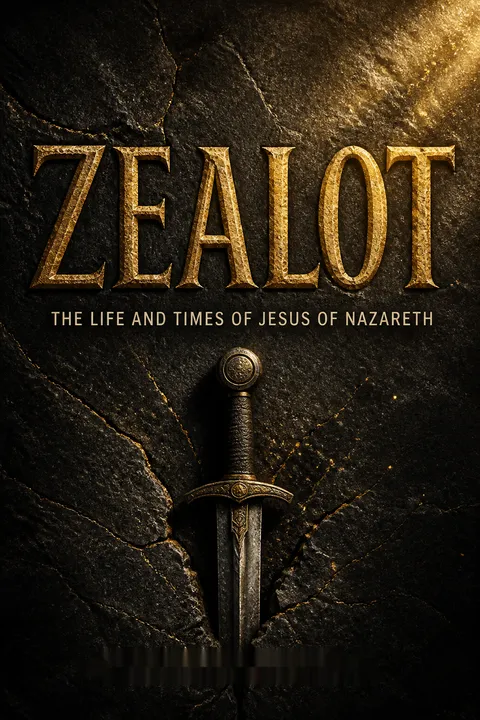
Zealot: The Life and Times of Jesus of Nazareth presents a historical perspective on Jesus as a revolutionary Jewish nationalist, challenging traditional Christian views. Aslan's research and engaging narrative style are praised, though some criticize his selective use of sources and potential bias. The book contextualizes Jesus within the political and religious landscape of first-century Palestine, exploring his role as a zealot against Roman occupation. While not offering new theories, it provides an accessible examination of Jesus as a historical figure, sparking both interest and controversy among readers.
People Also Read



Glossary
Q source
Shared sayings sourceA hypothetical early collection of Jesus's sayings inferred from material shared by Matthew and Luke but absent from Mark. No physical copy survives. Scholars use the term to describe a proposed source that may help explain how the later Gospels drew on earlier traditions.
Fourth Philosophy
Anti-Roman religious movementJosephus's label for the movement associated with Judas the Galilean and a strict refusal to accept foreign rule over Israel. In Aslan's account, its members treated loyalty to God as incompatible with serving Rome and helped shape later resistance movements.
zeal
Fierce loyalty to GodIn Aslan's use, zeal is a religious ideal of uncompromising devotion to Israel's God and rejection of rival earthly sovereignty. It could inspire strict observance of Jewish law and, for some, violent resistance to foreign rule or Jewish collaborators. It is not simply a formal party membership.
Sicarii
Dagger-wielding rebel groupA name Romans used for Jewish rebels known for assassinating opponents with concealed daggers. Aslan describes them as opponents of Roman occupation and of Jewish elites who cooperated with it. Their role in the revolt and their relationship to other rebel groups remain matters of historical interpretation.
Kingdom of God
God's rule on earthThe central theme of Jesus's preaching in the book. Aslan interprets it as an imminent, earthly order in which God alone holds sovereignty and the existing hierarchy is overturned, with relief for the poor and judgment for the powerful. Other readings may emphasize spiritual or future dimensions.
messianic secret
Jesus's concealed messianic identityA pattern, especially prominent in Mark, in which Jesus silences people who identify him as messiah and orders witnesses to keep certain events private. Scholars disagree over whether this pattern reflects Jesus's own caution, the Gospel writer's literary strategy, or both.
Son of Man
Jesus's enigmatic self-designationA phrase Jesus uses in the Gospels, with meanings that have long been debated. It can function as an ordinary expression for a human being or evoke the figure in Daniel who receives authority from God. Aslan argues that Jesus used it as an indirect claim to kingship.
FAQ
What's Zealot: The Life and Times of Jesus of Nazareth about?
- Historical Context: The book examines Jesus's life within the socio-political landscape of first-century Palestine, focusing on Roman occupation and Jewish responses.
- Jesus as a Revolutionary: Reza Aslan portrays Jesus as a Jewish revolutionary challenging Roman authority and the Jewish priestly class.
- Separation of Identities: It distinguishes between the historical Jesus of Nazareth and the Christ of faith, advocating for a historical rather than purely theological understanding.
Why should I read Zealot: The Life and Times of Jesus of Nazareth?
- Engaging Narrative: Aslan's writing is scholarly yet accessible, making complex ideas understandable for a general audience.
- Challenging Assumptions: The book encourages readers to reconsider widely held beliefs about Jesus and explore his life more deeply.
- Richly Researched: It draws on a wide range of historical sources, offering a well-rounded perspective on Jesus's life.
What are the key takeaways of Zealot: The Life and Times of Jesus of Nazareth?
- Jesus as a Zealot: The book suggests Jesus was part of a revolutionary movement against Roman rule.
- Critique of the Temple: It highlights Jesus's opposition to Temple authorities, aiming to reform Judaism from within.
- Messianic Expectations: The text explores various interpretations of messiahship, suggesting Jesus's understanding was unique.
How does Reza Aslan differentiate between Jesus and the Christ of faith in Zealot?
- Historical vs. Theological: Aslan argues the historical Jesus was a revolutionary, while the Christ of faith is a theological construct.
- Cultural Context: Understanding Jesus requires considering the cultural and political context of his time.
- Evolution of Belief: The early Christian community reinterpreted Jesus's life to fit emerging beliefs about the messiah.
How does Reza Aslan portray the political climate of Jesus's time in Zealot?
- Roman Occupation: Palestine is depicted as under Roman control, with widespread discontent and revolutionary fervor.
- Messianic Movements: Various messianic figures and movements arose in response to Roman rule, reflecting apocalyptic expectations.
- Conflict with the Temple: Tension between Jesus and Temple authorities is emphasized, portraying them as resistant to reform.
What is the significance of the title Zealot in Reza Aslan's book?
- Revolutionary Implications: "Zealot" refers to those committed to Jewish independence, suggesting Jesus was part of this movement.
- Religious Zeal: Jesus's teachings are connected to Jewish zealotry, indicating a politically charged message.
- Historical Context: The title reflects the historical reality of Jesus's life, positioning him within Jewish resistance traditions.
How does Reza Aslan address the miracles attributed to Jesus in Zealot?
- Historical Context: Miracles are acknowledged as part of the historical narrative, significant to contemporaries.
- Cultural Expectations: Miracles were expected of messianic figures, framing Jesus within that context.
- Symbolic Meaning: Miracles illustrate Jesus's message about the Kingdom of God and his role as a healer.
What does Reza Aslan say about the crucifixion of Jesus in Zealot?
- Political Execution: The crucifixion is framed as a political act by Romans who saw Jesus as a threat.
- Messianic Failure: Jesus's crucifixion is seen as a failure to establish the Kingdom of God.
- Legacy of Jesus: Despite execution, Jesus's teachings continued to resonate, leading to Christianity's formation.
How does Zealot contribute to the understanding of early Christianity?
- Contextualizing Jesus: Provides a historical framework for understanding Jesus's life and teachings.
- Reinterpreting the Narrative: Challenges traditional narratives, encouraging exploration of Jesus's identity.
- Impact on Beliefs: Illustrates how early Christians adapted Jesus's message, shaping Christian doctrine.
How does Reza Aslan critique the portrayal of Pontius Pilate in the gospels in Zealot?
- Evolving Narrative: Gospels increasingly depict Pilate as reluctant in Jesus's execution, absolving Rome.
- Historical Inaccuracy: Pilate was likely more ruthless than gospels suggest, a later theological construct.
- Implications for Anti-Semitism: Shifting blame onto Jewish authorities contributed to Christian anti-Semitism.
What role does the destruction of the Second Temple play in Zealot?
- Catalyst for Change: The destruction marked a turning point for Judaism and Christianity.
- Shift in Focus: Emphasis shifted from a Jewish messiah to a universal savior.
- Impact on Jewish Identity: Led to a crisis in Jewish identity, affecting Judaism-Christianity relations.
How does Reza Aslan address the concept of resurrection in Zealot?
- Historical Context: Resurrection was a radical reinterpretation of existing beliefs about life after death.
- Theological Implications: It affirmed Jesus's messianic identity and provided hope for believers.
- Cultural Influences: Influenced by surrounding cultures, shaping early Christian beliefs.
About the Author
Other books by Reza Aslan

Download PDF
Download EPUB
.epub digital book format is ideal for reading ebooks on phones, tablets, and e-readers.








