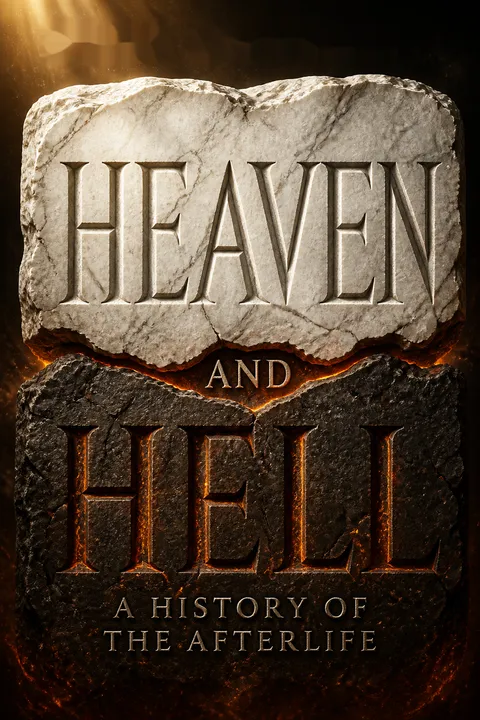


Key Takeaways
Treat heaven and hell as historical beliefs, not timeless Christian defaults
A belief with a history. Ehrman’s central claim is that heaven and hell were not Christianity’s original, settled picture of the afterlife. Ideas about death changed as people tried to make sense of injustice, suffering, and the fate of the dead. That history does not prove the beliefs false; it shows that people developed them over time. The distinction matters: origins and truth are separate questions.
Fear becomes the doorway. Ehrman opens with his own fear of eternal punishment, recalling how a graduate student’s late-night sauna made the image of everlasting fire feel physically immediate. He eventually stopped believing in Christianity, but kept studying its afterlife traditions. A poll cited in the book found that 72 percent of Americans believed in a literal heaven and 58 percent in a literal hell, evidence that these ideas remain culturally powerful.
The useful shift is from asking only whether a doctrine feels obvious to asking when, where, and why it became obvious to people. That historical distance can make inherited beliefs easier to examine without requiring automatic rejection. It also prevents a common mistake: treating a belief’s human history as proof that it is untrue. The book is strongest when it keeps those questions distinct. Its account can explain how a doctrine acquired authority, but historical reconstruction alone cannot settle what happens after death.
Read ancient afterlife visions as moral instruction, not neutral travel reports
Punishment with a purpose. The second-century Apocalypse of Peter describes sinners suffering punishments matched to their deeds, from torment for slander to grotesque penalties for sexual sins. Its paradise receives far less attention. The imbalance gives the text away: the vision is meant to deter wrongdoing, not simply map the unseen world. It was influential enough that some early Christians debated whether it belonged in the New Testament.
A vision can console, too. In the Passion of Perpetua, a young Christian woman awaiting execution dreams of climbing a dangerous ladder into a garden where Christ welcomes her. Her vision turns likely death into a passage to reward. Such accounts helped communities teach conduct, strengthen commitment, and offer hope under pressure. Their persuasive purpose does not, by itself, prove that their authors regarded them as fiction.
These stories show how an imagined future can organize behavior in the present. The threat of punishment can restrain, while a promise of reunion or vindication can help people endure danger. That makes afterlife writing a form of social instruction as well as theology. It also invites a careful question: whose behavior does a vision regulate, and whose suffering does it justify? A text can express sincere belief and still serve a powerful institutional or communal purpose.
Homer’s dead were shades, not souls rewarded or punished
Death meant diminished existence. In Homer’s Odyssey, the dead arrive in Hades as insubstantial shades, lacking the pleasures and vitality of life. Odysseus cannot embrace his dead mother. Achilles, once Greece’s greatest warrior, would rather live as a poor servant than rule among the dead. The ordinary dead do not receive separate fates according to virtue or wickedness. A few figures with divine connections escape this rule, while notorious offenders suffer exceptional punishments.
The soul was not yet immortal life. Homer’s Greek term psychē means the life breath that leaves a person at death. It does not describe an independently immortal self enjoying heaven. The earlier Mesopotamian Epic of Gilgamesh gives death a similarly bleak cast: after Enkidu dies, Gilgamesh searches for immortality and fails. In these old stories, death is less a moral verdict than the loss of life’s substance.
The contrast with later doctrines is striking because it reveals that the afterlife was not always imagined as a cosmic courtroom. Homer’s bleak shades also expose a tension in the later promise of justice: moral accounting may soothe the sense that life is unfair, but it transforms death into an extension of earthly judgment. These epics do not represent every ancient person’s belief. They show what influential literary traditions made available to audiences, not a complete survey of popular opinion.
Plato made postmortem justice answer the unfairness of ordinary life
A moral balance sheet. Plato’s afterlife stories answer a problem Homer leaves open: if good and bad people meet the same fate, where is justice? In Plato’s myths, souls face judgment, the virtuous receive reward, and the wicked are punished. His famous Myth of Er imagines a soldier returning from death with news of these fates and of souls choosing new lives. Plato presents such stories as myths that convey moral truth, not necessarily as literal geography.
The self moved into the soul. Plato’s philosophy also gives the soul greater importance than the body, treating it as the enduring person. Centuries later, Virgil’s Aeneid depicts a more developed moral afterlife, with Elysium for the blessed, Tartarus for the wicked, and purification before some souls return to life. The concern with fairness helped make differentiated rewards and punishments compelling.
Postmortem justice offers a response to a real moral wound: visible outcomes often fail to match what people deserve. Plato’s myths make virtue matter even when earthly success rewards the unscrupulous. But the explanatory comfort carries a risk. If injustice is expected to be corrected somewhere else, the promise of future balance can soften pressure to repair harms here. The stories can motivate ethical life, yet their effect depends on whether the future judgment supplements present responsibility or substitutes for it.
Read biblical resurrection in context: Israel’s revival came before individual resurrection
The Hebrew Bible offers no Christian hell. In most passages, Sheol means the grave or the realm of death, not a place of eternal punishment. The Hebrew word nephesh refers to life or life breath, not a separable, naturally immortal soul. The emphasis is often on remaining alive to worship God, rather than escaping to heaven after death. The Bible is diverse, however, and some passages imagine the dead as able to communicate with the living.
A nation rises first. Prophets such as Ezekiel use resurrection imagery to describe Israel’s restoration after national destruction. The valley of dry bones represents a people who believe their future is gone; the vision promises their return to their land. It is not originally a prediction that individual corpses will rise. Daniel, written during persecution centuries later, is the Hebrew Bible’s clearest account of individuals rising for judgment and everlasting life.
Context changes what familiar religious language appears to mean. A vivid image of bones returning to life can sound like a statement about individual resurrection, yet its original setting may concern a defeated nation. This is a useful interpretive discipline beyond biblical studies: images migrate, and later readers can inherit a meaning different from the first author’s. The caution cuts both ways. Context can rule out an easy reading, but it cannot make every difficult passage entirely unambiguous.
See persecution as the pressure that made bodily resurrection compelling
A new answer to suffering. Apocalypticism is the belief that evil powers dominate the present age but God will soon intervene, defeat them, and restore the world. It gained force when faithful Jews faced persecution and the old explanation, that suffering was punishment for the people’s sins, no longer seemed adequate. If the righteous died under oppression while their persecutors prospered, a future judgment could restore justice.
The body mattered. In Daniel and other Jewish writings, the dead are raised bodily at the end of history. The righteous receive lasting life; in early versions of the idea, the wicked are exposed to shame or destroyed, not necessarily tortured forever. The story of the seven Jewish siblings tortured under Antiochus, told in 2 Maccabees, gives this hope its human stakes: they refuse to abandon their ancestral law because they expect God to restore life. Jewish views remained varied, and scholars debate how outside influences shaped the idea.
Resurrection is not simply a theory about what happens to an individual. In these texts, it is a claim that oppression cannot have the final word and that bodies, communities, and moral histories matter to God. That emphasis differs sharply from philosophies that treat the body as a burden to escape. The historical explanation is persuasive, though not exhaustive: persecution helps explain why resurrection became meaningful, but it cannot identify one cause or account for every Jewish view.
Jesus expected God’s kingdom on earth soon, not heaven or hell at death
A near-term reversal. Ehrman argues that the historical Jesus shared the apocalyptic expectation of many Jews of his time: God would soon end the present age, defeat evil, and establish a just kingdom on earth. The faithful would be raised to life; the wicked would be destroyed. Jesus called for repentance and ethical action in preparation, and taught that some of his listeners would live to see the kingdom arrive.
Gehenna was not automatically hell. The term refers to a desecrated valley outside Jerusalem, associated in biblical texts with child sacrifice and slaughter. Ehrman reads Jesus’s warnings about Gehenna, fire, and destruction as threats of final death and exclusion, not endless conscious torment. His reading is an argument about Jesus’s historical context, not a claim that every later Christian interpretation is impossible. The Gospels themselves were written decades after Jesus’s death, so identifying his exact words requires judgment about sources.
This reconstruction makes Jesus’s message less like a guide to individual destiny immediately after death and more like a warning about a coming political and cosmic upheaval. It also puts ethical conduct at the center: the coming kingdom belongs to people who do God’s will. The historical case depends on evaluating later texts as evidence for an earlier teacher, so certainty has limits. A careful reader should distinguish the author’s well-supported historical thesis from the theological conclusions later communities draw from it.
Paul preserved resurrection while adding immediate life with Christ after death
The future body remains essential. Paul’s earliest letters focus on Jesus’s return and the future resurrection of believers. In 1 Corinthians, he argues that the dead will rise with transformed, immortal bodies. His “spiritual body” is still a body, but no longer vulnerable to decay, illness, or death. This differs from the idea that only an immortal soul survives.
The waiting period changes. In later letters, Paul suggests that believers who die before Jesus returns will be with Christ in the meantime. This interim state does not replace the final resurrection. Paul’s view thus holds both immediate presence with Christ and a future embodied life. He also makes salvation depend on faith in Christ and baptism, marking a significant shift from Jesus’s emphasis on preparing for God’s kingdom through righteous action.
Paul’s position illustrates how beliefs can adapt without discarding every earlier idea. The future resurrection remains, but the death of believers now needs an answer of its own. Holding both an interim state and a later bodily resurrection may seem conceptually awkward, yet it addresses two different concerns: what happens to the dead now, and what justice looks like at history’s end. The tension is a record of theological problem-solving, not necessarily evidence of careless thought.
Christian afterlife doctrine grew through competing visions, not one original blueprint
The Gospels diverge. In Luke, the parable of Lazarus and the rich man pictures reward and torment immediately after death, while directing attention to the rich man’s neglect of the poor. John portrays eternal life as already present for believers. Revelation uses symbolic visions: its Beast and Babylon point to Rome and its rulers. Ehrman argues that its lake of fire symbolizes the final destruction of evil and sinners, rather than literal, everlasting torment.
The debate continued. Early Christian martyr stories made immediate heavenly reward and punishment vivid. By Augustine’s time, eternal conscious torment had become a major Christian teaching, though it was not the only proposal. Some thinkers imagined temporary postmortem purification; Origen argued that, after ages of purification, all beings might return to God. These alternatives show that Christian teaching developed through argument, interpretation, and changing circumstances.
The range of views complicates any claim that one simple doctrine passed unchanged from Jesus to later Christianity. Different writers respond to different problems: poverty, delayed judgment, persecution, sin within the church, or the scope of divine mercy. At the same time, diversity does not make every interpretation equally persuasive. Readers still need to weigh genre, historical setting, and textual evidence. The history explains how doctrines took shape; it does not reduce them to mere tools of social control.
Let history reduce fear without pretending it proves what death brings
Origins do not settle truth. Ehrman’s history shows that people have imagined death in sharply different ways: Homer’s shadowy existence, Plato’s judgment, Jewish bodily resurrection, and Christian heaven and hell. The existence of these changing beliefs does not establish which, if any, is true. The author ends by saying that no one can know with certainty what follows death.
A less frightening possibility. Socrates considered two options: death may be unconsciousness, like a deep sleep, or a transition to another existence. Epicurus and Lucretius argued that if consciousness ends, there is no one left to experience harm. Ehrman finds nonexistence plausible, comparing it to the time before birth, but presents that as his own view, not historical proof. His practical conclusion is to value this life and help others live well.
The book’s most careful conclusion is epistemic rather than doctrinal: a history of beliefs can loosen the grip of inherited fear, but it cannot deliver a verdict about the afterlife. That distinction is intellectually honest and emotionally useful. The analogy between death and unconsciousness may ease anxiety for some readers, though it does not answer every concern, especially grief about losing relationships. Comfort need not depend on certainty; it can also come from taking seriously the life and relationships available now.
Analysis
Ehrman’s book is both a history of ideas and an argument about how religious traditions change under pressure. Its organizing movement is from a broadly shared, diminished existence after death, through moralized judgment, to Jewish resurrection, and then to Christian accounts of immediate reward and punishment. The narrative makes this evolution memorable by moving among texts and scenes: Gilgamesh’s failed search for immortality, Odysseus’s encounter with his mother, persecuted Jewish martyrs, Paul’s unresolved waiting period, and later Christian visions of torment. The strongest analytical point is that these doctrines answer different problems. Resurrection vindicates people whose bodies and communities have been destroyed. Immediate postmortem judgment addresses the apparent delay of justice. Eternal torment gives permanence to the moral authority of a sovereign God, while universal salvation presses the logic of divine sovereignty in a more merciful direction.
The method is historical comparison, not a proof or disproof of the afterlife. That distinction is essential. Showing that an idea developed over time does not establish whether it refers to a reality beyond history. It does, however, challenge the assumption that present-day Christian teaching is identical to the earliest Christian message. The book also shows why texts must be read in genre and context: a vision can warn or console, and a resurrection metaphor can refer first to a nation rather than to individual bodies.
The evidence has limits. Most surviving sources were produced by educated writers, not ordinary people, and the author’s reconstruction of Jesus depends on judgments about Gospels written decades after his death. The historical sequence is therefore better understood as a changing field of overlapping views than as a single, orderly progression. Ehrman sometimes presents contested interpretations, particularly of Jesus’s warnings and Revelation’s lake of fire, with forceful confidence. Even so, the wider case remains valuable: afterlife doctrines are historically layered, internally diverse, and shaped by real moral and political anxieties. Knowing that history can unsettle fear and sharpen interpretation, but it cannot tell readers with certainty what death itself contains.
Review Summary
Heaven and Hell: A History of the Afterlife by Bart D. Ehrman explores how Christian concepts of the afterlife evolved from ancient Greek, Jewish, and early Christian sources. Readers appreciated Ehrman's scholarly yet accessible approach and his non-judgmental treatment of religious beliefs. The book traces how Jesus's apocalyptic teachings about bodily resurrection differed from later Christian beliefs about immortal souls ascending to heaven or hell—concepts borrowed from Plato. Many found the historical context enlightening, particularly regarding biblical contradictions and the influence of early Church Fathers. Some critics noted the book focuses exclusively on Western traditions and can be repetitive.
People Also Read



Glossary
Sheol
Death or the graveA Hebrew Bible term used for death, the grave, or, in some passages, a shadowy realm of the dead. Ehrman argues that it does not mean the later Christian idea of hell as a place of eternal punishment. In Hebrew poetry, Sheol often appears in parallel with words such as grave, pit, or death.
nephesh
Life or life breathA Hebrew term sometimes translated as soul, but not equivalent to the Greek idea of a separate, immortal essence. In the book’s account of ancient Israelite thought, nephesh refers to life, breath, or the force that makes a body alive. When the person dies, nephesh does not continue independently as an immortal soul.
apocalypticism
Hope for divine interventionA Jewish religious outlook in which evil powers dominate the present age, but God will soon intervene, defeat them, judge the world, and restore creation. In the texts Ehrman discusses, this expectation helps explain why righteous people suffer while the wicked prosper. The dead may be raised so God can vindicate the faithful.
Gehenna
A desecrated valley near JerusalemThe Greek form of a name for the Valley of Hinnom, outside Jerusalem. Biblical texts associate the valley with child sacrifice and later with slaughter and disgrace. Ehrman argues that Jesus’s references to Gehenna evoke destruction and exclusion from God’s coming kingdom, not necessarily the later doctrine of eternal conscious torment.
interim state
Existence before final resurrectionA temporary condition between an individual’s death and the final resurrection or judgment. Paul appears to suggest that deceased believers are with Christ during this interval, while still expecting a future resurrection of transformed bodies. Later Christian writers developed more detailed accounts of immediate postmortem reward and punishment.
spiritual body
A transformed immortal bodyPaul’s description of the body believers receive in the resurrection. It is not a disembodied soul or simply the present body restored unchanged. It remains bodily existence, but transformed into an imperishable, powerful form no longer subject to illness, decay, or death.
gematria
Numerical reading of namesAn ancient interpretive practice that assigns numerical values to letters and adds them to produce a number for a word or name. Ehrman explains the number of the Beast in Revelation, 666, as a coded reference to Nero’s name written in Hebrew letters. An alternative spelling accounts for the manuscript reading 616.
apocatastasis
Final restoration of all beingsOrigen’s teaching that God’s goodness would ultimately restore all rational beings, including sinners and the devil, to their proper relationship with God. This restoration would follow extensive purification across immeasurable ages. It differs from later Purgatory because it proposes the eventual salvation of all, not merely the cleansing of people already destined for heaven.
About the Author
Other books by Bart D. Ehrman
Download PDF
Download EPUB
.epub digital book format is ideal for reading ebooks on phones, tablets, and e-readers.








