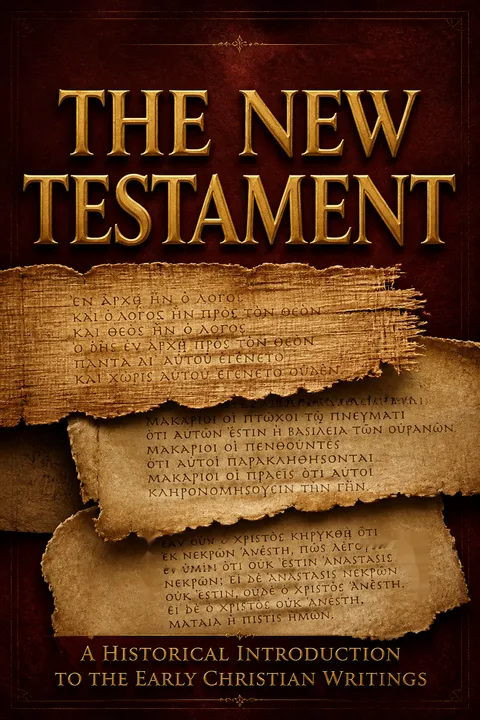


Key Takeaways
Read the New Testament as a library of arguments, not one seamless voice.
One collection, many voices. Ehrman treats the New Testament as writings produced by different authors, in different places, for communities facing different problems. The books reflect early Christian history, but they also helped shape it. Their later placement together can make them seem more harmonious than they are. Mark’s suffering messiah, Matthew’s Jewish interpreter of the Law, Luke’s rejected prophet, John’s heavenly revealer, and Paul’s gospel to Gentiles each present a distinctive perspective.
Read authors individually. The book models historical, literary, comparative, and social approaches rather than assuming that every author meant the same thing. The practical lesson is to ask who is speaking, to whom, and under what circumstances before combining passages into a single account.
What's striking is that disagreement becomes evidence, not a defect to smooth away. Reading a collection as a conversation lets each writer's priorities emerge and makes later unity itself a historical question. This approach resembles careful archival work: documents from different institutions are compared without pretending they share one agenda. The challenge is that readers may mistake difference for contradiction in every case. Ehrman's method instead asks for patient comparison, preserving both shared commitments and genuine tensions.
Treat early Christianity as a contested movement, not a unified original church.
Rival Christians claimed truth. The second century included Jewish-Christian adoptionists, who saw Jesus as a human chosen by God; Marcionites, who rejected the Jewish God and Law; Gnostics, who taught that secret knowledge brought salvation; and proto-orthodox Christians, who insisted Jesus was both human and divine. These groups did not share the same scriptures or authorities. Some rejected Paul, while others treated him as the chief apostle.
Victory shaped the canon. The proto-orthodox party eventually became dominant, and its collection of writings became the inherited New Testament. The twenty-seven-book canon was not formally listed by a Christian author until Athanasius did so in 367 C.E. The familiar canon records an outcome of conflict, not an uncontested agreement from Christianity's beginning.
The book's account makes religious authority look historical rather than self-evident: communities choose which teachers and texts count, then later generations inherit those choices. That does not make the resulting canon arbitrary; the competing groups offered arguments, traditions, and shared practices. But it does caution against treating the winners as if they had always represented every Christian. Diversity is a fact about the movement, not a verdict that all its claims are equally persuasive.
Use ancient context to decode Jesus, not to certify every miracle.
Ancient listeners heard differently. Most people in the Greco-Roman world assumed many gods were involved in daily life. Religion centered on ritual service and practical benefits, not on creeds or exclusive belief. Judaism shared practices such as sacrifice and prayer, yet stood out through its worship of one God, its covenant, and its Law. Jesus' contemporaries could therefore understand miracle-working and divine-son language without hearing it as modern readers do.
Context has limits. Jesus lived under Roman rule in a society marked by poverty, disease, and little social mobility. That background helps explain why stories about healing, exorcism, and divine deliverance mattered. It cannot, by itself, prove that any supernatural event occurred. Ehrman distinguishes historical interpretation, which weighs public evidence, from faith claims about the supernatural.
Contextualization is a safeguard against reading modern assumptions into ancient words. A claim about a divine man, for instance, had recognizable cultural meanings in antiquity that it may not carry now. Yet context explains intelligibility, not truth: showing why a miracle story made sense to its first audience does not establish that the event happened. Keeping those questions separate allows historical inquiry to be rigorous without dismissing religious interpretation.
Assume oral stories changed before the first Gospel appeared.
Decades came first. Jesus died around 30 C.E.; Mark was probably written around 65 to 70, Matthew and Luke around 80 to 85, and John around 90 to 95. Before these accounts appeared, stories circulated orally across communities and languages. Most people in the ancient world could not read, and traditions in oral cultures were often adapted to new situations rather than repeated word for word.
Transmission leaves traces. The Gospels themselves preserve different versions of shared events. Mark and John, for example, place Jesus' death on different days in relation to the Passover meal. Such differences suggest that storytellers sometimes reshaped details to convey religious meaning. Ehrman does not conclude that every tradition is invented; he argues that historical memories and theological interpretation can coexist in the same account.
The key distinction is between oral transmission and a modern recording. Repetition can preserve a core while changing wording, emphasis, or application, especially when stories travel between communities. That makes the Gospels neither stenographic transcripts nor disposable fiction. Their variations invite source criticism, but the surviving evidence cannot reconstruct every stage of transmission. The most responsible reading identifies both what a story meant to its community and what can plausibly be traced to earlier memory.
Compare the Gospels; their disagreements expose each author's priorities.
Similarity reveals sources. Matthew, Mark, and Luke share many stories and often similar wording. The dominant explanation, the four-source hypothesis, says Matthew and Luke used Mark and a shared source called Q, while also drawing on material found only in Matthew, called M, or only in Luke, called L. Q, M, and L are scholarly reconstructions, not surviving books.
Difference reveals emphasis. Matthew portrays Jesus as a Jewish teacher who fulfills Scripture; Luke stresses salvation moving from Jews to Gentiles; John presents Jesus as the one sent from heaven. Even shared stories can shift: Mark and John give different dates for Jesus' death. Comparing versions helps identify each author's message, though reconstructed sources remain hypothetical and cannot settle every historical question.
Comparison turns textual variation into a method rather than a nuisance. The four-source model explains many agreements, while redaction criticism asks what an author changes or preserves. Both methods are powerful precisely because they expose the choices behind a narrative. Their limit is that lost sources such as Q cannot be inspected directly; reconstructions remain arguments from surviving texts. Good analysis therefore distinguishes strong patterns of dependence from confident claims about documents no one possesses.
Read Jesus as an apocalyptic prophet expecting God's kingdom soon.
The end was near. Apocalypticism is a worldview in which evil powers dominate the present age, but God will soon intervene, judge the world, and establish a new kingdom. The earliest Gospel traditions portray Jesus proclaiming this imminent reversal and warning people to repent. He associated with John the Baptist, chose twelve disciples, predicted the Temple's destruction, and was executed after causing a disturbance there.
His deeds fit the message. Stories of exorcisms and healings were understood as signs that God's power was already challenging evil. Jesus' association with sinners, the poor, and women also anticipates a reversal of status in the coming kingdom. The book argues that his apocalyptic message best explains both how his ministry began and why his followers continued to expect an imminent divine judgment after his death.
This reading connects Jesus' sayings, actions, and execution into one historical picture: a prophet announcing God's intervention could threaten both religious and political authorities. It also explains why early followers expected the end soon. The interpretation is strong because multiple early sources preserve apocalyptic material, but it does not make every saying authentic or every prediction precise. The value lies in treating Jesus as a figure of his first-century Jewish world rather than a modern moral teacher in ancient dress.
Understand Paul's gospel as opening God's covenant to Gentiles without circumcision.
A dispute over belonging. Paul taught that Gentiles could join God's people through faith in Jesus, without first becoming Jews or accepting circumcision and the full Jewish Law. In Galatians, he defends this position against Christians who demanded circumcision. For Paul, Christ's death and resurrection fulfilled God's promises to Israel and extended their benefits to non-Jews.
Continuity with disagreement. Paul remained committed to the God of Israel and argued from Jewish Scripture, but his message differed from Jesus' own emphasis on the coming kingdom and the Law. The book cautions against calling Paul Christianity's sole founder: followers of Jesus had already formed beliefs and practices before Paul joined them. He was crucial in spreading the faith across ethnic boundaries, not inventing it from nothing.
Paul's claim was socially disruptive because it detached membership in God's people from visible Jewish practices. His argument also shows how religious continuity can coexist with sharp reinterpretation: he appeals to Israel's Scriptures while reaching a conclusion many Jewish believers opposed. The distinction matters for understanding Christianity's expansion, but Paul should not be reduced to a simple break with Judaism. His letters show a Jewish thinker arguing that God's promises have widened through Christ.
Read Paul's letters as crisis mail, not timeless theological manuals.
Occasions shape arguments. Paul wrote to real communities facing specific problems. In 1 Thessalonians he reassures converts distressed because fellow believers have died before Jesus' return. In Corinth he addresses factionalism, sexual misconduct, lawsuits, worship disputes, and disagreements about resurrection. In Galatia he confronts pressure to circumcise Gentile converts; in Philemon he appeals about a slave named Onesimus.
Context changes meaning. These letters are not complete handbooks of Paul's beliefs. Their silences do not prove that a topic was unimportant; it may simply not have arisen. The book also distinguishes seven widely accepted authentic letters from the disputed Deutero-Pauline and Pastoral epistles. Reconstructing the occasion first helps prevent isolated lines from being treated as abstract rules for every setting.
An occasional letter is a response to a live problem, not a balanced textbook chapter. That makes Paul vivid and strategically revealing, but also selective: readers hear one side of disputes and often lack the other participants' accounts. Contextual reading therefore improves accuracy while preserving uncertainty. It also cautions against using a sentence written to settle a local crisis as though it were a universal policy statement detached from the people and pressures that prompted it.
Notice women's early authority, then track how church rules narrowed it.
Women were active leaders. Paul names Phoebe as a church minister and patron, Prisca as a co-worker, and Junia among the apostles. In Corinth, women prayed and prophesied in worship. The Gospels also portray women traveling with Jesus, supporting his mission, and witnessing his crucifixion and resurrection.
Authority became contested. The Pastoral epistles tell women to be silent and subordinate, in marked contrast with the roles visible in Paul's undisputed letters. Ehrman connects this shift to broader ancient assumptions about gender and to the development of church authority. The change was not a smooth march toward equality: early communities offered women real roles, while later rules sought to restrict them.
The contrast matters because it replaces a timeless picture of women's place in Christianity with a history of contested authority. The evidence shows both participation and restriction, not a simple story of consistent inclusion or uniform oppression. Paul's communities could create space for women while remaining embedded in a patriarchal society. Reading the different letters together makes institutional change visible, although the surviving record is uneven and often written by men arguing over women's roles.
Separate Christian identity from anti-Jewish polemic and imperial suspicion.
Boundaries hardened. The Gospel of John often uses “the Jews” as opponents of Jesus, while Matthew attacks Jewish leaders yet portrays Jesus as fully committed to the Law. Later Christian writings such as Barnabas reject Judaism more sharply. Ehrman distinguishes these ancient conflicts from modern anti-Semitism, while showing how Christian claims of superiority helped fuel anti-Jewish hostility.
Rome brought another pressure. Christians refused to worship state gods, which could look like disloyalty in a world that linked public ritual with civic welfare. Local authorities sometimes punished them when disputes erupted, though there was no empire-wide policy of persecution during the first century. Early Christian self-definition grew through both internal disagreement and pressure from Jews and pagans outside the churches.
The distinction between ancient polemic and later persecution is essential, but it does not erase the harm carried by anti-Jewish rhetoric. The book shows how communities define themselves against rivals, then how those boundaries can harden into claims of moral superiority. Historical context helps explain why such language arose; it cannot make its consequences harmless. The same analysis also clarifies why Roman officials could view Christian refusal of civic cult as a public threat rather than a private belief.
Treat the canon and manuscripts as historical outcomes, not untouched originals.
A canon took time. Christians produced many writings about Jesus, including narrative, sayings, revelation, and infancy Gospels. The books now in the New Testament were selected amid disputes about age, apostolic authority, and accepted teaching. Athanasius listed the current twenty-seven books in 367 C.E., long after the last New Testament book was written.
Copies preserve variation. The original manuscripts have not survived, and handwritten copying introduced changes. Some were accidental; others appear to have been made to clarify a passage, harmonize accounts, or defend a theological position. Scholars compare manuscripts and use historical criteria to reconstruct the earliest text. The result is not certainty about every word, but a reasoned account of how the texts were transmitted.
The history of the canon and the history of the text are related but distinct. One concerns which books communities treated as authoritative; the other concerns how those books changed during copying. Neither fact makes the New Testament meaningless, but both complicate claims of a single untouched document arriving fully formed. The book's historical approach is strongest when it shows how evidence supports a conclusion and where uncertainty remains, rather than treating uncertainty as either proof or disproof.
Analysis
Ehrman's central achievement is to make historical distance do real explanatory work. The New Testament is not presented as a single voice but as a collection formed amid argument, missionary expansion, social strain, and changing expectations. That framing makes differences among Mark, Matthew, Luke, John, Paul, and later church writers intelligible rather than embarrassing. It also allows the reader to see how a small Jewish movement became a diverse, increasingly Gentile religion, and how the version that prevailed later shaped the canon and its interpretation.
The book's method is cumulative. Genre, source comparison, redaction, social context, and historical criteria each answer different questions. No one method can establish the historical Jesus by itself. The most persuasive reconstructions arise when several independent clues converge, as with Jesus' apocalyptic setting, his conflict around the Temple, and his execution under Roman authority. Conversely, claims based on a single late or tendentious source deserve caution. This is a disciplined way to handle evidence that is both religiously important and historically incomplete.
A limitation is unavoidable: the surviving record is overwhelmingly produced by Christians, and opponents usually appear through Christian descriptions of them. That asymmetry makes it difficult to recover what rival groups would have said for themselves. The book acknowledges this especially when reconstructing the secessionists, Gnostics, and Jewish-Christian communities. Its strongest conclusions are therefore not total biographies but bounded judgments about what is probable, what is disputed, and what cannot be known.
The resulting portrait is neither a harmonized Jesus nor a claim that history can settle theology. It shows how early believers interpreted Jesus differently, how those interpretations shaped communities, and how later power determined which writings became scripture. The reader gains a more exact question than “Which Gospel is right?”: what did each author believe, why did that belief matter in its setting, and what evidence allows a historian to say so?
Review Summary
Readers widely praise The New Testament as an exceptional academic introduction to early Christianity, lauding Ehrman's clarity, accessibility, and historical rigor. Many appreciate his ability to contextualize NT writings within their socio-cultural and literary landscapes without straying into theological debate. The book is frequently recommended as a college textbook. Some critics note occasional argumentative weaknesses, perceived bias toward atheism, or inconsistencies in applying historical standards. Overall, it is considered invaluable for anyone—believer or skeptic—seeking a scholarly, historically grounded understanding of the New Testament and early Christian movements.
Glossary
Canon of Scripture
recognized authoritative collectionThe set of books accepted as authoritative by a religious community. The New Testament canon developed over time as Christians debated which writings were ancient, apostolic, widely accepted, and consistent with their teaching. The present collection of twenty-seven books was listed by Athanasius in 367 C.E.
Synoptic Problem
relationship among three GospelsThe question of how Matthew, Mark, and Luke are related. They share many stories and sometimes nearly identical wording, yet they also differ in content, phrasing, and sequence. The dominant explanation is that Matthew and Luke used Mark and a shared source called Q, alongside material available to each alone.
Q
reconstructed shared sourceA hypothetical source used to explain sayings and a small number of narratives that Matthew and Luke share but that do not appear in Mark. The name comes from the German Quelle, meaning “source.” Q has not survived as a separate document, so its contents and shape remain matters of scholarly reconstruction.
Redaction criticism
study of editorial changesA method for examining how an author alters, preserves, or rearranges earlier sources. By comparing a Gospel with a source such as Mark, scholars infer what the later author emphasized. The method can reveal theological priorities, but it depends on reasonable judgments about which sources the author actually used.
Apocalypticism
end-time worldviewA worldview in which evil powers dominate the present age but God will soon intervene, judge the world, destroy evil, and establish a new order. Jewish and early Christian apocalypticists expected this change to be imminent and understood present suffering in light of the coming divine vindication.
Criterion of dissimilarity
test for distinct traditionsA historical test that treats a saying or action as more likely to be authentic if it does not appear to have been invented to support the beliefs of early Christians or to echo common Jewish expectations. It can strengthen a case for authenticity, but it cannot by itself prove that a tradition is historical.
Contextual credibility
fit with historical settingA criterion for evaluating traditions about Jesus by asking whether they make sense in the social and historical world of first-century Palestine. A tradition that clashes with what is known about that setting is suspect. A plausible fit, however, explains possibility rather than proving that an event happened.
Deutero-Pauline Epistles
letters disputed as Paul'sEphesians, Colossians, and 2 Thessalonians, which claim or have been associated with Paul but whose authorship is debated. Many scholars think they were written by later Christians influenced by Paul. They are important evidence for how Pauline ideas developed after the apostle's lifetime.
Pastoral Epistles
letters on church leadershipThe New Testament letters 1 Timothy, 2 Timothy, and Titus. They address church order, leadership, teaching, and conduct. Most critical scholars doubt that Paul wrote them, in part because their vocabulary, institutional concerns, and treatment of women differ from his undisputed letters.
Pseudepigraphy
writing under another's nameThe practice of publishing a work under the name of a famous or authoritative person who did not actually write it. It was known in antiquity and could serve different purposes, including gaining a hearing for a teaching. Scholars debate whether some New Testament letters are pseudepigraphical.
Proto-orthodox Christians
forerunners of later orthodoxyA label for early Christians whose beliefs and writings became dominant in later centuries. They affirmed that Jesus was both human and divine, rejected rival Christian teachings, and eventually established the collection of books that became the New Testament canon. The term is retrospective, not one they used for themselves.
About the Author
Other books by Bart D. Ehrman


Download PDF
Download EPUB
.epub digital book format is ideal for reading ebooks on phones, tablets, and e-readers.








