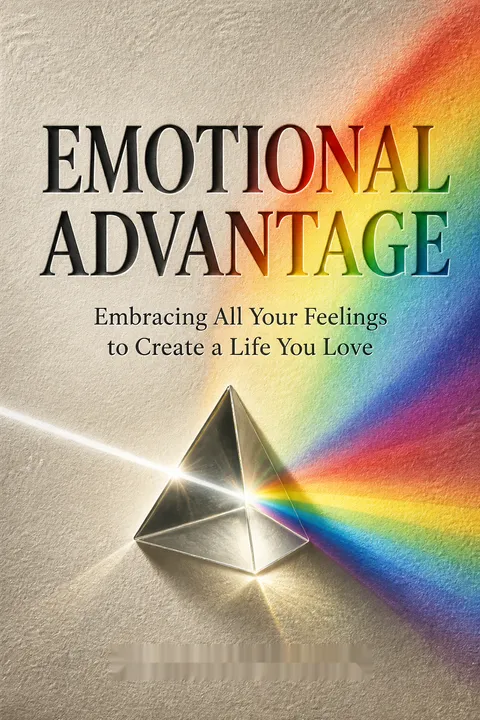


Key Takeaways
Treat every emotion as information, not an order to obey
Feelings carry clues. The book’s central claim is that emotions are not intruders to suppress but signals worth understanding. It distinguishes emotions, bodily responses that can happen automatically, from feelings, the conscious experience and interpretation of those responses. A racing heart might signal fear, excitement, or both. The sensation deserves attention, but its first interpretation may need checking.
Make room to choose. Before an emotional reaction takes over, notice your physical state, such as hunger or exhaustion, and identify the event or thought that triggered it. During the episode, name what is happening and choose a response rather than defaulting to suppression or outburst. Afterward, review what set it off and what helped. This precheck, response, and review turn emotional episodes into information for future decisions.
The useful distinction is between listening to a feeling and treating it as a fact. Emotion research often describes feelings as involving both bodily signals and the brain’s interpretation of them. That makes emotion a source of evidence, not an infallible verdict. A tight stomach can alert someone to danger, but it can also reflect fatigue, anticipation, or an old association. Naming the feeling creates a pause in which those possibilities can be examined. The book’s approach is strongest when awareness leads to choice, rather than to the assumption that every discomfort reveals a hidden truth.
Practice happiness as resilience, not a demand to feel cheerful
Pleasure is not the whole prize. The book describes three forms of happiness: hedonic happiness, or immediate pleasure; eudaemonic happiness, rooted in meaning and living well; and chaironic happiness, a sense of connection to something larger, sometimes felt amid hardship. Durable well-being draws on both enjoyment and purpose, not nonstop positivity. The PERMA framework similarly highlights positive emotion, engagement, relationships, meaning, and accomplishment.
Train the conditions. Taran presents a classic estimate that 40 percent of happiness comes from intentional activity, compared with 50 percent from genetics and 10 percent from circumstances. Her practical habits emphasize attention, gratitude, physical well-being, generosity, authenticity, relationships, and purpose. One small practice is to pause over a positive moment long enough to register it, countering the mind’s tendency to give threats more attention than ordinary good news.
This account avoids a common trap in popular wellness advice: turning happiness into another performance target. Its more defensible proposition is that habits can shape attention, relationships, and coping, not that people can choose their way out of every hardship. The cited happiness percentages are useful as a rough model, not a personal forecast; life circumstances can matter enormously, particularly under illness, poverty, or discrimination. The distinction between pleasure and meaning also helps explain why a pleasant purchase fades while a valued act of care can remain significant.
Let sadness clarify loss, while taking persistent depression seriously
Sadness has a job. Sadness commonly follows a recognizable loss or disappointment and can give someone space to grieve, reflect, and adjust. Depression is different: it can be persistent, affect many areas of life, reduce interest in things once enjoyed, and involve worthlessness or thoughts of self-harm. These descriptions are not a way to diagnose yourself. The book stresses that serious or lasting symptoms warrant support from a qualified professional.
A difficult mood can have uses. In studies discussed by Taran, participants placed in a sad mood recalled more details and detected deception more accurately than happy-mood participants, with accuracy reported at 62 percent rather than 49 percent in one experiment. Sadness can also motivate effort. After their children died, some grieving parents joined forces to help prevent similar losses, an example of post-traumatic growth. Growth is possible, not required, and never a reason to minimize grief.
The strongest contribution here is permission to experience ordinary sorrow without immediately treating it as a defect. The caution is equally important: mood experiments describe limited settings, and they do not mean sadness reliably improves judgment or memory for everyone. Nor does a clear trigger rule out clinical depression. Grief and depression can overlap, and context matters alongside symptoms. Post-traumatic growth is best understood as one possible response to trauma, not a standard survivors should be expected to reach. Making room for sorrow and seeking care are compatible choices.
Give desire a values-based destination before it becomes another craving
Wanting can move you. The book distinguishes hope from desire. Hope combines the will to pursue a goal with possible routes toward it; desire is more urgent and energizing. Anticipating a future reward can motivate action, but satisfying a desire often brings only temporary pleasure. The Cycle of Desire describes this loop: want something, obtain it, adapt to it, then want something else.
Passion needs room. Harmonious passion enriches life while leaving space for relationships and other priorities. Obsessive passion takes over time and attention, even when it damages well-being. The useful test is whether someone can stop or shift activities when needed. Rather than forcing a single life purpose, the book recommends noticing what feels alive, what problems evoke a wish to help, and what interests are worth exploring. Several interests can be a genuine strength, not evidence of failure to choose.
The distinction between a goal and a craving is especially useful in a culture designed to keep attention moving toward the next reward. Research on adaptation supports the broad idea that people often grow accustomed to positive changes, though the speed and degree vary. The practical question is not whether desire is good or bad, but whether it serves a chosen value or becomes its substitute. A person can pursue achievement intensely and still live meaningfully, provided success is not the only measure of identity or satisfaction.
Use fear's warning, but test anxiety's imagined forecasts
Separate alarm from anticipation. Fear responds to a present or perceived immediate threat; anxiety anticipates a possible future one. Worry often attaches to a concrete problem that can be addressed, while anxiety can feel diffuse and bodily. Some anxiety is a normal response to a speech, exam, or unfamiliar challenge. When it persistently disrupts daily life, it may require professional assessment and treatment.
Investigate the message. Katie, a woman in the book’s example, describes escalating anxiety while minimizing a partner’s emotionally harmful behavior. Her anxiety prompts her to seek help, but simply quieting the symptom would leave the relationship problem unexamined. That does not mean all anxiety hides an ignored danger. A practical first step is to track triggers, notice physical cues, and ask what is controllable. Breathing, mindfulness, lifestyle changes, therapy, or medication may help, depending on the person and situation.
Fear can be protective, but bodily alarm is not automatically an accurate reading of the present. Past experience, uncertainty, and stress can make neutral situations feel threatening; conversely, social pressure can lead people to dismiss genuine danger. The book’s best balance is to take signals seriously without granting them unquestioned authority. Its description of anxiety also rightly leaves room for treatment. Tools such as breathing exercises can help regulate arousal, but they are not substitutes for evidence-based care when symptoms are severe or persistent.
Build confidence through deliberate practice, not comparisons or perfect performance
Competence grows by doing. A fixed mind-set treats ability as settled, so difficulty can feel like proof to quit. A growth mind-set treats ability as developable through effort and strategy. The book illustrates this with two soccer players: a naturally gifted player stops attending demanding practices, while a less experienced teammate keeps training and improves. Confidence follows evidence of progress, not just reassuring thoughts.
Use a kinder standard. Self-esteem can rise and fall with grades, praise, or comparison. Self-compassion offers a steadier response to mistakes: notice the difficulty, remember that imperfection is human, and speak to yourself as you would to a friend. The book also notes that confidence gaps are shaped by social conditions, including unequal pay, responsibilities, and expectations. Individual courage matters, but it cannot by itself remove structural barriers.
The soccer example captures an important learning principle: repeated, appropriately challenging practice produces more durable confidence than reliance on early talent. Yet effort alone does not guarantee success; useful feedback, access to practice, and fair evaluation matter too. That qualification strengthens the book’s point rather than weakening it. Self-compassion can make persistence more sustainable because a mistake becomes feedback instead of a verdict on identity. A growth mind-set is most helpful when it encourages learning, not when it is used to blame people for barriers they did not create.
Turn anger into a boundary or remedy, not a weapon
Anger flags a problem. It may signal a violated boundary, blocked goal, or hurt that has not been addressed. But acting while anger is at full intensity can impair judgment and damage relationships. The book describes this as an amygdala moment, when the brain’s threat response makes reflective thinking harder. Naming the feeling, stepping away briefly, slowing the breath, or moving the body can create enough distance to choose a response.
Channel the energy. Anger can help someone protect themselves or confront injustice. Civil rights organizers, including John Lewis and other marchers, rehearsed how to respond to provocation without retaliating. Their discipline kept the focus on the injustice they opposed. In everyday life, the same principle means asking whether an outburst will improve the situation. Anger can support a clear boundary or a deliberate request; it does not need to dictate the delivery.
Anger is not simply destructive, and the example of disciplined protest shows how intense emotion can support collective action without becoming violence. That distinction matters: suppressing anger can preserve an unfair status quo, while uncontrolled expression can reinforce the very harm being resisted. The goal is not emotional neutrality, but alignment between the grievance, the strategy, and the likely consequences. A boundary is most effective when it states what behavior is unacceptable and what action will follow, rather than relying on force or humiliation.
Let guilt guide repair, and refuse shame's verdict on your worth
Judge actions, not identities. Guilt says that a particular action caused harm or violated a value; it can motivate apology and repair. Shame turns the judgment inward, suggesting that the person is fundamentally defective. Research discussed in the book links shame with withdrawal and risky coping, while guilt is more likely to focus attention on behavior and possible correction.
Make repair realistic. A sincere apology means listening to the other person’s account, recognizing the impact, expressing remorse, and offering a concrete way to make amends or prevent a repeat. The outcome is not under the apologizer’s control, and repair does not guarantee forgiveness. Some guilt is not caused by wrongdoing at all. Survival guilt after another person’s death, or guilt about leaving family expectations behind, calls for compassion and reflection rather than an invented debt to repay.
This distinction is useful because it preserves accountability without making a mistake into a permanent identity. A good apology also centers the harmed person’s experience instead of treating forgiveness as a reward owed to the apologizer. At the same time, guilt can be distorted by manipulation, unequal power, or impossible standards. The question is whether a specific action violated a legitimate responsibility and whether a proportionate repair is possible. If not, self-punishment may feel moral while doing nothing to help anyone.
Trade snap judgments for empathy, while keeping your own needs visible
Curiosity can interrupt division. Tolerance allows people with different beliefs to coexist; acceptance adds a sense of welcome. Empathy involves trying to understand another person’s perspective, feelings, or needs. The book describes several forms, from perspective-taking and emotional resonance to compassionate action and sharing someone else’s joy. Its practical sequence is to observe and listen, recall a similar feeling, imagine the other person’s experience, ask what they feel, and show care.
Check the mirror, too. Repeated irritation with another person may sometimes reveal a disowned need or trait in oneself, though it does not prove that the other person is harmless or that a boundary is unnecessary. The book’s Rat Park example contrasts isolated rats, which consumed more morphine solution, with rats living socially in a stimulating environment, which consumed less. The comparison highlights connection’s importance, but animal findings alone cannot explain human addiction.
Empathy is not agreement, and that distinction makes it useful in conflict. A negotiator can understand another person’s position while still disagreeing with it. At the same time, empathy is not a duty to absorb another person’s distress or excuse harmful conduct. Perspective-taking is strongest when paired with boundaries and questions that verify assumptions. The Rat Park story also shifts attention from individual weakness toward social conditions, an important corrective, although addiction has multiple causes and cannot be reduced to isolation alone.
Protect love with honesty, connection, and room to remain yourself
Love takes different forms. The book distinguishes self-love, family care, romantic love, friendship, love for humanity, and spiritual or transcendent connection. Romantic attraction also changes over time: early desire and infatuation give way, in some relationships, to deeper attachment. The book connects these stages with different brain systems and chemicals, including dopamine in reward and anticipation and oxytocin in bonding.
Make connection concrete. Intimacy grows when people share meaningful experiences and listen with care. A set of 36 questions, developed in relationship research, gradually invites people to discuss memories, values, fears, and hopes. The book also presents five common ways people give and receive affection, such as quality time and acts of service, as prompts for communication rather than fixed rules. Long-term closeness need not mean surrendering friendships, interests, or a sense of self.
The account usefully combines biology with practice: attraction has bodily mechanisms, but relationships are also shaped by conversation, attention, and mutual care. Explaining romantic intensity through reward systems can make early infatuation less mysterious, though it does not make every relationship destined to deepen. The 36-question exercise has research behind its use in fostering closeness, but disclosure should remain voluntary and responsive to trust. Likewise, affection categories can start a conversation, not define a person once and for all.
Analysis
Emotional Advantage is a practical guide organized around ten emotions, but its deeper structure is a repeated sequence: notice a feeling, ask what it may signal, choose a response, and reflect on what happened. This gives the book coherence despite its wide range of topics. Its most useful shift is from sorting emotions into good and bad to asking what each may help a person perceive or do. Happiness can strengthen coping; sadness can mark loss; fear can focus attention; anger can identify a boundary; guilt can prompt repair.
The book also links individual emotional skills to social conditions. Its discussions of loneliness, childhood adversity, gender inequality, and group prejudice resist the idea that well-being is solely a matter of personal attitude. That is an important counterweight to the recurring language of inner choice. Agency matters, but not everyone has the same resources, safety, health, or freedom to act. Practices such as gratitude or breathing can support people, but should not be presented as solutions to structural harm or clinical illness.
A further strength is the attention to emotional variety. A life devoted to maintaining a pleasant mood can lead people to suppress information carried by grief, fear, or anger. Still, interpreting emotion requires care: a feeling can reveal a concern without proving its cause. Anxiety does not always identify a hidden threat, and sadness does not always improve judgment. The book’s most reliable advice is therefore not to obey every emotional impulse, but to attend to it, test its interpretation, and select a response consistent with values and context.
The result is a generous, accessible emotional toolkit rather than a tightly bounded scientific theory. Some cited findings and broad claims are presented more confidently than the evidence can support, and techniques vary in relevance across people. Read its frameworks as prompts for reflection, not clinical diagnosis or universal laws. Its durable contribution is a vocabulary for meeting inner experience with curiosity, practical care, and responsibility toward others.
Review Summary
Emotional Advantage receives mostly positive reviews, with readers appreciating its practical approach to understanding and managing emotions. Many find the book insightful, calming, and filled with valuable journaling prompts. Readers praise Taran's ability to break down complex emotions into relatable terms and offer helpful coping strategies. Some criticize the book for being repetitive or cliché, but overall, it's recommended for those seeking emotional growth and self-improvement. The audiobook narration receives mixed reactions.
People Also Read










Glossary
PERMA
flourishing frameworkA framework associated with psychologist Martin Seligman that describes five elements of flourishing: positive emotion, engagement, relationships, meaning, and accomplishment. It is used to help people consider which parts of life support well-being. In the book, it complements the idea that happiness involves more than pleasant feelings.
Emodiversity
range of emotional experienceThe variety and relative abundance of emotions a person experiences, including pleasant states such as gratitude and awe, and difficult states such as sadness and worry. The book cites research associating greater emotional diversity with a lower likelihood of depression, compared with relying on positive emotion alone. The term describes emotional range, not a requirement to feel every emotion equally.
Taking in the good
savoring positive experiencesA practice associated with neuropsychologist Rick Hanson for strengthening attention to positive experiences. It involves noticing a positive fact, allowing it to become a felt experience, staying with it briefly, and imagining that its emotional value is being absorbed into memory. The book presents it as a way to counter the brain's tendency to prioritize threats.
Post-traumatic growth
positive change after traumaA concept developed by psychologists Richard Tedeschi and Lawrence Calhoun describing positive psychological change that some people report after struggling with major trauma. It can include stronger relationships, new priorities, greater appreciation of life, or a changed sense of purpose. It is not guaranteed, does not erase suffering, and should not be treated as an expectation imposed on survivors.
Cycle of Desire
recurring want and satisfactionThe repeating pattern in which a person desires something, obtains it, experiences a temporary rise in pleasure, adapts to having it, and begins wanting something else. The book uses this cycle to explain why satisfaction based only on external rewards can fade. It contrasts immediate gratification with pursuits connected to values, meaning, and enduring fulfillment.
Harmonious passion
passion that fits lifeA form of passion that a person can integrate into life without letting it dominate every priority. It can energize effort and enhance well-being while leaving room for relationships, rest, and other interests. The key distinction in the book is that the person retains some choice about when to engage and when to stop.
Obsessive passion
passion that takes controlA form of passion that becomes difficult to regulate and crowds out other responsibilities or sources of well-being. The activity may feel rewarding in the moment, yet overinvestment can contribute to conflict, exhaustion, or burnout. The book contrasts it with harmonious passion by asking whether someone can disengage when the costs become clear.
Name It to Tame It
labeling an emotionA strategy associated with psychiatrist and educator Dan Siegel. A person identifies an emotion in words, such as anger or fear, rather than remaining completely absorbed in it. The book presents labeling as a way to create distance from an emotional reaction and support calmer, more reflective responses.
ACEs
adverse childhood experiencesAn abbreviation for Adverse Childhood Experiences, a category of stressful or harmful events during childhood, including abuse, neglect, and serious difficulties in the household. The book describes research linking repeated early adversity with lasting effects on stress responses and health. An ACE score can inform awareness, but it is not a diagnosis or a complete account of an individual's future.
Growth mind-set
belief that ability developsA way of thinking, associated with psychologist Carol Dweck, in which abilities and skills are viewed as developable through learning, effort, and effective strategies. It contrasts with a fixed mind-set, which treats ability as largely settled. In the book, a growth mind-set helps people treat challenges and setbacks as information for improvement rather than proof that they lack potential.
Empathy diamond
five facets of empathyA framework described by Daniel Siegel and Tina Payne Bryson that presents empathy through five facets: perspective-taking, emotional resonance, cognitive understanding, compassionate motivation to help, and empathic joy in another person's well-being. The model emphasizes that empathy can involve understanding, feeling, and action, rather than a single response.
FAQ
What is Emotional Advantage by Randy Taran about?
- Comprehensive emotional guide: The book explores the full spectrum of human emotions, teaching readers to embrace and work with all feelings—positive and negative—to create a fulfilling life.
- Emotions as tools: It reframes emotions not as obstacles but as valuable signals and sources of wisdom for personal growth and self-understanding.
- Practical and scientific: Randy Taran integrates neuroscience, psychology, and spiritual wisdom, offering actionable strategies, exercises, and journal prompts for emotional mastery.
- Holistic happiness: The book covers a wide range of emotions, including happiness, sadness, fear, anger, guilt, shame, love, and more, showing how each can be harnessed for well-being.
Why should I read Emotional Advantage by Randy Taran?
- Embrace all emotions: The book challenges the stigma around difficult feelings, showing how even negative emotions like anger and guilt carry important messages and can be transformed into strengths.
- Science-backed empowerment: It provides evidence-based tools from neuroscience, psychology, and mindfulness to help readers navigate emotions and build resilience.
- Build lasting confidence: Readers learn to shift from self-criticism to self-compassion, fostering sustainable self-worth and inner confidence, especially empowering for women.
- Improve relationships: The book offers tools for empathy, tolerance, and acceptance, helping readers create more meaningful connections and contribute to a more compassionate world.
What are the key takeaways from Emotional Advantage by Randy Taran?
- Emotions as guides: Every emotion, even those considered negative, holds wisdom and can alert, protect, and fuel personal growth when acknowledged and understood.
- Happiness is a skill: Lasting happiness is built through intentional daily habits like mindfulness, gratitude, social connection, and living with purpose.
- Mindset and self-compassion: Developing a growth mindset and practicing self-kindness helps overcome perfectionism, fear, and self-doubt, enabling authentic living.
- Transforming challenges: Setbacks and difficult emotions can be reframed as opportunities for self-discovery, resilience, and deeper connection with oneself and others.
How does Emotional Advantage by Randy Taran define and differentiate emotions and feelings?
- Emotions as body signals: Emotions are automatic, physiological responses that evolved to protect or alert us, often occurring without conscious awareness.
- Feelings as mental experiences: Feelings arise from the mind’s interpretation of emotions, allowing us to perceive, remember, and plan based on emotional states.
- Interconnected but distinct: While the terms are sometimes used interchangeably, the book highlights that feelings enable conscious use of emotional information to guide behavior.
- Scientific perspective: The distinction is based on neuroscientific research, particularly the work of Antonio Damasio, emphasizing the value of both emotions and feelings in self-understanding.
What are the Seven Happiness Habits in Emotional Advantage by Randy Taran and why are they important?
- Mindfulness: Present-moment awareness reduces stress, improves focus, and enhances emotional regulation, helping us respond rather than react.
- Gratitude: Regular appreciation increases optimism, resilience, and social connection, boosting overall well-being.
- Well-being: Physical health through exercise, nutrition, and sleep supports mental and emotional happiness, creating a positive feedback loop.
- Doing good, authenticity, and connection: Acts of kindness, being true to oneself, forgiveness, and meaningful relationships are essential for thriving and happiness.
- Meaning and purpose: Aligning life with personal values and purpose sustains happiness beyond fleeting pleasure, fostering growth even after adversity.
How does Emotional Advantage by Randy Taran explain the difference between sadness and depression?
- Sadness as natural emotion: Sadness is a normal, temporary response to loss or disappointment, necessary for healing and growth.
- Depression as disorder: Depression is a chronic, abnormal emotional state that affects perceptions and behaviors, often without a clear external cause, and may require medical intervention.
- Misdiagnosis concerns: The book warns that clinical diagnoses can overlook context, leading to overprescription of antidepressants when lifestyle changes might help.
- Sadness’s hidden gifts: Mild sadness can improve memory, social judgment, motivation, and leadership, showing its adaptive value.
What practical strategies does Emotional Advantage by Randy Taran offer for working with fear?
- Recognize fear’s purpose: Fear is a protective mechanism that heightens awareness and prepares the body to respond to danger, not a sign of weakness.
- Name it to tame it: Identifying and labeling fears helps reduce their power and allows for objective assessment and response.
- Five strategies for change: The book suggests self-compassion, gentle acceptance (“The Peace Process”), visualization, gradual exposure, and the Five-Second Rule to prompt action.
- Reprogram limiting beliefs: Consciously replacing old fearful beliefs with empowering ones helps reshape subconscious programming and build confidence.
How does Emotional Advantage by Randy Taran distinguish between anxiety and fear, and what are its recommendations for managing anxiety?
- Fear vs. anxiety: Fear is an immediate response to present danger, while anxiety is anticipation of future threats, often vague and harder to control.
- Healthy vs. disordered anxiety: Some anxiety is normal and motivating, but anxiety disorders involve persistent, excessive worry that disrupts daily life.
- Management techniques: The book recommends mindfulness meditation, somatic therapies, supportive relationships, self-care, breathing exercises, cognitive reframing, and professional help when needed.
- Tracking and awareness: Keeping a journal to identify triggers and anxiety levels helps develop personalized coping strategies and fosters empowerment.
What is the difference between confidence and self-esteem according to Emotional Advantage by Randy Taran?
- Confidence as internal trust: Confidence arises from trusting oneself and witnessing personal growth through effort, making it more stable and resilient.
- Self-esteem as external validation: Self-esteem depends on external success and comparisons, making it fragile and easily shaken by setbacks.
- Pitfalls of self-esteem: Relying on external factors gives others power over one’s self-worth, leading to fluctuations in confidence.
- Self-compassion as foundation: The book emphasizes self-compassion as a more sustainable source of confidence, helping withstand life’s challenges.
How does Emotional Advantage by Randy Taran address the confidence gap in women?
- Early loss of faith: The book cites research showing girls lose faith in their talents by age six due to societal stereotypes, impacting confidence long-term.
- Mental beliefs and behaviors: Women often downplay talents, ruminate more, and feel pressured to be perfect, which can hinder decision-making and risk-taking.
- Practical advice: The book offers ten ways to foster confidence, including resilience over likability, empathy as strength, action over rumination, building supportive tribes, and trusting one’s ability to figure things out.
- Neuroplasticity and self-acceptance: Confidence is presented as a choice that can be developed through changing thought patterns and embracing self-acceptance.
What role does anger play in Emotional Advantage by Randy Taran, and how can it be managed?
- Anger as neutral energy: Anger is neither good nor bad; it signals that something is wrong and can motivate boundary-setting or social change.
- Common responses: People often either suppress anger or express it explosively, both of which can be harmful to health and relationships.
- Conscious expression: The book advocates for mindful management, including disengaging to cool down, physical activity, breathing exercises, and seeking support.
- Labeling and awareness: Naming anger helps engage the thinking brain, allowing for more constructive responses and emotional regulation.
How does Emotional Advantage by Randy Taran explain tolerance, acceptance, and empathy?
- Tolerance vs. acceptance: Tolerance is “live and let live,” while acceptance involves warmth and welcoming differences, making others feel they belong.
- Roots of intolerance: Intolerance often stems from fear and projection of disowned parts of ourselves onto others; healing requires self-acceptance.
- Empathy’s five types: The book details five facets of empathy—perspective taking, emotional resonance, cognitive empathy, compassionate empathy, and empathic joy.
- Cultivating empathy: Practical steps include listening, remembering similar feelings, imagining others’ experiences, asking about feelings, and showing care to deepen connection.
What are the best quotes from Emotional Advantage by Randy Taran and what do they mean?
- On confidence: “You were born with wings. Learn to use them and fly.” —Rumi. This encourages embracing innate potential and breaking free from limiting beliefs.
- On anger: “Anger is like an acid that can do more harm to the vessel in which it is stored than to anything on which it is poured.” —Seneca. Suppressed anger is destructive to oneself.
- On forgiveness: “Unforgiveness is like cancer; it will eat you from the inside out.” —Mary Johnson. Forgiveness is a healing act for oneself, not about excusing others.
- On self-acceptance: “If you can accept that even in the face of challenges things happen for you rather than to you, then you immediately give up the victim mind-set…” This quote highlights the power of perspective and reclaiming agency in life.
Download PDF
Download EPUB
.epub digital book format is ideal for reading ebooks on phones, tablets, and e-readers.








