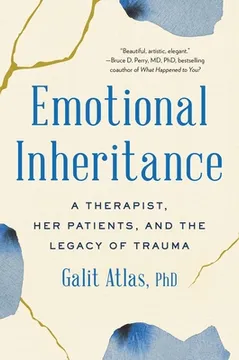


Key Takeaways
Treat family silence as evidence, not proof, of emotional inheritance
Pain can cross generations. Atlas uses emotional inheritance to describe how unprocessed family trauma shapes descendants’ feelings, bodies, choices, and relationships. It may pass through caregiving, silence, family roles, and social conditions, alongside possible biological effects. It does not mean descendants literally possess an ancestor’s memories.
Clues can appear sideways. Noah spent years collecting obituaries and imagining a dead twin. After his mother died, his father revealed that an older baby named Noah had died shortly before Noah’s birth. Rachel’s recurring childhood dream of fleeing with a baby gained context when she learned that her grandfather’s infant daughter, Ruth, had been murdered at Auschwitz. Their distress became more understandable once it could be connected to a family history.
The book’s central idea is strongest when inheritance means patterns of feeling and relationship, not a hidden memory transmitted intact. Research on descendants of trauma survivors has found differences in stress responses, but biology alone cannot explain an individual’s symptoms or establish what happened in a family. Silence, parenting, discrimination, and shared stories also shape development. The distinction matters: treating a family history as a possible source of meaning can open inquiry, while treating it as proof risks turning a compelling interpretation into a supposed fact.
Follow symptoms backward, but let the evidence stay uncertain
Notice what repeats. Atlas describes therapy as a careful investigation of words, pauses, dreams, bodily reactions, and missing pieces in a person’s account. A symptom is a clue to explore, not a coded message with one guaranteed answer. When Dana sought help to control her tears, her grief over her brother’s death gradually became speakable. The therapist’s own strong response also connected with her family history, though she recognized that resonance only as the work unfolded.
Interpretation needs restraint. Lara’s grandmother repeatedly accused Lara’s older half brother of sexual abuse, but investigations found no evidence. Later, Lara learned that her grandmother had experienced sexual abuse herself. That history helped make sense of the grandmother’s fear and behavior, but it could not by itself establish exactly what happened to Lara.
The detective metaphor captures an important clinical skill: attention to patterns that ordinary conversation may miss. It also carries a risk. A therapist’s emotional response can reveal a useful connection, but it can also reflect the therapist’s own history; a family resemblance is not independent confirmation. This is especially important when a child’s abuse is uncertain. Good inquiry makes space for competing possibilities, distinguishes emotional truth from factual certainty, and lets the person’s own account develop without supplying a plot in advance.
A childhood event can acquire its traumatic meaning years later
Memory is reworked over time. Freud’s term afterwardness describes how an early event can be revisited and understood differently as a person reaches new stages of life. The event may not have made sense to a child when it happened; later knowledge, relationships, or experiences can change what it means.
Lara’s family shows the process. As a child, Lara played Little Red Riding Hood, insisting that her story had no wolf, while her grandmother’s accusations and warnings about bodies left her confused. As an adult, Lara learned that her grandmother had been sexually abused by an older brother and had never discussed it with her own mother. That history offered context for the grandmother’s protective behavior and troubling boundaries. It did not make Lara’s childhood a simple, fully knowable story.
This account usefully challenges the idea that memory is a finished recording that either remains clear or fades. Development changes the concepts available for understanding an event, and later relationships can provide language for what once felt only strange or frightening. Yet retrospective meaning is not the same as recovered evidence. The same childhood memory can support several interpretations. A careful approach can honor how an experience feels now while remaining modest about claims concerning what another person intended or what exactly occurred.
Notice when a rescue fantasy repeats the wound it means to heal
Reparation can turn compulsive. Atlas uses reparation for the wish to repair damage and care for people who have been hurt. In Eve’s case, an affair with Josh seemed to restore a neglected woman’s sense of being wanted and cared for. The connection echoed the care she had missed and the loss her mother experienced when her own mother died. The affair began when Eve’s daughter was twelve, the age Eve’s mother had been when her mother became ill.
A perfect fix is impossible. After Eve’s son had an asthma attack while she was away with Josh, she saw how the affair was pulling her away from her children. Atlas calls endless, action-driven efforts at total repair manic reparation. They promise to erase the past, but can repeat its injuries. Mourning what cannot be undone lets Eve choose what to do next.
Eve’s story shows why a behavior can feel both life-giving and destructive. A relationship may meet real needs while also reenacting an old wound; identifying one function does not cancel the other. The idea of manic reparation is useful beyond therapy because it distinguishes care from fantasies of total control. At the same time, a clinician should avoid reducing an affair to childhood history alone. Present-day desire, unmet needs, and personal responsibility remain part of the picture.
Grieve losses your family could not publicly recognize
Some losses remain unnamed. Leonardo mourned his breakup with Milo for years, yet the grief seemed larger than the relationship. A dream of Milo knocking at a bathroom door reminded him of his father, who as a boy had tried to reach his own father before finding him dead by suicide. Family members had concealed the suicide and its circumstances.
Recognition makes grief possible. Leonardo’s aunt eventually disclosed that his grandfather had secretly had sex with men, in a time and family context that made an open life difficult. Leonardo came to imagine that his grandfather had lost a man he loved, but the exact relationship and the cause of the suicide remained unknown. The concept of grievability describes how a loss may be hard to mourn when the relationship itself was denied recognition.
This story makes a valuable distinction between the fact of a death and the social recognition of what was lost. People can be left grieving a relationship they were never permitted to name, while descendants inherit the family’s silence and shame. The interpretation of Leonardo’s grandfather’s love is meaningful, but the evidence does not establish that a breakup caused his suicide. That uncertainty strengthens the broader point: mourning can include an honest account of what remains unknowable.
An infant’s early relationships shape expectations, but do not seal a fate
A baby is already in relationship. Atlas draws on infant research showing that babies respond to caregivers’ faces, voices, movements, and pauses. Care is not perfect synchronization. The book cites research estimating that caregiver and infant are mismatched much more often than they are in sync, while emphasizing the importance of reconnecting after a mismatch.
Jon’s story gives this idea weight. He learned as an adult that his mother had not wanted another baby, and that his sister Jane died months after he was born. He had grown up feeling invisible and responsible for others. When his own daughter fell, his sudden collapse revived old fears of death and rejection. Therapy helped him give those feelings a history. The book’s term unwelcome child describes a baby born into an unwanted pregnancy, not a fixed destiny for that person.
The emphasis on repair, rather than flawless attunement, is psychologically humane. It suggests that relationships can recover from ordinary failures of attention and that reliable reconnection matters. Early caregiving research supports the importance of responsiveness, but it cannot reconstruct the precise experience of a particular infant decades later. Nor does an unwanted pregnancy determine a child’s later mental health. Jon’s story is best read as one person’s developing account, not a universal formula linking parental ambivalence to a specific adult crisis.
When grief cannot be fixed, offer presence instead of optimism
Witnessing is a form of care. Naomi idealized her closest friend, Isabella, and struggled to face the fact that Isabella was dying of cancer. Isabella prepared boxes of letters and gifts for her children, meant for future milestones. Naomi wanted to reassure her friend that treatment might work, but Isabella needed someone to bear the reality of saying goodbye.
No one knows a person completely. After Isabella died, a grieving man came to Atlas for help and revealed that he had been Isabella’s secret lover. Atlas referred him elsewhere to protect Naomi’s treatment and privacy. The discovery showed that even a close friend and a therapist who had heard years of stories could know only part of Isabella’s life. Grief needs company, but not a claim of total knowledge.
The scene captures a common failure of comfort: reassurance can protect the speaker from helplessness while leaving the grieving person alone with reality. Presence, listening, and tolerating silence can be more useful than advice. The secret lover complicates the story without making Naomi’s friendship false. Relationships are partial, and people may sustain different forms of intimacy that never meet. That limit calls for humility, not cynicism, when accompanying someone through loss.
Treat tears as strength, not a failure of masculinity
Invulnerability carries a cost. Ben had been a teenage soldier in an elite Israeli unit and had killed a man during an operation. He had spent decades treating the experience as something he could not discuss. When his wife became pregnant, he began having flashbacks and eventually cried for the dead man and the children who had lost their father.
History can shape a soldier’s role. Ben’s family carried poverty, migration, and shame about being treated as culturally inferior in Israel. Military success offered pride and a way to feel powerful, but it also drew him into violence. His father had told him not to cry when he entered the army. In Ben’s dream, as he prepared to become a father himself, that same father gave him permission to feel grief.
Ben’s story links private emotion to social expectations about gender, war, and belonging. A culture can reward toughness while leaving individuals without a way to process fear, guilt, or injury. His tears do not undo the harm he caused, but they help him face it rather than hide behind a heroic identity. Emotional expression is not automatically healing, either; it matters whether feeling is accompanied by accountability, reflection, and support.
Interrupt inherited violence by naming the child you once were
Victims can identify with aggressors. Guy grew up with a father who locked him and his brother in a bathroom when angry. As an adult, Guy struggled to condemn an abusive father in a court case, partly because he empathized with the man and feared his own anger. Atlas uses identification with the aggressor for a child’s attempt to gain control by adopting an abuser’s outlook or behavior.
A new response can break the pattern. After talking about his childhood, Guy voted that the father in the case was guilty. He was not required to excuse his own father or deny the family history. Instead, he could recognize the abused child he had been and take the child’s side. Leaving home had helped him survive, but the old fear still shaped his relationships and his ability to trust.
Guy’s change is not a simple story of forgiveness. It is a shift in allegiance, from protecting the family’s account of the father to recognizing the child’s harm. Research on learned behavior and family violence likewise points to the importance of interrupting patterns, though individual choices are shaped by broader conditions and support. Compassion for an abuser’s history can coexist with firm judgment of abusive acts. Understanding origins need not become an excuse.
Tell enough family history to create meaning, not overwhelm
Silence and exposure both have costs. Rachel knew that her grandfather survived Auschwitz, but relatives rarely described what happened. As a child she had recurring dreams of running with a baby and kept a knife under her pillow. As an adult, learning that Ruth, the baby murdered with her grandfather’s wife, was a real family member gave those fears a story.
Memory needs careful pacing. Holocaust Remembrance Day in Israel makes history public through lessons, rituals, and a national siren. Atlas describes the tension between preserving memory and exposing children to more horror than they can process. Rachel chose to learn more, traveled to Israel with her baby, and connected the family’s fragments. Her newborn daughter’s name honored the lost relative and joined family memory to a living future.
Rachel’s experience suggests that children need neither a wall of silence nor an unfiltered archive of atrocity. They need truthful, age-appropriate stories and adults who can help them make sense of fear. Collective commemoration can preserve history and solidarity, but repeated exposure to traumatic imagery can also distress people who did not experience the original events. The key question is not simply whether to remember, but how to make memory bearable, contextualized, and open to questions.
Become a parent without making your child repair your childhood
Parenthood can awaken old loyalties. Alice feared that her daughter would inherit her family’s pain and initially wished the baby did not share her genes. She was using a surrogate and egg donor after years of failed fertility treatment. Her distress included fear that she would not be a real mother if she did not give birth or breastfeed.
Separate your needs from your parents’. Alice had rejected her father after he left the family, largely while protecting her mother, who had also experienced profound loss. Therapy helped her recognize her own grief and see both parents as imperfect people. She considered accepting her father’s financial help and chose a name meaning life for her daughter. The work was not to erase the past, but to let the child begin without being assigned the job of healing it.
Alice’s case shows how a new family can expose the old family’s unspoken contracts. Her shift toward accepting help does not require declaring her father innocent or her mother wrong; it creates room for more than one attachment and more than one truth. The reproductive details also challenge narrow assumptions about what makes someone a mother. Still, no amount of self-understanding guarantees a parent will avoid repeating every pattern. Reflection offers choices and repair, not perfection.
Analysis
Emotional Inheritance is organized as a journey through family time: grandparents’ trauma, parents’ secrets, and the adult child’s chance to interrupt repetition. Its method is storytelling rather than a universal checklist. Each case begins with something that seems disconnected from the past, such as a dream, an affair, a fear of death, or a difficulty becoming a parent. The therapeutic work asks what history might give that experience meaning. This structure makes psychoanalytic ideas vivid and shows how the therapist’s own memories and feelings can enter the work.
The book’s most useful distinction is between processing the past and repairing it. Descendants may try to rescue an ancestor, repeat a family role, or avoid a loss by carrying it silently. Naming, mourning, and tolerating ambivalence can create a different relationship to that history. The stories also resist simple moral categories: an affair can be damaging and meet a real need; a violent parent may have been harmed and still be responsible for harm; a family secret can protect and injure at once.
The approach needs an epistemic boundary. A symptom or family resemblance can suggest questions, but it cannot independently prove a hidden event or its cause. That caution matters especially in accounts involving childhood abuse, early infancy, and suicide. The epigenetic research described in the book offers a biological dimension to intergenerational risk, but such findings do not mean trauma is inherited as a specific memory or that a person’s fate is encoded in their genes. Social context, caregiving, and individual experience also matter.
The book is most persuasive when its interpretations remain invitations rather than verdicts. Its deepest practical lesson is not that every difficulty conceals an ancestor’s trauma. It is that unexplained patterns deserve curiosity, and that honest curiosity must include uncertainty. A person can honor family history without being ruled by it, and can acknowledge inherited pain without making the next generation responsible for healing it.
People Also Read




Glossary
Emotional inheritance
Family trauma’s emotional legacyThe ways unprocessed experiences in one generation influence the feelings, relationships, choices, and symptoms of descendants. Atlas describes transmission through silence, caregiving, family roles, identification, and social conditions, as well as possible biological stress effects. The term does not mean that descendants literally remember events they never experienced.
phantom
A hidden family secret’s traceA term used by psychoanalysts Nicolas Abraham and Maria Torok for the effects of an unspoken or unprocessed experience that appears in descendants without being clearly understood. A phantom is not a literal ghost or an inherited memory. It describes how a family secret can shape feelings and behavior while remaining outside conscious knowledge.
radioactivity of trauma
Trauma’s spreading emotional effectsYolanda Gampel’s metaphor for the effects of large-scale violence that reach people who did not directly experience it, including later generations. Like radiation, the metaphor suggests an impact that may be difficult to see or name but can appear in emotional and physical distress. It describes psychological and social effects, not literal radiation.
confusion of tongues
Tenderness confused with exploitationSándor Ferenczi’s term for the mismatch between a child’s language of affection and an abuser’s sexualized or exploitative intentions. Because abuse may be mixed with attention, affection, or promises of special closeness, a child can struggle to distinguish care from violation and may feel confused or responsible.
afterwardness
Later meaning reshapes early experienceFreud’s idea that an earlier experience can acquire new meaning when it is revisited from a later stage of development. A child may not understand an event as traumatic when it occurs, while later relationships, knowledge, or life transitions change how it is remembered and felt. Later interpretation adds meaning but does not automatically prove a specific memory.
dead mother
An emotionally unavailable caregiverAndré Green’s term for a mother who is psychologically withdrawn or emotionally unavailable, often after a significant loss or depression. The child may continue trying to revive the relationship by seeking connection, or may become emotionally withdrawn in response. The term describes emotional absence, not literal death.
manic reparation
Compulsive attempts at total repairA defensive form of reparation in which a person repeatedly acts to undo damage or loss as if complete repair were possible. Because the effort avoids grief and human limits, it cannot achieve its imagined goal and may repeat the very pattern it is meant to fix. It contrasts with creative, realistic care that allows mourning.
unwelcome child
A child conceived without welcomeSándor Ferenczi’s term for a child born into an unwanted pregnancy or a family situation in which the child was not fully welcomed. In his clinical account, such histories could relate to pessimism, mistrust, and wishes to die. The concept is a psychoanalytic hypothesis, not a diagnosis or a prediction of any individual child’s future.
emotional holding
A caregiver’s steady emotional presenceWinnicott’s idea of a caregiver providing a dependable presence that can receive and respond to an infant’s feelings and signals. Like physical holding, it helps the child feel protected and able to rely on others. When that support is insufficient, a child may turn inward rather than seek comfort.
identification with the aggressor
Adopting an abuser’s outlookAnna Freud’s term for a defense in which a threatened child adopts aspects of an aggressor’s behavior or beliefs. This can create a temporary sense of control and reduce helplessness, but it may also lead the child to accept blame, repeat harmful patterns, or direct aggression toward others or themselves.
grievability
Social recognition of a lossJudith Butler’s term for the cultural recognition that a life or relationship matters and that its loss deserves mourning. When a relationship is hidden, stigmatized, or denied, those affected may be unable to grieve it openly. The resulting sorrow can remain difficult to name, including for later generations.
epigenetics
Environment affects gene expressionThe study of how environmental conditions can influence whether genes are expressed, without changing the underlying DNA sequence. The book discusses research on stress and descendants of people who experienced major trauma. Such research concerns patterns of risk and biological response; it does not show that specific family memories are encoded in genes or make outcomes inevitable.
Download PDF
Download EPUB
.epub digital book format is ideal for reading ebooks on phones, tablets, and e-readers.








