

Key Takeaways
Treat capitalism as a transition, not Russia's forbidden detour
Capitalism makes its own market. Lenin argues against the Narodniki, who imagined Russia could bypass capitalism and move from a peasant commune directly to socialism. In his account, specialization separates activities from farming, turns products into commodities, and draws more people into industry. As small producers lose control of their tools and land, they become wage workers, while their former means of production become capital. Together, these changes create buyers for both consumer goods and industrial equipment. The home market is not a separate prerequisite that must be found before capitalism begins. It develops as capitalism reorganizes production and labor.
A disputed historical claim. Lenin presents this process as both a theory and a reading of Russian economic data. His larger point is that socialists should analyze the economic relations already taking shape, rather than derive a political program from an idealized national tradition.
What's striking is the methodological move: Lenin treats a supposedly timeless peasant community as a changing economic system, not a cultural essence. That resembles later approaches in economic sociology, which trace markets through shifts in work, property, and exchange rather than treating them as natural institutions. The approach can expose hidden wage labor and inequality. Its limitation is that a general theory of capitalist development may flatten regional variation or make one path seem inevitable. The useful habit is to test claims about a society against relationships of production, while staying alert to evidence that does not fit the model.
Look for class divisions inside the village, not a united peasantry
The commune is not classless. Lenin describes Russian peasants as increasingly dependent on markets, loans, and competition for land. He calls the resulting split the disintegration of the peasantry: a smaller rural bourgeoisie accumulates land and equipment, while a large rural proletariat survives partly by selling its labor. Between them, middle peasants face an unstable position and can be pushed downward by poor harvests or debt. Lenin estimates that wealthy households were roughly one-fifth of peasant households, while rural proletarians could account for about half. These are his broad estimates, not precise counts for every district.
Change has two faces. The same transformation can raise production and deepen inequality. Lenin argues that the village commune does not protect peasants from capitalism; its internal economic relations already include employers, wage workers, creditors, and debtors.
The argument anticipates a central insight of stratification research: shared identity does not guarantee shared material interests. A village, occupation, or community can contain owners, debtors, employers, and workers at the same time. That lens is valuable wherever averages obscure who controls assets and who depends on wages. Still, class categories can understate other ties, including kinship, local obligation, and collective resource management. Lenin's analysis is strongest as a demand to disaggregate the category of peasant, not as proof that every communal institution is merely a disguise for capitalism.
Follow concentration until competition hardens into monopoly
Three forms of industry. Lenin traces Russian industry through small commodity production, manufacture organized around a division of labor, and large-scale machine production. He argues these are connected stages, not separate worlds: a small craft producer could become a manufacturer and eventually a factory owner. The Morozov family illustrates that path. Savva Morozov began as a peasant and weaver; by 1890, four family factories employed 39,000 workers.
Scale changes power. Lenin cites figures showing that in the United States in 1909, about 1.1 percent of industrial enterprises produced 43.8 percent of output. As production concentrates, a small number of firms can coordinate prices and markets through cartels, syndicates, and trusts. For Lenin, this is not competition disappearing completely, but competition producing powerful monopolies that can dominate smaller firms and workers.
The memorable mechanism is cumulative advantage: larger firms can secure financing, equipment, supply chains, and market access that make entry harder for rivals. Contemporary industrial organization still studies how concentration affects prices, innovation, and bargaining power. But concentration alone does not establish that every large firm behaves as a cartel, or that monopoly always suppresses technical change. Lenin's examples make a strong case for examining control and market structure rather than counting firms alone. His wider political conclusion depends on how those economic advantages translate into influence over workers and governments.
Read imperialism as finance capital exporting power, not merely flags
A broader definition. Lenin uses imperialism to describe a stage of capitalism marked by concentrated production, monopolies, close ties between banks and industry, large-scale capital exports, international business combinations, and the division of territories among major powers. In this account, empire is not only direct colonial rule. A formally independent country can still depend on foreign loans, investment, and diplomatic leverage.
Rivalry survives agreements. Lenin points to international cartels that divided markets, including an electrical-industry agreement between major American and German firms. Such arrangements could reduce competition for a time, but they did not end rivalry. Because countries and firms develop at different rates, Lenin argues, the balance of power shifts and shared territories or markets can be contested again. Capital exports, he says, link investment abroad to political pressure and commercial advantages at home.
This framework usefully connects corporate finance to geopolitics: loans and infrastructure can create influence without formal annexation. It also directs attention to who sets the terms of investment and who receives its returns. The analysis resembles later work on dependency and global value chains, where political independence can coexist with economic vulnerability. Its weakness is the temptation to treat every foreign investment as extraction or every conflict as a direct consequence of capital. A careful application distinguishes coercive dependence from mutually beneficial exchange and considers domestic actors who shape how external capital is used.
Make political education reach beyond the factory gate
Grievances are a beginning. Lenin values reports exposing factory abuses because they can help workers organize for better conditions. But he argues that a struggle limited to wages and workplace rules remains trade-union politics. To develop a broader political outlook, organizers should connect workers' experiences to other forms of state power and social conflict.
Widen the field of attention. Lenin points to police repression, censorship, the treatment of students, and violence against peasants as issues that can reveal common structures of authority. His proposed model is a political press that investigates events across society and explains their significance to workers. The aim is not to abandon workplace organizing, but to connect it with the interests of other groups and with the fight against the autocracy. Political learning, in this view, comes from interpreting concrete events, not only from abstract instruction.
Lenin's insight is that political understanding grows by comparison: workers can recognize patterns of power when they see how institutions treat people beyond their own workplace. This resembles civic education grounded in case analysis, where specific events make abstract rights and institutions legible. It also offers a way to build coalitions without pretending that all groups have identical interests. The challenge is editorial: an organization that claims to interpret every event can confuse its own line with political education. Credible analysis needs evidence, space for disagreement, and a clear distinction between reporting and persuasion.
Turn spontaneous protest into durable, coordinated organization
Protest does not organize itself. Lenin distinguishes spontaneous labor action from a movement with a developed political program. He treats strikes as important signs of workers' growing ability to act together, while arguing that workplace experience alone does not produce a complete theory of society or a plan to challenge state power. In his account, socialist consciousness must be developed through political education and organization.
The early circles were fragile. Small groups of students and workers often grew quickly, then collapsed when police arrested their leaders. Lenin describes this as a problem of untrained organizers, weak links between local groups, and little continuity. He therefore calls for planned work that can preserve knowledge and coordination as mass participation expands. His claim is not that mass action is unimportant, but that its scale increases the need for political and organizational capacity.
The tension between emergence and design remains familiar in social movements: decentralized action can mobilize quickly, while durable institutions help preserve memory, strategy, and coordination. Lenin's account warns against romanticizing spontaneity as automatically emancipatory. Yet the reverse danger is real too. Leaders may claim that their theory speaks for a movement while filtering out participants' own priorities. Organization is most defensible when it increases members' ability to act and learn together, rather than treating them as raw material for a program set elsewhere.
Separate broad worker organizations from clandestine revolutionary leadership
Different work needs different structures. Writing under Tsarist repression, Lenin distinguishes broad workers' organizations from a smaller organization of professional revolutionaries. Trade unions should include workers who want to organize around shared economic interests. The revolutionary organization, by contrast, should be compact, trained, and secret enough to withstand police raids. Lenin argues that confusing these bodies can expose a mass organization to repression without giving it the capacity to lead a wider political struggle.
Coordination reduces wasted effort. He also favors a shared all-Russian newspaper over a proliferation of short-lived local papers. A central publication, in his view, can carry investigations between regions, build continuity, and coordinate local work. The argument is shaped by illegal conditions: police surveillance and arrests made open, stable organization difficult. Lenin's solution is central coordination of secret tasks, alongside wider participation in less sensitive work.
This is an organizational design argument shaped by a specific risk environment, not a universal case for secrecy. In authoritarian settings, compartmentalization can protect people and preserve communications. In open settings, the same structure can reduce accountability and concentrate authority. Modern organizational theory would ask how information moves, who can challenge decisions, and how leaders are replaced. Lenin's distinction is useful because it rejects the idea that every organization should use the same membership rules. Its unresolved problem is how a secret leadership remains answerable to the broad movement it claims to serve.
Treat the state as class power, not a neutral referee
Institutions embody power. Lenin draws on Marx and Engels to describe the state as a system of authority that arises amid class conflict. Its standing army, police, prisons, and bureaucracy are not simply administrative conveniences; in this analysis, they help maintain the power of the economically dominant class. Elections and parliamentary institutions can offer real political participation, yet Lenin argues that they do not by themselves remove the influence of wealth or the coercive apparatus of the state.
Democracy has limits. The argument distinguishes formal political rights from the material ability to use them. Poverty, unequal access to public platforms, and the influence of money can restrict participation even where voting exists. Lenin therefore rejects the assumption that a democratic republic is automatically above class interests. He sees it as a political form that can still protect capitalist power.
The distinction between formal rights and effective capacity remains important in political science. Voting rights matter, but so do money, media access, administrative discretion, and the ability to organize without fear. Lenin's framework directs attention to those material conditions rather than judging democracy by constitutional language alone. It can, however, become too totalizing if every institution is treated as nothing but an instrument of class rule. States also provide public goods and arenas for contestation. The analytical task is to examine both their coercive functions and the ways citizens can constrain them.
Replace inherited state machinery with accountable, working institutions
The Commune as a model. Lenin reads the Paris Commune of 1871 as evidence that revolution cannot simply place new leaders atop the existing bureaucracy and army. The Commune replaced the standing army with an armed population and made officials elected, recallable, and paid at ordinary workers' rates. It combined lawmaking and administration in working bodies rather than leaving elected representatives as distant talkers. For Lenin, these measures begin to dismantle the separation between rulers and ruled.
Change the apparatus, not just its occupants. The Commune was defeated, but Marx treated it as a practical experiment from which later movements could learn. Lenin argues that its shortcomings do not cancel its institutional lesson: a new class needs new forms of public power. The replacement remains a state during the transition, because it must suppress resistance from the former ruling class, but its structure should make privilege and bureaucracy harder to reproduce.
The Commune's design speaks to a durable problem in democratic governance: elected officials can become insulated from the people who chose them. Recall, limited pay, and direct responsibility are mechanisms for reducing that distance. Yet direct control and constant accountability can also make administration unstable or encourage decisions driven by immediate pressure. Complex public services require expertise as well as oversight. The strongest reading is not that every office can be made simple, but that expertise should remain transparent, constrained, and answerable rather than becoming a protected social stratum.
Distinguish socialism's unequal first phase from communism's promised abundance
A transition, not an instant transformation. Lenin presents socialism as the first phase of communist society, emerging from capitalism with its habits and inequalities still partly intact. Private ownership of major productive resources is abolished, but distribution initially remains tied to labor performed. People with different needs or capacities may therefore receive unequal benefits, even without exploitation by private owners. Marx's analysis, as Lenin presents it, rejects the promise that equality in ownership instantly produces equality in outcomes.
The higher phase requires different conditions. Lenin links a society organized around need rather than measured labor to abundant production, changed patterns of work, and the fading of class divisions. The state does not vanish by decree. Its coercive functions are expected to diminish as class conflict and material scarcity recede. Lenin gives no precise timetable and insists that the higher phase cannot simply be introduced by political command.
The staged account usefully separates ownership reform from the harder questions of distribution, incentives, and administrative capacity. It avoids pretending that a new legal structure immediately changes social habits or material scarcity. Its most demanding premise is that abundance and altered social relations will weaken coercive institutions rather than create new reasons for control. That proposition is a political hope as much as an economic forecast. Any real transition would need safeguards against officials turning temporary authority into permanent privilege, especially when the promised endpoint is distant and difficult to measure.
Analysis
This collection's argument moves from economic diagnosis to political design. Lenin first disputes the claim that Russia can preserve a supposedly noncapitalist peasant world, then treats market dependence and class differentiation as evidence that capitalism is already remaking it. His account of industrial concentration extends the same method: follow changes in production and ownership until private competition produces monopolies, finance capital, and international rivalry. The result is a theory in which capitalism creates both vast productive capacity and conflicts it cannot reliably contain.
The political writings turn that diagnosis into an organizational prescription. A movement cannot, Lenin argues, rely on workplace grievances or spontaneous protest alone. It needs political education, continuity, coordination, and specialized organizers. The same confidence in purposeful design shapes his account of revolution: the working class must not simply inherit the existing state, but construct institutions intended to reduce bureaucracy and privilege. The Commune supplies his practical example, while the transition from capitalism to communism supplies the temporal frame. The state persists during a period of class conflict, then is expected to lose its coercive function as classes disappear.
The work's enduring intellectual strength is its insistence that economic structures and political forms must be analyzed together. Its unresolved tension is that the means proposed to secure emancipation concentrate authority in an organization claiming to represent a broad class. Secrecy, discipline, and centralized direction may answer the immediate dangers of autocracy, yet they can also weaken accountability and pluralism. The projected future of self-government therefore depends on institutions resisting the very concentration of power they use to win. Readers can take Lenin's diagnostic questions seriously without treating his answers as self-validating: who owns productive resources, who controls public institutions, how does a movement learn, and what keeps temporary authority temporary?
Review Summary
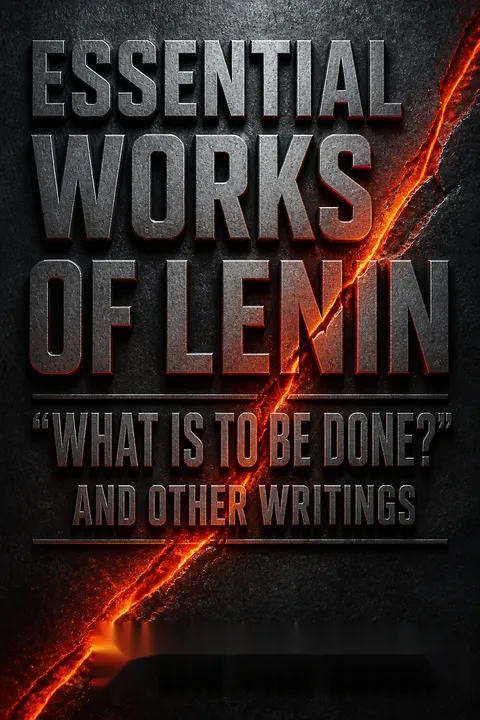
Essential Works of Lenin receives mostly positive reviews, with readers praising Lenin's passion, clarity, and revolutionary ideas. Many find his writings still relevant today, particularly on imperialism and capitalism. Some criticize the Dover edition for omissions and translation issues. Readers appreciate Lenin's arguments but note his authoritarian tendencies. The collection is seen as crucial for understanding 20th-century history and Marxist-Leninist thought, though some find parts dated or difficult without historical context.
People Also Read








Glossary
Economism
Workplace struggle aloneA tendency in Russian Social-Democracy that gives priority to workers' immediate economic struggles, such as wages and factory conditions, while limiting broader political agitation and organization. Lenin argues that this approach leaves workers' movements vulnerable to ideas and strategies that do not challenge the political system as a whole.
spontaneity
Unplanned mass actionThe activity that arises from workers' own experience and initiative, including strikes and collective resistance. Lenin regards this activity as essential, but argues that it does not by itself produce a complete socialist political outlook or a durable organization. He calls for conscious political work to develop and coordinate it.
professional revolutionaries
Trained revolutionary organizersPeople who devote their working lives to revolutionary activity and develop the skills needed for political organization, communication, and work under repression. Lenin proposes a small, disciplined, secret organization of such people alongside broader workers' organizations, especially in the conditions of Tsarist Russia.
imperialism
Monopoly-stage capitalismLenin's term for a stage of capitalism in which concentrated production creates monopolies, banks and industry become closely connected, capital is exported on a large scale, international monopolies divide markets, and major powers divide territories among themselves. He argues that uneven development fuels rivalry and makes peaceful agreements temporary.
finance capital
Bank-industry fused capitalCapital formed through the close union of banking and industrial interests, under the influence of concentrated banks and monopolist firms. In Lenin's account, finance capital enables a small financial oligarchy to influence production, investment, government, and international relations, including through loans and overseas investment.
dictatorship of the proletariat
Workers' transitional class ruleLenin's name for the political power of the working class after the overthrow of capitalist rule. He presents it as a transitional state that suppresses resistance from former exploiters while reorganizing production and society. In his theory, it differs from both capitalist class rule and the eventual classless society.
withering away of the state
State coercion gradually disappearsThe gradual disappearance of the state's coercive functions as class divisions and the need to suppress one class by another come to an end. Lenin distinguishes this process from the revolutionary destruction of the existing bourgeois state apparatus. He argues that the state can disappear fully only under advanced communism.
Commune
Paris's elected revolutionary governmentThe Paris government formed during the 1871 uprising, which Marx and Lenin treat as an experiment in working-class political power. Its measures included an armed population in place of a standing army, elected and recallable officials, and limits on officials' pay. Lenin sees it as a model for replacing, rather than inheriting, the old state machinery.
FAQ
What is Essential Works of Lenin: "What Is to Be Done?" and Other Writings by Vladimir Lenin about?
- Comprehensive Lenin anthology: The book collects four of Lenin’s most influential works, providing a broad overview of his theories on capitalism, imperialism, revolutionary organization, and the state.
- Theory and revolutionary practice: It explores Lenin’s analysis of capitalist development, the necessity of a disciplined revolutionary party, the nature of imperialism, and the transition to a communist society.
- Historical context: The anthology situates Lenin’s writings within the political struggles of late Tsarist Russia, highlighting his opposition to rival socialist factions and his leadership of the Bolshevik movement.
Why should I read Essential Works of Lenin by Vladimir Lenin?
- Foundational Marxist texts: The book contains essential readings for understanding Marxist theory, revolutionary strategy, and the historical development of socialism.
- Blueprint for revolution: Lenin’s works offer practical guidance on organizing for social change, critiquing reformism, and building a disciplined movement.
- Insight into 20th-century history: The writings illuminate the ideological and political roots of the Russian Revolution and the global impact of Leninist thought.
What are the key takeaways from Essential Works of Lenin by Vladimir Lenin?
- Role of the revolutionary party: Lenin emphasizes the need for a centralized, professional organization to lead the proletariat.
- Analysis of capitalism and imperialism: The book details how capitalism evolves into monopoly capitalism and imperialism, leading to global exploitation and conflict.
- Theory of the state and revolution: Lenin argues that the state is an instrument of class oppression, which must be smashed and replaced by a proletarian state that will eventually wither away.
What are the most important quotes from Essential Works of Lenin by Vladimir Lenin and what do they mean?
- “Imperialism is the highest stage of capitalism.” This means that capitalism inevitably leads to monopoly and global domination by a few powers.
- “The state is an organ of class rule, an organ for the oppression of one class by another.” Lenin underscores the state’s function as a tool for maintaining class dominance.
- “Without revolutionary theory there can be no revolutionary movement.” This highlights the necessity of clear, disciplined ideology for successful revolution.
How does Vladimir Lenin define imperialism in Essential Works of Lenin?
- Monopoly capitalism: Imperialism is described as capitalism’s stage of monopoly, where a few large enterprises dominate economic life.
- Fusion of finance and industry: Lenin identifies the merging of bank and industrial capital, forming a financial oligarchy.
- Global division and exploitation: Imperialism is marked by the export of capital, the division of the world among great powers, and the economic subjugation of less developed nations.
What is Lenin’s theory of the state and revolution in Essential Works of Lenin?
- State as class oppression: Lenin sees the state as a tool for maintaining the dominance of the ruling class through special bodies of armed men.
- Necessity of smashing the state: He argues that the proletariat must destroy the bourgeois state apparatus, not simply take it over.
- Dictatorship of the proletariat: A transitional proletarian state is necessary to suppress the bourgeoisie and reorganize society, eventually leading to the state’s “withering away.”
Why does Vladimir Lenin emphasize the need for a professional revolutionary organization in What Is to Be Done??
- Leadership over spontaneity: Lenin argues that spontaneous mass movements are insufficient; a disciplined, centralized party is essential for revolutionary success.
- Secrecy and specialization: He advocates for a core of professional revolutionaries, trained to withstand repression and guide the movement.
- Distinction from trade unions: Lenin differentiates between broad economic organizations and the secret, political work required for revolution.
How does Vladimir Lenin critique “Economism” and trade union politics in What Is to Be Done??
- Limits of trade unionism: Lenin criticizes those who focus solely on economic demands, arguing that this approach cannot challenge the autocracy.
- Political struggle is essential: He insists that Social-Democratic politics must address the broader fight against the state, not just employers.
- Need for political agitation: Lenin calls for exposing the regime’s abuses and mobilizing workers for revolutionary, not just reformist, goals.
What is Lenin’s critique of “freedom of criticism” within the socialist movement in What Is to Be Done??
- Opportunism disguised as freedom: Lenin contends that calls for “freedom of criticism” often mask attempts to dilute revolutionary Marxism with reformist ideas.
- Threat to party unity: He warns that unrestricted criticism undermines discipline and the effectiveness of the revolutionary party.
- Historical lessons: Lenin cites examples from other socialist movements where such “freedom” led to splits and the rise of opportunism.
How does Vladimir Lenin explain the relationship between spontaneity and class consciousness in What Is to Be Done??
- Spontaneity is insufficient: Lenin acknowledges the value of spontaneous mass action but argues it only produces basic, trade union consciousness.
- Consciousness from outside: He insists that socialist consciousness must be brought to the working class by a revolutionary party.
- Role of the party: The party’s task is to educate, organize, and lead the proletariat beyond immediate economic struggles toward political revolution.
What are the main organizational principles advocated by Vladimir Lenin in What Is to Be Done??
- Strict secrecy and selection: Lenin stresses the need for rigorous selection and secrecy to protect the organization from repression.
- Centralization of leadership: He calls for centralizing secret functions among a small group of professional revolutionaries.
- Training and specialization: Lenin emphasizes training workers to become professional revolutionaries, capable of organizing and leading the movement.
How does Vladimir Lenin connect imperialism to opportunism within the labor movement in Essential Works of Lenin?
- Imperialism breeds opportunism: Lenin argues that monopoly profits from imperialism corrupt sections of the working class, fostering reformist tendencies.
- Concealment of exploitation: He warns that opportunism often conceals the true nature of imperialist exploitation and undermines revolutionary goals.
- Necessity of combined struggle: Lenin insists that fighting imperialism must go hand-in-hand with combating opportunism to maintain revolutionary clarity and effectiveness.
About the Author
Other books by Vladimir Lenin

Download PDF
Download EPUB
.epub digital book format is ideal for reading ebooks on phones, tablets, and e-readers.








