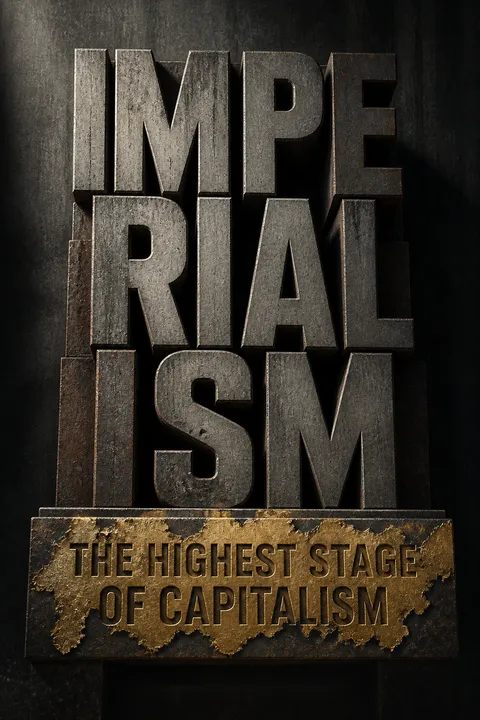


Key Takeaways
Read imperialism as monopoly capitalism, not merely an appetite for conquest
A structural definition. Lenin uses imperialism to describe a developed phase of capitalism, not just aggressive foreign policy. Its defining features are concentrated industries that form monopolies, banks fused with industrial firms, capital invested abroad, international business combines dividing markets, and powerful states dividing territory among themselves. These forces reinforce one another: monopolies and finance shape investment, while access to resources and markets becomes a contest among states.
Why the label matters. Written during the First World War, the book argues that war and diplomacy cannot be understood through leaders’ stated intentions alone. They must also be examined against the economic interests and power relationships of the ruling classes. Lenin’s account is both an economic explanation and a political argument for revolutionary opposition.
The definition’s strength is that it links corporate structure, finance, and geopolitics rather than treating empire as a matter of national temperament. That systems view remains useful: a foreign policy decision can serve interests that are dispersed across lenders, producers, and governments. The risk is that a tightly connected explanation can become too totalizing. Economic incentives help explain political choices, but institutions, ideology, security concerns, and public pressure can also redirect them.
When production concentrates, competition can build monopolies that dictate terms
Scale changes the contest. Lenin argues that large firms can outproduce and outlast smaller rivals, making agreements to control prices, output, and markets increasingly practical. In Germany in 1907, enterprises employing more than 50 workers made up less than 1 percent of businesses but used over three-quarters of industrial steam and electric power. In the United States, firms producing at least $1 million in goods rose from 0.9 percent of enterprises in 1904 to 1.1 percent in 1909, while their share of output increased from 38 percent to nearly 44 percent.
Competition does not vanish. Cartels could punish outsiders by restricting supplies, cutting prices below cost, or denying credit. The book’s point is not that every industry becomes one firm, but that competition increasingly takes place under the pressure of a few dominant groups.
The figures make concentration tangible: a tiny number of firms can command a disproportionate share of productive capacity. In modern organizational terms, control over essential inputs and infrastructure can matter as much as formal market share. Yet concentration alone does not prove a monopoly can maintain power indefinitely. New technologies, regulation, and rival firms can unsettle incumbents. Lenin’s analysis is strongest as a warning about structural advantage, not as a claim that every large firm becomes invulnerable.
Track who controls credit to see how banks become industrial rulers
From cashier to controller. Banks begin as intermediaries, gathering deposits and lending money. As they consolidate, Lenin argues, they gain the ability to monitor companies, decide who receives credit, and shape industrial investment. German statistics cited in the book show that nine large Berlin banks held almost half of the country’s bank deposits in 1912-13. Including affiliated banks, nine major banks controlled about 83 percent of German bank capital in 1909.
Connections create command. Bank directors sat on industrial boards, while industrial leaders joined bank boards. Lending relationships could give a bank detailed knowledge of a company’s position, as well as leverage over its future. Lenin calls the resulting fusion of bank and industrial capital finance capital. Economic influence, in this account, rests not only on owning factories but also on controlling the channels through which factories obtain money.
The important insight is relational power. A lender need not own every enterprise to influence which projects survive, expand, or fail. This resembles the principal-agent problem: one party supplies resources while another makes decisions, but information and dependence can give the supplier leverage. The analogy has limits, since banks also face risk and competition, and borrowers can sometimes seek alternatives. Still, examining credit networks can reveal forms of control that ownership statistics alone miss.
Capital exports turn loans into leverage over markets, resources, and states
Money travels for returns. Lenin distinguishes the export of capital from the export of goods. When investment at home appears less profitable, financiers direct money abroad, where capital is scarce, labor is cheaper, and resources may be easier to secure. For 1914, estimates in the book put British, French, and German investments abroad together at 175 to 200 billion francs. At a 5 percent return, Lenin calculates, that could produce 8 to 10 billion francs in yearly income.
Loans arrive with strings. A foreign loan might require the borrower to purchase railway materials, ships, or weapons from firms in the lending country. It could also secure commercial privileges, construction contracts, or access to ports. Capital export therefore links private profit to diplomatic influence. For Lenin, the creditor’s position turns financial dependence into political leverage, even where a country retains formal independence.
The book usefully treats finance as more than a flow of money: lending can shape what a country builds and from whom it buys. This connects investment to bargaining power, a relationship that can persist without direct political rule. The caution is that the book’s figures and examples describe a specific historical period, and its account emphasizes extraction more than possible benefits such as infrastructure or employment. Both the gains and the dependencies need to be assessed, including who controls the resulting assets.
A fully partitioned world invites recurring fights to redraw its map
There are no empty squares. Lenin argues that the great powers had largely claimed the world’s available territory by the early twentieth century. His figures show the colonies held by six major powers growing from about 40 million square kilometers in 1876 to 65 million in 1914. Once territory was divided, further expansion meant taking influence or possessions from another power, not simply claiming unoccupied land.
Dependence has many forms. A country could be formally sovereign yet financially dominated. Lenin describes Argentina as heavily tied to British capital and Portugal as politically independent but reliant on Britain for protection and commercial access. These cases show why he treats imperial power as more than direct colonial government. Control over loans, trade, and strategic access could also make a state dependent, and competition over such arrangements could sharpen rivalry.
The map is a helpful metaphor for a broader economic problem: when access to scarce resources is secured through exclusive claims, newcomers may see expansion as the only route to power. This helps explain why changing distributions of influence can become politically volatile. But a fixed-sum model can obscure negotiation, shared governance, or mutually beneficial trade. The book’s argument is persuasive as an account of rival powers competing for advantage, though it should not be treated as proof that every international dispute must end in war.
Monopoly organizes production socially while keeping ownership and gains private
Planning grows inside capitalism. Large combines estimate demand, secure raw materials, coordinate transport, and organize production across many firms. Lenin sees this as increasingly socialized production: work is coordinated on a vast scale, even across national borders. Yet the profits and ownership remain in private hands, concentrated among a small group of investors and executives.
Coordination is not public control. In the book’s example of the electrical industry, the American General Electric Company and Germany’s AEG divided much of the world market between them in 1907. They agreed on territories and exchanged technical knowledge, but remained private companies competing with other interests. Lenin also cites a bottle-making invention whose patent was bought by a German cartel and not used. The example illustrates his claim that monopoly can restrain useful technology when adopting it threatens profits.
This distinction between coordinated production and who benefits from it is one of the book’s most enduring analytical moves. A system can be highly organized without being accountable to the people who depend on it. The patent example sharpens the point: technical capability does not guarantee social use. At the same time, a single instance of suppressed innovation cannot establish how common the practice is. The broader question is institutional: what rules make private decisions responsive to public needs?
Watch creditor wealth turn industrial countries into rentier societies
Income can detach from production. Lenin uses rentier state for a country whose wealth increasingly comes from interest and dividends earned abroad, rather than from producing and selling goods. He cites estimates that British income from overseas investments had grown dramatically by the early twentieth century. In his account, this could support a class of people living on investment returns while productive work and industrial activity became less central to national life.
The shift is uneven. Lenin does not claim that capitalism stops growing. He argues that rapid growth can coexist with decline in particular industries or countries, and that the richest creditor nations may become more dependent on income from abroad. The book cites a fall in Britain’s share of its population employed in basic industries, from 23 percent in 1851 to 15 percent in 1901. For Lenin, this is a sign of parasitic tendencies, not a description of every worker or business.
The distinction between wealth generated by production and wealth collected through ownership remains a powerful lens for examining national economies. It directs attention to who receives income and where the underlying work takes place. Yet the label “parasitic” bundles together several different developments, including financial income, service work, and shifts in employment. Those categories need separate analysis. A society can be highly financialized without every investor being detached from productive activity, so the pattern matters more than the moral label.
Imperial profits can strengthen privileged groups inside the labor movement
Benefits divide workers. Lenin argues that unusually high profits from overseas investment and monopoly can allow employers to grant better conditions to some workers and pay labor leaders more. He calls the favored upper stratum the labor aristocracy. In his theory, its relative security can encourage support for national policies that defend employers’ overseas interests, even when those policies harm workers elsewhere.
Politics follows material interests. Lenin links this tendency to the wartime support some socialist leaders gave their own governments in 1914. He calls socialism in language combined with support for nationalist and imperialist policy social-chauvinism. This is a causal argument about how economic privilege can shape political allegiance, not a claim that all skilled workers or union officials hold the same views. The book treats that division as a major obstacle to international working-class solidarity.
The analysis highlights a real political question: shared class position does not ensure shared interests when wages, security, and national advantages differ. That insight connects economic inequality to coalition-building and political identity. The argument is most useful when treated as a hypothesis about incentives, not as a shortcut for dismissing workers’ motives. Patriotism, fear, and institutional loyalty may also shape wartime politics. A rigorous account would ask which groups benefit, how those benefits are distributed, and whether they actually explain political choices.
Judge anti-imperialism by its economic analysis, not pacifist promises
Policy criticism may stop short. Lenin’s dispute with Karl Kautsky centers on whether imperialism is a policy that governments can choose to abandon, or a stage of capitalism shaped by monopoly and finance. For Lenin, opposing annexations while leaving those economic structures intact treats the symptom but not its cause. He argues that reformist hopes for peaceful cooperation among capitalist powers evade the competition built into unequal economic development.
Agreements can be temporary. International cartels may divide markets peacefully for a time, but their members’ relative power can change. Lenin therefore rejects the claim that a permanent union of capitalist powers would end conflict. The book’s political conclusion is that pacifism alone cannot resolve the underlying rivalry. Its argument is sharpened by the First World War, which Lenin interprets as a struggle over territory, colonies, and economic influence.
Lenin’s challenge is to test political programs against the institutions and incentives they leave untouched. That standard can expose reforms that promise peace while preserving the conditions for rivalry. It also risks making structural explanations unfalsifiable if every peaceful agreement is defined as only a pause before conflict. International cooperation can sometimes reduce tensions, even if it cannot eliminate competition. The strongest reading treats Lenin’s claim as a demand to examine how durable an agreement is, whose interests it serves, and what happens when power shifts.
Analysis
Lenin’s pamphlet is a compact theory of how economic concentration can scale into international power. Its narrative moves from large firms, to banks, to finance capital, then to overseas investment, territorial rivalry, and finally the politics of the labor movement. Statistics and examples give the argument an unusually material texture: the reader is asked to look at deposits, railways, loans, patents, and colonial acreage, not merely official speeches. The historical setting matters. Written during the First World War and under tsarist censorship, the work is also a strategic intervention against socialists who supported their own governments’ war efforts.
Its central analytical achievement is to connect domestic economic organization with foreign policy. Lenin shows how firms and banks can gain influence without formal ownership of every asset, and how financial ties can create dependence without annexation. His distinction between coordinated production and private appropriation also identifies a tension that is not unique to imperialism: society may depend on systems whose decisions answer primarily to owners.
The limits are equally important. The data describe the early twentieth century, and some figures are estimates assembled from sources that Lenin himself treats selectively. The argument can make economic incentives appear more deterministic than political history warrants. States pursue security, legitimacy, and domestic goals as well as commercial advantage; international institutions and negotiated settlements can matter, even when they do not dissolve rivalry. Nor does identifying a structural incentive prove that a particular war had only one cause.
A careful modern reading therefore separates the book’s mechanisms from its forecasts and political prescriptions. Concentration, credit dependence, and unequal bargaining power are questions to investigate, not automatic proof of a single historical law. Lenin’s lasting contribution is the insistence that empire can operate through ownership, lending, markets, and political alliances at once. His polemic is most useful when it makes those connections visible while leaving room to test their strength in each case.
Review Summary
Imperialism: The Highest Stage of Capitalism is widely regarded as a prescient and insightful analysis of capitalism's evolution into monopolistic imperialism. Readers praise Lenin's economic understanding and ability to foresee global developments. Many find the work still relevant today, noting parallels with modern financial systems and global power dynamics. Critics argue some data is dated or oversimplified. The book is seen as essential Marxist theory, offering a framework for understanding capitalism's contradictions and imperialist tendencies. Some reviewers highlight its continued relevance to current geopolitical and economic issues.
People Also Read


Glossary
Imperialism
monopoly capitalism abroadLenin’s term for a stage of capitalism in which concentrated firms and monopolies dominate economic life, bank and industrial capital are fused, capital exports become important, international monopolies divide markets, and powerful states divide territory. The term refers to an economic structure and its political consequences, not simply to conquest or an expansionist foreign policy.
Finance capital
bank and industrial capitalCapital formed through the growing connection between large banks and industry. Banks gather and direct money, acquire influence over firms through credit and shareholdings, and often place representatives on industrial boards. Lenin treats finance capital as a central feature of monopoly capitalism because financial power can shape investment and industrial decisions across many enterprises.
Financial oligarchy
small circle controlling financeThe concentrated group of financiers and business leaders who, in Lenin’s account, gain influence over banks, major companies, and public institutions. Their control comes not only from direct ownership but also from networks of credit, shareholdings, board appointments, and political connections. The term describes the concentration of economic and political power in a small elite.
Rentier state
nation reliant on investment incomeA country that increasingly receives income from interest, dividends, and overseas investments rather than from domestic production alone. Lenin uses the idea to describe creditor countries whose investors collect returns from other economies. He associates this pattern with parasitism, while also arguing that it can coexist with rapid growth in other industries or countries.
Labor aristocracy
privileged worker stratumLenin’s term for a comparatively well-paid and secure section of the working class, whose position he links partly to the superprofits of monopoly and imperialist activity. He argues that material advantages can encourage this group, or its leaders, to support reformist or nationalist politics rather than revolutionary international solidarity. It is a political-economic explanation, not a label for all organized workers.
Ultra-imperialism
proposed peaceful capitalist allianceKarl Kautsky’s proposed possibility that capitalist powers might unite under internationally coordinated finance capital and exploit the world jointly, reducing rivalry and war. Lenin rejects this as an inadequate account of changing economic power. He argues that alliances among capitalist states are temporary because uneven development shifts their relative strength and can renew competition.
Social-chauvinism
socialism joined to nationalismLenin’s term for claiming socialist commitments while supporting one’s own country’s nationalist or imperialist policies, especially during wartime. He uses it to criticize socialist leaders who backed their governments in the First World War. The concept names a political contradiction between international working-class solidarity and support for a national state’s imperial aims.
FAQ
What is "Imperialism: The Highest Stage of Capitalism" by Vladimir Lenin about?
- Lenin’s analysis of imperialism: The book presents Lenin’s theory that imperialism is the final and highest stage of capitalism, marked by the dominance of monopolies and finance capital.
- Economic and political focus: It examines how economic changes in late capitalism lead to new forms of exploitation, global division, and conflict among capitalist powers.
- Historical context: Written during World War I, Lenin connects imperialism to the causes of the war and the betrayal of socialist principles by many socialist leaders.
- Call to action: The book argues that imperialism creates the conditions for socialist revolution, especially in the most advanced capitalist countries.
Why should I read "Imperialism: The Highest Stage of Capitalism" by Lenin?
- Foundational Marxist text: It is a key work for understanding Marxist theory on global capitalism and imperialism.
- Explains modern global conflicts: The book provides a framework for analyzing wars, colonialism, and economic exploitation in the 20th and 21st centuries.
- Critique of reformism: Lenin’s critique of social-democratic and reformist approaches remains relevant for debates on leftist strategy.
- Historical influence: The book has shaped revolutionary movements and anti-imperialist thought worldwide.
What are the key takeaways from "Imperialism: The Highest Stage of Capitalism" by Lenin?
- Monopoly replaces competition: Capitalism evolves from free competition to monopoly, with a few large firms dominating entire industries.
- Finance capital’s dominance: Banks merge with industrial capital, creating a financial oligarchy that controls economies and politics.
- Export of capital: The export of capital (not just goods) becomes central, leading to the exploitation of less developed countries.
- Division and redivision of the world: Capitalist powers divide the world into colonies and spheres of influence, leading to conflict and war.
- Parasitism and decay: Advanced capitalist countries become “rentier states,” living off profits from abroad, which breeds stagnation and social decay.
How does Lenin define imperialism in "Imperialism: The Highest Stage of Capitalism"?
- Five key features: Lenin defines imperialism as (1) the concentration of production and capital into monopolies, (2) the merging of bank and industrial capital into finance capital, (3) the export of capital as a dominant feature, (4) the formation of international monopolist capitalist combines, and (5) the territorial division of the world among the biggest capitalist powers.
- Monopoly stage of capitalism: Imperialism is capitalism at the stage where monopolies and finance capital dominate.
- Not just policy, but system: Lenin insists imperialism is not just a policy choice but a structural stage of capitalism’s development.
- Global division: The world is fully divided among capitalist powers, making only redivision (through conflict) possible.
What is the role of monopolies in Lenin’s theory of imperialism?
- Concentration of production: Monopolies arise from the concentration of production and capital, replacing free competition.
- Control of key industries: A handful of large firms dominate entire sectors, often through cartels, trusts, and syndicates.
- Suppression of competition: Monopolies use their power to eliminate or absorb smaller competitors, stifling innovation and raising prices.
- Economic and political power: Monopolies influence state policy and international relations, driving the imperialist scramble for resources and markets.
How does "Imperialism: The Highest Stage of Capitalism" by Lenin explain the role of finance capital and banks?
- Merger of bank and industrial capital: Banks and industrial firms merge, creating finance capital that dominates the economy.
- Financial oligarchy: A small group of bankers and industrialists control vast resources, influencing governments and shaping policy.
- Export of capital: Finance capital seeks higher profits by investing in less developed countries, leading to global exploitation.
- Manipulation and speculation: The financial oligarchy engages in speculation, manipulation, and the creation of “holding” systems to control multiple companies and industries.
What does Lenin mean by the "export of capital" in his analysis of imperialism?
- Shift from goods to capital: In imperialism, exporting capital (investments, loans) becomes more important than exporting goods.
- Search for higher profits: Capital is exported to less developed countries where profits are higher due to cheap labor and resources.
- Economic domination: Exported capital leads to the economic subjugation of recipient countries, making them dependent on imperialist powers.
- Drives colonialism: The need to protect and expand foreign investments fuels colonial expansion and international conflict.
How does Lenin describe the division and redivision of the world among capitalist powers in "Imperialism: The Highest Stage of Capitalism"?
- Complete partition: By the early 20th century, all territories are claimed by capitalist powers, leaving only the possibility of redivision.
- International cartels and agreements: Monopolist combines and trusts form international agreements to divide markets and resources.
- Source of conflict: Changes in economic and military strength lead to struggles for redivision, often resulting in wars.
- Colonial and semi-colonial forms: The division includes direct colonies, semi-colonies, and countries under financial dependence.
What is the significance of "parasitism and decay" in Lenin’s theory of imperialism?
- Rentier states: Advanced capitalist countries become “rentier states,” living off interest and profits from foreign investments rather than productive labor.
- Social stagnation: The dominance of finance capital leads to economic stagnation, speculation, and a decline in productive activity.
- Bribery of labor aristocracy: Superprofits from imperialism allow the bourgeoisie to bribe a section of the working class, fostering reformism and opportunism.
- Decay of capitalism: Parasitism is a sign of capitalism’s decay and its transition toward a higher social order (socialism).
How does Lenin critique other theories of imperialism, such as Kautsky’s "ultra-imperialism"?
- Critique of "ultra-imperialism": Lenin rejects Kautsky’s idea that capitalist powers could peacefully cooperate in a stable, united imperialism.
- Inevitable conflict: Lenin argues that uneven development and competition make conflict and war inevitable under imperialism.
- Reformism vs. revolution: He criticizes theories that suggest imperialism can be reformed or made peaceful, insisting only revolution can end its contradictions.
- Exposes opportunism: Lenin shows how such theories serve to justify collaboration with the bourgeoisie and betray the working class.
What are the best quotes from "Imperialism: The Highest Stage of Capitalism" by Lenin and what do they mean?
- “Imperialism is capitalism at that stage of development at which the dominance of monopolies and finance capital is established…”: This defines imperialism as a structural stage, not just a policy.
- “The division of the world among the international trusts has begun. The division of all territories of the globe among the biggest capitalist powers has been completed.”: Highlights the global scope and finality of imperialist division.
- “Imperialism is the eve of the social revolution of the proletariat.”: Asserts that imperialism creates the conditions for socialist revolution.
- “The rentier state is a state of parasitic, decaying capitalism…”: Emphasizes the stagnation and decay inherent in imperialist capitalism.
How does "Imperialism: The Highest Stage of Capitalism" by Lenin remain relevant for understanding modern capitalism and global politics?
- Framework for global analysis: Lenin’s concepts help explain ongoing economic exploitation, neocolonialism, and global inequality.
- Insight into wars and conflict: The book’s analysis of the causes of imperialist wars remains applicable to modern international relations.
- Critique of reformism: Lenin’s warnings about opportunism and reformist illusions are relevant for leftist movements today.
- Understanding financialization: The dominance of finance capital and speculation in today’s economy echoes Lenin’s analysis of the financial oligarchy.
About the Author
Other books by Vladimir Lenin

Download PDF
Download EPUB
.epub digital book format is ideal for reading ebooks on phones, tablets, and e-readers.








