

Key Takeaways
Lead from wherever you stand; people follow conduct, not your title.
Leadership is behavior. A title can grant authority, but people decide whether to follow based on how someone acts and relates to them. In a study of more than 35,000 people, family members, teachers, coaches, supervisors, and colleagues were named as leadership role models far more often than public figures. Influence tends to grow close to home, in ordinary interactions where others can see what a person does under pressure.
Your example travels. The authors also report that, among individual contributors, peer ratings of leadership effectiveness rose with observed leadership behaviors. The relationship was strong, though not proof that behavior alone caused the ratings. The practical shift is to stop waiting for permission or promotion: a colleague, volunteer, parent, or student can guide others through everyday actions.
The local nature of role models makes leadership less glamorous and more demanding. Famous examples are easy to admire at a distance; people nearby can compare stated principles with actual conduct. This makes small interactions consequential: they teach others what is acceptable, not just what is announced. The claim is empowering, but it should not imply that titles and authority never matter. Formal power can shape resources and decisions. The book's useful distinction is narrower: authority may enable action, but it does not automatically earn willing cooperation.
Earn willing followers by being trustworthy, capable, future-minded, and inspiring.
Credibility comes first. In surveys of more than 120,000 people, four qualities consistently stood out in someone they would choose to follow: honesty, competence, a forward-looking outlook, and the ability to inspire. Honesty led, selected by 87 percent; each of the other three was selected by roughly two-thirds. Together, these qualities make a person believable: their word can be trusted, they can do the work, and they can help others see a worthwhile direction.
The message depends on its messenger. The authors connect this pattern to source credibility, a concept used to explain why people trust some communicators more than others. When a leader asks people to accept uncertainty or make sacrifices, charm alone is thin currency. Followers need reasons to trust both the leader's character and judgment.
These four qualities balance warmth with competence and hope with realism. A leader who offers inspiration without capability risks sounding detached from practical constraints; a capable leader without honesty invites suspicion. The framework is especially useful as a self-audit because it makes credibility observable rather than mysterious. Still, perceived credibility is not the same as moral correctness. A persuasive person can be confidently wrong. Trust should therefore be paired with room for questions, evidence, and dissent, rather than treated as a substitute for them.
Make your values visible in choices, calendars, and promises kept.
Values need a voice. Erin McElroy, a community volunteer during the COVID-19 shutdown, began with her commitment to service. She helped launch Project Front Line, which raised more than $50,000 from 542 residents, involved 40 local food businesses, and provided meals to 8,130 frontline workers. She donated first, coordinated the work, and kept contributors informed. Her values became credible through visible choices, not a mission statement alone.
Consistency is the proof. The authors report that 91 percent of peers strongly agreed that people who very frequently kept promises were effective leaders. Daily signals matter too: where time goes, which problems receive attention, and how someone responds when priorities collide. Personal values provide direction, but effective collaboration also requires discovering which principles colleagues share and what those principles mean in practice.
Values become useful when they help resolve a real tradeoff, such as whether to protect a deadline or improve a user's experience. A calendar and a kept promise are persuasive because they impose costs: they show that a principle survived competition with other demands. The Project Front Line example also shows how a clear personal commitment can invite collective participation. Yet values are not self-interpreting. People may share a word like service while disagreeing about whose needs come first. Dialogue is essential, or shared values can become a slogan used to silence disagreement.
Turn a personal dream into a future others can recognize themselves in.
A vision begins inward. After retirement, educator Diann Grimm realized that her new job did not fulfill her own aspirations. She joined a Nepal-based education effort and helped build early childhood classrooms with local residents, teachers, and government partners. The initiative eventually established 48 classrooms serving about 900 children each year. Its impact extended beyond preschool: older siblings, often girls, could attend school while younger children were cared for.
A future must be shared. Diann's dream gained force because it connected with local hopes and capabilities rather than being imposed from outside. The authors advise looking for recurring themes in past experiences, then listening for what matters to others. Describe the future concretely enough that people can picture their role in it. A vision is not a prediction. It is a direction people can choose to help create.
The Nepal project highlights a distinction between importing a solution and building one with the people who will live with it. Shared purpose is more than agreement with a leader's ambition; it gives participants a stake in defining the work. Vivid images can help make an abstract destination understandable, but imagery cannot replace practical questions about resources, local knowledge, and who bears the costs. The strongest vision therefore invites contribution and revision. It offers coherence without pretending that one person can see every consequence in advance.
Improve what exists through small, safe experiments, not grand declarations.
Start where you are. Jenna Wingate, a part-time zookeeper, helped organize a fundraiser for rhino conservation despite having little event-planning experience. Her team tested sponsorship ideas, approached local businesses, and learned from mistakes, including a bake sale ruined by summer heat. The Cincinnati chapter raised $9,000 in its first year, while some established chapters took about six years to reach $2,000; five years later, Jenna's chapter raised $35,000.
Make learning safe. The book describes psychological safety as the shared sense that people can raise ideas, questions, or mistakes without being humiliated or punished. Small experiments reduce the cost of uncertainty and make progress visible. The authors also emphasize learning from setbacks rather than assigning blame. A useful question after a test is not only whether it worked, but what it revealed and what can be tried next.
Incremental experiments make change less intimidating and more informative. They also give skeptics evidence to assess instead of asking them to endorse a sweeping promise. Jenna's results suggest that initiative can matter more than formal expertise, especially when a team is willing to adapt. However, small wins are not automatically meaningful: a sequence of efficient improvements can still serve the wrong goal. Experiments need a clear purpose and honest evaluation. Safety also does not mean avoiding accountability; it means treating an unsuccessful attempt as information, while still owning its consequences.
Make cooperation rational by building trust, reciprocity, and shared stakes.
Trust changes the conversation. A study described in the book found that groups told to expect trust were more open, considered more alternatives, and felt more satisfied with their decisions than groups primed to expect distrust. Trust is not merely a pleasant mood. It affects what people are willing to disclose, question, and attempt together.
Make success interdependent. In the Prisoner's Dilemma, people choose whether to cooperate or compete when they cannot be sure what the other party will do. The long-run strategy highlighted in the book is to cooperate first, then respond in kind. In everyday teams, shared goals, useful listening, and fair exchanges help cooperation feel worthwhile. Kyle Barnes, an analyst without formal authority, rebuilt trust between business and IT teams by explaining a clearer project process and keeping plans transparent.
Trust is both a feeling and an expectation about what others will do when interests diverge. That makes repeated, reciprocal conduct especially valuable: people learn whether cooperation is safe through experience, not assurances. The emphasis on mutual benefit also avoids romanticizing teamwork. Collaboration is more durable when responsibilities and rewards are arranged so that helping the group does not require one person to absorb every cost. Reciprocity should not become scorekeeping, though. A team can respond fairly to exploitation while still leaving room for forgiveness and repaired relationships.
Give people real choices, then equip them to own the result.
Freedom needs support. People are more able to contribute when they have discretion over how to do their work, along with the skills, information, and confidence to use that discretion. Karyn DeMartini learned this while coordinating care for her ill aunt across an extended family. Instead of controlling every task, she asked relatives to take responsibility for appointments, meals, and communication. Family members felt useful, and their ideas improved the response.
Responsibility completes empowerment. The book connects choice with accountability: when people have meaningful authority, they also need clear commitments and support to meet them. Coaching, practice, and thoughtful assignment of work build competence. Simply handing someone a task without preparation can create anxiety rather than agency. The aim is not to transfer burdens, but to help people take ownership of work they can do well and understand why it matters.
This is a more precise account of empowerment than simply telling people to take initiative. Autonomy without capability can feel like abandonment; capability without autonomy can feel like being treated as a tool. The balance is to offer meaningful choices, clarify boundaries, and provide help without reclaiming every decision. Karyn's family example also shows that people may welcome demanding work when its purpose is clear. The principle needs limits in high-risk settings, where some decisions require strict procedures. Good judgment includes knowing where discretion is safe and where coordination must be firm.
Notice effort personally; appreciation turns progress into team identity.
Recognition should fit the person. Alex Dinh had no direct reports, yet a colleague's long days on a difficult video project made the work possible. Alex arranged a comfortable place to stay, listened to the colleague's frustrations, named the specific contribution, and later credited him to managers and teammates. The colleague felt valued and said he would gladly work with Alex again.
Celebrate what the group values. A sincere thank-you, a personal note, or a shared celebration can make effort visible and show which behaviors matter. Recognition is strongest when it is timely, specific, and tailored rather than delivered as a routine reward. The authors argue that celebration is not a distraction from work: it can renew connection, mark progress, and help people see themselves as part of a team.
Recognition does more than make an individual feel good. It creates a public record of what the group notices and respects, which can guide future behavior. Specific praise is more credible because it shows the observer paid attention. But recognition can distort priorities if only visible, measurable achievements receive attention. Quiet maintenance, support work, and learning from an unsuccessful effort may also deserve acknowledgment. Celebration works best when it reflects genuine contribution, rather than serving as a substitute for fair pay, manageable workloads, or addressing the conditions that made the work difficult.
Treat leadership as a practiced craft, not a trait you either possess.
Practice changes capacity. The authors' Leadership Practices Inventory gathers self and peer observations of leadership behaviors. Across more than 3.5 million respondents, almost nobody received the lowest possible rating across all 30 behaviors. That finding supports the claim that leadership actions are broadly available, though it does not mean everyone will choose to develop them.
Development requires varied practice. People in the book learned through direct experience, observing others, and formal education. The authors urge readers to seek challenging assignments, ask for advice, learn from mistakes, and reflect on how their actions affect others. Their comparison of people's estimates of talent used by their worst and best leaders is striking: an average 31 percent for the worst, versus 95 percent for the best. Those are reported perceptions, not objective measures, but they show how strongly a leader can influence others' willingness to contribute.
The book's strongest democratic claim is also its most practical: leadership can be approached as a set of behaviors that can be rehearsed, observed, and improved. That view replaces the hunt for a rare personality type with a question about what someone does in a particular moment. Its evidence supports the value of the practices, but many reported relationships are observational, so they cannot establish that a behavior alone produces better outcomes. Context matters too. Skillful action can be blocked by poor incentives, inadequate authority, or unsafe conditions. Development is necessary, but organizations must make it possible to use what people learn.
Analysis
The book's central achievement is to relocate leadership from the person at the top to the relationships and behaviors visible throughout a group. Its examples make the argument tangible: a volunteer organizes meals during a crisis, an analyst repairs cooperation between departments, and a zookeeper turns an unfamiliar fundraiser into a durable success. The recurring premise is that influence is earned through credible conduct, a meaningful direction, improvement, shared work, and recognition.
The structure moves from identity to practice to development. It first challenges the assumption that leadership is a title or innate gift, then offers five recurring behavior clusters, and finally frames development as an ongoing discipline. This sequence matters. Without the opening claim, readers without authority might dismiss the advice as meant for executives. Without concrete practices, the claim that everyone can lead would remain encouragement without instruction.
The research lends weight, but its implications require care. Much of the reported evidence links peer observations of behavior with peer judgments of effectiveness, commitment, or morale. Such consistency is useful, yet ratings can overlap: people who like a colleague may describe both their behavior and effectiveness favorably. Observational relationships also do not prove cause. The book is most persuasive when its claims are treated as tested patterns worth trying, not universal laws guaranteeing results.
Its most useful tension is between personal agency and organizational conditions. Readers can listen, keep promises, share responsibility, and recognize others without holding a title. But they cannot individually fix every structural barrier, or substitute encouragement for resources and fair treatment. The practices work best as both personal habits and organizational norms. A person who makes room for initiative can help; a system that consistently punishes initiative can undo that work. The book's lasting value is its practical standard: measure leadership not by status or charisma, but by whether conduct helps people coordinate, learn, and contribute more fully.
Review Summary
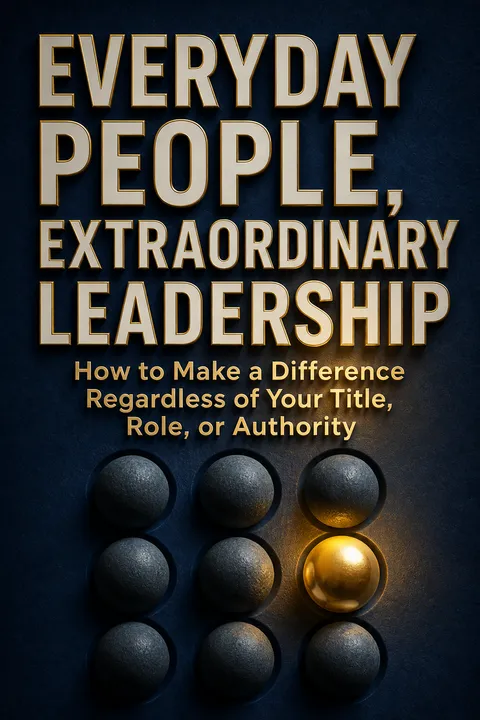
Everyday People receives mixed reviews, with an average rating of 3.75/5. Readers appreciate its insights on leadership and practical advice, finding it accessible and applicable to daily life. Many value the book's emphasis that anyone can be a leader. However, some criticize the writing as repetitive and stale. The book's core message resonates with readers: leadership is about behavior and relationships, not titles. The five practices of exemplary leadership framework is frequently mentioned as a useful tool for personal development.
People Also Read










Glossary
The Five Practices of Exemplary Leadership
Five behavior clustersThe authors' research-based framework for describing what people do when they lead effectively. Its five clusters concern acting consistently with values, helping others see a shared future, improving the status quo, building collaboration and capability, and recognizing contributions. The framework is intended as a learnable guide to behavior, not a personality test or a job description.
Personal-Best Leadership Experience
A peak leadership episodeA story someone tells about a time when they felt they led at their best. The authors collected such accounts from people across roles and settings to identify recurring leadership behaviors. The experience might involve a workplace project, a community effort, a family challenge, or another situation requiring people to coordinate toward change.
Leadership Practices Inventory
A 360-degree behavior surveyOften abbreviated LPI, this questionnaire assesses how frequently a person is observed using leadership behaviors. It can include the person's own ratings and observations from colleagues, managers, direct reports, or other people. In the book, peer responses are used to compare reported leadership behavior with assessments of effectiveness and workplace experience.
psychological safety
Safety to speak and experimentA shared workplace condition in which people believe they can raise relevant ideas, questions, concerns, or mistakes without being ridiculed or punished. The book connects this condition to candor, asking for help, experimentation, and learning. It is presented as a feature of the work environment, not as an individual's personality trait.
small wins
Incremental progress markersSmall, visible achievements that make a larger change easier to begin and sustain. Each win offers evidence, builds confidence, and provides information for the next step. The approach favors testing manageable changes and learning from them rather than waiting for a perfect plan or relying on a single sweeping overhaul.
psychological hardiness
A learnable response to stressAn attitude toward difficult or uncertain circumstances organized around commitment, control, and challenge. Commitment means staying engaged, control means trying to influence what can be influenced, and challenge means treating experience as an opportunity to learn. The book presents hardiness as something that can be strengthened, not a fixed personal quality.
L.I.F.E. paradigm
A leadership reflection exerciseA reflection tool for imagining how others might describe a person's leadership and impact in the future. The letters refer to Lessons, Ideals, Feelings, and Evidence: what others learned, what principles the person represented, how they felt in the person's presence, and what lasting contributions they could point to. The exercise connects an imagined reputation to present behavior.
FAQ
What's Everyday People, Extraordinary Leadership about?
- Leadership for Everyone: The book emphasizes that leadership is accessible to all, not just those with formal titles or authority. It shows how everyday individuals can lead and make a significant impact.
- Five Practices Framework: Authors James M. Kouzes and Barry Z. Posner present a framework of The Five Practices of Exemplary Leadership, which includes Model the Way, Inspire a Shared Vision, Challenge the Process, Enable Others to Act, and Encourage the Heart.
- Research and Real-Life Examples: Grounded in decades of research, the book includes personal stories and experiences that illustrate how leadership principles can be applied by anyone.
Why should I read Everyday People, Extraordinary Leadership?
- Practical Guidance: The book offers actionable insights and strategies that can be applied in various contexts, making it a valuable resource for enhancing leadership skills.
- Empowerment: It empowers individuals by reinforcing the idea that they can make a difference in their organizations and communities, regardless of their formal role.
- Inspiration from Real Stories: Filled with inspiring stories of ordinary people achieving extraordinary results, the book motivates readers to recognize and act on their potential.
What are the key takeaways of Everyday People, Extraordinary Leadership?
- Leadership is Learnable: Leadership is a set of behaviors that can be learned and practiced by anyone, not just those in power.
- Importance of Relationships: Leadership is fundamentally about relationships and the connections between leaders and their constituents.
- Credibility and Trust: Credibility, built on honesty and competence, is essential for effective leadership, and trust is crucial for building strong team dynamics.
What are The Five Practices of Exemplary Leadership?
- Model the Way: Leaders must clarify their values and set an example through their actions, ensuring alignment between words and deeds.
- Inspire a Shared Vision: Effective leaders articulate a compelling vision of the future that resonates with others, encouraging them to share in that vision.
- Challenge the Process: Leaders should seek opportunities for innovation and improvement, taking risks and experimenting with new ideas.
- Enable Others to Act: Fostering collaboration and building trust among team members is crucial for empowering others to contribute effectively.
- Encourage the Heart: Recognizing and celebrating contributions helps to motivate and uplift team members, reinforcing a sense of community.
How can I "Model the Way" in leadership according to Everyday People, Extraordinary Leadership?
- Clarify Values: Leaders must identify and articulate their personal values, which serve as a guiding compass for their actions and decisions.
- Lead by Example: Actions must align with stated values; leaders earn respect by demonstrating the behaviors they expect from others.
- Build Credibility: Consistency between words and actions is essential for establishing trust and credibility among team members.
How can I "Inspire a Shared Vision" according to Everyday People, Extraordinary Leadership?
- Clarify Your Vision: Leaders should envision a future that is meaningful and compelling, rooted in their values and aspirations.
- Engage Others: Involve team members in the vision development process, ensuring that their hopes and dreams are incorporated.
- Communicate Effectively: Use vivid language and storytelling to paint a clear picture of the future, making it relatable and inspiring for others.
What does "Challenge the Process" entail in Everyday People, Extraordinary Leadership?
- Seize Initiative: Leaders should actively seek opportunities for improvement and innovation, rather than maintaining the status quo.
- Encourage Experimentation: Taking calculated risks and experimenting with new ideas is essential for fostering a culture of innovation.
- Learn from Mistakes: Emphasizing that setbacks are part of the process allows teams to learn and adapt, ultimately leading to better outcomes.
How do I "Enable Others to Act" as a leader according to Everyday People, Extraordinary Leadership?
- Foster Collaboration: Create an environment where team members feel safe to share ideas and work together towards common goals.
- Build Trust: Establishing trust is crucial; leaders should demonstrate reliability and support to empower others to take initiative.
- Strengthen Others: Encourage team members by recognizing their strengths and providing opportunities for them to develop their skills.
What does it mean to "Encourage the Heart" in leadership according to Everyday People, Extraordinary Leadership?
- Recognize Contributions: Acknowledging and celebrating the efforts of team members fosters motivation and a sense of belonging.
- Create Community: Building a spirit of community among team members enhances collaboration and commitment to shared goals.
- Show Genuine Care: Leaders should express appreciation and concern for the well-being of their team, reinforcing positive relationships.
What are the best quotes from Everyday People, Extraordinary Leadership and what do they mean?
- "Leadership is not a position, it is a relationship.": This quote encapsulates the book's core message that effective leadership is about connections and influence, not just titles.
- "If people don't believe in the messenger, they won't believe the message.": This highlights the importance of credibility in leadership, emphasizing that trust is essential for effective communication.
- "You are already leading.": This statement encourages readers to recognize their potential to influence and lead, regardless of their formal role or title.
How can I apply the concepts from Everyday People, Extraordinary Leadership in my daily life?
- Start Small: Implement small changes in your interactions with others, such as recognizing contributions and offering support.
- Set Clear Goals: Use the framework of The Five Practices to set personal leadership goals and track your progress over time.
- Seek Feedback: Regularly ask for feedback from peers and colleagues to understand how your actions impact others and refine your leadership style.
What is the significance of trust in leadership as discussed in Everyday People, Extraordinary Leadership?
- Foundation of Relationships: Trust is essential for building strong relationships within teams, enabling open communication and collaboration.
- Reciprocal Nature: Trust is a two-way street; leaders must demonstrate trust in their team members to foster a trusting environment.
- Impact on Performance: High levels of trust within a team lead to increased engagement and productivity, encouraging initiative and positive contributions.
About the Author
Other books by James M. Kouzes


Download PDF
Download EPUB
.epub digital book format is ideal for reading ebooks on phones, tablets, and e-readers.








