

Key Takeaways
Bring Zen into love and work instead of escaping ordinary life.
Ordinary life is the curriculum. Beck presents Zen not as a retreat from family, jobs, and practical troubles, but as a way to meet them more fully. Zazen, or seated Zen meditation, offers a quiet setting to notice how the mind avoids what is happening. Yet the practice is not confined to the cushion. Raising children, answering work emails, and cleaning a kitchen can all become occasions to give full attention to the task at hand.
No special life required. Beck began Zen practice in her forties, after marriage, motherhood, and years of paid work. Her own path supports the book’s central claim: spiritual life need not be imported into daily life as a separate project. Sitting matters, but its value appears in how someone listens, works, loves, and responds to ordinary difficulty.
The book’s distinctive move is to make spiritual seriousness compatible with the unspectacular texture of adult life. This resembles research on mindfulness that treats attention as a trainable capacity, not a rare altered state. The practical payoff is substantial: a person need not wait for a retreat or a calmer household to begin. Still, ordinary life is not automatically a sound teacher. An exploitative job or harmful relationship should not be sanctified as a spiritual lesson. Attentive practice can help reveal what is happening, including when the appropriate response is to change the situation.
Train attention to notice thought, then return to direct experience.
Attention starts with listening. As a young piano student, Beck spent months repeating a tiny musical passage until she learned to hear it accurately. The lesson transfers to meditation: the task is not to force the mind blank, but to notice what is actually present. Samadhi is the collected attention that comes from being fully engaged with experience, rather than scattered among mental stories.
Name the recurring story. During sitting, notice sensations, sounds, breathing, and thoughts. When a thought appears, label its particular content, such as judging someone or predicting failure, then return to bodily sensation and the surrounding sounds. This is not a command to stop thinking. Practical thinking helps with tasks; repetitive judgments and imagined futures often pull attention away from the life unfolding now.
The piano story makes attention concrete: technical competence is not the same as perceiving what is there. Beck’s method also resembles cognitive defusion in acceptance and commitment therapy, where a person learns to see a thought as a mental event rather than a fact or instruction. That distinction can create room for choice without requiring thought suppression. The approach is especially useful because it includes mundane sensory details, not only breath. Its limit is that observation can become another performance standard. Precise noticing is a practice, not a test of whether someone is meditating correctly.
Meet pain directly before the mind builds a second injury.
Separate sensation from the story. Beck recounts a friend recovering from major surgery. At first, the physical pain felt clear; as thoughts about the injury gathered, distress intensified. Beck calls this added, thought-driven distress false suffering. The term does not mean that pain is imaginary. It describes the extra struggle created by insisting that an experience should not be happening, replaying its causes, or forecasting catastrophe.
Return to the body. The practice is to notice the story without treating it as the whole event, then feel the actual sensations as they are. Beck calls this direct contact with the present the razor’s edge: the moment of experiencing discomfort without turning it into a separate mental drama. That does not prohibit seeking treatment, protection, or practical change. It means acting without adding avoidable layers of rumination.
This distinction is close to the difference between primary pain and secondary suffering used in some clinical approaches to chronic pain. Attending to sensation can reduce the grip of catastrophic interpretation, while acceptance-based therapies likewise aim to change a person’s relationship to distress rather than promise a pain-free life. The useful nuance is that suffering is not always caused by thought. Grief, trauma, illness, and social danger have real sources. Treating distress as a personal failure to accept reality would distort Beck’s point and could discourage someone from seeking help.
Feel anger as sensation before it becomes a verdict or attack.
Make room before reacting. Beck describes anger as a signal that pride or expectation has been touched. In a quarrel, her advice is to say and do as little as possible at first, then observe the mental replay: the accusation, the defense, and the plan to get even. A Bigger Container is her name for growing capacity to experience strong feelings without being ruled by them.
Feel, then choose. Instead of rehearsing the argument, notice the bodily contraction that accompanies it. Beck uses the image of an empty rowboat striking another boat: anger changes when the collision is no longer interpreted as a deliberate personal attack. This does not mean pretending that harmful conduct is acceptable. The aim is to experience anger without suppressing it or automatically passing it on to someone else.
The method connects emotional awareness with response flexibility. Research on emotion regulation suggests that identifying and observing an emotion can make behavior less automatic, particularly when a person has enough time and safety to pause. Beck’s distinction between feeling anger and acting it out is important: emotional honesty need not become aggression. The empty-boat image, however, should not erase accountability. Some harms are intentional, repeated, or dangerous. A wider capacity for feeling can support clearer boundaries and firmer action, not merely calmness.
See the self as a pattern, not a fortress to defend.
Loosen the fixed identity. Beck argues that a separate, permanent self is built from habits of thought, memory, fear, and self-protection. No-self, a Buddhist term she uses, means the absence of an independent, unchanging self at the center of experience. It does not mean that a person vanishes or that everyday identities become useless.
Notice the boundaries you add. Beck compares state borders to the lines drawn on a map: useful for organizing life, but not divisions in the land itself. The mind similarly divides experience into me and other, then defends those divisions as though they were absolute. Practice makes these self-protective reactions easier to see. As identification loosens, the person can respond to events and other people with less automatic defensiveness.
This is the book’s most radical claim, and it can be read pragmatically without settling a metaphysical debate. Contemporary cognitive science often treats the self as a model assembled from memory, bodily signals, and social roles, rather than a single inner object. That perspective can soften rigid identity and make change less threatening. Yet a working sense of self also supports responsibility, continuity, and consent. The useful application is not to deny personhood, but to question whether every fear, preference, or self-description deserves to govern the next action.
Replace enlightenment expectations with aspiration to meet this moment.
Distinguish direction from payoff. Beck separates aspiration, the commitment to realize and express one’s deepest nature, from expectation, the demand that practice deliver a particular reward. A student can begin sitting in hopes of becoming calm, admired, or enlightened, then turn meditation into another contest for personal security. The result is disappointment whenever experience fails to match the imagined prize.
Let practice be its own work. Beck’s example is Dōgen’s meticulous monastery cook, who treats preparing food as serious practice. The cook does not postpone attention until a more inspiring task appears. Beck’s phrase no hope means giving up the fantasy that life must eventually become perfectly comfortable, not giving up effort, planning, or care. The practical question shifts from what meditation will provide to how fully the present task can be met.
The distinction has a useful counterpart in values-based therapy: action can be guided by what matters, even when it does not produce immediate comfort or a guaranteed outcome. This helps preserve ambition while loosening its grip as a measure of personal worth. Beck’s language of having no hope can sound bleak if detached from that distinction. Goals still help people coordinate effort, prepare for danger, and improve conditions. The target is not future-oriented action itself, but the belief that a future achievement will finally make present life complete.
Let relationships reveal your demands, rather than promise comfort.
A partner is not a delivery system. Beck argues that relationships become painful when one person is expected to confirm an ideal image, provide security, or behave according to a private script. Daily friction then exposes the gap between the imagined partner and the actual one. Practice means noticing the expectations and experiencing the disappointment beneath them, rather than assuming every uncomfortable relationship has failed.
Love is not a bargain. Beck tells of a wife who learned that her dying husband had loved another woman in Japan and had children with her. After working through her anguish, the wife traveled to Japan, brought the woman and children home, and helped them build a life. The story presents care that is not organized around repayment. It does not imply that every relationship should continue; Beck says some must end.
The relational insight is powerful because close relationships reveal expectations that solitary reflection can leave hidden. Attachment research likewise shows that intimacy can activate fears about rejection, dependence, and control. But the example of extraordinary generosity needs careful handling. Love without scorekeeping is not the same as accepting mistreatment, abandoning one’s needs, or carrying every burden alone. Healthy relationships require mutuality and boundaries. Beck’s strongest practical point is that expectations should be examined before they are mistaken for proof that another person is defective.
Make decisions from present needs, not endless self-protective debate.
Turn the problem into a decision. Beck says people often treat choices as external puzzles, then circle them with worry. Sitting with a difficult choice can reveal the fear, desire, and bodily tension beneath the debate. For example, someone weighing a better-paying job elsewhere against a valued life at home may discover that the obstacle is not a lack of formulas, but confusion about what matters.
Awareness should lead to action. Beck is not recommending passivity. An unemployed person should look for work; an ill person should seek appropriate care. The practice is to notice the extra self-judgment and imagined catastrophe, then respond to the concrete situation. She points to Mother Teresa as an image of action that begins with seeing the immediate task, rather than spending all available attention rehearsing what it means for the self.
This approach usefully counters rumination, which can feel like problem-solving while delaying a decision. Attention to bodily responses may contribute information about fear or reluctance, but bodily signals are not infallible guides; they can reflect habit, prejudice, or prior harm. High-stakes choices also benefit from facts, counsel, and time. Beck’s claim is most persuasive when practice clarifies deliberation, not when intuition is treated as a substitute for evidence. The aim is to see the choice more clearly, then take responsibility for acting.
Do not force spiritual openings faster than life can integrate them.
Intensity is not the same as maturity. Beck warns that a dramatic meditation experience may arrive before a person is ready to absorb it. In high-pressure retreats, students may be pushed toward powerful openings that feel liberating to some but destabilizing to others. A glimpse of non-self does not automatically resolve emotional patterns or make someone more compassionate in daily life.
Favor steady integration. Beck recommends patience, careful attention, and a pace suited to the person. She also acknowledges that Zen will not address every psychological difficulty and that help from other fields may be needed. Practice is measured less by unusual experiences than by whether fear, anger, and self-protection increasingly shape life less destructively. A retreat can intensify the process, but it is not a shortcut around the work of becoming more balanced.
This caution anticipates an important modern concern: contemplative practice is not uniformly benign, and intensity, personal history, and support affect how meditation is experienced. A trauma-informed approach similarly emphasizes choice, pacing, and safety rather than assuming that more exposure is always better. Beck’s warning is particularly valuable in spiritual settings where dramatic experiences can earn status. Its limitation is that readiness is difficult to judge from the outside. Skilled teachers, honest communication, and access to qualified mental-health care can help keep practice from becoming a test of endurance.
Recognize the enlightenment train in the life you are already serving.
The search becomes a detour. Beck’s parable follows Joe, a man who loses his job and wife, then goes to a train station hoping to catch the Train of Enlightenment. Others arrive to wait with him. As their children need food, care, and schooling, Joe begins helping. The station grows into a community, and he takes on work he never planned to do.
Practice is what remains. Joe eventually sits regularly, serves the community, and becomes less preoccupied with the train. One night it stops in front of him, and he realizes he had been living the life he was trying to reach. He returns to ordinary work, helping build a playground swing. The story brings Beck’s argument to its conclusion: enlightenment is not a prize that replaces daily life. It is the quality of attention and care brought to that life.
The parable gives the book a memorable answer to spiritual consumerism: the seeker can become so busy waiting for transformation that the needs directly in front of him go unattended. This echoes the idea of vocation as enacted through repeated responsibilities, not merely declared as an identity. The story also makes service a test of practice that involves consequences beyond private feelings. Still, service should not become a new badge of spiritual worth. A useful measure is whether care responds to real needs while remaining sustainable, not whether the helper can erase personal limits.
Analysis
Everyday Zen is a collection of edited talks, not a linear manual. Its unity comes from returning to one experiment: notice the mind’s self-protective story, feel the body and surroundings directly, and act from that fuller contact. The recurring stories make an abstract Zen claim practical. The piano student learns to listen; the surgical patient notices how commentary compounds pain; Joe abandons his search for enlightenment by caring for a community. Across these examples, transformation is not a new personality or a permanent pleasant mood. It is a changed relationship to experience, expressed in how someone works and treats others.
The book’s strongest contribution is its refusal to divide spiritual practice from ordinary responsibility. Meditation is not presented as a private refuge from children, employment, anger, or grief. Even conflict becomes usable when it exposes expectation and defensiveness. This makes the teaching unusually relevant to household and workplace life, and helps explain why Beck repeatedly warns against chasing impressive states.
The central method also carries risks if its language is read literally or without context. Claims that suffering is created by the mind, that all conditions can be accepted, or that the separate self is unreal can be misused to minimize illness, abuse, or structural injustice. Beck explicitly rejects passivity and allows for practical action, but readers need to retain that distinction. Acceptance means seeing a situation clearly, not approving it; nonattachment means loosening compulsive reactions, not surrendering boundaries. The book is best understood as a discipline of attention and ethical responsiveness, not a complete psychology or a universal substitute for therapy. Its invitation is demanding but concrete: stop waiting for a special life, and examine how this one is being lived.
Review Summary
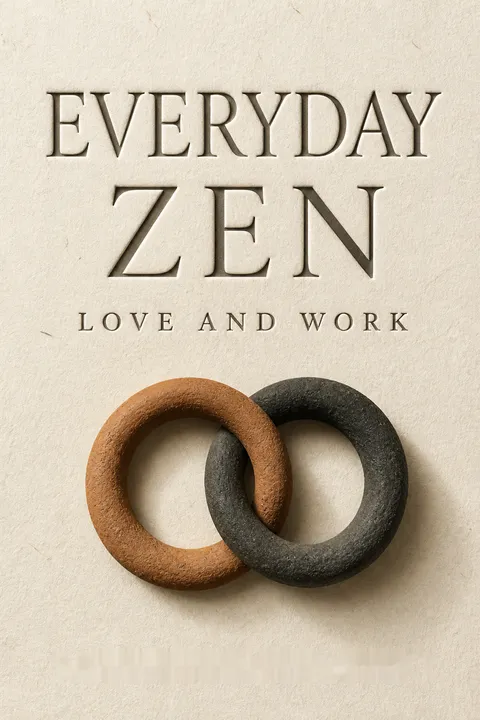
Everyday Zen: Love and Work receives mostly positive reviews, praised for its clear, accessible approach to Zen Buddhism. Readers appreciate Beck's practical wisdom, no-nonsense style, and ability to apply Zen principles to daily life. Many find the book helpful in understanding meditation and mindfulness practices. Some readers note the book's challenging ideas about letting go of attachments and expectations. While a few find it repetitive or difficult to grasp, most consider it a valuable resource for those interested in Zen philosophy and practice.
People Also Read





Glossary
zazen
seated Zen meditationZazen is the seated meditation practice central to the book. Practitioners sit with a balanced posture and attend to bodily sensations, breathing, sounds, and thoughts without trying to manufacture a special state. Beck treats zazen as both formal training and preparation for meeting daily activities with the same attention.
samadhi
collected, unified attentionSamadhi is a state of concentrated, unified attention in which awareness is fully engaged with its object or with the present field of experience. Beck distinguishes ordinary concentration on a chosen activity from the broader attention cultivated in Zen practice. In her account, samadhi is not a trophy state but a capacity that supports clear perception.
sesshin
intensive Zen retreatA sesshin is a period of intensive Zen practice, usually lasting several days. It typically includes many hours of sitting meditation, work practice, and limited conversation. Beck presents retreats as demanding settings where habitual thoughts and reactions become easier to notice, while cautioning that intensity should be appropriate to a person's capacity.
false suffering
distress added by mental resistanceFalse suffering is Beck's term for the additional distress created when the mind turns pain or difficulty into a story of personal injustice, catastrophe, or unacceptable reality. It does not mean that physical pain or grief is unreal. The distinction is between directly experiencing what hurts and adding repetitive resistance that increases confusion and distress.
emotion-thought
self-centered thought with emotional chargeEmotion-thought is Beck's term for thoughts shaped by attachment, expectation, and a self-protective point of view. Such thoughts can present interpretations as unquestionable facts, as when someone assumes another person is deliberately insulting them. Beck's practice is to notice the thoughts and their bodily effects, rather than suppress them or automatically act on them.
no-self
absence of a fixed separate selfNo-self is a Buddhist concept Beck uses to challenge the assumption that an independent, permanent self stands apart from experience. It does not mean that a person literally ceases to exist or that practical identities are useless. It points to the possibility of loosening self-centered identification so that thoughts and feelings need not dictate behavior.
A Bigger Container
capacity to hold strong experienceA Bigger Container is Beck's phrase for the growing ability to remain aware of difficult emotions, such as anger, without being dominated by them. The practice is to pause, observe the mind's story, and experience the bodily tension beneath it. The aim is not to eliminate emotion, but to increase the capacity to respond without reflexively attacking, withdrawing, or suppressing.
razor's edge
direct contact with present experienceThe razor's edge is Beck's image for the demanding moment of experiencing discomfort directly, without retreating into self-protective mental commentary. It is not a call to seek pain or remain in danger. It describes attending to what is happening now, including bodily fear or anger, so that action can arise from clearer perception rather than automatic reaction.
FAQ
What's Everyday Zen: Love and Work about?
- Focus on Ordinary Life: The book integrates Zen practice into everyday life, emphasizing its application in love and work. It challenges the idea that Zen is only for monastic experiences.
- Practical Teachings: Charlotte Joko Beck shares insights from her life, making Zen accessible to Western practitioners. The teachings address real-life issues like relationships and emotions.
- Emphasis on Awareness: The core message is about being present and aware in each moment, leading to a deeper understanding of oneself and interactions with others.
Why should I read Everyday Zen: Love and Work?
- Practical Guidance: Offers practical advice on applying Zen principles to everyday situations, providing tools for dealing with emotional challenges.
- Personal Growth: Readers gain insights into their behaviors and thought patterns, fostering personal growth and emotional resilience.
- Accessible Zen: Demystifies Zen practice, making it approachable for those intimidated by traditional teachings, with a straightforward writing style.
What are the key takeaways of Everyday Zen: Love and Work?
- Practice in Daily Life: Zen practice should permeate all aspects of life, including work and relationships, not just meditation.
- Understanding Emotions: Emotions like anger and fear should be experienced fully rather than suppressed, allowing for deeper understanding.
- Letting Go of Expectations: Emphasizes the importance of letting go of expectations in relationships and life for a more natural existence.
What are the best quotes from Everyday Zen: Love and Work and what do they mean?
- “From the withered tree, a flower blooms.”: Signifies that beauty and growth can emerge from difficult situations, reflecting personal transformation.
- “Be a lamp unto yourself.”: Encourages self-reliance and personal responsibility in one's spiritual journey, emphasizing internal understanding.
- “If I do not do it now, when else can I do it?”: Highlights the urgency of living fully in the present moment, urging immediate engagement with life.
How does Charlotte Joko Beck define Zen practice in Everyday Zen: Love and Work?
- Awareness of the Present: Zen practice is about continuous awareness of the present moment, emphasizing engagement in the here and now.
- Working with Emotions: Encourages working with emotions rather than suppressing them, fostering deeper self-understanding.
- Lifelong Commitment: Zen practice is a lifelong commitment, with personal growth and understanding as ongoing processes.
What is the significance of relationships in Everyday Zen: Love and Work?
- Mirror for Self-Understanding: Relationships reflect our inner states, helping us understand our emotional responses.
- Opportunity for Growth: Relationships provide opportunities for personal growth and practice, deepening self-understanding.
- Compassion and Acceptance: True love and compassion arise from understanding and accepting others without imposing expectations.
How does Beck address the concept of suffering in Everyday Zen: Love and Work?
- Distinction Between Sufferings: Differentiates between true suffering, a natural part of life, and false suffering from thoughts and attachments.
- Embracing Pain: Encourages embracing pain and discomfort as part of the human experience for deeper healing.
- Practice as Understanding: Through practice, we can navigate suffering more skillfully, with understanding as key to growth and compassion.
What role does mindfulness play in Everyday Zen: Love and Work?
- Awareness of Thoughts: Mindfulness involves being aware of thoughts and emotions without judgment, cultivating awareness.
- Living in the Present: Helps individuals stay grounded in the present moment, reducing anxiety about the past or future.
- Transformative Power: Mindfulness is portrayed as transformative, leading to greater clarity and compassion.
How does Beck suggest we deal with anger and other difficult emotions?
- Experience Emotions Fully: Advocates for experiencing emotions like anger fully rather than suppressing them.
- Labeling Thoughts: Recommends labeling thoughts associated with anger to create distance and clarity.
- Compassionate Response: Encourages a compassionate response to emotions, leading to greater self-understanding.
What is the relationship between Zen practice and personal responsibility in Everyday Zen: Love and Work?
- Self-Reliance: Emphasizes self-reliance in Zen practice, highlighting the need for personal responsibility in one's spiritual journey.
- Owning One’s Experience: Personal responsibility involves owning experiences and emotions, not blaming others.
- Commitment to Practice: Involves committing to ongoing practice and self-reflection for personal growth.
How does Everyday Zen: Love and Work make Zen accessible to Western practitioners?
- Practical Examples: Uses relatable examples from everyday life to illustrate Zen principles, making them easier to understand.
- Straightforward Language: Written in a clear, straightforward manner that resonates with modern readers.
- Focus on Real-Life Issues: Addresses common issues like relationships and emotions, making Zen relevant to Western lifestyles.
How does Everyday Zen: Love and Work challenge traditional views of Zen practice?
- Integration into Daily Life: Challenges the notion that Zen is only for monastic settings, advocating for its integration into daily life.
- Focus on Practicality: Emphasizes practical application over esoteric experiences, making Zen more accessible.
- Demystification of Zen: Demystifies Zen practice, encouraging a more approachable and relatable understanding.
About the Author
Other books by Charlotte Joko Beck


Download PDF
Download EPUB
.epub digital book format is ideal for reading ebooks on phones, tablets, and e-readers.








