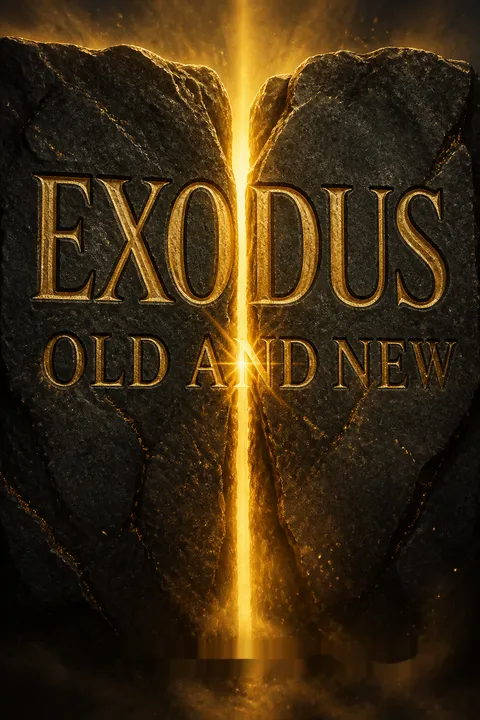


Key Takeaways
Read the Bible's exodus as humanity's route home from exile
The story begins outside Eden. Morales reads Genesis 1 to 11 as the account of humanity’s growing estrangement from God. Expelled from the garden, people pursue life without their Creator: Cain builds a city for security and lasting fame, while Babel’s builders seek the same things on a grander scale. Their ambition ends in scattering, not peace. In this account, exile means more than displacement. It is separation from the source of life, which damages human purpose and relationships.
Exodus reverses that direction. The Bible’s central movement is not escape from the earth, but the restoration of people to God and, ultimately, life together in a renewed creation. Israel’s deliverance from Egypt becomes the defining historical pattern for that return.
What's powerful about this reading is its insistence that salvation repairs a relationship and a home, rather than merely relocating souls to safety. It also gives familiar stories a shared trajectory: alienation creates false substitutes for belonging, while redemption restores fellowship. As a theological lens, however, the exile theme can become so expansive that almost any biblical story appears to confirm it. The argument is strongest when grounded in explicit narrative echoes, such as the movement from Babel's scattering to the prophets' vision of nations gathering to God.
See Abraham's journey as an early sketch of Israel's exodus
Abraham's story rehearses rescue. God calls Abram out of Ur, promising that his family will become a blessing to all nations. Morales connects this departure to Israel’s later journey out of Egypt: in both, God brings a people out of a foreign setting and toward an inheritance. Abraham’s own time in Egypt adds a preview. During famine, he goes there, Pharaoh takes Sarah, and God sends plagues; Pharaoh sends the couple away with substantial possessions.
The pattern deepens on Moriah. In Genesis 15, God’s presence passes between animal pieces as he promises that Abram’s descendants will suffer in a foreign land and then be delivered. In Genesis 22, a ram takes Isaac’s place. Together, these scenes anticipate Passover: rescue from death comes through God’s provision.
Abraham's episodes make the biblical pattern feel less like a single rescue story copied repeatedly and more like a set of themes accumulating meaning. The same motifs, foreign land, danger, deliverance, and inheritance, return with greater clarity in the national exodus. The Moriah connection also illuminates how later sacrificial worship might be read through the story of Isaac. A useful caution is that literary resemblance does not make every detail a direct prediction. The interpretation works best as a claim about theological pattern, not a claim that Abraham's conduct is always exemplary.
Measure liberation by the worship and knowledge it restores
Freedom has a destination. In Exodus, the people are not simply released from Pharaoh; they are released to serve and worship Yahweh. The book repeatedly makes knowledge of God a purpose of the plagues and the sea crossing. Pharaoh asks who Yahweh is, and the unfolding signs answer by showing that Israel’s God rules nature and is not one power among many.
Deliverance also reveals care. Yahweh hears Israel’s cries and remembers his covenant, so the exodus displays both power and compassion. The people who feared they did not know their ancestors’ God end the sea crossing singing of his unmatched greatness. Morales therefore sees the exodus as a public revelation, meant to reach beyond Israel. Rahab, a Canaanite woman who has heard of Yahweh’s acts, later responds with faith.
This distinction between release from domination and restoration to a purpose helps explain why the book treats worship as part of liberation rather than an optional sequel. It also resists reducing the exodus to a political metaphor: Israel’s actual oppression matters, but the narrative gives deliverance a religious and communal aim. The difficult point is the account of Pharaoh’s hardened resolve. Morales argues that God sustains Pharaoh’s defiance so the signs can reveal divine glory. That reading fits the book’s stated purpose, but it leaves a serious question about the cost borne by the oppressed during the prolonged conflict.
Read the sea crossing as Israel's passage through death into new life
The crossing resembles creation. At the sea, darkness gives way to light, wind divides the waters, and dry ground appears. These details recall Genesis, where God orders the waters and makes a habitable world. Israel’s passage through the sea is therefore presented as more than an escape route: it is a new beginning for a people who emerge on the other side as Yahweh’s people.
Egypt becomes an image of the grave. Morales notes the repeated language of descending into Egypt and ascending out, and the story’s framing by the Nile and the sea. Elsewhere, biblical poetry describes Yahweh’s defeat of Egypt as the defeat of a sea dragon, a symbol of powers that oppose life. These images interpret the historical deliverance as a victory over death and chaos, not as a claim that the event was merely symbolic.
Creation imagery gives the sea crossing a larger imaginative scale: political rescue becomes the making of a people and a habitable future. The dragon language also connects particular empires with the broader threat of violence and disorder, while keeping those empires distinct from evil itself. Such metaphor can sharpen moral perception, but it can also be misused if ordinary human opponents are treated as monsters beyond moral complexity. Morales's account is most compelling when the imagery magnifies the text's claims about divine power without erasing the historical people caught in the conflict.
Let Passover teach how rescue leads into a life with God
The lamb marks the way out. On the night of Passover, Israelite households also face judgment. A lamb dies in place of each firstborn, and its blood marks the household as spared. The family eats the lamb as a sacred meal. Morales interprets these elements as substitution, cleansing, and consecration: the household is rescued from death and set apart for God. Unleavened bread and bitter herbs preserve the memory of urgent departure and bitter bondage.
Worship reenacts the journey home. Israel’s sacrificial worship follows a related movement: a purification offering addresses sin and guilt; a whole burnt offering, also called an ascension offering, represents a life given wholly to God; and a peace offering ends in a shared meal. The ritual portrays restored fellowship, not just pardon.
The sequence matters: deliverance is not an isolated rescue but the beginning of a changed allegiance and shared life. The household Passover meal makes a national event intimate and repeatable, giving later generations a way to inhabit the story rather than merely recall it. The sacrificial imagery also supplies the book's language for understanding Jesus. This account is specifically a Christian theological interpretation of Israel's rites, not a neutral description of how every Jewish community has understood them. Keeping that distinction visible respects both the text's historical setting and the author's argument.
Expect the second exodus to change hearts, not just return exiles
A return to land was not enough. After Babylonian captivity, some Judeans returned and rebuilt the temple, but foreign rule continued, the promised Davidic king was absent, and the people’s spiritual failures persisted. Morales argues that this return could not fulfill the prophets’ larger hope. Their second exodus would surpass the first by gathering the scattered, restoring the relationship with God, and drawing the nations into that blessing.
The needed change comes from God. Moses speaks of God circumcising the people’s hearts so they can love him. Jeremiah pictures God’s instruction written within them; Ezekiel describes a new heart and Spirit. These promises answer the problem that physical rescue alone could not solve: the people still turned away. The prophets join inward renewal with a restored community, a new Davidic ruler, and life from death.
This distinction between political return and spiritual restoration gives the prophetic hope a clear reason to exceed the historical events that partially resemble it. It also treats the community's repeated failures as more than a lack of information or opportunity: the promised renewal must reach the will and affections. The framework is more than an account of private conversion, since it includes a people, a ruler, and the nations. Its interpretive challenge is how to distinguish a prophecy's historical referent from its later theological fulfillment, especially when the first return is meaningful but incomplete.
See Isaiah's servant as Israel's calling embodied in a suffering Messiah
Israel's mission needs a faithful representative. In Isaiah, Israel is called Yahweh’s servant and charged with bringing God’s light to the nations, yet the nation is described as blind and unfaithful. The servant songs then present a figure who embodies Israel’s vocation, seeks to restore Israel, and serves the nations. Morales links this figure with both Moses, the mediator of the first exodus, and David, the shepherd king expected to lead the next.
His suffering becomes the means of rescue. In Isaiah 53, the servant bears the people’s sin as a guilt offering, suffers rejection, and is then exalted. The result is a renewed community, the servant’s spiritual offspring, who receive the benefits of his work and share Israel’s mission. For Morales, this pattern finds its identity in Jesus.
The representative logic here offers a precise account of how a failed community might still fulfill its vocation: a faithful member carries the community's identity and acts for its good. It also joins suffering and exaltation without treating suffering itself as virtuous or desirable. The move from Israel as a collective servant to a particular Messiah is a consequential reading of Isaiah, and Christian interpretation depends on seeing those layers as connected. Readers can test the case by attending to the poems' shifting voices and contexts, rather than assuming every reference to the servant has the same referent.
Follow Jesus through death into God's household by the Spirit
John presents Jesus as Passover Lamb. The Gospel repeatedly places his ministry beside the Passover feast, then links his crucifixion to the lamb through details such as the timing of his death and the unbroken bones. The cross is not the end of the journey: Jesus rises on the first day of the week, in a garden setting that recalls Eden. His resurrection marks the beginning of new creation.
The Spirit brings others into that life. After rising, Jesus breathes the Spirit on his disciples, an act that echoes both Adam receiving life and Ezekiel’s vision of exiles raised from dry bones. John’s Gospel presents the Spirit as the means by which believers are united to Jesus and welcomed into the Father’s household. The new exodus is therefore shared life with God, not merely Jesus’ private escape from death.
John's images make theology tangible: a garden, a tomb, breath, a meal, and a household turn abstract claims about salvation into scenes readers can picture. The Spirit is not an accessory to Jesus' work in this account; the Spirit makes participation in that work possible. These images support a coherent reading, though some of the finer links, such as symbolic meanings attached to numbers or repeated words, are more persuasive when treated as suggestive patterns than as certain authorial signals. The central claim rests less on any single detail than on their convergence around death, life, and communion.
Let resurrection, not mere survival, define Christian hope and action
The final problem is death. Morales argues that death is bound up with sin and separation from God, so temporary improvements cannot be the whole answer. Paul’s hope centers on Jesus being raised and on the future raising of God’s people. The promise extends beyond individual bodies: creation itself is to be renewed. Without resurrection, Paul says, faith and hope lose their foundation.
Future hope reshapes present life. Paul understood himself as united to Jesus in death and resurrection, already belonging to the new creation while still living in the old one. That did not mean withdrawing from the world. He endured hardship and urged believers to turn from destructive behavior and live differently. For Morales, resurrection is both a future bodily hope and the basis for present holiness, courage, and service.
The book's conclusion refuses to shrink salvation into either improved circumstances now or a disembodied afterlife. That whole-person, whole-creation horizon helps explain why resurrection can motivate engagement rather than escapism: the world matters because it is to be renewed. It also places a demanding question beside consolation: if hope is bodily and communal, what kinds of present action honor that future? The theological argument depends on accepting the resurrection as an actual event. For readers who do, it offers a far larger account of hope than indefinite survival.
Analysis
Morales's central achievement is to make the exodus function as a reading strategy for the Bible's whole plot, rather than as one episode among many. The strategy moves through recurring correspondences: exile and return, death and life, bondage and worship, failed service and faithful representation. Its strength lies in showing how these patterns accumulate. Abraham's departure, Israel's escape, prophetic restoration, Isaiah's servant, and Jesus' resurrection become stages in a single theological argument whose destination is renewed life with God.
The method is canonical and typological. It reads later biblical texts as interpreting earlier ones, and it treats verbal echoes, ritual patterns, and narrative structure as evidence of theological continuity. For Christian readers who accept the Bible as a unified body of Scripture, this yields an unusually integrated account of why Passover, sacrifice, the Spirit, and resurrection belong together. It also prevents the New Testament from appearing to discard Israel's story: Jesus' work is presented as its fulfillment and transformation.
The same method carries interpretive risks. Some proposed connections are explicit in the texts, while others depend on subtle wordplay, numerical patterns, or analogies among stories. Those claims do not all have equal evidential force. The reader should distinguish clear textual links from suggestive readings, especially when the argument moves from collective Israel to an individual servant, or from historical deliverance to cosmic symbolism. Morales's theological conclusions are most persuasive when they rest on multiple converging features rather than one isolated parallel.
The book is also deliberately confessional. It treats sin as humanity's deepest problem, God's redemption as the answer, and bodily resurrection as the necessary horizon of hope. That framing is not a detached survey of competing interpretations. Its value is the clarity and force with which it shows what follows if those convictions are true: liberation must restore worship, grace must create a people, and hope must include the renewal of bodies and creation. The result is a coherent, memorable biblical theology, best read as an argument to examine in the texts themselves.
Review Summary
Exodus Old and New receives overwhelmingly positive reviews, with readers praising its rich biblical theology, accessible writing, and insightful connections throughout Scripture. Many highlight Morales' ability to trace the exodus theme from Genesis to Revelation, offering fresh perspectives on familiar passages. Readers appreciate the book's devotional quality and its impact on their understanding of God's redemptive plan. Several reviewers note the book's concise yet comprehensive nature, making it valuable for laypeople, students, and scholars alike. Overall, it is highly recommended for those seeking a deeper grasp of biblical themes.
People Also Read

Glossary
Exodus formula
God identifies as delivererA recurring biblical declaration in which God identifies himself by the rescue he has performed, especially bringing Israel out of Egypt. Morales also points to the formula's earlier use in God's promise to Abraham. It presents deliverance not as an isolated act, but as a defining disclosure of God's identity and relationship with his people.
Second exodus
Prophetic restoration from exileThe prophets' promised future deliverance, modeled on Israel's escape from Egypt but described as greater in scope and effect. It includes the gathering of dispersed Israel, inward renewal through God's Spirit, renewed Davidic rule, blessing for the nations, and ultimately resurrection life. The return from Babylon is treated as a partial sign, not the complete fulfillment.
Servant of Yahweh
God's representative servantIn Isaiah, this designation first applies to Israel, called to display God's ways and bring light to the nations. Because Israel fails in that calling, Morales reads the servant songs as focusing on a faithful figure who embodies Israel, restores the people, and serves the nations through suffering. The renewed community formed by his work is also described as God's servants.
Cultic exodus
Worship's journey to GodMorales's term for the movement enacted through Israel's sacrificial worship. The worshiper approaches God's dwelling through purification, consecration, and communion. Sacrifice recalls the historical exodus while portraying restored access to God's presence: the blood addresses sin, the whole burnt offering signifies a life given to God, and the peace offering culminates in a shared meal.
New creation
Renewed life with GodThe transformed reality inaugurated by Jesus' resurrection and completed when God renews creation and raises his people bodily. In Morales's reading, it is not simply a metaphor for personal improvement or a departure from the physical world. It is the restoration of life with God, extending to human bodies and the wider creation.
Sheol
Realm of the deadThe biblical term for the grave or realm of the dead. Morales uses it in connection with Egypt and the sea as theological images of death and exile. Israel's passage out of Egypt and through the sea can therefore be read as a rescue from death into life, while this imagery does not mean the historical events are merely figurative.
FAQ
1. What is Exodus Old and New: A Biblical Theology of Redemption by L. Michael Morales about?
- Central exodus motif: The book explores the exodus as the central biblical-theological theme of redemption, tracing its development from Israel’s historical exodus out of Egypt to the prophesied second exodus and its fulfillment in Jesus Christ.
- Structure and scope: Morales divides the narrative into three parts: the historical exodus, the prophetic second exodus, and the new exodus in the Gospel of John, showing how each stage reveals God’s plan for redemption.
- Biblical theology approach: The book situates the exodus within the grand storyline of Scripture, highlighting its role in revealing God’s character, his redemptive plan, and the restoration of humanity’s relationship with God.
2. Why should I read Exodus Old and New by L. Michael Morales?
- Accessible and insightful: The book serves as an accessible primer for students, church leaders, and laypeople, offering a clear and concise biblical theology of the exodus motif.
- Deep theological connections: Morales connects Old Testament narratives with New Testament fulfillment, especially emphasizing Jesus’ resurrection as the ultimate exodus, enriching Christian understanding and worship.
- Practical spiritual application: Readers are encouraged to experience their own “exodus” from spiritual complacency to renewed fellowship with God, making the book both intellectually and spiritually transformative.
- Endorsed by scholars: The book is praised by respected biblical scholars for its masterful demonstration of the exodus theme and its value for teaching, preaching, and personal study.
3. What are the key takeaways from Exodus Old and New by L. Michael Morales?
- Exodus as central theme: The exodus is presented as the central story of the Bible, shaping the pattern of redemption from bondage to covenant relationship and inheritance.
- Universal scope of salvation: Morales shows that Israel’s exodus was intended to bring blessing and knowledge of Yahweh to all nations, culminating in the new creation.
- Jesus as fulfillment: The book demonstrates how Jesus embodies and fulfills the exodus motif as the new Moses, Passover Lamb, and giver of the Spirit, inaugurating the new exodus through his death and resurrection.
- Transformation and hope: The exodus pattern offers a framework for understanding Christian salvation, spiritual transformation, and hope for the renewal of all creation.
4. What are the best quotes from Exodus Old and New by L. Michael Morales and what do they mean?
- “The exodus is the central theme and story of the Bible.” This quote underscores Morales’ thesis that the exodus motif unifies the entire biblical narrative.
- “From exile and death to life and fellowship with God.” Morales uses this phrase to describe the movement at the heart of redemption, both historically and spiritually.
- “Jesus’ resurrection is the ultimate exodus.” This statement highlights the climax of the book, showing how Christ’s resurrection fulfills and surpasses the original exodus.
- “The Spirit is the essential agent of the new exodus.” Morales emphasizes the indispensable role of the Holy Spirit in bringing about spiritual transformation and new creation.
5. How does L. Michael Morales define the exodus motif and its significance in biblical theology?
- Pattern of redemption: The exodus is a multifaceted symbol representing deliverance from bondage, covenant relationship, and inheritance of God’s promises, foundational for understanding both Israel’s story and the New Testament.
- Historical, spiritual, and eschatological: Morales shows the exodus prefigures Christ’s resurrection, the soul’s conversion from sin, and the church’s ultimate deliverance into the new creation.
- Central to God’s character: The exodus reveals God as Redeemer, Judge, and King, making it a lens through which to understand his actions throughout Scripture.
6. How does Exodus Old and New by L. Michael Morales describe humanity’s condition before the exodus?
- Exile from God’s presence: Humanity’s story begins with exile from God due to sin, resulting in spiritual death, alienation, and a loss of purpose.
- Broken relationships: Sin disrupts relationships with God, others, nature, and self, leading to violence, injustice, and a restless longing for home.
- Futile human efforts: Narratives like Cain’s city and the Tower of Babel illustrate humanity’s attempts to find security and meaning apart from God, deepening their exile.
7. What is the connection between Abraham’s life and the exodus theme in Exodus Old and New by L. Michael Morales?
- Prefiguration of exodus: Abraham’s call out of Ur, his sojourns, and the binding of Isaac are stamped with exodus motifs, foreshadowing Israel’s later deliverance.
- Exodus language and symbolism: Morales highlights elements like the call to “Go, get yourself out,” the covenant ceremony, and the substitute lamb as echoes of the exodus pattern.
- Spiritual journey: Abraham’s life models a spiritual exodus from exile to faith in Yahweh, linking the patriarch’s story to the broader theme of redemption.
8. How does L. Michael Morales explain the knowledge of Yahweh revealed in the historical exodus?
- Revelation through mighty acts: The exodus reveals Yahweh as the one true God, demonstrated through signs, wonders, and judgments against Egypt’s gods.
- Purpose of the plagues: The plagues are designed to overcome ignorance and defiance, leading Egypt and Israel to “know that I am Yahweh.”
- Restoration of relationship: The exodus transforms Israel from slaves to worshipers, establishing a covenant relationship and setting a pattern for all nations to recognize Yahweh.
9. What is the theological significance of the sea crossing and the slaying of the sea dragon in Exodus Old and New by L. Michael Morales?
- Sea as chaos and death: The crossing represents Israel’s passage from death to life, with the sea symbolizing chaos and evil that God defeats.
- God as dragon slayer: Morales interprets Yahweh’s victory over Egypt as the slaying of mythological sea dragons, symbolizing triumph over evil powers.
- Cosmic and eschatological battle: This motif connects creation, redemption, and final judgment, with Jesus as the ultimate dragon slayer in the new exodus.
10. How does Exodus Old and New by L. Michael Morales interpret the Passover event and its role in the exodus?
- Heart of redemption: Passover is the defining event where the blood of the lamb redeems Israel’s firstborn from death, making the exodus a deliverance from death itself.
- Ritual symbolism: The slaying of the lamb, blood on doorposts, and eating the lamb’s meat symbolize substitutionary atonement, purification, and consecration.
- Ongoing and ultimate significance: Passover reorients Israel’s identity and calendar, prefiguring Jesus as the ultimate Passover Lamb whose sacrifice fulfills the ritual.
11. What are the key elements of the second exodus in Exodus Old and New by L. Michael Morales?
- Vindication of Yahweh’s name: The second exodus will glorify Yahweh among the nations, reversing the shame caused by Israel’s sin.
- New Davidic king and messenger: A new Moses-like figure from David’s line and an Elijah-like messenger will lead and herald the second exodus.
- Outpouring of the Spirit: God will pour out his Spirit, enabling obedience and spiritual renewal, fulfilling new covenant promises.
- Resurrection and restoration: The second exodus culminates in resurrection from the dead, bringing new life and ultimate restoration.
12. How does Exodus Old and New by L. Michael Morales present Jesus and the Holy Spirit as fulfilling the new exodus?
- Jesus as Passover Lamb: John’s Gospel presents Jesus as the Lamb of God, linking his death to the exodus deliverance and Passover sacrifice.
- Crucifixion and resurrection: Jesus’ death is portrayed as his exodus departure, and his resurrection inaugurates the new creation, reversing the exile from Eden.
- Gift of the Spirit: Jesus breathes the Holy Spirit on his disciples, empowering them to participate in the new exodus and become children of God.
- Spirit as essential agent: The Spirit is the life-giving water and agent of new creation, uniting believers to Christ and enabling spiritual and eventual bodily resurrection.
Download PDF
Download EPUB
.epub digital book format is ideal for reading ebooks on phones, tablets, and e-readers.








