

Key Takeaways
Turn what you know into a business by proving it helps someone else.
Expertise starts in practice. Brunson’s first information product grew from a college spring-break project: he and a friend learned to build potato guns, recorded instructions, and sold DVDs online. The small business brought in about $20 to $30 a day, but its larger lesson was that useful knowledge could be packaged and shared. Coaching younger wrestlers also made Brunson better at wrestling because teaching forced him to explain skills he had previously performed by instinct.
Test before you scale. The book recommends choosing a result and a process, then helping a small beta group achieve that result before building a polished product. Jacob Hiller followed a similar path, sharing his experiments to jump higher until an audience formed around his videos. Early outcomes and honest feedback give an expert more than marketing material: they show what actually helps.
What's striking is the link between teaching and learning. Explaining a tacit skill forces its owner to identify steps, exceptions, and common mistakes, a process familiar in apprenticeship and deliberate practice. A beta group adds a second advantage: it tests whether a method works for people beyond its creator. Free work can be a sensible experiment, but it should have boundaries, especially in health, finance, or other high-stakes fields. Confidence gained from helping someone is not a substitute for relevant training, safety standards, or evidence.
Design a genuinely new route, not a shinier version of a crowded offer.
Escape the comparison trap. An improvement offer asks customers to choose among familiar alternatives, where price and minor features dominate. Brunson argues that a new opportunity gives people a different route to a result. His example is the iPod: earlier devices held more music in stages, while Apple presented carrying a whole music collection in a pocket as a different experience. The marketing task is not merely to rename an existing product. The new route must offer a real, understandable benefit.
Check the market first. The book recommends narrowing from broad areas such as health, wealth, or relationships into a specific audience, then looking for an underserved angle. Check whether people gather around the topic, discuss it in specialized language, attend events, and already spend money on solutions. An Ask Campaign, a simple survey about people’s biggest question, can reveal recurring needs before a course is built.
The strongest version of this idea resembles customer discovery: learn how people currently solve a problem, then test whether a proposed alternative is meaningfully better. Novelty can lower the friction of comparing near-identical products, but it is not proof of value. A fresh label can conceal an old method, and a persuasive promise can outrun the evidence. The practical test is whether customers can describe the difference, use the new approach, and achieve a result they care about.
Give people a leader, a shared identity, and a future worth joining.
Make belonging visible. Brunson’s movement model pairs a recognizable leader with a cause and a picture of a better future. The leader need not appear flawless: sharing an earlier struggle helps an audience relate to the person who has learned the path. A clear identity gives members language for seeing themselves as part of the group. ClickFunnels users called themselves “Funnel Hackers”; a weight-loss company changed its name so customers could identify as “Lady Bosses,” and the book reports that customer churn fell by 10% in three months.
Make progress imaginable. A cause needs evidence that change is possible. Brunson describes showcasing members who crossed a major business milestone, so peers could see a goal once considered unlikely become attainable. Consistent publishing can help a leader find a distinctive voice and learn what resonates. The purpose is not to manufacture a personality, but to make a community’s shared direction concrete enough for people to recognize and join.
Identity can turn a product into a social practice: members gain peers, vocabulary, and a sense of progress, not only instruction. That is useful in behavior change, where social support can help people persist. The same mechanisms demand care. A group built around a common mission can become a group built around an enemy, and belonging can discourage disagreement. Strong communities make participation welcoming without making loyalty a test of truth. Visible success stories should inspire, while making clear that one member’s result is not a guarantee for everyone.
Build the pitch around one belief that makes buying make sense.
Find the hinge belief. The book calls the central proposition a Big Domino: the one belief that, if accepted, makes the offer relevant and reduces the force of other objections. For a funnel-building product, Brunson’s core argument was that a structured sales path matters to online business, and that his software makes one easier to create. The exercise is to state the customer’s desired result, the method being proposed, and why that method is a credible route to the result.
Test the claim. If the statement falls apart when alternatives are considered, the offer may be an improvement rather than a distinctive opportunity. That is useful feedback, not a reason to hide alternatives. A persuasive presentation can emphasize one central idea, but customers still deserve accurate evidence about what the product does, what it cannot do, and what other routes might work.
A single organizing claim improves clarity because it gives listeners a mental structure for evaluating details. In communication research, reducing cognitive load can make complex information easier to follow. But a clean argument is not automatically a sound one. The book’s sales formulation can slide from “this is a useful approach” to “this is the only way,” an assertion that is rarely established by a story or a successful case. The hinge belief should simplify the decision without suppressing meaningful alternatives or uncertainty.
Tell the discovery story before burying people in technical explanations.
Build a bridge to the idea. An Epiphany Bridge is a story about the experience that changed an expert’s mind about a new method. Brunson’s own story begins with a potato-gun DVD business, then turns when rising ad costs threaten that income. Learning to add related offers to a sale changes his understanding of online selling and points him toward sales funnels. The story gives listeners a human reason to care before they encounter technical details.
Show both journeys. The book draws on the Hero’s Two Journeys: the visible pursuit of a goal and the less visible change in the protagonist’s beliefs or identity. In practice, a strong story establishes the person’s situation, what they want, what blocks them, what they discover, what happens when they act, and how the experience changes them. Concrete scenes and feelings help an audience understand why the discovery mattered.
Stories help audiences organize unfamiliar information around motives, obstacles, and consequences. A well-told account can make a process memorable and emotionally legible, which is useful when facts alone feel abstract. Yet vividness can also make a single success seem more typical than it is. An origin story explains why its teller believes in a method; it does not establish that the method caused the outcome or will work for others. Pair narrative with transparent evidence, including failures and limits.
Answer doubts about the method, the person, and the circumstances.
Sort resistance before responding. Brunson groups likely objections into three areas: doubts about the proposed method, doubts about one’s own ability to use it, and doubts about outside constraints such as time or access to customers. His funnel example includes a prospect who questions whether funnels fit their business, doubts their technical ability, or worries about finding traffic. These are different problems and need different answers.
Use relevant proof. The book recommends collecting customer questions, identifying the experiences behind their doubts, and answering with a story or example that addresses the specific concern. A case study can show that a method worked in a context like the prospect’s; a demonstration can clarify the steps; a tool can reduce a real barrier. The goal is not to label every objection false. Some objections reveal that the offer is a poor fit or that a genuine limitation needs to be fixed.
This diagnostic approach resembles good advising: distinguish a knowledge gap from a confidence gap and a resource constraint instead of responding to all three with generic encouragement. It also prevents a common sales mistake, answering the objection the seller prefers rather than the one the buyer raised. The ethical boundary matters. Stories can loosen an unhelpful assumption, but should not be used to dismiss legitimate concerns about cost, safety, time, or suitability. Sometimes the most credible answer is that the product is not right for that person.
Package implementation tools and proof, not just more information.
Sell the path to action. Brunson’s Stack is a presentation of the complete offer in accumulating pieces. It starts with the main training, then adds practical tools, evidence that the approach can work, help for personal barriers, and support for external obstacles. The point is to make the customer’s next steps clearer, not to overwhelm them with extra lessons. Brunson suggests assigning values to each component and making the displayed total substantially exceed the price, though those figures are seller estimates, not objective appraisals.
Match support to the price. For a higher-priced service, the book recommends an application and a conversation to understand a prospect’s desired outcome, obstacles, available resources, and willingness to be helped. This can establish fit before a commitment. Guarantees, clear terms, and realistic claims can lower the risk of trying an offer, but they cannot replace a product that reliably delivers what it promises.
The emphasis on tools reflects an important design principle: reducing the effort between learning and doing can be more valuable than adding content. Templates and guided support can make a method usable for people with different starting skills. The weak point is value inflation. A bonus does not become worth a large amount because a slide assigns it that number, and an artificial deadline can impair considered choice. Strong offers earn trust through usefulness, transparent pricing, and urgency tied to a real constraint rather than pressure for its own sake.
Improve one live presentation through repetition before automating it.
Treat the webinar as a test. The Perfect Webinar is Brunson’s presentation format for introducing an opportunity, telling a discovery story, addressing major doubts, and making a structured offer. He argues for delivering it live repeatedly so audience questions and sales patterns can expose unclear explanations. His Funnel Hacks presentation changed after feedback; he reports that one version sold about $30,000, while a revised presentation several hours later sold about $120,000. These are his results, not a forecast for other businesses.
Repeat, then reuse. Brunson’s weekly model combines promotion, a live presentation, reminders, and replay follow-up. He offers example targets of 1,000 registrants, a 25% attendance rate, and a 10% purchase rate at a $997 price, while acknowledging that markets differ. Once the presentation is refined, its stories can be adapted for email sequences or a product-launch sequence. Repetition creates opportunities to learn; it does not guarantee profitable advertising.
This is a compelling form of iterative design: deliver, observe, revise, and deliver again. Live questions reveal confusion that a creator working alone may miss, while repeated sessions create comparable evidence about changes. Still, conversion rates can be affected by audience quality, price, timing, platform, and many other factors. A disciplined operator measures more than revenue, including refunds, customer outcomes, and acquisition costs. Automation is useful only when the underlying presentation works ethically and consistently for the audience it is meant to serve.
Reach buyers through trusted intermediaries already serving your market.
Start where attention already lives. Brunson’s Dream 100 is a list of people or organizations that already reach an expert’s intended audience. He suggests looking across email-list owners, bloggers, podcasters, and social-media creators, then building relationships before asking for promotion. That can mean following their work, interviewing them, or finding a practical way to support a project they care about. The aim is to complement their work with a useful offer, not arrive as a stranger demanding access.
Earn distribution over time. The book tells how Chet Holmes narrowed a database of roughly 2,000 advertisers to 167 major buyers and pursued them consistently. Within six months, he had secured 29 accounts; the company later rose from last place to first in its magazine category. The model also includes paid ads aimed at relevant audiences and integrating compatible products into another business’s customer journey.
This strategy recognizes that attention is costly to build and often already concentrated in communities with established trust. A thoughtful partnership can help an expert reach people who would never find a new offer through general advertising. But access to an influencer’s audience is not the same as endorsement, and borrowed trust can be damaged by a poor fit. Partnerships work best when the audience’s interests remain central, compensation is disclosed, and the promoted product meets the standards the intermediary has helped establish.
Analysis
Expert Secrets is best read as a sales and product-development operating manual, not as neutral proof that its conversion methods work in every market. Its strongest sequence begins with a specific audience, tests a new approach through hands-on service, gathers real outcomes, and turns those outcomes into a clear story and repeatable presentation. The potato-gun origin is more than an entertaining entrepreneurial anecdote: it shows how an improvised experiment can become a first product, then how business failure can force a new commercial insight.
The book’s central strength is its insistence that expertise must be translated. A person may possess useful knowledge yet struggle to explain, package, or distribute it. The beta group, customer-question survey, story structure, and live presentation all turn tacit knowledge into something other people can understand and act on. Its emphasis on repeated live delivery also resembles disciplined product testing: audience confusion and questions are evidence that the offer or explanation needs work.
The major tension is that the same tools that clarify a decision can also narrow or manipulate it. Identity, status, social proof, urgency, and a single pivotal claim can create motivation, but they can also make a buyer feel that hesitation signals weakness or disloyalty. The book’s advice to position an offer as uniquely necessary deserves particular scrutiny. In many fields, more than one method can work, and a vivid success story cannot establish exclusive effectiveness.
A responsible adaptation keeps the useful machinery while changing its ethical center. Find a real customer problem, describe the method accurately, report results with context, state who is not a fit, and make deadlines and guarantees genuine. Evaluate business performance alongside customer outcomes, complaints, and refunds. That approach preserves the book’s practical insight, that good ideas need clear communication and distribution, while refusing to confuse persuasion with proof or revenue with impact.
Review Summary
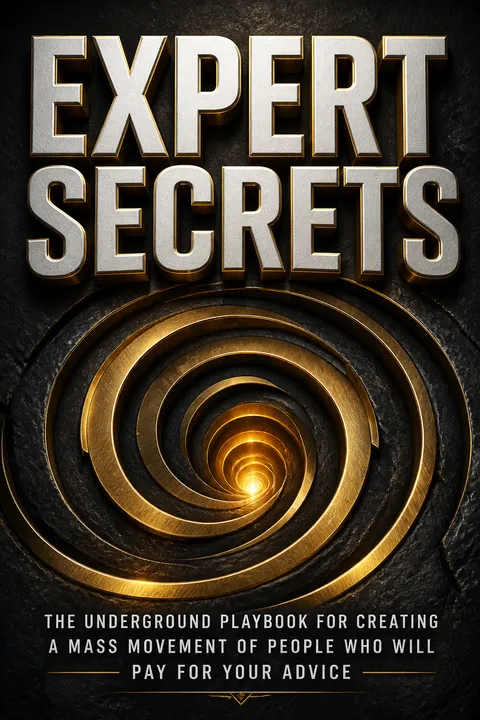
Expert Secrets receives mixed reviews, with ratings ranging from 1 to 5 stars. Readers appreciate the valuable marketing insights and strategies presented, particularly for digital businesses. However, some criticize the book's aggressive sales tactics and promotion of the author's products. Critics argue that the methods taught may compromise ethical standards, while supporters find the content actionable and transformative for their businesses. The book's focus on personal branding, creating online courses, and effective storytelling resonates with many readers seeking to monetize their expertise.
People Also Read








Glossary
Attractive Character
Relatable expert personaThe public-facing expert persona an audience comes to know and follow. In Brunson’s usage, it is built from a person’s identity, experiences, vulnerabilities, and recurring stories, not just credentials. Showing both the earlier struggle and the present capability can help an audience relate to the guide while seeing a plausible path forward.
New Opportunity
Distinct route to a resultA proposed way to reach a desired result that is presented as meaningfully different from the familiar solutions in a market. The term contrasts with an improvement offer, which promises a better version of an existing approach. A genuine new opportunity needs a real benefit, not merely a novel name or sales angle.
Opportunity Switch
Move to a new methodAn initial offer designed to move a prospective customer away from their current approach and toward a different method for pursuing a goal. It introduces the central opportunity and asks the customer to reconsider how the result can be achieved. The method should be distinct enough to explain clearly and credible enough to justify the switch.
Big Domino
Central belief behind an offerThe single central belief a presentation is designed to establish. If the audience accepts it, the product’s relevance and the next action should become clearer. Brunson uses the concept to focus a sales argument, while the claim still needs evidence and should not imply that a particular product is the only possible solution unless that is demonstrably true.
Epiphany Bridge
Story of a changed beliefA story about an experience that led someone to recognize and adopt a new approach. It connects a listener’s familiar problem to the teller’s discovery by showing the situation, desire, obstacle, insight, action, and outcome. The story is intended to make an idea emotionally understandable before technical explanation, but it is not, by itself, proof that the method works generally.
The Hero’s Two Journeys
Outer goal, inner changeA story model that distinguishes the visible goal a character pursues from the internal change in beliefs or identity that occurs during the pursuit. Brunson applies it to marketing stories: an expert describes both the practical result sought and the personal transformation along the way. Conflict and obstacles make the change consequential rather than merely asserted.
False Belief Patterns
Assumptions blocking actionThe collection of beliefs a prospective customer holds about why a proposed opportunity will not work, why they cannot use it, or why circumstances prevent success. The book recommends identifying the experiences that shaped these beliefs and responding with relevant explanations, demonstrations, or stories. The term should not be used to dismiss valid evidence or reasonable caution.
The 3 Secrets
Three objection categoriesA presentation-planning device that groups major customer doubts into three areas: the proposed method, the customer’s own ability to use it, and external constraints such as time or access to customers. A presenter selects a central concern in each area and addresses it with relevant proof or explanation. The categories organize objections rather than establish that every concern is mistaken.
The Stack
Layered offer presentationA way of presenting an offer by introducing its components one at a time and showing how they combine. Components may include the main training, implementation tools, case studies, support, or additional services. The presentation is meant to help a buyer understand the complete package, but assigned component values are estimates and should not be mistaken for independent market valuations.
Perfect Webinar
Structured selling presentationBrunson’s format for an online or live presentation that introduces an opportunity, establishes one central belief, uses stories to address objections, and then presents an offer. The format can be adapted to other channels, including email or video sequences. Its name is promotional, not a claim that one script guarantees success across audiences, products, or markets.
Dream 100
Priority distribution partnersA selected list of people and organizations that already have relationships with an expert’s intended audience. The list may include publishers, creators, community leaders, or businesses. Brunson recommends learning about these potential partners and offering value before asking for promotion, then exploring endorsements, advertising, collaborations, or complementary offers.
Ask Campaign
Survey of customer questionsA simple audience-research campaign that asks people to submit their most important question about a topic, sometimes in exchange for access to a beta class. Repeated responses can reveal common concerns and guide course content and marketing language. Its value depends on reaching representative prospective customers and treating the answers as feedback rather than definitive market proof.
FAQ
What's "Expert Secrets" about?
- Purpose of the book: "Expert Secrets" by Russell Brunson is a guide to turning your specialized knowledge, talents, and abilities into a profitable business. It provides a roadmap for creating a mass movement of people who will pay for your advice.
- Core focus: The book emphasizes the importance of creating a new opportunity for your audience, rather than offering improvements on existing solutions. This involves crafting a unique niche and building a following.
- Structure: The book is divided into five sections, each focusing on different aspects of building and monetizing a mass movement, from creating belief to developing sales funnels.
Why should I read "Expert Secrets"?
- Monetize expertise: If you have specialized knowledge or skills, this book offers a step-by-step guide to turning that expertise into a profitable business.
- Create a movement: It teaches you how to build a loyal following by creating a new opportunity that resonates with your audience.
- Proven strategies: The book is based on Russell Brunson's own experiences and successes, providing practical advice and strategies that have been tested in various markets.
What are the key takeaways of "Expert Secrets"?
- Mass movement creation: Learn how to create a mass movement by becoming a charismatic leader, establishing a future-based cause, and offering a new opportunity.
- Storytelling for belief: Master the art of storytelling to create belief in your audience, using techniques like the Epiphany Bridge and the Hero’s Two Journeys.
- Sales and funnels: Develop effective sales presentations and funnels using the Perfect Webinar model to convert followers into paying customers.
What is the "Perfect Webinar" model in "Expert Secrets"?
- Webinar structure: The Perfect Webinar is a script designed to sell products and services through webinars, focusing on breaking and rebuilding belief patterns.
- Three parts: It consists of an introduction to build rapport, a content section to address false beliefs, and a stack section to present the offer.
- Repetition for mastery: Brunson advises delivering the same webinar weekly for a year to refine the presentation and maximize conversions.
How does "Expert Secrets" define a "new opportunity"?
- New opportunity vs. improvement: A new opportunity is a unique solution that offers a fresh start, as opposed to an improvement offer that suggests fixing existing problems.
- Blue ocean strategy: The book encourages creating a niche that stands out in a crowded market, akin to finding a "blue ocean" where competition is minimal.
- Status elevation: A new opportunity should promise to elevate the status of the audience, making it more appealing and desirable.
What is the "Epiphany Bridge" in "Expert Secrets"?
- Storytelling tool: The Epiphany Bridge is a storytelling technique used to convey the emotional journey that led you to your big "aha" moment.
- Structure: It involves sharing your backstory, the wall you hit, the epiphany you experienced, and the transformation that followed.
- Purpose: The goal is to help your audience experience the same epiphany, leading them to believe in your new opportunity.
What are the "3 Secrets" in "Expert Secrets"?
- Core beliefs: The 3 Secrets address the core false beliefs that prevent people from accepting your new opportunity: the vehicle, internal beliefs, and external beliefs.
- Vehicle belief: This involves convincing your audience that your new opportunity is the right vehicle for achieving their desires.
- Internal and external beliefs: These secrets tackle personal doubts and external obstacles, using stories to break and rebuild these beliefs.
How does "Expert Secrets" suggest building a mass movement?
- Charismatic leader: Become a leader who inspires and attracts followers by sharing your journey and being relatable.
- Future-based cause: Create a vision of the future that your audience can rally behind, giving them hope and direction.
- New opportunity: Offer a unique solution that promises to elevate their status and fulfill their desires.
What is the "Stack Slide" in "Expert Secrets"?
- Offer presentation: The Stack Slide is a visual tool used to present the components of your offer, showing the value of each element.
- Value stacking: It involves listing each part of the offer with its value, building up to a total that far exceeds the asking price.
- Purpose: This technique helps the audience see the immense value they are getting, making the offer irresistible.
What are the best quotes from "Expert Secrets" and what do they mean?
- "You’re just one funnel away…" This quote emphasizes the potential of a well-crafted sales funnel to transform your business and life.
- "People will do anything for those who encourage their dreams…" This highlights the importance of understanding and supporting your audience's aspirations to build trust and loyalty.
- "If you believe in the product or service you’re selling, then you have a moral obligation to try and serve your customers in every way possible." This underscores the ethical responsibility of selling something that genuinely helps people.
How does "Expert Secrets" address false belief patterns?
- Identify false beliefs: The book teaches you to recognize the false beliefs your audience holds about your new opportunity.
- Epiphany Bridge stories: Use storytelling to break these false beliefs and replace them with empowering truths.
- Rebuild beliefs: The goal is to guide your audience to new beliefs that align with your offer, making them more likely to take action.
What is the "Dream 100" strategy in "Expert Secrets"?
- Target influencers: The Dream 100 strategy involves identifying 100 people or companies who already have your dream customers.
- Build relationships: Focus on building genuine relationships with these influencers to gain access to their audience.
- Leverage partnerships: Use these relationships to promote your new opportunity, either through direct promotion or integration into their existing sales funnels.
About the Author
Other books by Russell Brunson




Download PDF
Download EPUB
.epub digital book format is ideal for reading ebooks on phones, tablets, and e-readers.








