

Key Takeaways
Make synthesis visible, so research can credibly lead to design.
The hidden middle matters. Designers gather interviews, photographs, and observations, then privately turn them into themes and ideas. To a client, the leap can look like magic, or guesswork. Kolko argues that this invisible middle creates practical damage: clients may dismiss research, firms may fail to budget for synthesis, and newer designers may have no clear way to learn it.
Show how meaning forms. Synthesis is the work of organizing, interpreting, pruning, and connecting research until a design opportunity becomes understandable. Its methods are not recipes that guarantee one answer. They make judgment observable, discussable, and easier to explain. A messy wall of notes can be valuable if the team can show how it led from evidence to a useful direction.
Making intermediate reasoning visible improves more than client confidence. It gives teams a chance to catch leaps that rest on weak evidence, and it lets colleagues disagree about the interpretation rather than merely approve or reject a polished concept. This resembles good scientific practice, where the path to a claim matters alongside the claim itself. Yet documentation should not become theater: a neat diagram can make a speculative inference look proven. The useful standard is traceability, not visual polish. Readers should be able to distinguish observed evidence, interpretation, and the design decision built from them.
Treat intuition as a testable best guess, not a mysterious gift.
Ill-defined problems need judgment. A well-structured task has clear starting conditions, rules, and tests. Creative design rarely does. Kolko illustrates the difference with a manager trying to staff a project: unable to find the right email about an experienced colleague, the manager relies on memory, calls the colleague's manager, and proceeds with incomplete information.
Abduction adds a hypothesis. Deduction draws a conclusion already contained in its premises. Induction generalizes from repeated observations. Abductive reasoning proposes the explanation that best fits incomplete evidence, while accepting that it may be wrong. Designers use experience to make such informed guesses, satisfy themselves with enough information to move, and sometimes question constraints that block progress. These leaps are useful precisely because they create possibilities, but they still need examination.
This account gives intuition a more disciplined status than either mystical talent or mere bias. A hunch becomes useful when it can be stated as a hypothesis, connected to observations, and exposed to criticism. That resembles Bayesian reasoning in spirit: confidence should shift as evidence changes, rather than becoming permanent after an appealing first explanation. The caution is that experience can also encode stale assumptions. A designer may recognize a familiar pattern where a new one is emerging. Treating abductive ideas as provisional protects their generative power without confusing plausibility with proof.
Change the frame before accepting the client's version of the problem.
Perspective shapes the problem. A frame is the perspective through which a person decides what counts as relevant evidence and what a good solution should do. For a wireless router, one designer may prioritize ease, another control, and another the pleasure of using it. Each frame adds constraints, but it also narrows an overwhelming field of choices into a workable one.
Models make assumptions tangible. A mental model is a simplified account of how something works. It need not be technically accurate to help people reason. The book imagines a designer temporarily treating soil contact as the main cause of seed growth. That mistaken model suggests new ways to explore planting, even if those ideas later prove unusable. Making frames and models explicit helps teams see which assumptions are steering their work.
The frame is not merely a bias to eliminate. It is also a tool for deciding where attention goes, which makes frame comparison more productive than demanding a supposedly neutral viewpoint. A team can ask what an engineer, a novice user, or a service worker would treat as central, then notice what each view leaves out. This is especially useful when stakeholders disagree about priorities. The limitation is that a deliberately strange model can generate novelty without relevance. It needs to be treated as an exploratory lens, not quietly substituted for evidence about how the world works.
Put research on a wall where teams can rearrange and challenge it.
Externalize the evidence. Research stored only in a laptop is difficult to see as a whole or rearrange across formats. Kolko recommends making observations tangible with notes, images, and other artifacts displayed together. Teams can move related items, separate weak groupings, and label themes once patterns begin to emerge. The aim is not to find the single correct arrangement, but to develop and debate plausible connections.
Use affinity diagrams. In this method, each research observation goes on its own movable card or note. Participants cluster notes by perceived similarity, explain why they grouped them, and then name the emerging themes. Keeping a reference to each note's source helps the team return to the original evidence. The discussion is part of the work: people make assumptions explicit, add context, and discover where their interpretations differ.
The wall works as shared external memory. By moving ideas into physical space, a team can compare more than any one person could comfortably hold in mind, while the arrangement itself becomes a prompt for discussion. This is a practical form of distributed cognition: thinking is supported by people, artifacts, and their environment, not only by an individual brain. But the method has a risk. A cluster can feel convincing because the notes sit close together, even when the underlying observations are weak. Source tracking and deliberate attempts to disconfirm a theme help keep visual coherence from masquerading as evidence.
Use design research to find opportunities, not predict the whole market.
Different research answers different questions. Marketing research often seeks to predict how a larger population may behave. Design research observes people in context to uncover needs, workarounds, emotions, and unexpected opportunities. In the book's example, a client points to a survey of thousands of respondents and questions the cost of observing eight people. The methods are not interchangeable: a survey may estimate what people report wanting, while close observation can reveal how tasks actually unfold.
Research does not equal innovation. Design research can identify an opportunity, but synthesis must translate it into design criteria and ideas. Then engineering, production, distribution, and marketing still matter. A new product is not automatically an innovation merely because it is novel; it must also succeed in the world. The chain runs from observation to interpretation to design, and each link requires distinct work.
This distinction guards against a common category error: asking one research method to answer questions it was not built to answer. Small, contextual studies can reveal mechanisms and possibilities, while larger samples can estimate prevalence or compare responses. Neither alone establishes what should be built. The stronger approach is methodological fit, with evidence types matched to decisions. There is also a boundary to protect: unusual behavior can inspire a design, but it does not show how widespread the need is. Teams should preserve the vivid case without presenting it as a population-level conclusion.
Map the user's experience beyond the product's moment of use.
Zoom out and through time. A concept map shows entities and the relationships between them. Forced semantic zoom redraws that map at wider or narrower scales, from a product detail to its wider business and social setting. Forced temporal zoom follows the experience across a lifecycle, including discovery, purchase, first use, routine use, failure, and replacement. Both approaches reveal connections that a product-only view can miss.
Follow the whole journey. At Spence Diamonds, shoppers could become overwhelmed while waiting for an available sales associate. Researchers mapped physical and emotional touchpoints, from entering the store to choosing a ring. That view helped the team spot unmet needs and shape details such as places for private discussion and tools for organizing choices. In a library project, breakpoint diagrams similarly showed where people lost their way while trying to find a book.
Journey maps are valuable because they make transitions visible. A product can work well in isolation and still fail when people discover it, pay for it, ask for help, or replace it. Mapping these transitions encourages designers to notice handoffs between channels and organizations, not just interface screens. The map remains a hypothesis, however. A clean line can flatten varied experiences into a single ideal path. Teams should preserve exceptions and emotional differences rather than treating one journey as universal, especially when users have different abilities, resources, or goals.
Make room for playful experiments before demanding polished certainty.
Novel ideas need temporary freedom. Playfulness in design is not about toys or casual office decor. It is permission to propose unlikely ideas, bend assumptions, and explore possibilities without treating every suggestion as a final commitment. In one mobile-app brainstorming conversation, an intentionally outrageous idea about tracking people's movements prompted a more practical thought: aggregated location patterns could help users find lively places.
Protect concentrated work. Kolko connects synthesis to flow, a state of focused involvement supported by immediate feedback, sustained attention, low fear of failure, and reduced self-consciousness. Sketches, notes, and diagrams help because they make each move visible and free working memory for further thought. Rigid meeting schedules, constant interruptions, and early demands for consensus can undermine this exploratory work before a promising direction has time to form.
The example shows why a team needs psychological safety: people are more willing to offer an awkward first thought when it will be treated as material to examine, not a verdict on their character. The useful distinction is between protecting exploration and suspending accountability. Play opens options; evidence, feasibility, and ethics still determine which options deserve development. Flow also cannot be scheduled by command. Organizations can improve its conditions by reducing interruptions and giving people room to work, but no method can guarantee a creative breakthrough on demand.
Reframe users' situations, then combine insights with existing patterns.
Empathy asks what changes with perspective. Reframing starts with an ordinary account of a problem, then considers it from another person's position or setting. A toothbrush designed for an adult at home may look different when considered from a child's or dentist's perspective. The point is not to pretend that the designer can fully inhabit someone else's experience, but to expose assumptions and generate questions about goals, feelings, and constraints.
Join observation to precedent. Insight combination pairs a research-based observation with a known design pattern to produce possible ideas. The book's example links a negative association between mouthwash and the dentist with consumer products that use distinctive flavors. That pairing suggests a different flavor direction. The resulting idea is a proposal, not a finding. Generate several combinations first, then assess which are useful, feasible, and supported.
This closes the chain from understanding people to making something: empathy broadens the designer's view, while patterns offer material for recombination. The method also makes a useful distinction between insight and solution. An insight interprets an observation; a design idea is one response among many. That separation protects teams from treating their first clever connection as inevitable. Perspective-taking has limits, too. Imagining another person's feelings can slide into projection, so reframes should be checked with people who have relevant lived experience whenever possible.
Analysis
The book's central achievement is to make the interpretive middle of design work legible. Rather than treating creativity as a private talent or as an unstructured pause between research and production, it presents synthesis as a sequence of visible judgments: choosing what matters, arranging evidence, proposing relationships, testing frames, and translating an opportunity into design criteria. Its strongest practical contribution is the range of methods that let teams perform this work together, from movable-note clustering to experience maps and deliberate shifts in perspective.
Its theory is most persuasive when it treats conclusions as provisional. Abductive reasoning explains why incomplete evidence can still support useful action, while the examples show that such action can be wrong. This creates a productive standard: designers need not wait for certainty, but they should make their assumptions inspectable. The book is less convincing if repeatability is read as reproducibility of outcomes. Two capable teams may build different interpretations from the same fieldwork because their knowledge and frames differ. The methods can discipline that variation, not eliminate it.
A further tension concerns the business case. Making synthesis visible can help clients value time spent interpreting evidence, but visual deliverables risk turning judgment into bureaucracy. The goal should not be to produce a diagram for every decision. It should be to choose representations that help a team notice, question, and communicate what matters. Likewise, celebrating unusual observations is valuable for invention, but market reach and technical feasibility require other forms of evidence.
The book's enduring lesson is therefore both practical and epistemic: design insight is neither a magic trick nor a mechanical deduction. It is a human inference process that becomes more responsible when its evidence, assumptions, and transformations can be seen. The methods matter less as fixed templates than as ways to make that process teachable, collaborative, and open to correction.
Review Summary
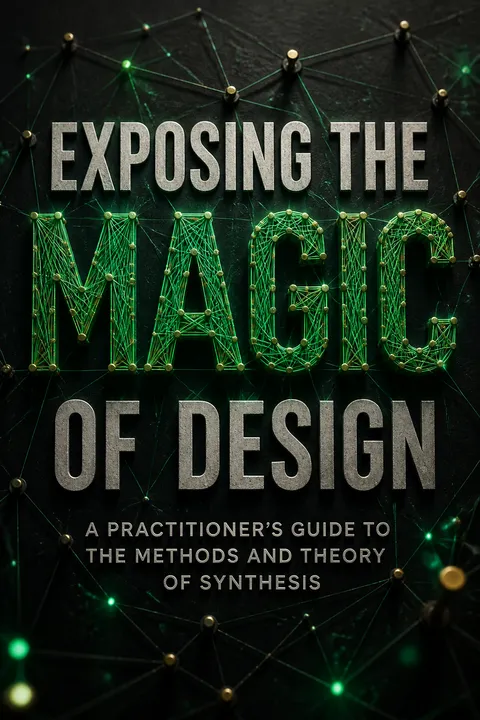
Exposing the Magic of Design receives mostly positive reviews, with readers praising its insights on design synthesis. The first half is particularly lauded for explaining the "magical" aspect of the design process. Some find the second half less engaging, with mixed opinions on the presentation of synthesis methods. Readers appreciate the book's attempt to make the implicit design process explicit and repeatable. Critics note academic language and rigid descriptions. Overall, it's recommended for designers and non-designers seeking to understand and communicate design processes.
People Also Read

Glossary
Synthesis
Research into design understandingThe interpretive work of organizing, combining, pruning, and reframing gathered material so it becomes meaningful for design. Synthesis connects research observations to a clearer understanding of a problem and to possible design directions. It is not a formula that guarantees one correct answer, but it can be made visible and practiced through repeatable methods.
Abductive reasoning
Inference to a likely explanationA form of reasoning that proposes the explanation that best fits incomplete observations and prior experience. Unlike deduction, it does not guarantee its conclusion. Unlike induction, it is not simply a generalization from repeated cases. Designers use abduction to form new hypotheses and ideas, then need to examine whether those ideas remain credible and useful.
Sensemaking
Connecting information to actAn ongoing effort to connect scattered information in order to understand a situation and act effectively. In design, sensemaking draws on observations, experience, and personal perspective to identify patterns and relationships. It can happen internally, but synthesis methods make parts of it external and collaborative so others can discuss the interpretations.
Frame
Perspective shaping the problemA perspective that influences what a person notices, which evidence counts, and what kinds of solutions seem appropriate. A frame can add constraints that make a large problem manageable, as when a design team prioritizes ease of use or user control. Different frames can produce distinct design directions from the same assignment.
Mental model
Simplified account of a systemA person's internal representation of how something works. Mental models simplify complex systems, often inaccurately, but still help people reason and anticipate outcomes. Designers also use models as starting points for exploring possibilities. Temporarily testing an unconventional model can suggest ideas, provided it is not mistaken for a factual account.
DIKW
Data to wisdom progressionAn organizing shorthand for data, information, knowledge, and wisdom. Data are discrete material without much context. Information gives data an arrangement and meaning. Knowledge connects information into principles, theories, or stories. Wisdom involves applying knowledge in a new way. The progression is not perfectly linear, but it describes increasing interpretation.
Affinity diagramming
Clustering related observationsA method for finding patterns by placing individual pieces of information on movable notes and grouping items that seem related. Participants explain the logic of their groupings, revise them, and name the themes that emerge. Because the groupings are interpretive, preserving links to original sources helps teams check their conclusions against the evidence.
Concept map
Diagram of connected conceptsA graphical representation of concepts and the relationships between them. Terms are connected with labeled links that describe how people, objects, actions, or systems relate. Creating the map helps a team clarify its understanding, reveal missing connections, and communicate a complex domain. The map is a working model, not a neutral or final account.
Forced semantic zoom
Mapping context at different scalesA method that redraws a concept map at broader and narrower scales. Zooming out can reveal the larger business, social, or product context around a design. Zooming in can expose a feature's details and constraints. Moving across these levels helps teams see how a specific design choice relates to a wider system.
Forced temporal zoom
Mapping experience through timeA method for examining a product, service, or system across stages of use. It can include discovery, acquisition, first use, ordinary or expert use, failure, and replacement. Mapping these points in time helps teams notice needs and breakdowns outside the moment of primary use, including the transitions that shape a full customer experience.
Reframing
Viewing a problem anewA method for changing the perspective through which a design problem is understood. A designer can reconsider the user, setting, or form of the design, then ask how goals and constraints shift. Reframing is intended to expose assumptions and generate new possibilities, not to claim that imagined perspectives fully represent real people's experiences.
Insight combination
Pairing insight with design patternsA technique for generating ideas by combining a research-based insight with an established design pattern. The insight links an observation to experience or knowledge; the pattern offers a familiar approach or recurring design feature. Their combination can produce a new proposal. The proposal remains a hypothesis to assess for usefulness, feasibility, and relevance.
Flow
Deep, focused involvementA focused state of involvement in an activity, associated in the book with immediate feedback, sustained attention, reduced concern about failure, and less self-consciousness. In synthesis, externalized work can support focus by making changes and their effects visible. Flow is a condition that can be encouraged, not an outcome a team can command.
About the Author
Other books by Jon Kolko
Download PDF
Download EPUB
.epub digital book format is ideal for reading ebooks on phones, tablets, and e-readers.








