


Key Takeaways
Treat eye contact as a signal of attention, not a shortcut to attraction.
A visible social signal. Moore’s central claim is that steady, relaxed eye contact can communicate confidence, interest, and presence. He argues that this matters in dating, work, and leadership, but eyes work alongside voice, posture, and the conversation itself. His stories about two friends attracted to men with strong personalities illustrate his view that confidence may stand out more than conventional politeness or looks. They are anecdotes, not proof that a particular gaze creates attraction.
Confidence is not permission. In the stories, one man repeatedly asks after being turned down, and another ignores a request for space. Those actions cross boundaries, whatever the author’s interpretation of their confidence. The useful lesson is to communicate genuine interest while respecting the other person’s response, not to treat attraction as a button to push.
What's valuable here is the focus on eye contact as communication rather than a magic technique. A gaze can show that someone is listening, but the same behavior can also feel intrusive when it is unwanted or poorly timed. The book’s dating anecdotes make that distinction especially important: persistence is not persuasive evidence of confidence when someone has said no. A more durable model treats eye contact as an invitation to connect, then lets the other person’s response guide whether to continue.
Build the confidence behind your gaze before polishing its performance.
Inner game comes first. Moore uses “inner game” for the beliefs and emotional steadiness beneath outward behavior. He argues that a practiced gaze cannot reliably conceal persistent self-doubt. To make the point, he asks volunteers to hold a light piece of candy at arm’s length. Though the object is easy to lift briefly, fatigue eventually makes their arms drop. He compares that effort to trying to sustain confident body language without an inner foundation.
Use both directions. The book says mental and physical changes can reinforce each other: acting more steadily may support confidence, while growing confidence can make steady behavior feel more natural. Its useful warning is against treating eye contact as a mask. Its account of the unconscious mind as a programmable mechanism is simplified, though; confidence is not a switch that affirmations can reliably set.
The reciprocal link between bodily behavior and self-perception is more persuasive than the book’s idea of a hidden mind programmed toward a fixed destination. Practicing a manageable behavior can provide a small experience of competence, which may make the next attempt less daunting. But forced eye contact can also intensify self-consciousness, especially for someone with social anxiety or a different cultural norm. The practical aim is not to hold a gaze at any cost. It is to become comfortable enough to attend to the person, rather than monitoring one’s own performance.
Find where old self-doubt was learned, then gather better evidence.
Confidence has a history. Moore traces self-belief to four influences: family, classmates and teachers, media, and personal experiences. He recalls his mother warning him that he would forget things or could not manage a new undertaking. At school, classmates mocked his weight in a humiliating incident he says stayed with him into adulthood. Such experiences, he argues, can teach a person to expect failure or rejection.
Notice the messages. He also describes advertisements that imply people need products to be attractive or complete, and explains how past romantic rejection can color later encounters. Identifying these influences can help separate an old lesson from a current fact. The author’s examples are personal interpretations, not diagnoses, but they offer a practical prompt: ask which repeated messages still shape behavior, and whether present experience supports them.
This section usefully shifts the question from “What is wrong with me?” to “What taught me to expect this?” That change can replace shame with curiosity and make a vague insecurity more specific. The book’s account is strongest when it names concrete sources, such as a parent’s repeated warnings or peer ridicule. It is weaker when it assumes a single cause or a simple path from childhood to adult confidence. People can respond differently to similar experiences, and later relationships can revise old expectations.
Practice confidence through small wins, supportive self-talk, and useful recovery.
Give confidence evidence. Moore recommends recalling a past success, doing something already familiar, and completing neglected tasks. He also describes volunteering to build homes for a poor community; the experience shifted his attention from what he lacked to what he had. Other suggested confidence boosts include exercise, rest, gratitude, clothes that feel good, and enjoyable food in moderation.
Reframe without pretending. For setbacks, the author contrasts despair, indifference, and a more constructive response that acknowledges what went wrong while looking for a lesson. He also proposes writing down discouraging beliefs and replacing them with encouraging statements, then reading those statements regularly. These practices can support action, but repeating a positive sentence alone does not make it true. Pair it with small, observable steps that give the new belief something real to stand on.
The most useful idea is to make confidence behavioral and cumulative. Completing a task or attempting a conversation creates evidence of agency; a slogan without action can instead feel hollow. The book’s volunteering story also shows how a change of perspective can loosen fixation on perceived deficits, though comparison with people who have less can sometimes minimize genuine hardship. A balanced approach combines self-compassion with specific feedback: recognize the attempt, identify what can improve, and choose a next step small enough to try.
Match your gaze to the conversation, distance, relationship, and culture.
Context changes the signal. Moore says eye contact varies with the topic, physical proximity, who is speaking, the relationship, and cultural expectations. A serious discussion or intimate exchange may invite more gaze; close quarters, such as an elevator, can make sustained looking uncomfortable. He also notes that some cultural or religious settings discourage certain forms of eye contact.
Treat numbers as rough prompts. The book reports that a speaker may look at a listener about 75 percent of the time, while a listener may look about 40 percent. Elsewhere, it recommends a 90/60 rule. These figures are not presented with a method or qualification, and the difference between them itself argues against treating them as universal targets. Look for reciprocal comfort and the demands of the moment instead of counting seconds.
This is the book’s most important corrective to a one-size-fits-all technique. Eye contact has meaning only within a social setting: the same gaze may signal attention in one exchange and challenge, intimacy, or disrespect in another. Cultural awareness is not a footnote to confidence; it is part of reading the other person accurately. The percentages can be memorable as rough reminders to look up and engage, but precise quotas risk replacing listening with self-surveillance. Responsiveness matters more than hitting a prescribed ratio.
Show interest without turning eye contact into pressure or surveillance.
Distinguish connection from staring. Moore warns that unbroken staring can feel unsettling and calls watching someone’s body without consent “eye-groping.” He recommends relaxed expressions and says a gaze should not cross the line from confident to socially strange. That distinction matters more than any flirting tactic: another person’s comfort is part of the situation, not an obstacle to overcome.
Skip coercive signals. The book also recommends prolonged looks, scanning a woman’s body, and holding eye contact after being noticed. Those suggestions can easily make someone feel watched or pressured, so they should not be treated as reliable routes to attraction. A brief, friendly look followed by attention to the conversation is a safer way to express interest. If the other person disengages, looks uncomfortable, or asks for space, stop and give them room.
The distinction between being attentive and making someone feel observed is essential, especially because the book sometimes treats discomfort as a tool for creating excitement. Social signals are not under the sender’s control alone; their meaning depends on how they are received. A respectful approach preserves the other person’s ability to opt in or out without having to manage a stranger’s persistence. In practical terms, confidence is compatible with backing off. Indeed, the ability to accept a clear boundary is a stronger sign of emotional steadiness than an unwillingness to break eye contact.
Train calm attention gradually; discomfort is practice, not proof of power.
Start with controlled focus. Moore’s “singular focus exercise” asks the reader to look at a small object for 60 seconds, three times, while noticing distraction and calmly returning attention. He suggests adding background sound once the exercise becomes easier. The purpose is to practice holding attention while tension arises, not to win a staring contest.
Practice with people carefully. The book also proposes cold-water showers while focusing on a spot, and an exercise of looking at five strangers until noticed, then holding the gaze for three more seconds. Neither is necessary for learning respectful eye contact; deliberately making strangers uncomfortable is not a good practice method. A better application of the book’s gradual-practice principle is to use ordinary conversations, notice tension, breathe, and let gaze move naturally. Increase difficulty only when the interaction remains comfortable for both people.
The small-object exercise has a clear advantage: it isolates attention without involving another person who has not agreed to participate. That makes it a more considerate way to practice noticing distraction and returning to focus. The cold-shower drill assumes that tolerating physical discomfort transfers to social ease, a link the book asserts rather than demonstrates. Likewise, being “caught” staring can teach persistence while neglecting the other person’s perspective. Practice should build self-regulation and social awareness together, not reward the ability to impose a gaze.
Let relaxed posture support connection, not a performance of dominance.
Make the whole signal coherent. Moore pairs eye contact with upright posture, relaxed shoulders, a natural smile, calm hands, and slower movements. He argues that a still head and unhurried walk can make a person seem more confident. His broader point is sound as a communication principle: a tense face or restless body can contradict a deliberate gaze.
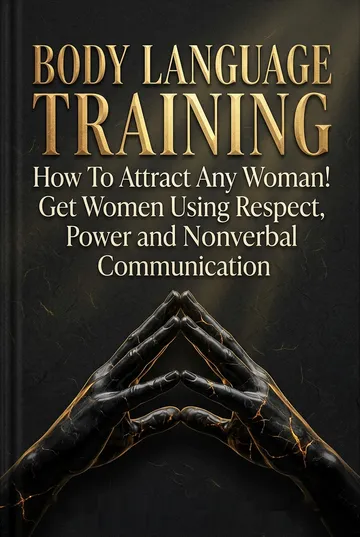
Stay natural, not theatrical. The book’s body-language preview goes further, recommending expanded posture, leaning back, and even drawing attention to the crotch. Those prescriptions turn communication into a display of sexual status and may be awkward or unwelcome. The useful version is simpler: stand comfortably, keep your face responsive, and use gestures that fit the setting. The book’s claims that body language accounts for 80 to 90 percent of communication are presented without supporting detail and should not be treated as universal measurements.
Nonverbal behavior matters because people read more than words, but it is not a fixed code in which a particular stance always means confidence. A relaxed posture can help someone feel less guarded, while an exaggerated pose can look rehearsed or intimidating. The book’s best advice is coherence: the eyes, face, and body should support the same genuine message. Its weaker status rules invite performance for an imagined audience. In leadership or dating alike, comfort, clarity, and responsiveness are more useful goals than appearing dominant.
Analysis
This is a short, sales-oriented self-help manual organized around one practical skill: using eye contact to appear confident in dating and professional situations. Its underlying narrative moves from attraction, to the origins of self-confidence, to techniques and drills. The most transferable thread is the claim that a social skill cannot be reduced to its visible mechanics. The author connects eye contact with self-belief, past experience, posture, and attention, then offers practice routines intended to make the behavior feel less stressful.
The book is less reliable when it turns that insight into a theory of attraction and status. Its claims about what women want, what men naturally provide, and which sex responds to looks or personality are broad generalizations supported mainly by anecdotes. The stories of Dianne and Melanie also expose a serious gap between confidence and respect: the author interprets repeated pursuit and ignored requests for space as evidence of appealing autonomy. That framing risks teaching readers to mistake boundary violations for charisma. The book’s own warnings against staring and unwanted watching point toward a more coherent standard: eye contact should be reciprocal and sensitive to context.
The exercises also vary in value. Focusing on an object can help someone notice distraction without involving an unwilling stranger. Cold-water exposure and deliberate staring are more questionable as social training, because tolerating discomfort does not automatically teach attunement. Likewise, competing eye-contact percentages and unsupported body-language statistics invite false precision. A reader can retain the useful core while discarding the performance mythology: build confidence through practice, use gaze to show attention, read the situation, and stop when the other person signals disinterest. Eye contact is a tool for communication, not proof of rank, attraction, or consent.
Review Summary
Eye Contact Training receives mixed reviews, averaging 3.58 out of 5. Many readers find it best suited for beginners, noting that a significant portion of the book focuses on the importance of eye contact rather than actionable training. Some appreciate the holistic approach, linking confidence to strong eye contact, and enjoy the exercises provided. However, critics feel the content lacks substance, with only a few practical recommendations. Common complaints include it being too short, overly simplistic, and not delivering on the promise of actual training techniques.
People Also Read


Glossary
High status eye contact
Controlled, socially aware gazeMoore’s term for deliberate control over where and when a person looks, while remaining aware of social expectations. He associates it with relaxed confidence and attention that is not easily disrupted by outside events. The book distinguishes it from staring, though some of its specific prescriptions risk crossing that boundary.
Inner game
Beliefs beneath outward behaviorThe book’s label for the internal confidence and self-beliefs that it says support visible behavior such as eye contact. Moore argues that outward techniques are difficult to sustain when a person expects failure or feels inadequate. He recommends working on self-belief alongside physical practice rather than treating confident behavior as a disguise.
90/60 rule
Suggested gaze-time ratioMoore’s guideline to look at another person for about 90 percent of the time while speaking and about 50 to 60 percent while listening. The book presents this as a way to appear attentive and confident, while advising occasional breaks in gaze. It should be understood as the author’s rough prescription, not a universal standard.
singular focus exercise
One-minute attention drillAn exercise in which a person looks at a small object for about 60 seconds, notices when attention wanders, and calmly returns focus. Moore recommends repeating the set three times and adding background sound when the basic version becomes easier. He presents the drill as practice for sustaining attention during tension.
cold shower exercise
Gaze practice under discomfortA drill in which the reader alternates warm and cold shower water, then focuses on a small spot while cold water runs for about 60 seconds. Moore suggests three sets and argues that physical tension prepares a person to handle emotional tension. The book does not establish that this discomfort is necessary for social confidence.
get caught exercise
Brief gaze exposure drillMoore’s proposed exercise of looking at five strangers until they notice, then maintaining the gaze for three additional seconds before looking away. It is meant to reduce discomfort about being noticed while making eye contact. Because it involves imposing a gaze on strangers, it is not a recommended substitute for practice in mutually engaged conversations.
rapport
Comfortable interpersonal connectionMoore uses rapport to describe an interaction in which two people are getting along and feel at ease with one another. He sees eye contact as one way to show attention and help a conversation feel connected. The book distinguishes rapport from attraction, though neither can be created by gaze alone.
About the Author
Other books by Robert Moore


Download PDF
Download EPUB
.epub digital book format is ideal for reading ebooks on phones, tablets, and e-readers.








