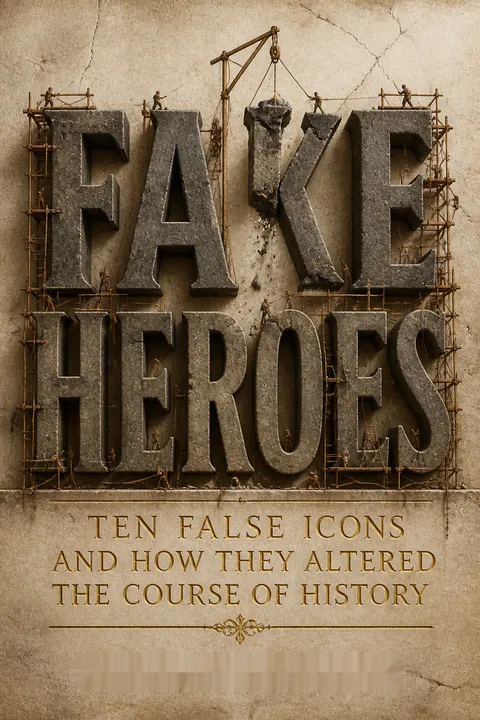


Key Takeaways
Separate spontaneous courage from society's celebrity-made heroes
Courage without a script. In 2007, Wesley Autrey pulled a stranger away from a subway platform, then jumped onto the tracks when the man fell back. A train passed over both men while Autrey shielded him in a drainage gap. Autrey was with his young daughters, had no connection to the stranger, and sought no reward. The book calls this unplanned, selfless response the Wesley Factor: a form of innate heroism prompted by another person's need, not by a search for fame.
Fame changed the story. Autrey was quickly turned into a celebrity, courted by politicians, brands, and television shows. The attention brought gifts and opportunities, but also pressure, opportunists, and disappointment. His rescue was extraordinary; the celebrity narrative that followed was manufactured.
What's striking is the gap between a difficult act and the easy story society builds around it. Autrey's rescue involved fast judgment under danger, but the resulting celebrity campaign made his character seem like public property. Social psychology offers a useful nuance: crowds can diffuse responsibility, as the bystander effect suggests, but they can also help people coordinate a response. The nearly empty station may have mattered, yet it cannot fully explain why Autrey acted. A careful account can honor his courage without pretending one story reveals a universal recipe for heroism.
Treat heroic stories as narrative patterns, not proof of virtue
Stories shape the hero. A monomyth is a recurring story pattern: someone leaves familiar life, faces a transformative ordeal, and returns changed. The book traces versions of this pattern from Gilgamesh to modern movies, and even to Autrey's rescue and its celebrity aftermath. Ancient Greek kleos means glory that survives through remembrance. In both cases, what endures is not simply the deed, but the story people repeat about it.
Screens feel like truth. The 1916 film The Battle of the Somme mixed real footage with staged scenes, including a supposed advance filmed behind the lines. Roughly 20 million Britons saw it in its first six weeks. The term alief describes an automatic, feeling-based response that persists even when someone consciously knows an image is staged. Film can make a constructed account feel lived.
A narrative template helps people remember history, but it can also make moral judgment feel unnecessary. If a figure completes a familiar journey, audiences may mistake emotional satisfaction for evidence of virtue. Film intensifies this effect because viewers experience events through faces, edits, and music rather than through records alone. The Somme film shows how a persuasive image can outlast the circumstances that produced it. Yet stories are not inherently deceptive: they can transmit courage and shared experience. The safeguard is to ask what the story leaves outside the frame.
Audit the record for both inflated icons and erased contributors
Reputation is edited. Douglas Bader's wartime image was promoted by the RAF and reinforced by the film Reach for the Sky. The book questions that heroic portrait: Bader's Big Wing tactic was celebrated despite evidence that pilots overstated their victories by roughly seven to one, and accounts also describe his bullying and racist views. Ian Gleed, a skilled fighter pilot who died at 26, was far less visible in the national story, in part because his homosexuality was concealed.
Credit goes missing. The Matilda Effect describes the recurring pattern in which women's scientific work is overlooked or credited to men. The book also recalls Shirley Chisholm, whose presidential run challenged racial and gender barriers, and Arctic explorer John Rae, dismissed after reporting Inuit evidence about Franklin's lost expedition. Their stories show that fame and merit are not the same thing.
What's useful here is the double audit: question the celebrated person's record, then ask who was denied a place beside them. Historical canons often reflect the institutions that preserve them, not a neutral ranking of courage or skill. Recovering overlooked contributors corrects that imbalance, though it should not require replacing one perfect hero with another. Bader could inspire disabled people while also behaving badly; Rae's insight can matter even if every aspect of his life is not known. A richer history allows contribution, conduct, and public reputation to remain separate questions.
When events feel too random, resist the comfort of conspiracy
A satisfying culprit beckons. After John F. Kennedy was assassinated, many Americans rejected the idea that Lee Harvey Oswald had acted alone. The book argues that Soviet disinformation helped spread alternative explanations, while New Orleans prosecutor Jim Garrison built a case against Clay Shaw on weak claims and a homophobic theory. The Warren Commission found that Oswald acted alone, citing his rifle, workplace, prior attempted shooting, and the murder of a police officer. Doubts persisted: a 2018 poll found 60% of Americans believed state or other actors were involved.
Pattern is not proof. Apophenia is the tendency to see meaningful connections in unrelated events. It can help people detect danger, but it also makes ambiguous details, such as a man opening an umbrella in Dallas, look like signals in a plot. Investigators later identified the umbrella man as a protester, not an accomplice.
Conspiracy stories thrive because random violence is frightening and unsatisfying. A coordinated plot can feel more comprehensible than the possibility that an isolated, angry person altered history. But suspicion alone is not evidence, and the account of Garrison's prosecution shows how a theory can turn a real person's private life into supposed proof of guilt. The counterpoint matters too: official investigations can be incomplete or mistaken. A sound test is comparative: which explanation best fits the available evidence, and what new evidence could disprove it? Skepticism should apply to both institutions and their critics.
Read artistic fame and price as branding, not proof of greatness
The name can outrun the work. In 1998, writer William Boyd and musician David Bowie invented Nat Tate, a supposedly forgotten American painter, complete with a biography and paintings. Art-world guests attended the launch and discussed Tate as if he were real. The hoax exposed how easily expert confidence can follow a convincing story.
Authorship gets complicated. Andy Warhol understood art as a public image and a business. His assistant Gerard Malanga made many silkscreens, sometimes signing Warhol's name, and Warhol later authorized a series of Che Guevara prints he had not known about beforehand. The works' market value depended heavily on the Warhol brand. This does not make the art worthless, but it complicates the idea that a famous artist's hand alone explains either its creation or its price.
The Nat Tate prank works because the art market depends on more than the object: it also relies on attribution, expert endorsement, scarcity, and shared belief. Those forces can sustain real value, but they are not the same as aesthetic quality. Warhol's collaborative practice further unsettles the modern ideal of the solitary genius. Still, collaboration does not automatically erase artistic authorship; selecting, directing, and framing other people's work can itself be consequential. The sharper question is not whether a work is authentic in one narrow sense, but which parts of its value come from craft, concept, provenance, or reputation.
Verify a saint's conduct instead of trusting the halo
Good deeds can grant access. Jimmy Savile raised money and volunteered at hospitals, gaining trust and unusual access to vulnerable people. After his death, investigations identified 214 specific offences, while the full number of victims may never be known. The book argues that his charitable image helped shield him and made complaints easier to dismiss.
Virtue needs scrutiny. Mother Teresa was celebrated worldwide, but critics and former volunteers described poor medical care in her homes for the dying, including inadequate hygiene and little pain relief. The book also questions her acceptance of money from disreputable donors and the gap between charitable funds and conditions in her facilities. In Australia, Anne Hamilton-Byrne's followers enabled her abuse of children and control over members. Steve Hassan's BITE model identifies four forms of cult control: behavior, information, thought, and emotion.
A public record of generosity can be genuine and still fail to establish that a person or institution is safe. The crucial distinction is between evaluating visible good works and independently checking how power is used behind closed doors. This is especially important where charities, hospitals, or religious groups control access to people with little ability to complain. The comparisons should not flatten very different kinds of wrongdoing into one category. They instead reveal a shared vulnerability: admiration can lower scrutiny. Independent safeguarding, financial transparency, and routes for reporting abuse are stronger protections than reputation.
Demand evidence before declaring profitable technology safe
The hazard was known. Thomas Midgley promoted tetraethyllead as a cheap way to stop engines knocking, although lead's toxicity was established. Workers at production plants became ill and died; Midgley himself had suffered health problems, yet publicly minimized the danger. At a 1925 government conference, industry expert Robert Kehoe argued that the product should be treated as safe until opponents proved harm. The book calls this burden-shifting approach the Kehoe Rule.
Denial had consequences. Geochemist Clair Patterson found lead contamination across the environment and challenged industry claims, facing pressure and loss of support. Leaded petrol was eventually phased out. Midgley's later refrigerant, Freon 12, also proved damaging: chlorofluorocarbons depleted the ozone layer. These cases show how profit, selective expertise, and false balance can delay action on well-established risks.
The strongest lesson is procedural: safety claims deserve independent testing, transparent data, and a burden of proof that does not force the public to absorb the risk first. Kehoe's position sounded cautious, but in practice it favored the party already making money. This same asymmetry appears whenever harms accumulate slowly and are difficult for individuals to trace. The book's account also warns against turning one inventor into the sole villain. Companies, regulators, and credentialed experts shared responsibility. Focusing on the system clarifies why a dangerous product can persist even when warning signs are visible.
In hostile terrain, local knowledge beats imperial confidence
Preparation beats spectacle. Robert Falcon Scott's Antarctic expedition carried ponies, failing motor sledges, and elaborate supplies, while mismanaging its dogs and relying on man-hauling. His team reached the South Pole after Roald Amundsen, then died on the return journey. Amundsen used dogs and skis, travelled lightly, and learned practical survival skills from Inuit people in the Arctic. His team reached the Pole first and returned safely.
Listen to expertise. John Rae likewise learned from Inuit and Cree guides in the Arctic. When they told him that members of John Franklin's lost expedition had resorted to cannibalism, British society rejected the report as incompatible with its image of naval gentlemen. Later archaeological evidence supported the Inuit account. The book's contrast is not simply between brave and timid explorers, but between those who learn from people who know the environment and those who trust status or tradition.
These expeditions make a broader point about expertise: knowledge is often situated, acquired through long practice in a particular place, and easy for distant institutions to undervalue. Amundsen's success depended less on a heroic temperament than on preparation and methods suited to the conditions. Scott's courage does not cancel his errors, just as Amundsen's victory does not make him morally superior in every respect. The comparison is most useful as a warning against equating sacrifice with competence. In dangerous settings, listening to local knowledge is not a gesture of humility alone; it can determine who survives.
Treat inherited titles as status, not evidence of character
Rank changes the reception. The book argues that royal titles confer instant authority, helping audiences treat a ruler as exceptional before examining the record. Shakespeare's Henry V became a model of the brave, witty king, but the historical ruler invaded France for power and territory, ordered prisoners killed at Agincourt, and oversaw the slaughter of men and boys after taking Caen. His familiar heroic image softens those acts.
Privilege reproduces itself. In nineteenth-century Australia, William Wentworth proposed an unelected hereditary upper chamber. Satirist Daniel Deniehy mocked the plan as a fanciful aristocracy, and the proposal failed. The episode gives the book a way to examine how status claims persist in political institutions, including Britain's House of Lords. Deniehy, however, held racist views of Chinese migrants, a reminder that opponents of privilege can carry prejudices of their own.
Status operates like a shortcut in social judgment: people infer competence, dignity, or even virtue from position. That shortcut can stabilize institutions, but it also hides the ordinary political interests behind grand language about tradition and service. The Henry V example is particularly useful because the same person can be a successful ruler and a brutal conqueror. Still, exposing the violence does not settle every question about monarchy or constitutional design. The stronger habit is to separate institutional arguments from inherited prestige, then assess each claim by its consequences, accountability, and evidence.
Let childhood heroes stay human without losing what their art gave you
Memory edits the past. The author recalls wanting to watch John Wayne while the 1980 Iranian Embassy siege interrupted television coverage. Years later, checking the schedule revealed that he had misremembered the day and the film. The book connects such errors to the Mandela Effect, a label for widely shared memories that conflict with the historical record.
Separate performance from person. Wayne's screen image stood for courage and fairness, but he avoided military service during the Second World War and later voiced racist and homophobic views. The author contrasts that image with his father Peter, who described a wartime encounter in which he ran from a German soldier rather than pursue a cinematic fight. That act of fear and restraint became a more honest model of courage than the films had offered.
The ending is powerful because it does not demand that affection disappear once a hero's flaws are exposed. Art can shape a childhood, offer language for courage, and remain meaningful even when its maker's conduct deserves criticism. The danger lies in treating emotional attachment as a defense brief. The author's father's story also complicates the usual image of bravery: survival, hesitation, and fear are ordinary features of war, not failures of character. Memory is fallible, but checking it need not destroy personal meaning. It can make that meaning more truthful.
Analysis
Fake Heroes is a work of popular history organized around a moral question: who gets remembered as heroic, and who benefits from that remembrance? Its chapters move across politics, war, religion, art, business, exploration, monarchy, science, and childhood memory. The recurring method is narrative reversal. A familiar icon is introduced in the polished form most readers know, then archival detail, neglected testimony, or institutional history complicates the image. The opening rescue by Wesley Autrey supplies a useful contrast: an unplanned act of courage becomes a media product almost immediately.
The book's strongest contribution is not the assertion that famous people are secretly bad. It is the demonstration that reputations are produced by mechanisms: propaganda films, family mythmaking, political patronage, commercial brands, gendered credit, religious authority, and repeated public ritual. The science chapters make that mechanism unusually consequential. Industry-backed expertise and delayed regulation helped normalize products whose dangers were measurable, while the explorer and artist chapters show how status can discredit inconvenient witnesses or inflate market value.
The method has risks. A deliberately provocative label such as fake hero can make unlike cases seem morally equivalent. A flawed person may still perform a genuinely courageous act, and an icon's public value may include work beyond the defects emphasized in a debunking. Some historical interpretations also depend on contested evidence or inference, so the reader should distinguish documented events from the author's judgments about motive. The most useful response is not to swap one pantheon for another. It is to separate four questions that public memory often fuses: What did the person do? What were their motives and effects? Who shaped the story? Who was excluded from it? That framework preserves admiration where it is earned while making hero worship harder to exploit.
Review Summary
Fake Heroes receives mixed reviews, with praise for its entertaining and informative content but criticism for editing issues and occasional lack of focus. Readers appreciate the debunking of myths surrounding historical figures, though some find the author's tone cynical. The book challenges perceptions of well-known personalities, offering new perspectives on their lives and accomplishments. While some reviewers find it eye-opening, others question the research quality and argue that the author's biases are too apparent. Overall, it's seen as a thought-provoking read that encourages critical examination of celebrated icons.
People Also Read

Glossary
The Wesley Factor
Unplanned altruistic courageThe book's term for an immediate, selfless act of courage prompted by another person's need rather than by a deliberate pursuit of fame, reward, or status. It takes its name from Wesley Autrey, who risked his life to rescue a stranger on a New York subway track while his young daughters were nearby.
monomyth
Recurring heroic story patternJoseph Campbell's name for a story structure found across myths and popular narratives. A central figure leaves familiar surroundings, faces trials that change them, and returns with new knowledge or capacity. The book uses the pattern to explain why audiences readily recognize heroic stories, while warning that narrative shape does not establish moral worth.
kleos
Glory preserved through memoryAn ancient Greek idea of glory that survives through stories and remembrance. In the book, it helps explain how a person's reputation can outlast their life and become part of a community's identity. Public commemoration, poems, monuments, and repeated narratives can preserve kleos, whether or not the remembered person deserves the praise.
alief
Automatic belief-like responsePsychologist Tamar Gendler's term for an instinctive, feeling-driven reaction that can persist even when a person consciously knows something is false or safe. Someone may know a film is staged yet feel genuine fear, or understand that a glass floor is secure while still gripping the rail. The book applies the idea to cinema's emotional power.
Apophenia
Seeing patterns without evidenceThe tendency to perceive meaningful connections among events or details that may be unrelated. The book uses apophenia to explain why ambiguous clues can seem to confirm conspiracy theories. Pattern detection is useful when danger may be present, but it can also make coincidences look like evidence of a coordinated plot.
Matilda Effect
Women's work loses creditA term coined by historian Margaret Rossiter for the pattern in which women's scientific achievements are overlooked, minimized, or attributed to male colleagues. Named for feminist activist Matilda Joslyn Gage, it describes a recurring distortion in the historical record, not a claim that every disputed credit has the same explanation.
BITE model
Framework for cult controlA model developed by former cult member and researcher Steve Hassan to identify forms of coercive control. BITE refers to behavior, information, thought, and emotional control. The book applies it to groups that regulate members' daily lives, limit access to outside information, discourage independent judgment, and use emotional pressure to secure loyalty.
Kehoe Rule
Burden proof shifted to criticsThe book's label for an argument associated with toxicologist Robert Kehoe: a potentially dangerous product should be treated as safe until opponents prove that it causes harm. In the leaded-petrol debate, this approach favored manufacturers and delayed protective action, even as workers and researchers reported serious risks.
Mandela Effect
Shared but inaccurate memoryA popular label for cases in which many people share a vivid memory that conflicts with the historical record. The term arose from people who believed Nelson Mandela had died in prison decades before his actual death. The book uses it to illustrate how personal recollection and collective stories can diverge from verifiable events.
FAQ
What is Fake Heroes: Ten False Icons and How they Altered the Course of History by Otto English about?
- Critical examination of icons: The book investigates ten widely celebrated historical figures, revealing the complexities, controversies, and sometimes damaging legacies behind their heroic reputations.
- Deconstruction of heroism: Otto English explores how myths, propaganda, and selective storytelling have constructed and sustained these "fake heroes" for political, cultural, or ideological purposes.
- Impact on society: The narrative highlights how these myths have shaped national identity, politics, and collective memory, urging readers to question accepted histories and the nature of heroism.
- Broad thematic scope: The book spans diverse fields, including exploration, science, royalty, and celebrity culture, to illustrate the pervasive influence of false hero narratives.
Why should I read Fake Heroes by Otto English?
- Encourages critical thinking: The book challenges readers to look beyond surface-level narratives and question the motives, actions, and legacies of celebrated figures.
- Reveals hidden truths: It uncovers lesser-known facts, controversies, and uncomfortable realities about iconic personalities, providing a more nuanced understanding of history.
- Relevance to modern discourse: By examining how myths are constructed and maintained, the book offers valuable insights into how public perception is manipulated, which is crucial for understanding current cultural and political narratives.
- Engaging and accessible: Otto English combines rigorous research with compelling storytelling, making complex historical reassessments both thought-provoking and readable.
What are the key takeaways from Fake Heroes by Otto English?
- Heroes are often flawed: Many celebrated figures have significant personal and moral failings that complicate their heroic status, with myths often overshadowing inconvenient truths.
- Myth-making serves agendas: Heroic narratives are frequently constructed to uphold national pride, political power, or social hierarchies, rather than reflect historical accuracy.
- Memory and perception are unreliable: Concepts like the Mandela Effect illustrate how collective memory can distort history, making it vital to question accepted stories and seek evidence.
- Importance of context: Understanding the social, political, and historical contexts behind these figures is crucial to grasping the full picture beyond their sanitized legends.
How does Otto English define and critique heroism in Fake Heroes?
- Innate vs. constructed heroism: The book distinguishes between genuine, altruistic acts (like Wesley Autrey’s) and manufactured celebrity or political heroism created for public consumption.
- Role of propaganda and myth: Otto English shows how media, cinema, and public relations shape heroic images, often turning flawed individuals into icons while glossing over their harmful actions.
- Consequences of false heroes: These constructed heroes influence national identity, culture, and politics, sometimes perpetuating falsehoods or harmful ideologies.
- Call for critical reassessment: The book urges readers to value genuine courage and integrity over myth and to question the motives behind hero worship.
What is the "Wesley Factor" in Fake Heroes by Otto English?
- Definition of the Wesley Factor: The term describes pure, innate heroism—selfless acts done without personal gain or societal pressure, exemplified by Wesley Autrey’s spontaneous rescue on New York subway tracks.
- Contrast with societal heroes: The book uses this concept to highlight the difference between authentic courage and the constructed heroism of those seeking fame or power.
- Significance in hero narratives: The Wesley Factor serves as a benchmark for true heroism, challenging the idea of the lone hero by emphasizing the interconnectedness of human actions.
- Societal discomfort: The book notes how society often struggles to handle authentic heroes who do not seek the spotlight, preferring more manageable, constructed icons.
How does Fake Heroes by Otto English explain the creation and impact of false hero myths?
- Manufactured legends: Societal heroes are often carefully selected, mythologized, and promoted by historians, politicians, and media to serve national or ideological narratives.
- Selective storytelling: Inconvenient facts are omitted or reinterpreted, and public relations and branding shape perceptions to fit desired narratives.
- Role of media and culture: Film, literature, celebrity endorsements, and political rhetoric all contribute to creating and sustaining idealized images of controversial figures.
- Impact on society: These myths influence political ideologies, cultural identities, and public memory, often obscuring the harm caused by these figures and preventing critical engagement with history.
What is the "monomyth" or "hero’s journey" and how does Fake Heroes use this concept?
- Definition of the monomyth: Popularized by Joseph Campbell, the monomyth is a narrative pattern where a hero undergoes separation, initiation, and return, transforming through trials and challenges.
- Application in the book: Otto English maps real-life stories, like Wesley Autrey’s, onto the monomyth stages to illustrate how society frames heroism in familiar narrative arcs.
- Cultural significance: The monomyth shapes how societies understand heroism and storytelling, influencing everything from ancient epics to modern films and political narratives.
- Explains universal resonance: The concept helps explain why certain heroic stories resonate so widely and persist across cultures and eras.
How does Fake Heroes by Otto English challenge the legends of specific historical figures like Douglas Bader, Che Guevara, and Coco Chanel?
- Douglas Bader: The book contrasts Bader’s sanitized, propaganda-fueled legend as a WWII hero with his real-life recklessness, bullying, and controversial alliances, including praise for a Nazi pilot.
- Che Guevara: Otto English exposes the gap between Che’s romanticized revolutionary image and his violent purges, economic mismanagement, and authoritarian actions, while acknowledging his enduring symbolic power.
- Coco Chanel: The book reveals Chanel’s collaboration with the Nazis, her use of antisemitic laws for personal gain, and her carefully sanitized postwar legend.
- Broader critique: These examples illustrate how myth-making can obscure moral failings and perpetuate harmful legacies.
How does Fake Heroes by Otto English portray the myth of British heroic failure, especially through figures like Captain Scott?
- Romanticizing failure: The book discusses Britain’s cultural tendency to glorify heroic failure, exemplified by Captain Scott and other explorers who died in tragic circumstances.
- Critical historical context: Otto English contrasts the myth with the harsh realities of these expeditions, highlighting poor leadership, arrogance, and avoidable mistakes.
- Comparison with successful figures: The book compares Scott’s sentimental and disorganized approach with Amundsen’s practical efficiency, challenging the narrative of noble sacrifice.
- Cultural impact: This myth of heroic failure shapes national identity and influences how history remembers success and failure.
What does Fake Heroes by Otto English reveal about the role of women in science and the "Matilda Effect"?
- Definition of the Matilda Effect: The phenomenon where women’s contributions to science are overlooked or credited to men, named after Matilda Gage’s work exposing this bias.
- Profiles of overlooked women: The book highlights figures like Alice Ball, Lise Meitner, Rosalind Franklin, and Marie Maynard Daly for their critical but underrecognized scientific achievements.
- Barriers faced: Otto English details the historical obstacles women encountered, including exclusion from education, professional marginalization, and erasure from scientific history.
- Advocacy for recognition: By telling these stories, the book calls for a more inclusive and accurate account of scientific progress.
What is the Mandela Effect and how does Fake Heroes by Otto English use it to explain collective memory?
- Definition and origin: The Mandela Effect describes collective false memories where groups remember events differently from recorded history, a term coined by Fiona Broome.
- Examples in culture: Misremembered movie lines, false beliefs about historical events, and confusion over public figures’ deaths illustrate this effect.
- Causes and implications: Otto English attributes it to the unreliability of human memory, cognitive dissonance, and the blending of personal and cultural narratives.
- Significance for history: Understanding the Mandela Effect helps explain why myths persist and why people resist correcting false historical beliefs.
What are the best quotes from Fake Heroes by Otto English and what do they mean?
- On heroism and myth: “Heroism is not a quality that can be manufactured, but a fleeting moment of selflessness.” This quote underscores the book’s distinction between genuine acts of courage and constructed legends.
- On the power of narrative: “History is not what happened, but what we choose to remember.” Otto English highlights the selective nature of collective memory and the role of storytelling in shaping history.
- On the dangers of idolization: “The more we idolize, the less we scrutinize.” This warns against blind hero worship and the importance of critical engagement with the past.
- On reclaiming true heroism: “Perhaps the greatest heroes are those whose names we never know.” The book encourages readers to value everyday acts of courage over mythologized figures.
Download PDF
Download EPUB
.epub digital book format is ideal for reading ebooks on phones, tablets, and e-readers.








