

Key Takeaways
Treat wealth as a century-long relay, not a personal finish line
Time changes the assignment. The book’s central claim is that lasting family wealth comes from planning beyond the lifetime of the person who earns it. The founders may never enjoy the full return: a repaired French chateau roof can outlast its owners, and an avenue of trees may reach its grandeur only for their grandchildren. The authors contrast families that remain established across generations with neighborhoods whose former industrial prosperity did not endure. Their explanation is a habit of saving and building for a distant future, rather than spending every surplus now.
Practice delayed gratification. The authors cite studies in which children who waited longer for a larger reward later tended to show stronger academic and self-regulatory outcomes. They connect this capacity to saving seed for next season, maintaining property, and investing for descendants who are not yet born.
What's compelling is the shift from wealth as a score to wealth as an intergenerational project. Long horizons can change everyday choices because the benefit of maintenance, education, and restraint becomes visible beyond one person’s lifespan. Behavioral research also cautions against treating patience as a fixed virtue: people wait more readily when future rewards seem dependable. The book’s insight is strongest when read as a design problem, not a character test. A family needs credible plans and relationships that make sacrifice feel worthwhile.
Develop the family’s capabilities before enlarging its balance sheet
Money is only one asset. The book’s family balance sheet tracks four kinds of capital: human, intellectual, organizational, and financial. Human capital includes ability, judgment, health, emotional stability, and the capacity to work with relatives. Intellectual capital includes what the family knows; organizational capital is its ability to coordinate; financial capital is its money and property. A fortune lacking the first three may be difficult to preserve or rebuild.
Train through participation. The Rockefellers offer an example: John D. Rockefeller Jr. did not follow his father into business creation. His work on family governance and philanthropy helped build structures that served the family across generations. The authors argue for mentoring, real responsibility, and learning by doing, rather than assuming a finance degree alone prepares heirs. Older relatives also contribute experience, household work, and judgment, rather than simply retiring from family life.
The four-part inventory resembles a broader idea in organizational science: performance depends not just on money, but on knowledge, coordination, and people able to use both. The Rockefeller example also challenges the assumption that a successor must copy the founder’s career. A family can benefit from complementary talents. The limitation is that family involvement can become nepotism if competence is assumed rather than demonstrated. Productive training therefore needs real standards, meaningful tasks, and room for a younger relative to choose a different path.
Turn shared family values into routines, roles, and honest conversation
Culture needs repetition. In the book, family culture means a shared account of who the family is, what it values, and how it treats work, money, and one another. It is built through ordinary practices: meals, stories about earlier generations, shared projects, family properties, and respect for the work that funds the household. The authors assign a central role to the matriarch, often the person who notices emotional strain and keeps relationships connected. They name three threats: division, dissatisfaction, and distance.
Keep everyone engaged. One family heir had been treated as a failure because he did not want to join the family company. When the family involved him in its foundation, he found a meaningful role and became an effective leader there. The book is skeptical of much philanthropy, but presents family projects as a possible training ground when the family stays involved and evaluates the results.
Rituals and shared stories can create what sociologists call social capital: trust and expectations that make cooperation easier. A family gathering is not just sentimental if it gives relatives a dependable setting to raise concerns before a crisis. The book’s gendered picture of the matriarch is narrower than its underlying principle. Emotional leadership, conflict detection, and continuity work are essential functions, but they need not belong to women or to one person. Making those duties explicit can prevent them from becoming invisible labor.
Build a business people can inherit, not just proceeds to divide
A business keeps wealth active. The authors prefer a working enterprise to a pile of cash because a business generates income, requires attention, and gives relatives a shared task. It also makes the source of family money concrete. Their own publishing company began with one newsletter, then expanded step by step. By contrast, ventures that jumped into magazines or a satire newspaper before the founders understood those businesses lost money.
Learn without betting everything. The recommended method is to test small, learn quickly, and avoid any single gamble that could sink the enterprise. Study other operators instead of assuming every lesson must be learned firsthand. The book favors businesses with durable know-how and barriers to easy entry, while warning that a family must adapt and keep creating value. A business can anchor a family, but only if the next generation learns how it works.
A family business can function as both an income stream and an apprenticeship. That combination gives younger relatives a chance to acquire tacit knowledge, the practical judgment that is hard to transfer through manuals alone. Small experiments also resemble modern lean-startup methods: test demand before committing substantial resources. Yet permanence is not automatically virtue. An inherited company can trap relatives in work they dislike or protect an obsolete model. The durable inheritance is not merely ownership, but the capacity to notice when the business must change.
Follow durable market tides instead of chasing the next winning stock
Choose the market first. The authors distinguish alpha, returns from selecting particular investments, from beta, exposure to a broader market or trend. They argue that long-term investors should spend more effort deciding where to invest than trying to identify the next superstar stock. They cite studies of pension funds and balanced funds in which asset allocation explained most of the variation in returns; one study reported a 96.7 percent correlation between index-based and actual fund returns.
Wait for evidence. The authors’ 2012 investment view favored emerging economies over developed ones and gold over government debt, based on their expectations about growth, energy, and paper currencies. They illustrate trend investing with a hypothetical sequence of moving between gold and stocks that could have multiplied money many times. That is a retrospective scenario, not a reliable forecast or guaranteed result.
The emphasis on broad allocation usefully counters the fantasy that a clever stock pick can overcome every structural risk. Diversification and low turnover can also reduce avoidable costs and emotional decisions. But asset-allocation studies describe past fund performance; they do not prove that anyone can reliably identify the best future market. The book’s emerging-market and gold predictions are especially tied to its 2012 setting. A sensible reader can retain the method of questioning consensus and considering long horizons without treating those specific bets as timeless instructions.
Make compounding survive taxes, fees, inflation, and panic
Small leakages grow large. The book treats time as a force that magnifies both returns and costs. Its illustration says that $1 million growing at 6 percent annually could reach about $18.4 million in 50 years before interruptions and depending on the assumptions. The same compounding works against a family when recurring fees, taxes, and inflation reduce what remains invested.
Protect the net return. The authors therefore favor keeping costs low and avoiding needless trading. They also argue that investments producing deferred capital gains can compound more efficiently than assets paying taxable income every year. Their examples are illustrations, not personal tax guidance: actual returns, tax rates, inflation, and legal rules vary. Their broader point is that a small annual difference in what stays invested can become a large difference over decades.
The mathematics of compounding gives the book’s long-horizon argument real force: recurring costs are not isolated charges, because each dollar paid out also loses the chance to earn future returns. This is why fee transparency and tax awareness matter more for long-term pools than a single year’s performance might suggest. Still, the example’s smooth growth rate can obscure volatility, changing rules, and investment losses. Compounding is powerful, but it cannot rescue a poor asset or eliminate the need for liquidity and risk controls.
Make wealth hard to liquidate before spending catches up
Illiquidity can protect capital. The authors use the term financial escape velocity for the point at which wealth grows faster than a family’s spending. They argue that businesses, land, timber, and other assets that cannot be sold instantly can help families resist turning every gain into a bigger lifestyle. One example is a family’s forest land, held across five generations and difficult to sell without challenging the family’s own traditions.
Choose the lock deliberately. A family asset can appreciate without producing cash that tempts immediate spending. But an illiquid asset may also be hard to sell when a family needs money. The book suggests that even $300,000, earning a hypothetical 4 percent, could generate $12,000 per year or help finance education, housing, or a business. The useful question is not simply whether an asset is hard to spend, but whether the family can carry its costs.
Illiquidity can serve as a behavioral commitment device: when money cannot be accessed with a quick transaction, impulse spending becomes harder. This connects the book’s family strategy to behavioral finance, where changing the choice environment can matter more than relying on willpower. The same barrier can become dangerous, however, if a family faces medical costs, debt, or a sudden need to diversify. Durable wealth needs both commitment and an emergency plan, rather than treating difficulty of sale as an unqualified advantage.
Set your freedom target before chasing a rich-person number
Enough depends on autonomy. The book calls F-U money the amount that lets someone refuse unwanted work or dependence. It is not a fixed sum: a person with modest needs may need far less than someone seeking a lavish lifestyle. The authors describe a friend who lost an inherited $1 million while trying to turn it quickly into a much larger fortune, then rebuilt wealth through work over decades.
Separate capital from income. The book argues that a family fund should not be confused with a personal retirement account. Its principal is meant to remain available to support future relatives, while distributions can fund productive needs such as education, a new career, or a business. A $300,000 fund earning 4 percent would provide only $12,000 annually before taxes and other effects, but could still offer a meaningful safety net or opportunity.
The freedom measure is more useful than a status threshold because it connects money to specific choices: the ability to change jobs, start a venture, or withstand a setback. This resembles the economic idea of an option, a resource that preserves future choices even when it is not spent immediately. The distinction between family capital and personal spending can also protect a fund from lifestyle inflation. Yet rigid rules can deny legitimate needs, so a family needs transparent criteria for support, not just a prohibition on consumption.
Write succession rules before a death forces the family to improvise
Conflict grows in silence. The Waxman recycling business began with an immigrant founder and was built by two brothers. Disagreement over ownership and control turned into a 14-year lawsuit, with $5 million in legal fees. The dispute helped destroy the company. The book’s lesson is that vague promises, unequal participation, and delayed handovers can convert ordinary tensions into existential fights.
Transfer authority gradually. The authors recommend preparing successors while the founder can still teach, delegate, and resolve disputes. A family council can set policies for ownership, leadership, family employment, and the inclusion of spouses. The book also recounts the Busch and Guinness brewing families, whose ownership stakes shrank as companies expanded or went public. Keeping control is not always possible or desirable, but a family should decide deliberately what it is willing to trade away.
Succession is not a document-signing event. It is a transfer of knowledge, legitimacy, and decision-making power, so it benefits from rehearsal while the incumbent leader is still available. Clear rules can reduce the ambiguity that turns sibling comparisons into legal claims. At the same time, family control is not automatically superior to outside ownership: a sale may be prudent if the business is failing or heirs lack interest. The key is to make that choice openly, before urgency and grief dictate the terms.
Use legal structures to protect assets, but keep them comprehensible
Build the legal shell carefully. The book calls wills, trusts, estate plans, tax arrangements, and bank accounts hard structures because they are costly and difficult to change. It favors trusts as a way to hold assets across generations and reduce some transfer risks. It also discusses foreign accounts and tax jurisdictions, while noting that U.S. citizens generally remain subject to U.S. tax rules wherever they live.
Complexity can backfire. The authors describe an acquaintance whose elaborate tax arrangement led to years of legal expense, anxiety, and eventual settlement. Their practical warning is more durable than any specific strategy: understand the purpose of each structure, use qualified legal and tax professionals, and do not treat a book as a substitute for advice. Tax rules change, and a structure that looks efficient on paper may reduce control or become costly to maintain.
Legal structures can reduce predictable risks, especially when ownership, incapacity, or inheritance would otherwise be left unresolved. They are most useful when they serve a clear governance plan rather than substituting for one. The book’s complicated cross-border proposals demand particular caution because tax residence, citizenship, and beneficial ownership interact in jurisdiction-specific ways. Simplicity is not always possible, but comprehension is essential: if beneficiaries and decision-makers cannot explain what a structure does, they may be unable to manage its consequences.
Own a family place that builds belonging and practical resilience
A place can do double duty. The book’s family stronghold is a home base where relatives gather, build shared memories, and reconnect with family history. The authors also see it as a hedge against breakdowns in complex supply systems. They describe using a country property as a retreat, with stored food and firewood, nearby resources, and access to neighbors who could trade or help.
Prepare without pretending certainty. The book recommends access to water and a rotating supply of food, while arguing that rural skills and relationships can make a family more resilient during disruption. Its own family restoration projects show the cultural side: relatives repairing fences, buildings, and land together. A stronghold need not be a survivalist compound. It can be a modest, maintained place that gives a family both practical options and a reason to spend time together.
The stronghold joins resilience planning with a less obvious benefit: a shared place can make family relationships tangible. Working together on property creates recurring contact and practical knowledge that a formal family meeting cannot manufacture by itself. Preparedness is most useful when it is proportionate, maintained, and compatible with ordinary life. The book’s sharp distrust of cities and public institutions risks overstating the case; communities, infrastructure, and emergency services are also sources of resilience. A family refuge works best as a supplement, not a substitute, for them.
Analysis
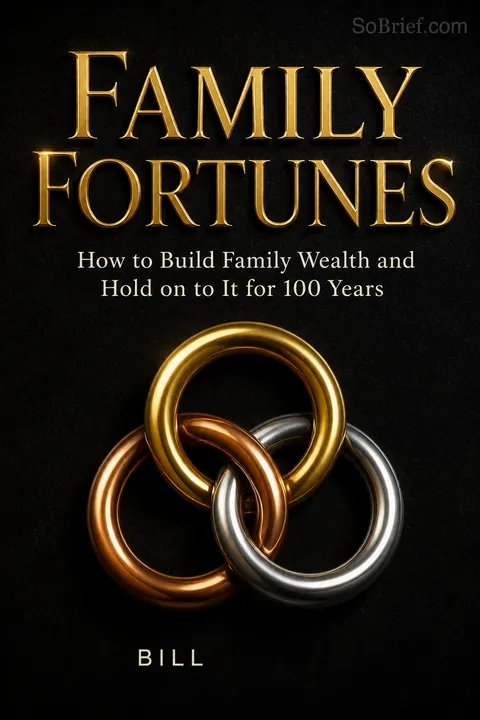
Family Fortunes is part financial strategy, part family-governance manual, and part polemic against short-term consumption and dependence on centralized institutions. Its most powerful organizing idea is that a fortune is not just a quantity of money. It is a living system of people, knowledge, relationships, ownership rules, and assets, all exposed to time. That frame explains why the book moves from delayed gratification to family culture, from business creation to investment allocation, and finally to trusts and a physical home base.
The strongest practical insight is that wealth transfer is also capability transfer. A trust can preserve legal ownership, but it cannot by itself create judgment, trust, or competence among heirs. Regular participation, gradual succession, and open discussion address the human causes of failure that technical estate planning cannot solve. The contrasting stories of the Mulliez and Waxman families make the distinction vivid: family participation can support continuity, while opaque control and unresolved grievances can turn a business into a courtroom battle.
The book’s financial prescriptions are less secure than its governance insights. Its recommendations about gold, emerging markets, government bonds, energy, and national decline reflect a particular moment in 2012. Its illustrations often assume stable returns and use broad claims about taxation, charity, and markets that deserve independent scrutiny. The emphasis on preserving family control can also discount the value of selling an unsuitable business, while its traditional gender roles obscure how care and leadership can be shared.
Read most usefully, the book is not a universal investment plan or a defense of every inherited advantage. It is a challenge to ask what money is for, who is being prepared to manage it, and whether institutions can survive their founders. Its durable contribution is to make the family itself part of the balance sheet, without pretending that money alone can make a family cohesive or that cohesion alone can make wealth permanent.
Review Summary
Family Fortunes received mixed reviews. Some praised its long-term perspective on wealth building and family legacy, while others criticized its lack of concrete data and perceived biases. Positive reviewers found value in its contrarian views and focus on family culture. Critics felt it was poorly researched, sexist, and based too heavily on speculation. Many noted the authors' lack of personal experience with multi-generational wealth. Overall, readers appreciated the book's unique approach but were divided on its practical usefulness and ideological stance.
People Also Read










Glossary
Family balance sheet
Inventory of family assetsA way of assessing a family’s capacity to create and preserve wealth by looking beyond cash and investments. The book divides family capital into human, intellectual, organizational, and financial forms. The framework highlights that money may be difficult to retain when a family lacks the skills, shared knowledge, and coordination needed to manage it.
Financial escape velocity
Wealth outpaces spendingThe point at which a family’s assets or earnings grow faster than its expenses. The book argues that this can happen when profits are reinvested, a business compounds its capabilities, or wealth is held in assets that are not easily converted into spendable cash. The term describes a behavioral and financial threshold, not a guaranteed rate of return.
F-U money
Capital that supports independenceThe amount of money a person needs to make important choices without being controlled by an employer, financial desperation, or reliance on government support. The book does not assign it a universal dollar figure. The required amount depends on a person’s costs, ambitions, and definition of freedom.
Alpha
Investment-specific excess returnIn the book’s investing vocabulary, alpha means return attributed to choosing particular securities or investments that outperform a broader market. The authors argue that consistently finding such winners is difficult and unreliable. They contrast it with beta, which they use for exposure to a wider market or long-term economic trend.
Beta
Exposure to broad market trendsThe book uses beta broadly to mean choosing the markets, asset classes, or economic trends in which to invest, rather than attempting to outperform through individual stock selection. Its approach asks investors to identify large shifts, wait for prices to reveal a trend, and hold positions over long periods. The authors’ particular forecasts remain time-specific opinions.
Hard structures
Legal and tax arrangementsThe legal and financial arrangements used to own, protect, and transfer family assets. The book includes wills, estate plans, trusts, tax strategies, and bank or investment accounts. They are called hard because they can be costly to establish and difficult to alter. Their purpose is to support a family’s aims, not replace shared decisions or competent advice.
Soft structures
Informal family governanceThe family-created practices and decision-making arrangements that guide relationships and shared assets without functioning as legal entities. Examples in the book include a family council, mission statement, constitution, investment committee, mentoring, and regular meetings. They can evolve more readily than trusts or wills and help relatives communicate, resolve conflict, and prepare successors.
Endowment model
Trust-funded family developmentThe book’s proposed arrangement for holding family wealth in a continuing trust and distributing funds selectively for productive purposes. Examples include education, starting a business, developing a career, and responding to emergencies. A family council oversees decisions, while beneficiaries are expected to contribute to family responsibilities. The model aims to support relatives without treating the principal as unrestricted spending money.
Family Council
Family-wide governing groupA group of relatives that makes or coordinates decisions about shared family affairs and wealth. In the book’s model, it helps set family policies, oversee investment and property matters, manage distributions, address conflicts, and prepare succession. Its composition and authority should adapt as the family expands, with broad agreement favored for major decisions.
FAQ
What's Family Fortunes about?
- Focus on Family Wealth: Family Fortunes by Bill Bonner and Will Bonner explores strategies for building and maintaining family wealth across generations, emphasizing a long-term perspective.
- Cultural and Historical Context: The book discusses how certain families have successfully preserved their fortunes over time, highlighting cultural values and practices that contribute to wealth longevity.
- Practical Strategies: It provides practical advice on managing family finances, including establishing family offices, investment strategies, and fostering a strong family culture.
Why should I read Family Fortunes?
- Long-Term Wealth Preservation: The book offers insights into thinking long-term about wealth, crucial for families aiming to maintain their financial legacy.
- Avoid Common Pitfalls: It outlines common pitfalls wealthy families face and offers strategies to avoid them, helping families navigate wealth management complexities.
- Cultural Insights: Emphasizing the importance of family culture in wealth preservation, the book encourages developing a strong family identity that supports financial goals.
What are the key takeaways of Family Fortunes?
- Importance of Family Structure: A strong family structure is essential for wealth preservation, built on solid relationships and shared values.
- Delayed Gratification: The concept of delayed gratification is crucial for long-term success, advocating for forgoing immediate rewards for longer-term goals.
- Investment in Human Capital: Investing in the education and development of family members is vital, as the family's most valuable resource is its human capital.
What are the best quotes from Family Fortunes and what do they mean?
- "Behind every great fortune there is a crime.": Reflects the historical context of wealth accumulation, suggesting ethical considerations in wealth.
- "It takes teamwork.": Emphasizes collaboration within families to build and maintain wealth, leveraging each member's strengths.
- "You can’t have family money by accident.": Highlights the need for intentionality and planning in creating and sustaining family wealth.
How do I accumulate a family fortune according to Family Fortunes?
- Start with a Business: Most family fortunes are created through successful businesses rather than salaries or investments.
- Focus on Long-Term Growth: Accumulating wealth requires a long-term perspective, investing in businesses that can grow over time.
- Avoid Quick Gains: The book warns against seeking wealth too quickly, as it often leads to loss.
What is the role of the matriarch in family wealth according to Family Fortunes?
- Emotional Leadership: The matriarch maintains family harmony and emotional well-being, acting as the "chief emotional officer."
- Cultural Preservation: She instills family values and culture, essential for long-term wealth preservation.
- Conflict Resolution: Responsible for mediating disputes and ensuring family unity, preventing wealth transfer failures.
What are the common pitfalls for wealthy families mentioned in Family Fortunes?
- Lack of Communication: Failure to communicate openly about wealth and responsibilities can lead to misunderstandings.
- Division Among Heirs: Sibling rivalries and divisions can lead to the downfall of family wealth.
- Overemphasis on Competition: Excessive competition among family members can be destructive, encouraging collaboration instead.
How does Family Fortunes define family money?
- Different from Personal Money: Family money is meant to be preserved and passed down through generations, unlike personal money.
- Long-Term Focus: Requires a long-term perspective, focusing on growth and sustainability rather than immediate consumption.
- Investment in Family Values: Should be invested in ways that align with the family's values and culture.
What investment strategies are recommended in Family Fortunes?
- Focus on Illiquid Assets: Investing in illiquid assets like real estate or family businesses, which are less likely to be squandered.
- Avoiding Public Markets: Cautions against relying heavily on public market investments due to volatility.
- Long-Term Growth Investments: Advocates for investments with potential for long-term growth, emphasizing patience and strategic planning.
How can families develop a strong family culture according to Family Fortunes?
- Shared Values and Identity: Developing a shared family culture with common values and a sense of identity is crucial.
- Regular Family Engagement: Engaging in regular activities and traditions that reinforce culture and bonds.
- Education and Communication: Open communication and education about family wealth and responsibilities ensure understanding and preservation.
What is the significance of delayed gratification in Family Fortunes?
- Key to Long-Term Success: Delayed gratification is crucial for building and maintaining family wealth.
- Cultural Value: Presented as a cultural value that families should instill in their members.
- Generational Mathematics: Essential to teach younger generations the importance of saving and investing for the future.
How do hard structures and soft structures differ in Family Fortunes?
- Definition of Hard Structures: Legal entities like trusts, wills, and estate plans that manage and protect wealth.
- Definition of Soft Structures: Informal agreements and governance systems like family councils and mission statements.
- Importance of Both: Both are essential for long-term wealth preservation, protecting against external threats and ensuring internal harmony.
Download PDF
Download EPUB
.epub digital book format is ideal for reading ebooks on phones, tablets, and e-readers.








