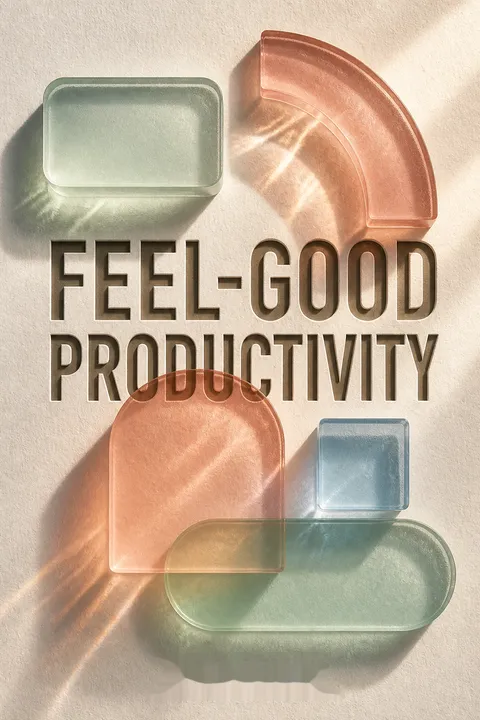


Key Takeaways
Treat feeling good as productive infrastructure, not a prize for finishing
A Christmas shift broke the old formula. As a new doctor, Ali Abdaal tried to handle an impossible workload by working harder. He became exhausted, less effective, and miserable. His turning point was questioning whether success had to feel like suffering. The book’s central idea, feel-good productivity, reverses the usual sequence: wellbeing can support the energy and attention that help people do meaningful work.
Positive moods widen the view. In the candle problem, participants had to attach a candle to a board using matches and thumbtacks. People given a small mood-lifting gift solved it more often, suggesting that positive emotion can make people more flexible in their thinking. Barbara Fredrickson’s broaden-and-build theory describes how positive emotions can expand attention in the moment and help develop lasting resources such as resilience and social connection.
The useful reversal is not that happiness guarantees achievement, but that emotional state belongs inside any serious account of performance. Stress narrows attention toward immediate threats, while a more relaxed mind can notice options that pressure obscures. That makes wellbeing a practical condition, not merely a reward. The claim needs a boundary, however: positive feeling cannot compensate for an unsafe workload, inadequate resources, or chronic illness. Nor should workers be assigned responsibility for feeling cheerful in harmful conditions. The strongest reading is modest and actionable: improve the conditions of work where possible, because mood influences how much capacity people can bring to it.
Turn dull work into a low-stakes game that curiosity can keep alive
Play can restart serious work. Physicist Richard Feynman had lost interest in research after his wife died. A spinning cafeteria plate caught his attention, and he began playing with the mathematics of its wobble simply because it intrigued him. That curiosity drew him back toward physics, including questions connected to the work that earned him a Nobel Prize. The lesson is not to make every task entertaining, but to look for a point of interest that makes beginning easier.
Add adventure, fun, and safety. Try a new route, explore a question alongside the main task, or ask how the work could be more enjoyable. Music, a playful challenge, or focusing on the process can help. Stress suppresses play, so treat mistakes as information rather than verdicts. A NASA engineer’s coding experiment found that people made fewer attempts when errors were framed as losing points, even though the penalty was arbitrary.
Play is more than a break from effort. It can change the meaning of effort, turning repetition into experimentation and making attention easier to sustain. That connects naturally to creative practice, where low-stakes exploration often precedes useful discoveries. The distinction between playful and careless matters: playful work can still be rigorous, while purely chasing novelty can scatter attention. A practical test is whether a playful adjustment increases engagement without damaging the task’s purpose. The author’s emphasis on psychological safety also matters. People are unlikely to experiment when every error carries humiliation or a real penalty.
Build confidence through small mastery experiences, not by waiting to feel ready
Belief affects performance. In a study of students who did not exercise regularly, some were falsely told they were among the fittest participants. When they returned to cycle, that group enjoyed the session more, especially as it became harder. Psychologist Albert Bandura called belief in one’s capacity to succeed at a task self-efficacy. The book’s advice is to create evidence for that belief: use encouraging self-talk, observe a relatable person succeeding, and learn by doing.
Ownership adds energy. Teaching a subject can deepen the teacher’s own learning, a pattern called the protégé effect. Autonomy, or a sense of control over one’s actions, also supports intrinsic motivation. Even when the assignment is fixed, a person may have some choice over method, sequence, or attitude. A junior developer, for example, can volunteer to explain a tool to a colleague, gaining practice while helping someone else.
Confidence here is not a personality trait that must be acquired before action. It is partly built through successful contact with a challenge, which gives a person more credible evidence than affirmations alone. This is a useful bridge between mindset and skill: belief can help someone attempt the task, while practice supplies the competence that makes belief durable. The approach works best when the challenge is appropriately scaled. Telling someone to act confident cannot replace training, support, or sound judgement, especially in high-risk work. Agency also has limits, so the goal is to find real choices rather than pretend every circumstance is controllable.
Make colleagues allies, because shared effort changes how hard work feels
A team can exist in the mind. Brian Eno noticed that influential artists often grew through a surrounding creative scene, not through isolated genius. A laboratory puzzle study found that participants who thought a fellow participant had sent them a helpful tip worked on the puzzle 48 percent longer than those who thought the tip came from a researcher. Feeling that someone is alongside the effort can change motivation, even when people are not doing the same task.
Help and communication build connection. Volunteers surveyed by Allan Luks often reported feeling happier and more energized after helping others. Asking for help can also strengthen a relationship, rather than impose the burden people often fear. Share good news with active enthusiasm, and give difficult feedback with care, specific observations, and a constructive next step. These small exchanges can make work feel less isolating and turn competition into mutual progress.
The chapter’s strongest point is that collaboration is partly relational, not just logistical. People can work independently yet feel supported by a shared purpose, and that perception can sustain effort. This is particularly valuable in workplaces where tasks are divided into narrow individual targets. Helping also counters the mistaken assumption that contribution flows only one way: receiving assistance can give others a meaningful role. Still, warmth is not a substitute for fair workloads or good management. A team culture cannot be built by asking individuals to absorb endless work in the name of solidarity. Connection energizes best when reciprocity is credible.
Clear the fog before demanding motivation: define why, what, and when
Procrastination can signal confusion. Abdaal argues that motivation and discipline often treat the symptom while leaving the obstacle untouched. If a task feels impossible because its purpose or instructions are unclear, pushing harder may only intensify avoidance. The military idea of commander’s intent offers a useful model: communicate the mission’s purpose and desired result, then allow flexibility about the route. Before planning steps, identify why the work matters.
Make the next move concrete. NICE goals focus on near-term actions that are input-based, controllable, and energising, rather than distant outcomes alone. Imagine in advance what might derail the plan, then choose when to act. Implementation intentions link a cue to an action, using an if-then plan. A calendar block can serve the same purpose. Together, these tools convert a vague intention into a defined action that can fit into actual time.
This approach treats ambiguity as a design problem instead of a character flaw. That is a valuable shift because vague requests and oversized goals create unnecessary cognitive work before the task even begins. Defining purpose while leaving room to adapt is also a good balance: rigid scripts break when circumstances change, but a clear destination helps people improvise. The caution is that an input goal is not automatically a good goal. A controllable daily action may still be misdirected if the underlying purpose is borrowed from someone else. Clarity should establish both what to do and why that action deserves attention.
Name the fear, shrink its imagined stakes, then start before confidence arrives
Fear often wears a disguise. Abdaal delayed making videos for years, telling himself that he needed the right idea or higher standards. He later recognized fear of failure and judgement underneath. In an experiment with people afraid of spiders, participants instructed to name their emotions approached a tarantula more successfully than comparison groups. Affective labelling means putting feelings into words so they can be examined rather than silently steering behaviour.
Put the threat in proportion. The 10/10/10 exercise asks whether a setback will matter in 10 minutes, 10 weeks, and 10 years. The spotlight effect describes how people tend to overestimate how much others notice their mistakes. When these reminders are not enough, an imagined persona can help someone act with qualities they admire. The aim is not to erase fear. It is to make a small move while fear is still present.
Naming fear creates a small separation between an emotion and the action it demands. That pause can make avoidance visible: a person can recognize, for example, that postponing a presentation is about anticipated judgement rather than lack of interest. Time perspective and the spotlight effect can then challenge the mind’s inflated threat estimate. These tools should not be used to dismiss legitimate risks or serious anxiety. Some fears contain important information, and persistent distress may need more than a productivity technique. The practical distinction is between a danger that requires protection and discomfort that can be approached gradually.
Beat inertia by removing the first obstacle and making progress visible
Starting has its own friction. A Dutch supermarket study placed green sections in shopping carts to make vegetables more visible and easier to choose. Shoppers with the inserts bought over 50 percent more vegetables on average. The same principle applies to personal tasks: put the needed materials within reach and make distracting alternatives less automatic. When motivation is low, commit to five minutes, or identify only the next physical action, such as opening the document.
Evidence sustains momentum. Writer Brandon Sanderson tracks his daily word count, turning a long book into visible increments. Progress tracking can reveal when plans need adjustment and make small advances tangible. An accountability partner adds social commitment, while self-forgiveness interrupts the shame that can follow procrastination. Students in a study who forgave themselves for not studying were more productive afterward. A missed start need not become a reason to abandon the whole project.
Inertia is a useful metaphor because it explains why a task can feel disproportionately difficult before it begins, then manageable once underway. Environmental design and small first actions reduce the activation cost rather than relying on a fresh burst of willpower. Tracking provides feedback, but it can also become another source of pressure if the metric is treated as a measure of personal worth. The most productive measures are informative, not punitive. Likewise, accountability works best when agreed upon and supportive. Shame may briefly produce effort, but it often makes the next attempt harder.
Protect energy with fewer commitments, real breaks, and restorative downtime
Burnout has more than one route. Abdaal distinguishes overexertion, from taking on too much; depletion, from failing to recharge; and misalignment, from investing effort in work that conflicts with personal values. To prevent overexertion, list long-term ambitions separately from active projects and limit what receives energy now. A new commitment has an opportunity cost: it displaces something else, including sleep, relationships, or recovery.
Rest should actually restore. A break is not a prize earned after exhaustion. In one study described in the book, workers who took about 17 minutes off after roughly 52 minutes of work were more productive than those who worked continuously. Creative hobbies can provide competence, choice, freedom from work, and a calmer pace, summarized by the acronym CALM. Nature can also help: even brief views of greenery improved attention in a study. Sometimes recovery means intentionally doing very little.
This section broadens productivity from managing effort to managing recovery. Its insistence that rest is functional, not indulgent, challenges cultures that treat visible busyness as proof of value. The distinction between restorative and numbing leisure is useful, though it should not become another standard people feel obliged to optimize. Passive entertainment can be a reasonable recovery choice, especially when energy is low. Likewise, reported work-break patterns are observations, not universal schedules. The deeper principle is individual calibration: notice which forms of rest genuinely improve capacity, and protect enough space for them.
Choose work that serves your values, then test alignment in daily actions
Motivation can reflect personal value. University of Missouri researcher Kennon Sheldon studied hikers attempting the 2,650-mile Pacific Crest Trail. Many lost some enjoyment of hiking during the demanding journey, but those who connected the effort to goals they personally valued were more likely to finish and reported greater wellbeing. This is identified motivation: doing something difficult because its purpose matters to the person, even when the activity itself is not enjoyable.
Turn values into experiments. Write the life you would want remembered in a eulogy, sketch several plausible futures, or rate how aligned different areas of life feel. Then translate a value into a near-term action. Abdaal’s daily alignment exercise chooses one action for health, work, and relationships. If a major life change seems uncertain, test a smaller version first and observe how it affects engagement and wellbeing.
Values provide a way to distinguish meaningful difficulty from effort spent merely satisfying external expectations. The trail example makes the distinction vivid: enjoyment may dip while commitment remains, provided the purpose still feels chosen. This avoids the simplistic demand to love every task. Reflection exercises can help expose conflicts between stated priorities and actual calendars, but they cannot by themselves resolve financial dependence, caregiving, or limited choices. A small experiment is therefore often wiser than a dramatic declaration. Alignment is not a fixed destination; it is an ongoing check between what matters and where time and effort go.
Analysis
Feel-Good Productivity is built around a causal claim that is easy to overlook: emotional wellbeing is not merely the reward at the end of productive work. It can be one of the conditions that makes effective work possible. The book turns that claim into a practical sequence. First, energise work through play, agency, and social connection. Next, treat procrastination as a clue to uncertainty, fear, or inertia, rather than proof of laziness. Finally, protect capacity through limits, genuine recovery, and work connected to personally endorsed values.
The sequence matters because it refuses to reduce productivity to a single virtue. Discipline can help, but it is a poor universal explanation for why a task remains undone. A person who lacks clarity needs definition; someone afraid of judgement may need a manageable exposure; someone depleted may need rest rather than another motivational speech. The book’s best contribution is this diagnostic sensibility: ask what emotional or practical condition is missing before prescribing more effort.
Its evidence and anecdotes make psychological ideas memorable, but the scientific claims deserve proportion. Experiments in laboratories and observational studies can illuminate mechanisms without proving that a tactic works identically across people, workplaces, or cultures. Positive mood is not a substitute for adequate staffing, fair treatment, or material security. Personal agency is real, but unevenly distributed. The framework is most responsible when used both personally and organizationally: individuals can redesign a task, while managers can reduce ambiguity, grant meaningful autonomy, and protect breaks.
The final instruction to experiment is therefore more than a friendly closing. It is the method that keeps the book from becoming another rigid productivity doctrine. A strategy should be evaluated by whether it improves both the experience of work and progress toward something worth doing. When those measures diverge, the mismatch is information. The point is not to feel good every moment, nor to make all work fun. It is to build a life in which energy, effort, recovery, and purpose reinforce rather than sabotage one another.
Review Summary
Feel-Good Productivity receives mixed reviews, with ratings ranging from 1 to 5 stars. Many readers appreciate the book's accessible approach to productivity and mental well-being, finding it refreshing and insightful. However, some criticize it for rehashing ideas from other self-help books and lacking originality. Fans praise Abdaal's writing style and practical tips, while detractors argue the content could have been condensed into a blog post. The book's focus on feeling good while being productive resonates with many, but experienced readers in the self-help genre may find it less valuable.
People Also Read









Glossary
Feel-good productivity
Wellbeing-powered meaningful workAn approach to productivity that treats positive emotion, energy, and wellbeing as supports for effective action, not rewards that must wait until work is finished. It aims to help people do more of what matters without relying on relentless pressure, and combines energising work, removing emotional blockers, and protecting long-term capacity.
Broaden-and-build theory
Positive emotion expands resourcesPsychologist Barbara Fredrickson’s theory that positive emotions can broaden attention and the range of thoughts and actions available in the moment. Over time, these experiences can help build resources such as resilience, creativity, problem-solving ability, and social connection, which may support future wellbeing and action.
Unblock method
Resolve causes of procrastinationAbdaal’s alternative to relying only on motivation or discipline when work is being delayed. It asks what is making a task feel difficult and addresses the underlying obstacle. The book groups common blockers as uncertainty, fear, and inertia, each calling for a different response.
Self-efficacy
Belief in task capabilityPsychologist Albert Bandura’s term for a person’s belief that they can carry out the actions needed to achieve a particular objective. Self-efficacy is task-specific and can change. The book describes ways to strengthen it, including encouraging self-talk, seeing relatable people succeed, and learning through practice.
Protégé effect
Teaching strengthens learningA learning effect in which preparing to teach material to someone else can improve the teacher’s own understanding. In a study described in the book, students who expected to teach the material to a digital learner learned more effectively than students who studied only for a test.
NICE goals
Energising near-term action goalsA goal-setting approach that emphasizes goals that are near-term, input-based, controllable, and energising. Rather than focusing only on distant outcomes, it directs attention to actions a person can take soon and influence directly. The approach is intended to make progress manageable and reduce discouragement when outcomes are uncertain.
Implementation intentions
Cue-linked action plansPlans that connect a recognizable situation to a specific action, commonly expressed as an if-then statement. By deciding in advance what to do when a cue occurs, a person reduces the need to reconsider the decision in the moment. Research summarized in the book links these plans with improved follow-through.
Affective labelling
Naming feelings in wordsThe practice of identifying an emotional experience and putting it into words. In the book’s example, people who named their fear while approaching a tarantula handled the situation more effectively than comparison groups. The technique can increase awareness of fear and help interrupt repetitive, avoidant thinking.
Spotlight effect
Overestimating others’ attentionA social-psychological tendency to assume that other people notice and judge one’s actions or appearance more than they actually do. The book uses this idea to explain why fear of embarrassment can become exaggerated and to encourage people to begin tasks despite imagining an unusually attentive audience.
Relative autonomy continuum
Spectrum of motivation ownershipA framework that distinguishes forms of motivation by how self-directed they are. It places externally controlled motives, such as seeking approval, toward one end; guilt-driven motives further along; personally valued outcomes closer to the other end; and enjoyment of the activity itself at the most autonomous end.
CALM
Four qualities of restorative creativityAn acronym for competence, autonomy, liberty, and mellowing. The book uses these qualities to describe why some creative activities can help people recover: they allow skill to grow, offer choice, provide distance from work, and feel relatively relaxed. CALM hobbies and projects are intended to recharge rather than become another high-pressure obligation.
Energy investment portfolio
Separate ambitions from active projectsA planning exercise that divides a person’s hopes and ambitions from the projects receiving energy now. The ambitions list can remain broad, while the active list should reflect the person’s actual time and capacity. The distinction helps make overcommitment visible and encourages deliberate choices about which projects deserve current attention.
Reitoff principle
Permission for intentional restThe idea that a person can deliberately write off a day or evening when exhaustion makes productive effort unrealistic. Instead of half-working while feeling guilty, the person chooses to step away and rest. The purpose is to reduce self-reproach and allow recovery, not to treat every difficult day as a reason to disengage.
Alignment experiments
Small tests of personal fitA way to investigate whether a change may bring everyday actions closer to personal values. A person identifies an area of dissatisfaction, forms a hypothesis about a small change, tries it for a limited period, and observes its effects. Keeping the test localized can make it easier to learn what helps without committing to a major life change immediately.
FAQ
What's "Feel-Good Productivity" by Ali Abdaal about?
- Core Concept: "Feel-Good Productivity" is about achieving more by focusing on what makes you feel good. It challenges the traditional views of productivity that emphasize discipline and hard work at any cost.
- Three-Part Framework: The book is structured around three main parts: Energise, Unblock, and Sustain. Each part addresses different aspects of productivity and how to enhance it.
- Scientific Approach: Ali Abdaal uses scientific research and personal anecdotes to explore how positive emotions can boost productivity and overall well-being.
- Practical Experiments: The book offers practical experiments and strategies to help readers apply the concepts to their own lives, aiming to transform work into a source of energy rather than a drain.
Why should I read "Feel-Good Productivity"?
- Alternative Perspective: It provides a fresh perspective on productivity, focusing on well-being and happiness rather than just output.
- Actionable Strategies: The book is filled with practical tips and experiments that can be easily integrated into daily life to improve productivity.
- Scientific Backing: The strategies are backed by psychological research, making them credible and effective.
- Personal Growth: It encourages readers to understand themselves better and align their work with their personal values, leading to more fulfilling and sustainable productivity.
What are the key takeaways of "Feel-Good Productivity"?
- Energisers: The book identifies three energisers—play, power, and people—that can boost productivity by making work feel better.
- Unblock Method: It introduces the unblock method to tackle procrastination by addressing underlying emotional blockers like uncertainty, fear, and inertia.
- Sustainable Productivity: Emphasizes the importance of sustainable productivity by avoiding burnout through conservation, recharging, and alignment with personal values.
- Experimental Mindset: Encourages adopting an experimental mindset to find what productivity strategies work best for you personally.
How does Ali Abdaal define "Feel-Good Productivity"?
- Focus on Well-being: Feel-good productivity is about prioritizing well-being and using it as a foundation for productivity.
- Positive Emotions: It leverages positive emotions to enhance cognitive processes, creativity, and motivation.
- Alternative to Hustle Culture: It challenges the notion that success requires suffering and promotes a more balanced approach to achieving goals.
- Personalized Approach: Encourages individuals to find what makes them feel good and use that to drive their productivity.
What are the energisers in "Feel-Good Productivity"?
- Play: Incorporating play into work can make tasks more enjoyable and less stressful, boosting creativity and productivity.
- Power: Feeling empowered and in control of your work can increase motivation and effectiveness.
- People: Positive interactions and relationships can energize and inspire, making work more fulfilling and productive.
What is the "Unblock Method" in "Feel-Good Productivity"?
- Addressing Emotional Blockers: The unblock method focuses on understanding and addressing the emotional blockers that lead to procrastination.
- Three Blockers: It identifies uncertainty, fear, and inertia as the main blockers that prevent productivity.
- Practical Solutions: Offers strategies to gain clarity, find courage, and get started on tasks to overcome these blockers.
- Focus on Feelings: Emphasizes the importance of feeling good to enhance productivity, rather than relying solely on motivation or discipline.
How does "Feel-Good Productivity" suggest avoiding burnout?
- Conserve Energy: Encourages doing less and saying no to overcommitment to avoid overexertion burnout.
- Recharge Properly: Highlights the importance of recharging through creative, natural, and mindless activities to prevent depletion burnout.
- Align with Values: Suggests aligning actions with personal values to avoid misalignment burnout and maintain long-term motivation.
- Scheduled Breaks: Recommends scheduling regular breaks and embracing distractions that energize rather than drain.
What are NICE goals in "Feel-Good Productivity"?
- Near-term: Focus on immediate steps rather than distant goals to avoid feeling overwhelmed.
- Input-based: Emphasize the process and actions you can control rather than the outcome.
- Controllable: Set goals that are within your control to increase the likelihood of success.
- Energising: Ensure goals are aligned with what makes you feel good to maintain motivation and productivity.
What is the "Eulogy Method" in "Feel-Good Productivity"?
- Long-term Perspective: Encourages thinking about what you want people to say about you at your funeral to clarify your values and priorities.
- Align Actions: Helps align current actions with long-term values to ensure a meaningful and fulfilling life.
- Reflect on Impact: Focuses on the impact you want to have on others and the world, guiding daily decisions and actions.
- Life Planning: Provides a framework for life planning that emphasizes personal growth and contribution over material success.
How does "Feel-Good Productivity" address procrastination?
- Understanding Procrastination: Identifies emotional blockers like uncertainty, fear, and inertia as root causes of procrastination.
- Unblock Method: Offers strategies to gain clarity, find courage, and take action to overcome these blockers.
- Focus on Feelings: Emphasizes the importance of feeling good to enhance productivity, rather than relying solely on motivation or discipline.
- Practical Experiments: Provides practical experiments to help readers apply the concepts and overcome procrastination in their own lives.
What are the best quotes from "Feel-Good Productivity" and what do they mean?
- "Success doesn’t lead to feeling good. Feeling good leads to success." This quote encapsulates the book's core message that well-being should be the foundation of productivity, not the other way around.
- "If the treatment isn’t working, question the diagnosis." Encourages readers to reassess their approach to productivity and consider whether their current strategies are truly effective.
- "No failure is ever just a failure. It’s an invitation to try something new." Highlights the importance of viewing failures as opportunities for growth and experimentation.
- "Don’t rote-learn your way to feel-good productivity. Experiment your way." Emphasizes the value of an experimental mindset in discovering what productivity strategies work best for you.
How can I apply the concepts from "Feel-Good Productivity" in my daily life?
- Identify Energisers: Incorporate play, power, and people into your daily routine to boost productivity and well-being.
- Use the Unblock Method: Address emotional blockers like uncertainty, fear, and inertia to overcome procrastination.
- Set NICE Goals: Focus on near-term, input-based, controllable, and energising goals to maintain motivation and productivity.
- Align with Values: Regularly reflect on your values and align your actions with them to ensure a meaningful and fulfilling life.
Download PDF
Download EPUB
.epub digital book format is ideal for reading ebooks on phones, tablets, and e-readers.








