

Key Takeaways
Ask one thing at a time to get the whole story
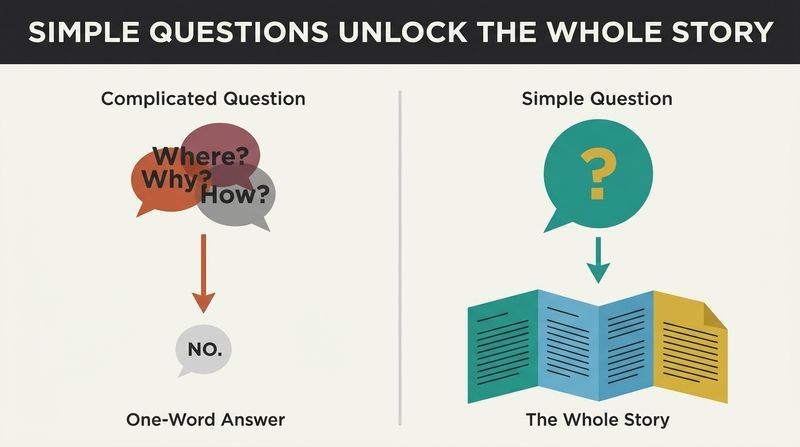
The paradox of good questioning: simple questions unlock detailed answers, while complicated ones get you one-word replies. Pyle, a veteran U.S. Army interrogation instructor, watched White House correspondents stuff three concepts into a single question and hand President Obama the chance to answer with a plain yes or no.
Watch how a toddler asks. A child points at a bug and says only, "What's that?" An adult rambles: "Where did it come from? Does it bite? Will it eat my tomatoes?" That clutter buries the answer. A mother asks her son, "What happens when you finish the term and can't get a job?" and is baffled when he answers about wrapping up the semester, because that is literally the question she asked. Say less. Focus on a single issue, and the answer arrives clean.
The counterintuitive core here rhymes with information theory: a question packed with premises forces the respondent to choose which thread to follow, and cooperative people follow the wrong one while evasive people exploit the ambiguity. Cognitive load research supports this. Working memory holds only a few items, so a compound question taxes both parties. Journalists resist the advice because multi-part questions signal sophistication to viewers. Pyle's insight is that sophistication and yield are inversely related. The discipline of narrowing is harder than it sounds precisely because adult vocabulary tempts us to show off rather than to discover.
Reclaim the unbiased curiosity you had at age two

Questioning is discovery, not interrogation in the scary sense. Pyle frames good questioning as a handshake, an invitation to a relationship, rather than a poke in the ribs. His formula reduces to recapturing childlike curiosity: the persistent, unprejudiced "why" of a two-year-old who genuinely wants to know one thing.
He proves the point with exercises. He shows students a picture of Santa Claus and tells them to react as a toddler would. Almost nobody, once committed to that mentality, asks a bad question. They naturally drop "Do you think" and "Would you say" and switch to clean, focused questions: Why is he coming? When? How can he visit every house in one night? Pyle spent seven years as a preacher pushing answers at people, then discovered that selling cemetery plots at Forest Lawn, where he asked questions instead, taught him more about people than preaching ever had.
There is a developmental irony worth naming: as our vocabulary and knowledge expand, our questioning degrades, because we start answering our own questions inside the question. The Santa exercise works as a kind of beginner's-mind reset, echoing Zen practice and Carol Dweck's distinction between performance and learning orientations. When we ask to look smart, we contaminate the query with an agenda. When we ask to learn, the interrogative flows naturally. Pyle's biographical pivot from preacher to salesman dramatizes the shift from talking at people to genuinely eliciting them, a reminder that the best questioners are often recovering explainers.
Start every question with who, what, when, where, why, or how

Interrogatives force narrative; "do" and "could" invite silence. Openers like "Did you" or "Could you" can be answered with a single syllable. An interrogative demands a story rich with leads. Compare "Did you do something last night?" ("Yes") with "What did you do last night?" which opens a chain: which theater, where, what show.
Pyle argues that interrogatives also strip out bias. When you consciously avoid prejudice, you gravitate toward clean interrogatives; when judgment creeps in, you drift toward loaded forms. He contrasts NPR's Terry Gross interviewing Gene Simmons, where an early insult pushed her into combative "are you trying to say" questions, with her recovery once she returned to how and why questions about his fire-eating and his mother. Delivery matters too. Even "Who are you?" can drip sarcasm. Tone can inject bias that the words alone do not carry.
This maps onto linguistics: wh-questions are open-class and elicit propositions, while polar (yes/no) questions merely request confirmation of a proposition the asker already framed. The subtler claim, that interrogatives correlate with neutrality, is more debatable. Mike Wallace weaponized short interrogatives like daggers, proving a clean grammatical form can still corner someone. Pyle acknowledges delivery carries prejudice independent of syntax. The practical upshot survives the nuance: default to wh-openers and you will collect more and presume less. Trial lawyers know the inverse trick, using yes/no leading questions precisely because they suppress narrative and control the witness.
Exhaust a topic with "What else?" before chasing details
The bouncing-ball trap. Ask a child what she had for lunch and she says "a sandwich." Most adults pounce: "What kind of sandwich?" But the disciplined next question is "What else did you have for lunch?" which surfaces the milk, peaches, and cookie you would otherwise never learn about. Only after "That's it" do you drill into particulars.
This is Pyle's persistent-questioning engine. A tech support rep who asks "What other problems are you having?" harvests three interrelated bugs at once, while one who asks "What kind of images?" tunnels down a single path. In interrogation it is life or death: a prisoner admits placing an IED, and "What else were you doing?" yields "Surveillance" before the details matter. One of Pyle's students credited relentless "what else?" with breaking a detainee who confessed to being a regional insurgent leader, saying he assumed the questioner already knew more.
The technique inverts the natural conversational reflex to specify. Sales and consulting frameworks reach the same conclusion from another angle: breadth before depth prevents premature convergence, the error decision scientists call anchoring on the first salient detail. There is a persuasion mechanism buried here too. Repeated open prompts create an impression of omniscience, so respondents volunteer more to match what they assume you already know. That doubles as a caution: "what else" can pressure people into fabricating filler. The skill is hearing the genuine "that's all" and stopping, rather than mining an empty vein.
Keep questions arm's-width short and never suggest the answer
Size and leading are the two great spoilers. Pyle offers a physical gauge: a good question fits between palms held straight ahead; a bad one sprawls across arms spread wide. A radio host once asked why Obama and Boehner both wore purple ties, then buried it under a lecture about purple being red plus blue. The interrogative was there; the payload smothered it.
Leading questions plant answers. Psychologist Elizabeth Loftus showed 490 subjects films of car crashes in 1975 and found that the wording of a follow-up question reshaped memory, implying objects that were never there. Leading forms include embedded assumptions ("How much will the price drop?"), associated ideas, cause-and-effect nudges, agree-with-me demands, and danglers ("great spot, isn't it?"). Lawyers and talk-show hosts use them deliberately, trading discovery for influence or entrapment.
Loftus's misinformation effect is one of psychology's most replicated findings and it reframes questioning as an act that alters the very evidence it seeks. This has real stakes in policing and therapy, where suggestive interviewing has produced false confessions and implanted memories. Pyle's arm-span heuristic is folk wisdom that tracks a real cognitive constraint: every extra clause is another premise the respondent must accept or contest. The honest tension in his account is that the same leading forms he condemns are professionally indispensable in cross-examination. The tool is neutral; the ethics live in whether your goal is discovery or manipulation.
Organize everything into people, places, things, and events in time
Four discovery areas give questioning a mental filing system. Whether interviewing a felon or a pastor, you pursue the same four buckets: people, places, things, and events in time. Pyle even takes notes on four separate sheets labeled P, Pl, T, and E-in-T, so a stray mention of a location during "people" questioning becomes a lead note he circles back to rather than losing in a linear scrawl.
Each area has its own logic. For places, borrow the person's own reference points and landmarks, since many people cannot give cardinal directions. For things, category first (mechanical, electronic, structure, process, concept, expendable), then components. For events, you begin with a photograph and end with a movie: an event is chained to what preceded and followed it. Pyle dissects the 9/11 attacks with unbiased who, what, when, where, why, and how questions, deliberately not calling the hijackers "terrorists" to avoid a leading frame.
The framework functions like a cognitive checklist, and checklists demonstrably reduce omission errors, as Atul Gawande documented in surgery and aviation. By pre-committing to four categories, the questioner offloads working memory and spots gaps systematically. The insistence on neutral labeling during event reconstruction is quietly profound: naming shapes recall and judgment, a point cognitive linguists like Lakoff have pressed for decades. One limitation is that rigidly sorting a fluid conversation can feel mechanical and may sacrifice rapport. Pyle's own note-taking method, flipping the page to stash leads, is an elegant fix, keeping the conversation natural while the structure runs underneath.
If you won't listen to the answer, don't ask the question
Listening carries equal weight to questioning. Karinch, learning Spanish in Mexico, proudly asked a stranger the time, then returned to her boyfriend so excited she had not registered the answer. A journalist drew brilliant quotes from a celebrity, only to find his recorder had failed and he had taken no notes and, distracted by the star, remembered almost nothing.
Active listening is both demonstration and perception: you show engagement through posture, eye contact, and a slight lean while hunting for keywords, emphasis, and telling gaps. Two ears, one mouth, used in that ratio. Pyle's practical rules are blunt: turn your phone off, sit face-to-face, and stop composing your next question while the person is still answering, because you cannot know the best next question until you have heard this answer. He also champions handwriting notes, citing neuroscience that cursive co-activates sensation, movement, and thought.
The failure mode Pyle names, mentally rehearsing your next line instead of hearing the current answer, is what communication researchers call response preparation, and it is the single most common listening defect. Customer service illustrates the cost: reps interrupt because the brain pattern-matches to a familiar script before the sentence finishes, a shortcut that misfires when the actual question is novel. The handwriting claim rests on real but contested imaging studies; the effect size is modest and the mechanism debated. Still, the broader principle holds independent of neuroscience: externalizing information onto paper exposes gaps and inconsistencies that a confident memory papers over.
Salt in questions you already know the answer to
Control questions test the person, not the topic. When you already know the answer, the question stops being about discovery and becomes about calibration: is this person truthful, informed, and paying attention? Pyle met a soldier on leave and asked routinely when he had to report back. The soldier broke eye contact and said "I'm not sure." Pyle knew every service member knows that time to the minute, so the vague answer exposed an AWOL situation.
Repeat and persistent questions cross-check. Ask how many soldiers are in a platoon, get 22, then later ask how many rifles they have. A matching 22 corroborates; a mismatch demands clarification. F. Lee Bailey demolished a witness in the O.J. Simpson trial by circling the visibility of footprints from a dozen angles until the witness looked incoherent. Same information, many doors, and the discrepancies fall out.
Control questions are essentially built-in reliability checks, the interpersonal equivalent of a lie-detector's baseline or a survey's attention-check item. The logic is Bayesian: a known-answer probe updates your confidence in every unknown-answer response that follows. Polygraphers, auditors, and even A/B testers use analogous seeded controls. The Bailey example reveals a darker cousin, persistent rephrasing deployed not to verify but to manufacture the appearance of contradiction, a courtroom theater that can make an honest but flustered witness seem unreliable. That ambiguity is the recurring theme of Pyle's method: the same instrument reveals truth or fabricates doubt depending on the operator's intent.
Read the person's type and adjust how you probe
People answer in recognizable patterns. Pyle sorts respondents into four types, each demanding a different follow-up:
1. Integrator: weighs options, offers balanced or multiple answers, watches your reaction.
2. Dictator: answers definitively, sometimes serving opinion as fact (his example is Donald Trump in a Bill O'Reilly interview).
3. Commentator: over-delivers, giving far more than asked and threatening to hijack the direction.
4. Evader: sidesteps, sometimes from a contrarian mind, sometimes from discomfort or shyness.
Each type calls for a countermove. With a commentator CEO who spun off into new business ideas, a consultant learned to frame tightly: "What is the single most important problem facing you right now?" With an evader, persistent rephrasing or a non-pertinent icebreaker about last night's ballgame loosens them up. The type you discover is itself information, even when your questions were aimed elsewhere.
Typologies like this are pragmatically useful and theoretically shaky. They resemble the practitioner shorthands salespeople and negotiators swear by, and they overlap loosely with Big Five traits (the commentator is high in extraversion, the evader possibly high in disagreeableness or anxiety). The risk is the Barnum effect, seeing four neat boxes where behavior is context-dependent and fluid. A person can be a dictator about politics and an evader about feelings. Pyle's saving move is treating type as a real-time observation to adjust tactics, not a fixed label, which keeps the framework diagnostic rather than deterministic. Used flexibly, it is a rapport accelerator.
Distrust the storyteller who suddenly goes vague
Incongruity in narrative style is the reddest flag. When someone lavishes detail on most subjects but clams up on one, suspect a cover-up. Nicole's fiance Bobby chattered endlessly about skydiving and the Marine Corps but described his "government testing" job in fog. When he returned from a supposed Nevada trip with malaria, the story cracked: he had been in Kenya, working intelligence, and the vague zones were exactly the lies.
Pyle offers analytic tools beyond gut feeling. "Sellin' vs. tellin'": a person recalling facts is telling, one working to convince you is selling. "Text bridges," a term from FBI behavior analyst Jack Schafer, are words like "then," "after," and "eventually" that skip over omitted events ("we walked to the market, then she said she was leaving"). Deviations from a person's sorting style (time-based versus event-based) also betray deception. Give both logic and intuition their due.
The vagueness-asymmetry heuristic aligns with statement analysis research: liars often produce accounts that are internally uneven, detailed where truthful and thin where invented, because fabrication is cognitively expensive. Schafer's text bridges echo forensic linguistics, where temporal connectors flag missing narrative segments. The caution, which Pyle honors, is that stress and vagueness signal discomfort, not necessarily guilt; introverts, trauma survivors, and people bound by legitimate confidentiality all go vague under scrutiny. Modern deception research (notably Aldert Vrij) warns against reading single cues; reliability comes from clusters and, better still, from strategic questioning that increases a liar's cognitive load rather than mere observation.
In a crisis, drop discovery and issue direct commands
Context dictates whether you explore or execute. Most of the book preaches open narrative questioning, but emergency response inverts it. A 911 dispatcher facing a bleeding caller skips the leisurely why and jumps to instructions to stop the bleeding. Brett Patterson, who trained emergency dispatchers, calls this "structured interrogation": rapid direct questions, then a resource assignment, then scripted instructions, because people cannot improvise in a passion-filled moment.
Yet listening still decides outcomes. When Amanda Berry escaped a decade of captivity and called 911, the dispatcher droned through business-as-usual questions, seemingly deaf to a kidnap victim. A study in Suicide and Life-Threatening Behavior found that in 723 of 1,431 hotline calls, volunteers never even asked whether the caller felt suicidal. For a suicidal person, the key questions are simple, empathetic, and repeated ("What else is going on?"), reflecting that you value their feelings and are not going anywhere.
This is the book's most important scope qualification: the celebrated open-ended, one-thing-at-a-time method is optimized for cooperative, low-urgency discovery and can be dangerous under time pressure. Aviation and emergency medicine reached the same conclusion, which is why they codify checklists and scripts precisely where seconds and adrenaline destroy free recall. The suicide-hotline data is genuinely alarming and points to a systemic failure of training rather than of individual empathy. The through-line uniting crisis scripting and open discovery is listening: the Amanda Berry transcript shows a scripted operator who followed protocol while failing to hear the human being on the line.
To fake expertise fast, interrogate the news and the expert
You can find out everything about anything without knowing anything. Pyle demonstrates with a black box he invented, the Electronic Language Simulator, letting students who know nothing extract its name, purpose, components, and cost purely through interrogatives, always ending with the crucial question to any expert: "Why do you know so much about this?" Because the answer reveals the person.
Three practice drills sharpen the skill. "Interrogate the news source": read a headline like Sandy Hook's "Unthinkable" and reverse-engineer the who, what, when, where, why a reporter must have asked. "Vet the source": confirm they are actually associated with the subject, accessible, and cross-checkable. "Question like a skeptic": confront a conspiracy theory by looping back to who the source is and what evidence they actually hold. Pyle also warns to prepare for surprises, quoting his mentor's advice to "watch the food channel," because everyone connects over food.
The claim that ignorance is an asset is provocative but sound: a novice's questions are unencumbered by the curse of knowledge, the well-documented bias where experts skip the very fundamentals a newcomer needs. Journalism's inverted-pyramid structure is itself a codified discovery protocol, so reverse-engineering it is excellent training. The source-vetting triad (associated, accessible, cross-checkable) is a lightweight version of intelligence tradecraft's reliability grading. The "why do you know so much" closer is the sharpest tip: expertise questions double as authenticity tests, exposing the difference between someone who has genuinely done the thing and someone parroting Wikipedia, a distinction that matters enormously when hiring or buying.
Analysis
Pyle's book belongs to a small, valuable genre: tradecraft manuals that translate a high-stakes professional skill (military interrogation) into everyday life. Its thesis is deceptively simple, that the quality of your information is capped by the quality of your questions, and that most educated adults have unlearned how to ask. The structural spine is elegant: recover a toddler's focused curiosity, lead with interrogatives, exhaust one thing before moving on, organize by four discovery areas, listen actively, and analyze for deception. What distinguishes the book from generic communication advice is its operational specificity, drawn from teaching Navy SEALs and the interrogators who located Saddam Hussein.
The method's intellectual center of gravity is a single paradox: simple questions yield complex answers, complex questions yield simple ones. This is nonobvious and true, and it explains the book's recurring villain, the journalist who performs sophistication while collecting nothing. Pyle is at his best exposing this gap between appearing informed and being informative.
Two tensions run unresolved and are worth flagging for readers. First, nearly every good tool doubles as a manipulation device. Control questions verify or entrap; persistent questions clarify or fabricate doubt; leading questions are banned for discovery yet essential in cross-examination. The book's ethics live entirely in the operator's intent, which it treats as a given rather than examining. Second, the open-ended paradigm has a scope limit the book only partly acknowledges: under crisis and time pressure, scripts and direct commands outperform exploration, an inversion the emergency-response chapter reveals almost in passing.
Set against modern deception science (Vrij, Loftus), Pyle's observational cues are the weakest link; single behavioral tells are unreliable, and the field has moved toward cognitive-load strategies. But as a discipline for eliciting rather than detecting, the book is durable, humane, and immediately usable. Its reframe of questioning as a handshake, not a poke, is its lasting gift.
Review Summary
Find Out Anything From Anyone, Anytime receives mixed reviews, with an average rating of 3.62/5. Readers appreciate its practical questioning techniques, particularly the use of "W-words" and follow-up questions. Many find it useful for improving communication skills in various settings. Some critics note that the content could be repetitive or dry, and the audiobook narration received negative feedback. Overall, readers value the book's insights on effective questioning but suggest it may require multiple readings to fully grasp and apply the concepts.
People Also Read




Glossary
Discovery areas
People, places, things, eventsPyle's four-category filing system for organizing any line of questioning: people, places, things, and events in time. Committing to these buckets helps the questioner track what they are seeking, spot gaps, and manage leads without losing them in a chronological jumble. Pyle even keeps four separate note pages, one per area, so stray mentions become lead notes for later.
Control question
Question you already knowA question the asker already knows the answer to, used not for discovery but to gauge the respondent's truthfulness, knowledge, or attentiveness. By comparing the known answer to what the person says, the questioner calibrates confidence in that person's other, unverifiable responses. Example: asking a soldier when leave ends, a fact every service member knows precisely.
Persistent question
Same question, many anglesAsking about the same information repeatedly in different phrasings to explore every facet and to check consistency. Useful for surfacing complete answers and for exposing discrepancies in a suspect account. F. Lee Bailey's O.J. Simpson cross-examination, circling footprint visibility from many directions, is Pyle's showcase example.
Text bridges
Words that skip eventsA phrase coined by FBI behavior analyst Jack Schafer for connective words (like then, after, eventually, in addition) that jump from one topic to another, potentially skipping over omitted details. They can be innocent or signal concealment, so they warn a questioner to probe the gap the bridge glosses over.
Sellin' vs. tellin'
Convincing versus recallingPyle's gut-level distinction for analyzing answers. A person recounting genuine facts and recollections is telling. A person working to convince you that their account is true is selling. The shift toward selling, detected audibly and visually, is a cue to probe further for deception or incompleteness.
Structured interrogation
Scripted emergency questioningA term from emergency-dispatch trainer Brett Patterson for the rapid, protocol-driven questioning used by 911 operators: pointed direct questions, then assignment of the right resource, then scripted instructions. Because callers cannot improvise under high emotion and urgency, a script outperforms open-ended discovery in true emergencies, reversing Pyle's usual preference.
Framing (framer)
Context that precedes a questionA technique of supplying orienting information or a comment before a question to set the tone and help the person answer, without suggesting the answer itself. A lawyer opening with "Estate planning means different things to different people" frames the topic. Unlike a leading question, a framer introduces the subject rather than implying the desired response.
FAQ
What is "Find Out Anything From Anyone, Anytime" by James O. Pyle about?
- Comprehensive guide to questioning: The book teaches the art and science of effective questioning, drawing on the author’s experience as a military interrogator and trainer.
- Focus on discovery, not interrogation: It reframes questioning as a tool for discovery and connection, not coercion or manipulation.
- Applicable to all areas of life: The methods are designed for use in professional, personal, and even high-stakes environments, from sales and interviews to parenting and law enforcement.
- Step-by-step questioning process: The book provides a structured approach to asking questions, analyzing answers, and building expertise through calculated curiosity.
Why should I read "Find Out Anything From Anyone, Anytime" by James O. Pyle?
- Improve communication skills: The book helps readers become more effective communicators by teaching how to ask better questions and truly listen to answers.
- Gain a professional edge: Mastering questioning techniques can give you a competitive advantage in fields like sales, management, law, journalism, and customer service.
- Enhance personal relationships: The skills taught can deepen rapport, resolve conflicts, and foster understanding in personal interactions.
- Learn from a veteran interrogator: The advice is grounded in real-world experience, making it practical, actionable, and proven in high-pressure situations.
What are the key takeaways from "Find Out Anything From Anyone, Anytime"?
- Ask one thing at a time: Focus each question on a single topic to get clear, actionable answers.
- Use interrogatives for discovery: Start questions with who, what, when, where, why, or how to elicit narrative responses rather than yes/no answers.
- Structure and sequence matter: The way you frame and order your questions can dramatically affect the quality and completeness of the information you receive.
- Active listening is essential: Good questioning is inseparable from attentive, purposeful listening and effective note-taking.
- Analyze answers critically: Evaluate responses for reliability, completeness, and possible deception using both logic and intuition.
How does James O. Pyle define a "good question" in "Find Out Anything From Anyone, Anytime"?
- Starts with an interrogative: Good questions begin with who, what, when, where, why, or how.
- Focused and concise: They address only one topic at a time and avoid unnecessary qualifiers or complexity.
- Unbiased and open-ended: Good questions are neutral, avoid leading the respondent, and invite narrative answers.
- Designed for discovery: The goal is to uncover new, relevant information, not to confirm assumptions or push an agenda.
What are the main types of questions described in "Find Out Anything From Anyone, Anytime"?
- Good question types: Direct, control, repeat, persistent, summary, and non-pertinent questions, each serving a specific purpose in information gathering.
- Bad question types: Leading, negative, vague, and compound questions, which can confuse, bias, or limit the respondent’s answers.
- Non-discovery questions: Includes requestions, pre-questions, polite questions, corrective questions, and rhetorical questions, which are not primarily aimed at information discovery.
What is the "discovery areas" framework in "Find Out Anything From Anyone, Anytime"?
- Four key areas: All questioning should cover people, places, things, and events in time.
- Organizes information: This framework helps questioners systematically explore all relevant aspects of a subject.
- Guides note-taking and analysis: Sorting information by these areas ensures completeness and makes it easier to identify gaps or leads for follow-up.
- Applicable to any context: Whether interviewing, investigating, or just conversing, these areas provide a mental checklist for thorough questioning.
How does "Find Out Anything From Anyone, Anytime" advise structuring a questioning session?
- Begin with rapport-building: Use polite or non-pertinent questions to establish comfort and trust.
- Frame and focus: Clearly introduce the subject and use frames to set the context for sensitive or complex topics.
- Progress through discovery areas: Systematically ask about people, places, things, and events in time, using direct and persistent questions.
- Follow up and summarize: Use summary and repeat questions to clarify, confirm, and ensure completeness before moving on.
What are the essential listening and note-taking skills recommended in "Find Out Anything From Anyone, Anytime"?
- Active, face-to-face listening: Engage physically and mentally, maintain eye contact, and avoid distractions.
- Listen for more than words: Pay attention to tone, body language, and what is not said, as well as the content of answers.
- Organized note-taking: Sort notes by discovery area (people, places, things, events in time) rather than chronologically to avoid losing leads.
- Review and analyze notes: Go over notes soon after the conversation to identify gaps, inconsistencies, or areas needing follow-up.
How does "Find Out Anything From Anyone, Anytime" teach readers to analyze answers for truthfulness and completeness?
- Content analysis: Check if answers meet your requirements, are reliable, and make logical sense.
- Look for LIEs: Watch for Lies, Inconsistencies, and Evasions in responses.
- Use control and repeat questions: Cross-check information by asking the same thing in different ways or at different times.
- Observe manner and body language: Note deviations from a person’s baseline behavior, such as changes in tone, pace, or gestures, which may indicate stress or deception.
How can the questioning techniques in "Find Out Anything From Anyone, Anytime" be applied in professional settings?
- Education: Teachers can foster critical thinking and engagement by asking open-ended, discovery-oriented questions.
- Medicine: Clinicians use persistent and control questions to clarify symptoms and ensure accurate diagnoses.
- Law and negotiation: Lawyers and negotiators use structured questioning to uncover facts, test credibility, and guide discussions toward desired outcomes.
- Customer service and sales: Effective questioning uncovers customer needs, builds rapport, and resolves issues more efficiently.
What practical exercises and journaling methods does "Find Out Anything From Anyone, Anytime" suggest for improving questioning skills?
- Uncovering expertise: Practice extracting as much information as possible from someone about a subject they know well, using only discovery questions.
- One-a-day challenge: Each day, pick a topic you know little about and use questioning to learn as much as possible from a human source.
- Advanced journaling: Keep a daily log of questions you asked, wish you hadn’t asked, or could have asked better, and reflect on how different phrasing might have changed the outcome.
- Role-play and games: Use exercises like "To Tell the Truth" or "Six Degrees of Separation" to sharpen questioning and listening skills in a fun, low-stakes environment.
What are the best quotes from "Find Out Anything From Anyone, Anytime" and what do they mean?
- “Questioning is about discovery, and the process I’ve developed... will give you the tools you need to extract all of the components from under the hood and get all the way to the pistons.”
- This highlights the depth and thoroughness that good questioning can achieve, likening it to taking apart an engine to understand how it works.
- “Find out one thing at a time.”
- A core principle: focus each question to avoid confusion and get clear, actionable answers.
- “A good question should always start with an interrogative.”
- Emphasizes the importance of open-ended questions for eliciting detailed, narrative responses.
- “We have two ears and one mouth so that we can listen twice as much as we speak.”
- Stresses the value of listening as an integral part of effective questioning.
- “Question with the curiosity of a 2-year-old.”
- Encourages readers to approach questioning with genuine, unbiased curiosity, as children do, to maximize discovery.
Download PDF
Download EPUB
.epub digital book format is ideal for reading ebooks on phones, tablets, and e-readers.








