

Plot Summary
The Wall and the Wake
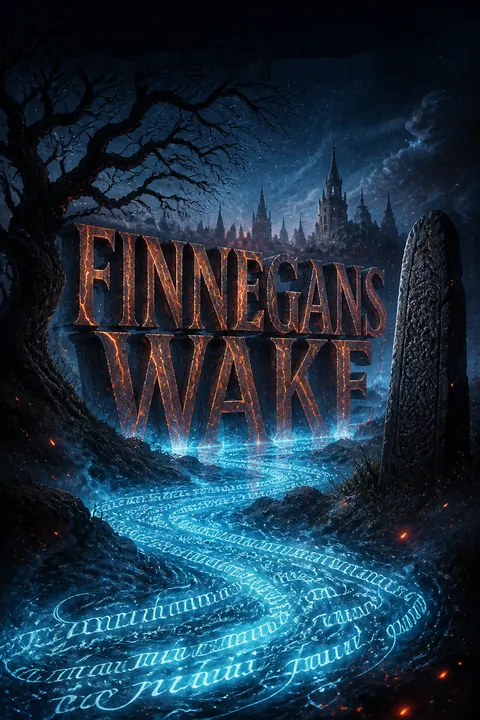
At the book’s circular opening, Finnegan, a builder raising a great wall, tumbles from his ladder. The fall becomes a public wake, where mourners drink, argue, and tell conflicting versions of his life. Some accounts treat him as dead and buried; others imagine him stirring again.
His body merges with a hill, a city, and the remembered shape of Ireland, so that one man’s mishap gathers the weight of ancient battles and later generations. Before the story can settle into a single history, it folds back toward its own beginning. The family and neighborhood drama that follows inherits this pattern: a fall is never simply over, and every ending may be another return.
Joyce makes the opening event both intimate and impossible to contain. A builder’s fall becomes a community’s occasion for mourning, drinking, invention, and disagreement, so no witness possesses the event completely. The wake turns private death into public story, while the circular sentence makes return part of the form itself. Finnegan is less a stable character than a human measure that expands to contain city, nation, and myth. This matters for the later Earwicker scandal: the reader enters a world where testimony does not settle facts, but continually renews them.
A Stranger in Phoenix Park
The fallen builder gives way to HCE, usually Mr Earwicker, a publican and father living above his pub in Chapelizod. During a walk in Phoenix Park, he meets a stranger who asks him the time. HCE answers, but the encounter breeds a more damaging story: witnesses claim that he exposed himself to two maidservants, while other versions add soldiers, sexual impropriety, or simple misunderstanding.
The stranger’s report passes from private gossip to public accusation, changing HCE from prosperous local figure into a name people whisper and reshape. A popular ballad turns the allegations into ridicule, and HCE’s silence only gives the story more room to multiply.
The inciting disturbance is not a confirmed crime but the conversion of an ordinary encounter into a public narrative. HCE’s social standing depends on being legible as a respectable provider, yet the park rumor makes his body available for other people’s interpretation. The unnamed stranger matters less as a reliable witness than as the first carrier of the story. Once gossip becomes a ballad, humiliation acquires a public rhythm and can be repeated without proof. HCE’s silence may protect him from a verdict, but it cannot recover control of his name.
The Case Goes Underground
As the accusation spreads, reports of HCE’s alleged misconduct appear in newspapers, songs, courtrooms, and tavern stories. The testimony contradicts itself, and the more investigators try to establish what happened, the more versions surface. HCE withdraws into sleep, while the community stages his burial beneath Lough Neagh, as if the scandal could be sealed underground.
Festy King, a drunken figure hauled before the court, turns the proceedings into farce; his evasions and testimony complicate rather than resolve the case. The authorities then demand a written account. With HCE unable or unwilling to provide one, they summon his wife, ALP, and make her letter the next object of scrutiny.
The legal process does not correct the rumor because its evidence is already social: songs, anecdotes, and hearsay carry as much force as testimony. Festy King’s comic performance exposes the instability of official truth without supplying a clean alternative. HCE’s sleep and burial make withdrawal look like a defense, yet both only deepen his absence from the public story. The demand for a letter shifts authority from witness to document. This is not a reliable solution; the document will become another surface onto which readers, relatives, and critics project competing accounts.
ALP Sends the Letter
ALP, HCE’s wife and the river-like center of the family, supplies a letter recovered from a midden. Its paper is stained and damaged, and its handwriting seems to hold several identities at once. Readers try to decide who wrote it, what event it records, and whether it clears or condemns HCE.
ALP’s catalogue of names and possible titles turns the document into a family memorial as well as legal evidence. The letter survives, but its meaning will not hold still. Each interpretation produces another question, and the family’s private history becomes inseparable from the public record being assembled around them.
The letter is not a key that unlocks a hidden, final truth. It behaves more like a damaged family archive, preserving traces while making certainty impossible. ALP’s role is crucial because she brings the document into public view, yet the letter’s many possible authors and meanings prevent her from controlling its reception. Its location in waste also joins intimate memory to what society discards. Joyce makes reading itself part of the plot: every attempt to recover the past alters the evidence by selecting, arranging, and narrating it.
The Mookse Meets the Gripes
During a sprawling quiz about Irish places, rulers, and stories, the book pauses for the fable of the Mookse and the Gripes. The Mookse arrives armed with titles, learning, and claims to authority; the Gripes answers with nervous resistance. Their argument repeats the larger clash between command and dissent, but neither can truly hear the other.
Nuvoletta, a child watching from above, tries to draw their attention and fails. When night deepens, the two disputants disappear into separate transformations, while Nuvoletta leaps from her height into the stream. Her fall enlarges the little watercourse into the Liffey, carrying her into the book’s flowing geography.
This miniature drama condenses the novel’s central conflict into a comic imbalance. The Mookse’s confidence depends on systems that authorize him, while the Gripes’s resistance remains powerless without a shared language. Their failure of attention is also a failure of relationship: Nuvoletta watches, calls, and finally acts alone. Her leap changes a child’s private sorrow into a river’s public movement. The episode links authority, language, and water without resolving them, suggesting that what cannot be heard in direct argument may persist as landscape and return in another form.
Shem Writes on Himself
HCE’s son Shem appears as a shabby, isolated writer, mocked by the community for his smell, poverty, cowardice, and distance from Ireland. His brother Shaun treats him as a sham and claims the authority of the respectable messenger. Shem, however, becomes the suspected maker of the family letter.
In the account of his working life, he writes with ink made from his own bodily waste and uses his body as the page when ordinary materials fail him. Shaun condemns the result, but Shem’s writing preserves the history the clean, official voice would rather exclude. Their quarrel leaves authorship unsettled and makes the letter a record of rivalry as well as accusation.
Shem’s humiliations are not incidental comic decoration; they expose the material cost of writing and of social exclusion. He is denied respectable tools, status, and a stable home, then makes the body itself carry the record. Shaun’s disgust expresses a wish to separate public language from bodily need, yet his authority depends on the very text he disowns. The brothers therefore embody competing forms of power: one writes from marginality, the other claims to deliver and interpret. Neither can become fully independent of the other’s account.
Washerwomen Become Riverland
On the banks of the Liffey, two washerwomen scrub HCE’s clothing and trade stories about his reputation, marriage, and dealings with women. They have heard many versions of the park incident and add their own, mixing intimate detail with neighborhood rumor. As evening closes around them, their conversation grows difficult to hear.
One washerwoman becomes a tree and the other a stone, leaving their talk embedded in the landscape they have been describing. ALP’s history flows through this gossip: she is at once wife, mother, woman of the city, and the river itself. The tale does not conclude; it runs onward toward the next telling.
The washerwomen make gossip a form of communal memory, neither neutral nor wholly dismissible. They handle HCE’s laundry while handling the story of his conduct, joining domestic labor to public judgment. Their speech is fragmented, but it travels farther than a courtroom transcript because it belongs to the everyday life of the riverbank. Their transformation into tree and stone makes the act of telling inseparable from place. ALP becomes more than an individual wife: her changing forms carry the continuity of the family through nature and time.
Glugg Loses the Girl
In the children’s nightly play, Glugg faces riddles and tries to win the attention of Izzy, surrounded by a group of girls. His rival, Chuff, appears as the favored fair-haired boy, while their mother Ann oversees the game and Hump shadows its adult authority. Glugg fails to solve the challenge and cannot secure Izzy’s affection.
The girls turn toward Chuff, leaving Glugg disgraced and alone. As the game ends, the children are gathered indoors, their play replaced by prayers and bedtime rules. The episode echoes the adult family’s jealousies, but filters them through schoolyard teasing, where desire, shame, and exclusion arrive as a child’s immediate defeat.
The game gives the family’s adult conflicts a smaller, sharper scale. Glugg’s failure is not a death or a verdict; it is the child’s social experience of being seen, measured, and rejected. Chuff’s success shows how quickly a group can ratify one version of desirability and leave another boy outside. Issy is both the object of the contest and a person surrounded by expectations. The sudden shift from play to prayer illustrates how authority contains unruly feeling by enclosing the children in schedules, language lessons, and household discipline.
Lessons Become a Night Letter
The children’s lessons unfold as a night-class in grammar, history, geometry, and letter writing, with Shem and Shaun appearing as rival pupils and instructors. Their schoolwork repeatedly bends toward the family: a geometrical exercise draws the parents into its lines, and accounts of invasion and national history echo the quarrels around HCE.
The children then prepare a letter to their parents, but its spelling, authorship, and intention remain unstable. Education does not replace the household’s confusion; it gives that confusion new forms. The lesson ends with the children still inside the family’s dream, their exercises carrying the same disputes over who may speak and whose version will be believed.
The classroom turns abstract subjects into instruments for rereading family life. Geometry tries to make relationships measurable, while history tries to order invasion, inheritance, and conflict into a sequence. Yet the children’s letter cannot stabilize either family or authorship. Its misspellings and shared voices show that learning happens inside the same pressures it might seem to explain. The lesson’s structure is therefore diagnostic rather than corrective: it reveals how official disciplines organize experience, while the children’s unruly language continually bends those disciplines back toward desire and domestic trouble.
Buckley Shoots the General
Inside HCE’s pub, a tailor and a Norwegian captain tell a story that folds failed marriages, sea voyages, and Irish history into one another. Later, the comic pair Butt and Taff recount how Buckley shot a Russian general, who is caught with his trousers down. The tale turns humiliation into violence and links the general to HCE and older Irish rulers.
Four elderly historians press HCE for an account, but the questions only multiply the versions of his alleged offense. Surrounded by drinkers and stories, HCE consumes the dregs left in the pub and sinks into a stupor. His collapse leaves the accusation active, not answered.
The pub converts shame into performance. A sexual exposure, a general’s defeat, a father’s possible fall, and Ireland’s history become variations on the same scene of vulnerability and retaliation. Buckley’s shot seems to restore masculine honor through violence, but the comic framing makes that restoration unstable. The four historians then expose the limits of official memory: their questions cannot separate event from legend. HCE’s final drunkenness is not simply a private weakness. It is the bodily consequence of carrying too many incompatible histories at once.
Tristram Crosses the Sea
The narrative shifts to the voyage of Tristram and Iseult, with four historians watching the lovers from the margins. Their account folds the story into a wider pattern of old rulers displaced by younger desire. King Mark, aged and weakened, stands for an order that cannot prevent his betrayal; Tristram’s courtship of Iseult carries the force of a new generation entering the old household.
The historians struggle to describe what they witness, alternately treating it as legend, evidence, and political history. Their record does not settle the lovers’ meaning. Instead, it places another intimate betrayal beside HCE’s scandal and makes private desire part of the recurring story of power.
The episode makes the family’s erotic tensions legible through a borrowed legend, but it also destabilizes the authority of that legend. The four observers cannot remain outside the scene: their act of recording shapes what later generations will call history. Mark’s displacement and Tristram’s desire repeat the book’s pattern of inheritance under pressure, where the younger person’s arrival exposes the fragility of the older order. By refusing to distinguish myth from evidence cleanly, Joyce asks who gains the power to name betrayal and whose desire becomes historical fact.
Shaun Takes the Post
In Part III, Shaun becomes a traveling postman, a public voice moving through the landscape that previously carried ALP’s waters. He condemns Shem through a fable about the Ondt and the Gracehoper, presenting himself as industrious and the writer as wasteful. His journey includes a descent in a barrel and a farewell from Issy, while his identity shifts through new names and roles.
The motion seems to give Shaun freedom from the family quarrel, but his judgments repeatedly reveal anxiety about Shem and about the desires he claims to reject. Carrying messages does not make him neutral; each delivery becomes an argument over who deserves to speak.
Shaun’s postal role turns authority into circulation. He can carry a message without claiming to originate it, yet his attack on Shem shows how strongly he wants to control what counts as legitimate writing. The barrel journey makes his authority comic and precarious: the public moralist is physically carried by the current he tries to master. His farewell from Issy adds a private cost to his performance of self-sufficiency. Shaun’s changing names register not simple disguise but the instability of any public identity built from borrowed stories.
Jaun Courts Issy
As Jaun, Shaun addresses the girls of St Bride’s and delivers counsel on conduct, love, and obedience. His sermon repeatedly slips into personal desire, especially in his attention to Issy, who sends him a love letter amid the group’s chatter.
Jaun’s high-minded advice competes with flirtation and self-display; he also introduces Dave, widening the circle of listeners and rivals. The scene makes Issy both an author of her own message and a figure managed by male interpretation. After the encounter, Jaun’s identity shifts again toward Haun, suggesting that his role as teacher, suitor, and messenger cannot be kept apart.
The sermon exposes the gap between moral authority and desire through Jaun’s own behavior. He instructs a group of young women while directing attention toward Issy, whose letter gives her a voice that he cannot fully absorb into his lesson. His advice may sound universal, but it keeps bending toward possession and self-justification. The naming shifts are psychologically precise: Jaun is not simply one man adopting disguises, but a role assembled for different audiences. Issy’s written message briefly reverses the usual flow, making the supposed instructor a recipient.
Yawn Faces the Four
The restless figure Yawn is found stretched across a hill and questioned by the four old men. Their interrogation calls up fragments of earlier voices, including accounts from ALP, and turns the scene into a kind of trial and séance. HCE then revives within the testimony and defends his public standing, claiming credit for building the city and winning ALP.
The defense does not close the case; it adds another version to the archive of accusations, memories, and boasts. As the questioning breaks apart, the family’s identities return in altered form, leading the dream toward the parents’ bedroom and the children’s shared beginning.
Yawn’s interrogation stages memory as a pressure exerted by other people. The four men ask for a coherent account, but their questioning releases voices rather than a stable confession. HCE’s defense asserts civic achievement and marital possession, revealing how reputation is built from both public labor and private claims. Yet the defense cannot dominate the surrounding chorus. The scene therefore dramatizes a conflict between self-authorship and communal testimony, while its séance-like form suggests that no speaker can fully control the dead, the past, or the stories already attached to his name.
Parents Return to Bed
After the interrogation, attention settles on HCE and ALP in bed. The parents’ physical union becomes another version of the family’s origin, surrounded by positions, jokes, and allusions to the children they have produced. The adult brothers’ opposition fades as Shem and Shaun drift back toward their shared source, while Issy remains between girlhood, reflection, and future possibility.
The scene does not solve the park accusation or reconcile every grievance. Instead, it returns the family to the intimate room from which its arguments seem to emerge. Sleep gathers the parents, children, and earlier stories into one recurring household.
The bedroom scene makes reproduction the point where private bodies generate public history. HCE and ALP are not simply restored as a harmonious couple; their union is comic, awkward, and overlaid with the disputes that have preceded it. The brothers’ movement toward a common origin weakens their apparent separation without erasing rivalry. Issy’s presence keeps the family’s future open and unsettled. Sleep supplies a temporary convergence, not a final cure: the same household that produces children also produces secrecy, shame, and the need for stories.
The Dawn Argument Returns
Part IV brings the dream toward morning and revisits HCE’s alleged offense, now as a public story retold through spectacle and historical argument. HCE and ALP defend themselves, while the encounter between Patrick and the Irish philosopher Berkeley stages a contest between a single sanctioned truth and many competing perceptions.
The children, the old kings, and the earlier witnesses recur in altered guises. ALP’s letter returns as evidence that has never stopped changing hands or meaning. No court delivers a final verdict. Instead, the family’s history begins another pass through the same accusations, defenses, and reinterpretations as the night loosens its hold.
The Ricorso does not provide a conventional resolution because the book’s governing problem is how history gets made, not how a mystery gets solved. HCE’s defense and ALP’s support are set beside religious conversion and philosophical plurality, so no one voice can close the meaning of the scandal. The Patrick-Berkeley encounter makes the struggle over interpretation theatrical and local: Ireland itself becomes the site where competing systems claim authority. The letter’s return confirms that evidence persists, but its meaning remains dependent on who reads and retells it.
Anna Livia Flows Out
As night thins, ALP speaks as the Liffey, remembering her life through lovers, children, places, and the changing course of water. Her voice moves from the hills toward the sea, gathering the family’s memories without arranging them into a final judgment.
She grows tired and approaches dissolution, yet the river does not stop when her speech fades. The book ends on an unfinished word that leads back to its opening current, making the last page feed the first. HCE, ALP, Shem, Shaun, and Issy remain inside a cycle that can be entered again, though never in precisely the same form.
ALP’s final movement makes continuity bodily and geographic. Unlike the male accounts that seek to define, defend, or prosecute, her voice carries different places and memories without forcing them into one official sequence. Her fading is an ending, but the open final word refuses closure and returns the reader to the book’s first current. Renewal here is not redemption from history; it is the persistence of relation through change. The family survives as a pattern of voices, not as a settled verdict about what happened.
Analysis
Finnegans Wake turns the question of what happened to HCE into a question about how any community decides what happened. The Phoenix Park accusation never becomes a stable case because each form of evidence, gossip, ballad, letter, courtroom report, pub tale, and family memory, carries its own interests. The reader experiences the same problem as the four historians: assembling testimony does not remove contradiction. It may simply give contradiction a more authoritative shape.
The Earwicker family makes that problem intimate. HCE’s public authority and private vulnerability meet in the same body; ALP’s labor and memory pass between household, river, and landscape; Shem and Shaun struggle over whether writing should expose bodily disorder or clean it into respectable speech. Issy’s letters and reflections show how a young woman can be both speaking subject and object of others’ desire. Their conflicts are not detached symbols. They repeatedly affect who can narrate, who is believed, and who is made ashamed.
The book’s circular construction refuses the comfort of a final ruling. Finnegan’s fall returns as HCE’s scandal; old legends recur inside modern Dublin; ALP’s last movement leads back to the opening river. This is not simple repetition, because every return arrives with altered details and fresh witnesses. The structure suggests that history persists through revision rather than through a perfect archive. Memory is collective, but never innocent: it can preserve the excluded, mock the powerful, and invent what it cannot recover.
Joyce’s verbal play gives this social process a physical sound. Legal formulas, school lessons, songs, sermons, and multilingual fragments collide within a single dream. Language does not merely report the family’s divisions; it performs them, making authority stammer and private feeling leak into public speech. The book asks readers to attend without expecting mastery. Its most consequential act is not solving HCE’s case, but showing how every attempt to solve it becomes another telling.
Review Summary
Finnegans Wake polarizes readers dramatically. Critics praise it as Joyce's masterpiece—a revolutionary, multilingual linguistic experiment featuring portmanteau words, puns, and circular narrative structure. Enthusiasts celebrate its musicality, humor, and innovative dream language, recommending reading aloud. However, detractors find it incomprehensible, pretentious gibberish lacking plot or characters. Many admit not finishing despite high ratings. The book combines 60-70 languages, contains neologisms, and defies conventional understanding. Its 17-year composition created what some call modernism's pinnacle, others an elaborate joke. Readers either love its experimental brilliance or despise its inaccessibility, with few neutral opinions existing.
People Also Read



Characters
HCE
The publican under suspicionHCE, usually Mr Earwicker and sometimes Mr Porter, is a Dublin publican, builder, husband to ALP, and father of Shem, Shaun, and Issy. He wants to be seen as a respectable provider and civic figure, yet his identity is shadowed by a disputed incident in Phoenix Park. His defining difficulty is that he cannot control the stories told about him. He sleeps, drinks, boasts, and defends himself, but every version of his conduct is folded into older legends and public gossip. His shifting names suggest a man who is at once one family’s father and an emblem for many ordinary men, carrying private shame beneath a broad social presence.
ALP
The mother and riverAnna Livia Plurabelle, or ALP, is HCE’s wife and the mother of Shem, Shaun, and Issy. She carries messages, supports the household, and becomes inseparable from the Liffey and its surrounding landscape. Her letter is central to the family’s disputed history, though she cannot dictate how others read it. ALP’s emotional strength lies in her capacity to move among roles without becoming a single fixed account: wife, mother, lover, witness, and river. She is closely connected to washing, gossip, water, and renewal. The book presents her as active and resourceful, not merely a quiet counterweight to HCE’s public authority.
Shem
The taunted writerShem is HCE and ALP’s son and Shaun’s brother. He is represented as an eccentric, impoverished writer whose body, habits, and retreat from public life invite ridicule. Shem gathers words from other people and turns them into writing, making him a figure for both artistic invention and cultural borrowing. His rivals accuse him of shamelessness, yet the family’s letter is associated with his authorship. Shem’s distance from respectable Dublin reflects a refusal, or inability, to live by its approved standards. He is not simply the truthful brother: his work is unstable, impure, and made from other voices, just like the world he records.
Shaun
The moral postmanShaun is HCE and ALP’s son, Shem’s brother, and a messenger whose roles include postman, preacher, and public moralist. He values order, respectability, and practical authority, often using those values to condemn Shem. Yet his speeches reveal vanity, anxiety, and desires he tries to discipline in others. Shaun is repeatedly renamed as his audience and purpose shift, making him less a fixed person than a performance of public certainty. He carries messages and claims to interpret them, but cannot entirely escape the family stories he judges. His contrast with Shem is real, though the two remain bound as rival versions of authorship.
Issy
The watched daughterIssy is HCE and ALP’s daughter and the younger sister of Shem and Shaun. She appears among mirrors, schoolgirls, games, and love letters, often treated by others as an object of desire or a prize in rivalry. Yet she also writes, observes, and seeks affection on her own terms. Her shifting reflections suggest the difficulty of separating her identity from the roles projected onto her by family and society. Issy’s place in the household connects youthful sexuality with adult secrecy, but she is not reducible to either. She remains a lively, uncertain presence within the family’s changing dream.
The Four Old Men
The questioning historiansThe four old men appear as historians, judges, and witnesses, often linked with the evangelists and Irish chroniclers. They question HCE, observe lovers, and attempt to record events that keep changing around them. Their collective role matters more than their individual identities: they represent the institutions that preserve memory, while their disagreements show the limits of that work. Their questions create pressure for a stable account, but they never secure one. Even as they claim historical authority, their testimony remains another strand in the community’s gossip and dream.
The Cad
The rumor’s first carrierThe unnamed cad encounters HCE in Phoenix Park and later becomes associated with the account that damages HCE’s reputation. His motive and reliability remain uncertain. He functions less as a developed individual than as the point where an everyday meeting turns into a story that can be repeated, distorted, and made public.
Festy King
The drunken defendantFesty King is a drunken, comic figure brought before the court during the effort to examine HCE’s scandal. His testimony and evasions confuse the proceedings rather than clarifying them. He reflects the book’s suspicion of legal certainty: even a witness who appears central may turn the inquiry into performance, mockery, and another version of the story.
The Mookse
The voice of authorityThe Mookse is a grand, learned figure in the fable of the Mookse and the Gripes. He speaks from institutional confidence and expects his rival to submit. His polished authority makes him a comic embodiment of systems that mistake status for truth. He cannot hear the child watching him, and his certainty leaves little room for another perspective.
The Gripes
The resisting rivalThe Gripes is the Mookse’s smaller, anxious opponent, answering authority with complaint and evasion. His resistance does not make him powerful, but it exposes how unequal the argument is. Like several figures in the book, he is defined by opposition and by the failure of communication rather than by a stable personal history.
Nuvoletta
The unheard childNuvoletta watches the Mookse and the Gripes from above and tries to attract their attention. Neither notices her. She gives the fable its most vulnerable perspective, a child’s longing for recognition amid an argument dominated by adult certainty.
Glugg and Chuff
The rival schoolboysGlugg and Chuff are paired rivals in the children’s mime. Glugg is the awkward boy who fails the riddles, while Chuff appears as the favored, handsome competitor. Their contest over Izzy turns the family’s larger rivalries into a schoolyard game of embarrassment, popularity, and desire.
Kersse
The sailor’s storytellerKersse the Tailor appears in the pub’s tale of a Norwegian captain. His story mixes marriage, trade, travel, and failed intimacy, turning a local conversation into an overlapping account of Ireland’s encounters with outsiders.
Buckley
The soldier who firesBuckley is the soldier in the comic tale of how the Russian general is shot. His action makes a military anecdote echo the book’s recurring stories of humiliation, exposure, and retaliation. The shifting versions of his name and deed make him part of a legend that cannot be held to one historical scale.
The Russian General
The exposed commanderThe Russian general appears in the story recounted by Butt and Taff, vulnerable at the moment Buckley shoots him. His exposure turns military authority into comedy and links the pub tale to HCE’s own public shame.
Tristram and Iseult
The watched loversTristram and Iseult enter as legendary lovers observed by the four historians. Their voyage and courtship unsettle the older order represented by King Mark. In this book they are less isolated romantic heroes than figures through whom desire, betrayal, and historical repetition pass.
King Mark
The displaced older kingKing Mark is the aging ruler whose position is weakened by Tristram and Iseult’s love. His story gives the historians another example of private desire pressing against public authority and inherited power.
Patrick and Berkeley
The rival truth-makersSaint Patrick and the philosopher Berkeley meet in a comic debate that sets Christian authority against a more plural account of perception. Their exchange turns Irish history into an argument about who can name reality. Neither voice simply cancels the other; the scene stages the continuing contest between uniform doctrine and many-colored experience.
Plot Devices
ALP’s midden letter
Evidence that keeps changingThe letter found in a midden becomes the central document in the inquiry around HCE. Its stains, uncertain handwriting, and disputed authorship make it impossible to treat as transparent proof. ALP presents it, Shem is linked to its composition, and Shaun claims interpretive authority over it. Each new reader changes its apparent meaning. The letter joins the family’s private history to public memory, while its damaged condition ensures that no verdict can depend on it alone.
The circling Liffey
Memory carried by waterThe Liffey links ALP’s domestic life to Ireland’s geography and the book’s repeating structure. Washerwomen gossip beside it, Nuvoletta enters its flow, and ALP eventually speaks through its changing course. Water carries stories forward while continually reshaping them. The river is therefore not a decorative setting but a means of joining individual lives, city history, and the movement from ending back toward beginning.
The recurring fall
History returns in new formsFinnegan’s fall, HCE’s alleged offense, rulers’ defeats, and the family’s recurring quarrels echo one another without becoming identical. Characters and events change names and historical settings, while the pattern of accusation, collapse, and renewal persists. This cyclical structure makes the reader compare each new version with those already encountered. Instead of advancing toward a single final explanation, the narrative shows how societies retell their conflicts as if they were happening again.
The four historians
Questioning without final verdictThe four old men act as chroniclers, investigators, and judges. They question HCE, watch lovers, and try to arrange scattered events into a record. Their work repeatedly produces more voices and more contradictions rather than a settled account. They make the book’s interest in history concrete: testimony is gathered, arranged, and transmitted, but the record remains vulnerable to rumor, desire, and the limits of memory.
Dream-language and borrowed voices
Speech becomes shifting identityCharacters speak through mixed languages, puns, songs, school exercises, legal reports, ballads, and public announcements. The changing verbal forms let one person resemble another and make private thoughts sound like communal memory. Names also shift: HCE becomes Earwicker or Porter, while Shaun moves through messenger and preacher roles. This device gives the dream a social texture, but it also keeps any single speaker from owning the full story.
About the Author
Other books by James Joyce


Download PDF
Download EPUB
.epub digital book format is ideal for reading ebooks on phones, tablets, and e-readers.








