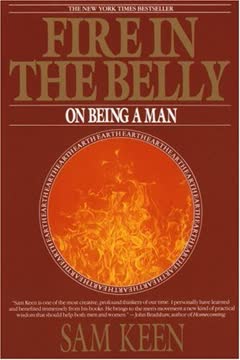
Key Takeaways
1. Modern Man's Crisis of Identity and the Shadow of "WOMAN"
Iam not talking about women, the actual flesh-and-blood creatures, but about WOMEN, those larger-than-life shadowy female figures who inhabit our imaginations, inform our emotions, and indirectly give shape to many of our actions.
A profound confusion. Modern men face a crisis of identity, feeling blamed and attacked without clear definitions of manhood. Traditional notions are under siege, leaving many feeling lost and boyish well into maturity. The author, Sam Keen, recounts his own adolescent struggles with societal expectations, highlighting a secret inner life often at odds with the "real man" facade.
Unconscious bondage. A significant source of this confusion stems from men's unconscious bondage to "WOMAN"—an archetypal, rather than literal, feminine force. This "WOMAN" manifests as goddess/creatrix, mother/matrix, and erotic-spiritual power, profoundly influencing men's self-perception and actions. Men often spend a lifetime denying or reacting to this primal power, hindering their ability to forge a separate identity.
Separation for self-discovery. To truly understand maleness, men must first become conscious of how deeply enmeshed they are in WOMAN's world and then undertake a journey of separation. This involves dispelling false mystification, dissolving vague fears, and learning to love flesh-and-blood women as individuals, rather than archetypes. The path to mature manhood requires leaving "Motherland" to wander in the world of men, only to return later to love an ordinary woman.
2. Traditional Rites of Manhood are Replaced by War, Work, and Sex
The male body is the biologically given 'hardware,' the myth of manhood is the 'software' inserted by society through a series of formal and informal rites of passage.
Manhood as a "chancy thing." Across cultures, manhood is seen as a difficult prize, requiring boys to "act like a man" and prove themselves. Historically, societies used formal rites of passage—separation, initiation, and reincorporation—to transform boys into men, often involving painful ordeals to break individuality and instill tribal values. These rites provided secure identities, but at the cost of individual freedom.
Modern substitutes. In contemporary society, these formal rites have largely vanished, replaced by informal, often damaging, substitute rituals centered around war, work, and sex. These modern "rites" shape men's minds, emotions, and actions, but often impoverish and alienate them, leaving them uninitiated into authentic manhood. The absence of conscious, communal initiation leaves men searching for meaning in these often destructive arenas.
The cost of conformity. While traditional rites ensured conformity and continuity, preventing individuality, modern men, though anxious and lost, may be better equipped to survive due to their instability. The task for individuals is to demythologize these unconscious modern rites and forge their own autobiographical truths, rather than accepting society's pre-programmed definitions of manhood.
3. The Warrior Psyche: A Legacy of Violence and Repression
The male psyche is, first and foremost, the warrior psyche. Nothing shapes, informs, and molds us so much as society's demand that we become specialists in the use of power and violence, or as we euphemistically say, "defense."
Conditioned for conflict. Men are systematically conditioned for violence, leading to a "warrior psyche" built on the irrational "I conquer; therefore I am." Military induction, with its destruction of individuality and emphasis on obedience, serves as a primary initiation into this mindset. This conditioning extends beyond the battlefield, influencing all men, even those who never serve.
Psychological armor. Freud's defense mechanisms and Reich's "character armor" illustrate how the warrior psyche is structured. Men develop muscular tension and rigidity, perpetually ready for conflict, repressing emotions like fear, compassion, and guilt. This constant state of "red alert" leads to a combative stance, black-and-white thinking, and a paranoid worldview, often resulting in heart attacks and a shorter lifespan for men.
The dilemma of the sensitive man. While destructive, the warrior psyche also introduced virtues like courage and self-sacrifice. However, in a world of total war and nuclear weapons, this traditional form of heroism is obsolete. The challenge is to manage power without violence, transforming the warrior's fierceness into a "loving combat" of dialogue and respect, rather than resorting to the "gang rape of men by the brutality of war."
4. Work as the Modern Man's Defining, Yet Degenerating, Rite
One does not work to live; one lives to work.
Identity through occupation. From childhood, boys are taught they are "what they do," with work becoming the primary rite of passage. Schooling, competitive sports, first jobs, and credit cards all serve as initiations into an economic system where money equals power and worth. Success is measured by financial accumulation and conspicuous consumption, with luxury items signifying advanced manhood.
The sacredness of work. The Protestant Reformation elevated work to a sacred vocation, replacing God as the source of blessings. This secular piety now means work provides the meaning of life, often becoming an end in itself. Many men are "workaholics," finding community and identity in the workplace, which increasingly functions as a "corporate Utopia" offering comforts and securities previously found at home.
The high price of success. This economic myth, however, comes at a high cost. Corporate culture, often described with military metaphors, fosters a "tyranny of extroverts" that demands conformity, specialization, and emotional desensitization. Success leads to stress, burnout, and a sense of emptiness, as men sacrifice their soulfulness and inner life for professional achievement. The danger is not that economics turns women into men, but that it destroys the fullness of both manhood and womanhood, creating "economic man"—a degendered being subservient to market laws.
5. Male Sexuality: From Primal Drive to Performance Anxiety
For reasons that are far from obvious, men's egos are nearly inseparable from their penises. Male identity revolves around the penis in a way that female identity does not revolve around the vagina.
The penis as a symbol. Male identity is deeply intertwined with the penis, often portrayed as larger-than-life in erotica, reflecting both celebration and compensation for feelings of unreliability and shame. This obsession with erection and size stems from a primal anxiety, where the penis's independent will can lead to embarrassment and a perceived failure of manhood.
Initiation into sex. A boy's sexual initiation often begins with wet dreams, linking the sexual and mystical before cultural distortions set in. However, the locker room quickly replaces this with a performance-oriented, objectifying view of sex, where "scoring" and conquest define potency. This adolescent philosophy, reducing women to "easy lays," often persists into adulthood, contributing to issues like date rape and the consumption of pornography.
Performance over pleasure. In relationships, the locker-room hero transforms into the "man with the magic wand," whose self-esteem depends on "satisfying" his woman. Despite feminist calls for shared responsibility, many men still feel immense pressure to ensure female orgasm, reflecting an ingrained "please your mother, or else!" message. This performance orientation often leads to a lack of genuine pleasure, resentment, and a failure to integrate passion with tenderness, leaving men "hooked on the proof of our potency to pause to enjoy the flowers."
6. Measuring Manhood: Beyond Fleeting Fame to Enduring Exemplars
A man is measured by the expanse of the moral horizon he chooses to inhabit.
Beyond popular opinion. In a world saturated with mass media and fleeting celebrity, defining ideal manhood requires looking beyond public opinion polls and popular heroes. While personal "Halls of Fame" reflect individual admirations, a deeper understanding comes from "Halls of Exemplars"—men who embody universal values and transcend their time and place. These are the "spiritual elite" who reveal aspects of human promise.
The power of exemplars. Exemplars, like Jesus or Gandhi, provide reference points for judging the fullness of human potential, even if their lives are not easily imitable. They are "pathfinders and definers of the human condition," demonstrating that human beings can transcend biological and cultural conditioning. Conversely, "Hall of Villains" residents, from Rhett Butler to Hitler, help define the moral boundaries and vices to avoid.
Self-definition and aspiration. Reflecting on these exemplary figures, both positive and negative, offers leverage for modern men to navigate confusion and create new visions of manhood. Our stature is determined by the moral horizon we choose to inhabit, the heroes we admire, and the willingness to measure ourselves against standards that go beyond the "lowest common denominator of opinion."
7. A Historical Tapestry of Manhood's Evolving Virtues
Look deep into your own being, as you would into an opal, layer upon layer. Under the facade of your modern personality you will find the whole history of man contained in your psyche.
Layers of identity. The male psyche is a layered history of evolving definitions of manhood, each a creative response to its time. From the primal "I hunt; therefore I am" of the hunter, to the "I plant; therefore I am" of the farmer, and the "I conquer; therefore I am" of the warrior, each era added new virtues and vices, shaping the male identity.
The rise of reason and spirit. The emergence of Homo sapiens (Socrates) introduced reason and dialogue as virtues, while prophetic men (Amos) brought a "transmoral conscience" and a call for justice. The "Man as Image of God" (Jesus) emphasized surrender and communion, highlighting that true virility involves life in relationship, not isolated willfulness.
Modern man's paradoxes. Later, "Man as Power" became an obsession, leading to folly, while "Scientific-Technological Man" (Prometheus) achieved godlike capacity but also the ability to destroy. The "Self-Made Man" created prosperity but repressed his inner world, leading to a "tyranny of extroverts." Finally, "Postmodern Man" embodies a weightless, ironic consumerism, lost without a unifying vision. Each stage, while creative, eventually reached a point of "paradoxical counterproductivity," where its virtues turned into destructive vices, leaving modern men with a complex, often contradictory, inheritance.
8. The Pilgrim's Quest: An Inward Journey to Authentic Selfhood
The search is what anyone would undertake if he were not sunk in the everydayness of his own life...To become aware of the possibility of the search is to be onto something. Not to be onto something is to be in despair.
Beyond the "homesteader." While most men are "homesteaders"—citizens, believers, culture-bound—a growing number are becoming "pilgrims." These are questers who undertake a heroic journey into uncharted inner territory, shattering norms and challenging the status quo. This pilgrimage involves a "death and rebirth" of the self, moving from the "sunlit world of easy roles" into the "chaos and pain of the old 'masculine' self."
Embracing the "dark night." This soulful quest requires men to lay aside pragmatic virtues and embrace the logic of the imagination, becoming acquainted with the unconscious world of dreams and repressed emotions. It means moving from having answers to living questions, from cocksureness to potent doubt, and from emotional numbness to manly grief. This journey confronts the "aching void of the absent father" and the "simple sadness that accompanies the awareness of the frailty and fleeting beauty of all passing life."
From fear to freedom. The path also demands confronting "artificial toughness" and "virile fear," recognizing that fearlessness often leads to feelinglessness. It involves moving from unconscious guilt and shame to responsible morality, taking authority for one's own values. Finally, it means transitioning from isolation to an awareness of loneliness, and from false optimism to honest despair, recognizing that despair is the "grave from which we may be born again," leading to renewal and the rebirth of joy.
9. New Heroic Virtues for the "Fierce Gentleman"
Good men are not products of an instant. There is no Shake 'n Bake identity, no microwave masculinity, no easy formula for authentic manhood.
A new kind of hero. The modern heroic man is not the traditional "larger than life" figure, but rather a "fierce gentleman" embodying virtues like modesty and humility. His courage lies in his willingness to "fit in" and live in harmonious intercourse with his surroundings, rather than dominating them. This emerging ideal emphasizes empowering others, as seen in leaders like Gorbachev and Mandela.
A collage of virtues. This new manhood is a collage of ancient and new virtues, forming a portrait of a humble yet virile man. Key virtues include:
- Wonder: A primal manly virtue, opening oneself to the gift of being with gratitude, protecting against spiritual claustrophobia.
- Empathy: "Spiritual availability," a self-forgetting capacity to listen and respond to others, recognizing shared wounds.
- Heartful Mind: Thinking passionately and deeply, harmonizing mind, heart, and body, cultivated through solitude and autobiographical reflection.
- Moral Outrage: A spiritual warrior's fierce indignation against surplus suffering and injustice, leading to action and perpetual repentance.
- Right Livelihood: Finding harmony between vocation and occupation, making a living in a way that aligns with spiritual integration and contributes to lasting value.
- Enjoyment: Cultivating gratitude and pleasure in elemental experiences, balancing the struggle against evil with a deep appreciation for life's sweetness.
- Friendship: A rugged, enduring love between equals, providing intimacy and validation, countering the isolation of individualism and overdependence on romantic partners.
- Communion: The essential bond of community, where men share stories, challenge each other, and overcome loneliness, forming a "listening community" that cherishes individual uniqueness.
- Husbanding: The art of stewardship, caring for one's place and resources, nurturing the earth and passing on its fullness to future generations, grounded in commitment and place.
- Wildness: Identification with literal wilderness, reminding men of their elemental connection to nature and providing necessary ordeals to test wits, preventing perversion into violence.
Generations in the making. These virtues are not instantly acquired but are cultivated over a lifetime, passed down through generations of fathers and sons. The vision of manhood is a blended figure, where the boundaries between grandfather, father, and son are porous, allowing care, wisdom, and delight to flow.
10. Reconciling Genders: The Dance of Authentic Love and Loving Combat
Authentic love is a dance with three movements: solo, counterpoint, and coming together; it embraces solitude, conflict, and intimacy.
Beyond romantic illusions. The "battle fatigue" between sexes stems from sentimental, romantic notions of love as unbroken intimacy. Authentic love, however, is a complex dance that includes solitude, respectful struggle ("loving combat"), and interdependence. It acknowledges that "No" is married to "Yes," and that true connection requires both firm boundaries and fierce engagement.
Fierceness, not violence. Men must learn the difference between fierceness—an expression of inner strength—and violence—an expression of frustrated impotence. To achieve authentic love, men must exorcise unconscious guilt and shame, stand firm, and learn to say "No" to women when appropriate, just as women have learned to express their anger. This honest struggle, though uncomfortable, is more loving than false peace.
Prophetic vs. ideological feminism. Feminism has profoundly changed the cultural climate, offering prophetic insights into patriarchy's harms and demanding equality. However, ideological feminism, fueled by resentment and blame, often demonizes men and romanticizes women, creating a "devil term" of patriarchy responsible for all societal ills. This simplistic, sexist moralism hinders genuine reconciliation, as it denies men's suffering and women's complicity in destructive systems.
11. The Profound Mystery of Man and Woman Beyond Social Constructs
God did not make persons,—chairpersons, mailpersons, or spokespersons—only men and women.
Problem vs. mystery. While social sciences can deconstruct gender roles and stereotypes, a genuine mystery of biological and ontological differences between men and women remains. Gender is ultimately a mystery in which we are intimately involved, not merely a problem to be solved or an inconvenience to be overcome through social engineering.
The danger of "unisex." The "unisex myth," fueled by the hope of eliminating gender differences for equality, risks dehumanizing individuals by reducing them to machines or robots. This approach, which seeks to free humans from "bondage" to biology, ultimately destroys the forms of love and the sacredness of "Mother" and "Father" that make life sweet.
Sexuality and spirituality intertwined. The mystery of our sexual being is deeper than scientific explanation, mingling sexuality and spirituality. The phallus and vulva have historically been metaphors for the sacred, linking carnal knowledge with spiritual awareness. Love, in this context, increases the mystery of self and other, celebrating the communion of opposites in a passionate dance of coming together and going apart.
12. The Common Vocation: Healing Earth and Family as the Path to Wholeness
The great calling of our time that is worthy of men and women is to hold each other within our hearts, and to conspire to create a hearth within the earth household.
Beyond gender wars. The future's major conflict will not be between sexes, but between "Progressives" (economic growth, technological dominance) and "Radicals" (ecological balance, interdependence). Men and women must unite in a common, erotic, and earthy vocation to heal the earth and create a new social order not based on enmity or conquest.
The centrality of family. The health and happiness of the family is the yardstick for societal success. Men and women cannot recover wholeness without rediscovering the central importance of family, children, and future generations. The family is the "first line of defense against dehumanization and misplaced loyalty," a natural school of love where children teach the virtue of hope and provide visceral evidence of investing in others' lives.
Husbanding the earth and hearth. Men, whether gay or straight, married or single, must embrace the virtue of "husbanding"—stewardship, caring for place, and nurturing the young. This involves creating a "hearth" beyond the nuclear family, a community of belonging and hospitality where friends and kin gather to share, celebrate, and support each other. This collective effort to foster an ecological conscience and transform political and gender relations is the monumental task of becoming "fierce gentlemen" and "earth fathers."
Last updated:
Similar Books