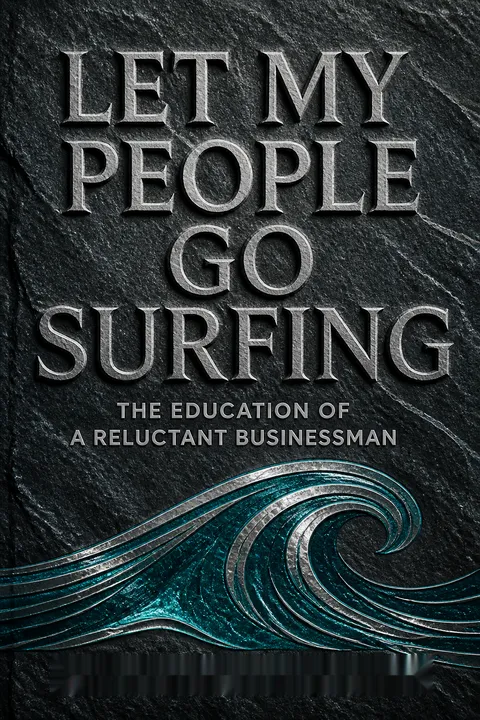


Key Takeaways
Build a business around the places its products depend on
A climber becomes a maker. Yvon Chouinard began by forging climbing tools for himself and his friends. The business grew because the equipment worked, but one of its main products, steel pitons, scarred the Yosemite rock that climbers loved. Chouinard and his partners chose to phase them out, despite their importance to sales, and developed aluminum chocks that could protect climbers without hammering the rock. This practice became known as clean climbing: using removable protection that leaves the rock largely unaltered.
Purpose enters the product. That decision foreshadows Patagonia’s mission: make excellent products, avoid unnecessary harm, and use the business to help address environmental problems. The company is not presented as a perfect solution, but as an experiment in making those commitments operational.
What's distinctive is that environmental responsibility begins with a product decision, not a charitable campaign. The climbing gear depended on healthy rock, so damage to the landscape was also damage to the activity and community sustaining the business. This is a useful test for any company: identify the living systems behind its materials, customers, and purpose, then ask whether its operations weaken them. The harder question is whether a company can credibly serve nature while selling more goods. Chouinard's answer is not innocence, but scrutiny and an obligation to reduce harm.
Define quality by usefulness, durability, and what a product leaves behind
Quality is more than polish. Patagonia's design approach starts with the job a product must do, then weighs durability, versatility, simplicity, fit, ease of care, and environmental impact. A beautiful shirt that cannot be washed easily may be inferior to a plainer one that performs well and lasts. A removable pad in a climbing pack could serve as a seat during a cold night and as a splint in an emergency. The principle is to make fewer, more useful things rather than multiply similar styles.
Test the whole object. Patagonia field-tested and lab-tested products until the weakest component failed, then improved it. Repairs should be possible, and components should wear out at roughly similar rates. This definition of quality resists both disposable goods and luxury that adds expense without practical value.
This view makes quality a relationship between an object and its full life, rather than a synonym for price or finish. It also links design to restraint: fewer parts can mean fewer failures, less waste, and less consumer confusion. The idea is especially persuasive when the product's performance is consequential, as climbing gear can be. Yet durability alone does not guarantee low impact. A long-lived product still uses materials and energy, and consumers may own more of it than they need. The strongest standard combines longevity with genuine usefulness and reduced total consumption.
Make environmental harm a design problem, not a donation problem
Look beyond the factory gate. Patagonia studied the environmental effects of its materials and discovered that conventional cotton was especially damaging. Cotton clothing represented about one-fifth of the business, yet the company decided to switch to organically grown cotton by 1996. The transition raised fabric costs sharply, reduced the number of styles, and forced staff to understand the supply chain from raw cotton onward. The company also made fleece from recycled polyester, using 25 soda bottles for a jacket.
Count use and transport. Environmental impact does not end when a garment leaves the factory. The book points to energy used in shipping and to the harm caused by washing and drying clothes. Patagonia's wider goal is to make products repairable and, where possible, recyclable into new products. Donations matter, but they do not excuse avoidable damage in the company's own operations.
The shift from donations to design changes the question from, 'How can the company compensate?' to, 'Why is the harm built into the product at all?' That is a stronger form of accountability because it alters purchasing, manufacturing, and material development. The cotton example also shows that good intentions require technical knowledge and supplier cooperation, not just a values statement. There is a real tension: organic inputs can still consume land and water, while recycling has its own energy and transport costs. Environmental claims need comparison across the full life cycle, not a single attractive attribute.
Choose a sustainable pace before growth chooses your company for you
Expansion outran capacity. From the mid-1980s to 1990, Patagonia's sales rose from about $20 million to $100 million. The company planned for another 40 percent growth year and hired roughly 100 people ahead of demand. Then sales grew by less than forecast, dealers canceled orders, and lenders cut credit. In 1991, Patagonia laid off 120 employees, about one-fifth of its workforce. The crisis exposed how expansion had strained its values, systems, and finances.
Set a limit on purpose. Chouinard describes natural growth as expansion driven by real customer demand, not by a mandate to become bigger. After managers reconsidered the company's purpose, Patagonia simplified its operations and aimed for a pace it could sustain over a hundred-year horizon. Growth became a choice, not the default definition of success.
The episode makes growth look less like a neutral reward and more like a commitment that consumes people, capital, and managerial attention. Patagonia's crisis was not simply a bad sales forecast; it revealed that the organization had built obligations around a future it could not control. A long horizon can discipline short-term decisions, but it cannot replace careful forecasting or protect workers from every downturn. The practical lesson is to make growth conditional: expand only when the operating capacity, product standards, and financial resilience can support it without quietly sacrificing the purpose that made the company distinctive.
Design work around people's lives, and trust them with the work
Culture is an operating choice. Patagonia built flexible hours around employees' outdoor pursuits and family responsibilities. Its Let My People Go Surfing policy allows workers to adjust their schedules when conditions are right, provided their work is done and colleagues are not burdened. The company also created an on-site child-care center, offered parental leave, and used open work areas to encourage communication rather than status.
Hire for contribution, not conformity. The company sought people who cared about its products or had a serious passion outside work, while valuing varied backgrounds and collaborative behavior. These practices were not perks detached from performance. Chouinard argues that employees who use or believe in the products can judge their quality directly, and that trust helps attract people who would reject a more rigid workplace.
The workplace is treated as part of the product system: people who are trusted, supported, and close to the company's work have more reason to take responsibility for its quality. Flexibility also recognizes that employees are not interchangeable units whose lives begin after office hours. Still, such a culture depends on clear accountability and fair distribution of flexibility. A policy that works for autonomous professionals can become a burden if some roles require fixed coverage or if informal norms privilege insiders. Trust is strongest when expectations are explicit and access to benefits is designed equitably.
Make suppliers partners in design before defects become expensive
Solve problems upstream. Patagonia does not own its mills or sewing factories, so product quality depends on how well independent partners understand the design. Chouinard learned this in his blacksmithing days by working directly with a skilled toolmaker, turning rough ideas into workable designs together. The book calls this concurrent work: designers and producers collaborate from the beginning instead of passing a finished plan down an assembly line.
Invest in the relationship. Patagonia prefers fewer, longer-term supplier relationships and looks for strong workmanship, fair prices, and acceptable working conditions. A loose-button example shows why timing matters: finding a faulty machine during early samples is cheaper than discovering weak buttons after a shipment arrives. The company also argues that buyers should use their leverage to help suppliers improve working conditions, not merely reject problems at the door.
This approach treats the supply chain less as a list of vendors and more as a network of interdependent capabilities. Early collaboration can prevent costly rework because production knowledge shapes the design before decisions become difficult to reverse. The same logic applies to labor standards: auditing can reveal risk, but lasting improvement may require training and sustained buyer commitment. The trade-off is concentration. Depending on a small number of partners can deepen trust while increasing exposure to disruption or misconduct. Partnership works best with transparency, shared expectations, and credible alternatives.
Teach customers what matters instead of shouting for attention
Marketing can educate. Patagonia used its catalog to explain products, outdoor techniques, and environmental concerns, not merely to list items for sale. The company found a balance of roughly 55 percent product information and 45 percent stories, essays, and images; it reported that adding more product pages could reduce sales. Its 1972 clean-climbing essay explained how to use new climbing chocks and helped shift climbers away from damaging pitons.
Let evidence carry the brand. Patagonia favored photographs of real customers and athletes in real settings, word of mouth, and independent press over heavy advertising. It also connected catalogs, stores, mail order, and online sales so customers could learn about the company in one place and buy through another. The aim was a relationship based on credibility rather than repeated persuasion.
The model makes communication part of the service: an informed customer can choose gear that fits the activity and understand the costs behind it. It also shows how a company's voice can influence industry norms, as the climbing essay did. But educational marketing has a built-in contradiction: it can teach restraint while still driving sales. Credibility therefore depends on whether the information includes inconvenient facts, such as environmental trade-offs, and whether the product itself earns the claims made for it. Storytelling becomes trust-building only when operations remain consistent with the story.
Give environmental action a fixed budget, not leftover profits
Fund the people closest to the problem. Patagonia began supporting small environmental groups after a local effort helped stop a plan to channel the Ventura River. The group documented wildlife in a river officials had described as dead, including steelhead that still returned to spawn. Patagonia gave the campaign resources and later directed substantial support to grassroots organizations. By 2005, the company reported $22 million in cash and in-kind environmental contributions.
Make the commitment measurable. Patagonia formalized an annual contribution of 1 percent of sales or 10 percent of pretax profits, whichever was greater. In 2001, Chouinard and fly-shop owner Craig Mathews founded 1% for the Planet, a network asking member businesses to donate at least 1 percent of annual sales to approved environmental groups. The fixed share makes giving part of the business model rather than a bonus for a good year.
A revenue-based commitment protects environmental giving from the accounting choices that can shrink reported profit, and grassroots groups often bring local knowledge that distant institutions lack. The Ventura River story also makes the case for funding evidence-gathering, not just public messaging. Yet a fixed donation cannot substitute for preventing harm at the source, and a logo can be mistaken for proof that a company is broadly responsible. The measure is most useful when paired with transparent reporting about both contributions and the business impacts those contributions cannot erase.
Ask why until you find the cause worth solving
Question the first explanation. When Patagonia's Japanese sales fell sharply in late 2003, managers initially blamed fashion and considered discounting winter jackets. They kept asking what else had changed. Other companies were also struggling, and the weather had been unusually warm. When cold weather arrived in January, demand returned and the company sold through its stock without dumping it.
Diagnose before reacting. Chouinard advocates repeatedly asking why a problem occurred, rather than treating its first visible symptom as the cause. That discipline can prevent expensive decisions made under panic, whether the issue is unsold inventory, late production, or a product failure. The method also requires humility: the people closest to the work may know more than the executive looking at a report, and a confident explanation is not necessarily a correct one.
This example is a compact lesson in causal reasoning. A sales decline looked like a brand problem until comparison with other businesses and attention to weather suggested a market-wide explanation. The cost of asking more questions was small relative to the cost of prematurely clearing inventory. The method is not a guarantee: causes can be multiple, data can be incomplete, and delay can also be costly. A useful discipline is to make the current explanation testable, seek evidence that could disconfirm it, and set a time limit for investigation before action.
Analysis
The book's most useful contribution is its refusal to separate business ethics from operating mechanics. Its values appear in material choices, product testing, catalog design, hiring, supplier relationships, financing, and the speed at which the company expands. This makes Patagonia more than a founder's moral statement: it becomes an attempt to build an organization whose routines reinforce its declared purpose. The narrative gives that attempt credibility because the values are tested by concrete costs, from abandoning profitable pitons to switching cotton, and by a painful failure of overexpansion.
The central tension is that Patagonia sells goods while asking customers to buy less. Chouinard does not resolve this contradiction by claiming purity. Instead, he treats the company as a participant in environmental damage that must examine its footprint, reduce what it can, and fund people working on larger problems. That is a more credible position than branding consumption as inherently virtuous, though it leaves a hard question: how much can product redesign offset a business model that still depends on selling products?
The book's evidence is strongest as an account of organizational choices and weakest as proof that these practices always produce superior financial or environmental outcomes. It relies heavily on company examples, founder judgments, and reported results. Other firms may lack Patagonia's ownership structure, customer base, margins, or culture, so copying its policies mechanically may fail. The more transferable lesson is not to imitate flextime or a donation percentage in isolation. It is to identify the conditions a company's purpose depends on, measure how its operations affect them, and make decisions that accept real trade-offs rather than hiding them.
The memoir's unusual force comes from the founder's original identity as an outdoor craftsperson. He approaches management as a practical extension of climbing: understand limits, prepare carefully, and pay attention to the next move rather than worship the summit. That model is inspiring, but its durability depends on succession and systems, not only on a founder's convictions. A mission becomes institutional only when people can apply it without needing the founder in the room.
Review Summary
Let My People Go Surfing receives mostly positive reviews for its inspiring story of Patagonia's founding and commitment to environmental and social responsibility. Readers appreciate Chouinard's unconventional business approach, focus on sustainability, and work-life balance philosophy. Many found the book thought-provoking and influential in changing their consumer habits. However, some critics found it repetitive, overly idealistic, or too focused on self-promotion. The book's mix of business advice, environmental advocacy, and personal anecdotes resonated with many readers, while others felt it was more of a lengthy advertisement for Patagonia.
People Also Read






Glossary
Clean climbing
Low-impact climbing protectionA climbing practice that protects a climber without repeatedly hammering metal pitons into cracks and removing them afterward. Chouinard Equipment promoted removable aluminum chocks, which could be wedged into rock and taken out with less lasting damage. The shift required changing both equipment and climbers' habits.
natural growth
Demand-led, bounded expansionPatagonia's approach to growing only when actual customer demand justifies making more products, rather than pursuing expansion as a goal in itself. The company links growth to its ability to preserve product quality, financial health, and environmental commitments. It is a limit-setting principle, not a promise to remain unchanged.
Let My People Go Surfing
Flexible work schedulingPatagonia's flexible-hours policy, named for the founder's outdoor priorities. Employees can adjust work around surf, snow, family, or other personal commitments, provided responsibilities are met and coworkers are not unfairly burdened. The policy expresses a broader effort to reduce the divide between work and life.
1% for the Planet
Sales-based environmental givingAn alliance founded by Yvon Chouinard and Craig Mathews in 2001. Member businesses commit to donating at least 1 percent of annual sales to approved nonprofit organizations working to protect or restore the environment. Members make donations directly, allowing them to build relationships with the groups they support.
cradle to cradle
Materials designed for reuseA product-design goal in which materials can be recovered at the end of a product's useful life and made into new products, rather than discarded as waste. Chouinard applies the idea to clothing that could be returned, broken down, and remade from the recovered material. It extends responsibility beyond manufacturing and sale.
FAQ
What's "Let My People Go Surfing" about?
- Author's Journey: The book is an autobiography of Yvon Chouinard, founder of Patagonia, detailing his journey from a reluctant businessman to a leader in sustainable business practices.
- Business Philosophy: It explores Chouinard's unique approach to business, emphasizing environmental responsibility, quality products, and a non-traditional corporate culture.
- Environmental Advocacy: The book highlights Patagonia's commitment to environmental activism and sustainable practices, including the company's 1% for the Planet initiative.
- Personal Insights: Chouinard shares personal stories and lessons learned from his experiences in climbing, surfing, and running a business.
Why should I read "Let My People Go Surfing"?
- Inspiration for Entrepreneurs: The book offers a fresh perspective on entrepreneurship, focusing on values and sustainability rather than profit maximization.
- Environmental Awareness: It provides insights into the importance of environmental responsibility in business and personal life.
- Unique Business Model: Readers can learn about Patagonia's innovative business practices, such as flextime and on-site child care, which prioritize employee well-being.
- Personal Growth: Chouinard's journey encourages readers to pursue their passions and live authentically, balancing work and play.
What are the key takeaways of "Let My People Go Surfing"?
- Authenticity in Business: Chouinard emphasizes the power of authenticity as an organizing force in business, advocating for staying true to one's values.
- Environmental Responsibility: The book underscores the importance of businesses taking responsibility for their environmental impact and actively working to reduce it.
- Quality Over Quantity: Patagonia's focus on making the best products, rather than the most, highlights the value of quality and durability.
- Innovative Work Culture: The book showcases Patagonia's unique work culture, which blurs the lines between work and play, fostering creativity and employee satisfaction.
What are the best quotes from "Let My People Go Surfing" and what do they mean?
- "The Zen master would say profits happen 'when you do everything else right.'": This quote emphasizes that financial success is a byproduct of focusing on quality, values, and sustainability.
- "The more you know, the less you need.": Reflects the philosophy of minimalism and the importance of knowledge in reducing unnecessary consumption.
- "You must be the change you wish to see in the world.": Encourages individuals and businesses to take proactive steps towards positive change, echoing Gandhi's famous words.
- "We have to take responsibility for what we make, from birth to death and then beyond death, back to rebirth.": Highlights the concept of cradle-to-cradle design, advocating for sustainable product life cycles.
How did Yvon Chouinard start Patagonia?
- Climbing Equipment: Chouinard began by making climbing equipment in the late 1950s, focusing on quality and innovation.
- Transition to Clothing: The success of his climbing gear led to the creation of Patagonia, initially offering functional clothing for climbers.
- Environmental Focus: From the start, Chouinard emphasized environmental responsibility, phasing out harmful products like pitons in favor of more sustainable alternatives.
- Growth and Challenges: The book details the challenges and growth of Patagonia, including financial crises and the shift to organic cotton.
What is Patagonia's business philosophy according to "Let My People Go Surfing"?
- Quality First: Patagonia prioritizes making the best products, focusing on durability, functionality, and simplicity.
- Environmental Commitment: The company aims to cause no unnecessary harm and actively works to reduce its environmental impact.
- Employee Well-being: Patagonia fosters a unique work culture with flexible hours, on-site child care, and a focus on work-life balance.
- Community and Activism: The company supports grassroots environmental activism and encourages employees to engage in community efforts.
How does "Let My People Go Surfing" address environmental issues?
- Sustainable Practices: The book details Patagonia's efforts to use sustainable materials, such as organic cotton and recycled polyester.
- Activism and Advocacy: Chouinard discusses the company's support for environmental causes and its role in raising awareness about ecological issues.
- 1% for the Planet: Patagonia's initiative to donate 1% of sales to environmental organizations is highlighted as a model for corporate responsibility.
- Continuous Improvement: The book emphasizes the ongoing journey towards sustainability, acknowledging challenges and striving for better practices.
What is the significance of the title "Let My People Go Surfing"?
- Work-Life Balance: The title reflects Patagonia's flexible work culture, allowing employees to pursue their passions, such as surfing, during work hours.
- Cultural Philosophy: It symbolizes the company's non-traditional approach to business, prioritizing employee happiness and creativity.
- Metaphor for Freedom: The phrase suggests a broader metaphor for freedom and autonomy in the workplace, encouraging a break from conventional corporate constraints.
- Personal Connection: Chouinard's love for surfing and the outdoors is a central theme, influencing Patagonia's values and operations.
How does Yvon Chouinard view the role of business in society?
- Agent of Change: Chouinard believes businesses have a responsibility to lead by example and drive positive change in society.
- Environmental Stewardship: He advocates for businesses to prioritize environmental sustainability and address the ecological crisis.
- Community Engagement: The book emphasizes the importance of businesses supporting local communities and grassroots activism.
- Long-term Vision: Chouinard encourages businesses to plan for the long term, considering the impact of their actions on future generations.
What challenges did Patagonia face, as described in "Let My People Go Surfing"?
- Financial Crises: The book details financial challenges, including a major crisis in 1991 that led to layoffs and restructuring.
- Environmental Impact: Patagonia faced the challenge of reducing its environmental footprint while maintaining product quality.
- Market Competition: The company navigated competition from larger brands and the pressure to expand without compromising values.
- Cultural Shifts: As Patagonia grew, it worked to maintain its unique culture and values amidst changing market dynamics.
How does "Let My People Go Surfing" inspire entrepreneurs?
- Values-Driven Business: The book encourages entrepreneurs to build businesses based on values and sustainability rather than solely on profit.
- Innovative Thinking: Chouinard's approach to problem-solving and innovation offers a model for creative entrepreneurship.
- Resilience and Adaptation: The book highlights the importance of resilience and adaptability in overcoming challenges and achieving long-term success.
- Authentic Leadership: Chouinard's leadership style, rooted in authenticity and passion, serves as an inspiration for aspiring business leaders.
Download PDF
Download EPUB
.epub digital book format is ideal for reading ebooks on phones, tablets, and e-readers.








