

Key Takeaways
Build meaning with people instead of waiting for life to feel meaningful.
Flourishing is made. The book defines flourishing as joyful, meaningful growth shared with other people. It is not a prize earned at the end of a perfect plan. It grows through repeated actions and the environments those actions create. In Homer, Alaska, volunteers spend weeks building sets and costumes for a community ballet that lasts only a few hours. Its value lies in the relationships and shared effort it creates, not in efficiency or permanence.
Achievement can be communal. Norwich, Vermont, a town of about 3,000 people, produced 11 Olympians without elite facilities or a professional coaching system. Neighbors supported one another’s children, and many athletes returned to help the next generation. In both places, flourishing looks less like individual success than a community making room for people to grow.
The useful shift is from treating meaning as a private feeling to seeing it as a social practice. Shared projects give people roles, memories, and reasons to depend on one another, much as civic rituals can turn neighbors into collaborators. This view also corrects achievement culture, which often credits the star and overlooks the web that sustains them. Still, community participation depends on time, money, and access. The ballet’s glow should not obscure who can volunteer, who is excluded, or whose labor goes unrecognized.
Pause task-focused attention before it makes the living world look like machinery.
Two modes of attention. The book distinguishes controlling attention, which narrows in on a task, from connective attention, which takes in context, relationships, and ambiguity. These are useful tendencies, not sealed brain compartments. In the 2010 Chilean mine collapse, 33 miners survived underground for 17 days before rescuers reached them. Their cohesion grew through pauses: gathering in a circle, sharing food, and checking on one another. Their first call also turned toward a missing colleague, and the miners sang together.
Focus can hide context. In Daniel Simons’s invisible gorilla experiment, people counting basketball passes often failed to notice a person in a gorilla suit crossing the scene. Concentration helps with precision, but it can screen out what matters beyond the immediate task.
The distinction is strongest as a practical model of attention, rather than a claim that one hemisphere exclusively performs one kind of thinking. Cognitive science supports the broader point that goals shape what people notice: directing attention toward one signal can make other visible signals disappear. The miners’ pauses show that stillness need not mean passivity; it can let a group update its shared understanding. The counterpoint is that narrow focus remains essential in emergencies and skilled work. The aim is flexible attention, not permanent openness.
Use rituals and honest questions to turn strangers into participants.
Create a receptive moment. An awakening cue is a pause or prompt that helps people loosen their usual focus and notice a meaningful connection. Fred Rogers used simple rituals to do this, including asking audiences to silently remember someone who had helped shape their lives. Facilitator Peter Block creates similar conditions by seating people in small groups, making advice-giving unnecessary, and asking questions about what matters to them. The point is not to force intimacy, but to make space for people to choose what they share.
Small prompts can matter. In Geoffrey Borman’s school experiment, seventh graders read older students’ reassuring messages and later reflected on reasons they might succeed. Across two 15-minute sessions, the intervention was associated with fewer disciplinary incidents, better attendance, and fewer failing grades than the comparison condition.
A well-formed question can change a conversation because it asks people to draw on memory and values, not merely trade opinions. This resembles psychological safety: people are more willing to contribute when they are not being corrected or judged. The school example is especially compelling because the intervention is brief and credible to students, arriving from peers rather than as a lecture from authority. Yet a question is not automatically welcoming. Personal prompts can feel intrusive, so genuine choice and permission to pass are part of the design.
Give unedited attention somewhere to go before demanding polished answers.
Make room for unfinished thought. Julia Cameron’s morning pages ask practitioners to fill three pages with whatever comes to mind, without editing or planning. Her related artist date is a regular stretch of playful attention to the world, without turning the experience into a task. The practices helped Cameron feel steadier and return to creative work. They are not presented as a shortcut to good writing; they reduce the pressure to judge every thought before it has had time to develop.
Imagine before optimizing. Zingerman’s cofounders used a similar free-form exercise to picture the business they wanted to build together. Their shared vision helped them resist an attractive expansion deal that did not fit their aims. In both cases, an open-ended practice made it easier to hear preferences obscured by immediate problems.
Unfiltered writing can function as a low-cost way to externalize mental clutter. Once thoughts are on a page, they can be observed rather than endlessly rehearsed, a useful distinction in expressive writing and reflective practice. The business example extends that principle from the individual to a team: imagine the desired destination before debating routes. These exercises still need boundaries. Free-writing may surface ideas, but it does not verify them, and visioning can privilege optimism unless it is eventually paired with evidence, critique, and practical constraints.
Ask what a conflict protects before bargaining over who is right.
Find the story underneath. John Gottman and Julie Schwartz developed relationship practices that redirect attention from fixing a partner to understanding them. In one counseling session, a couple argued about gift-giving. When the husband asked his wife what gifts meant to her, she described growing up without many presents and wanting love to be made visible. Her husband began to understand the longing beneath the complaint. The disagreement did not disappear because a clever solution was imposed; listening changed how each person saw the other.
Listen before solving. Their Dreams Within Conflict exercise asks one partner to speak about a persistent disagreement while the other asks open questions and listens without rebutting. Small daily signals of interest and appreciation matter too. The method treats conflict not only as a problem to settle, but as an occasion to discover the experiences and hopes each person brings to it.
The method resembles perspective-taking research: concrete questions about personal history can replace assumptions with information that changes the emotional meaning of a dispute. That does not make every conflict a misunderstanding waiting to be healed. Some involve incompatible needs, unequal power, or behavior that requires firm boundaries. Listening is most useful when it expands understanding without requiring someone to abandon their own account. The couple’s story shows how curiosity can lower defensiveness, but it should complement, not replace, clear requests and accountability.
Give groups a common aim, meaningful roles, and room to improvise.
Make contribution necessary. Group flow is the shared absorption and energy that can emerge when people work toward something together. In psychologist Elliot Aronson’s jigsaw method, a lesson was divided among five students in mixed-background groups. Each student learned one part, then taught it to the others, making cooperation necessary rather than optional. After six weeks, minority students in the jigsaw classes scored 11 points higher than those taught by the district’s top-rated teachers, according to the book’s account.
Let participants shape the standard. The Cleveland Guardians applied a related idea to player development. Instead of importing a finished coaching doctrine, they asked coaches to describe excellent coaching and built a shared model from their responses. The aim and structure were clear, but the people doing the work had a hand in defining how to do it.
The jigsaw classroom changes incentives, not just attitudes: students listen because each person holds information the group needs. That is a powerful design principle for schools and workplaces, where exhortations to collaborate often leave competition intact. The Guardians example adds legitimacy by making standards locally authored, which can strengthen commitment. Still, shared ownership does not guarantee equal influence. Facilitators must notice whose expertise is heard, who gets meaningful responsibility, and whether a common goal is genuinely shared rather than simply assigned.
Design environments that make cooperation easier than obedience.
Change the setting. Dutch traffic engineer Hans Monderman removed familiar signals, curbs, and barriers from some village streets, replacing them with textured paving and other cues that told drivers they were entering a place where people shared space. The change asked drivers, cyclists, and pedestrians to pay attention to one another. In Drachten, reported traffic accidents fell from 36 a year to 2 after a redesign.
Leave room to adapt. MIT’s Building 20, a temporary, makeshift structure, brought researchers from different fields into close contact and gave them unusual freedom to alter their workspace. Its occupants collaborated on projects ranging from acoustics to early computing. The building did not dictate discoveries; its informality made encounters and experimentation easier. Both cases suggest that a setting can guide behavior without prescribing every move.
This is an argument about affordances: the way a space makes certain actions easier to perceive and perform. A street that signals shared responsibility may invite caution more effectively than a sign that drivers have learned to ignore. Likewise, informal workspaces can increase cross-disciplinary contact. The traffic example is striking, but a reported decline in one location does not establish that removing controls is safe everywhere. Design must fit local conditions, including disability access, traffic volume, and unequal exposure to risk.
Start an experiment, then let its unexpected next steps emerge.
Follow the energy. In Voorstad, a dull Dutch neighborhood, two residents began removing sidewalk bricks to make flower beds. Neighbors joined, then created a gardening group, a knitting club, a playground, and a project welcoming Syrian refugee families. None of these developments was laid out in advance. Each new activity gave people a reason to meet and suggested another possible undertaking.
Notice emerging patterns. The book calls these attractors: new projects or patterns that form as people explore a shared possibility. A modest first action can create enough contact for further ideas to take shape. This is different from having no direction at all. The residents wanted a warmer neighborhood, but they discovered what that meant by doing things together rather than following a detailed master plan.
Small experiments are a form of collective learning. They create feedback from actual participation, which can reveal needs that a planning meeting would miss. Voorstad’s sequence also shows how a visible improvement can become an invitation: flowers make collaboration tangible, and collaboration makes larger projects imaginable. Emergence is not always benevolent, however. Groups can reproduce exclusion or conflict as easily as generosity. A shared direction, attention to who is missing, and a way to address harm help keep improvisation from becoming an excuse for neglect.
Listen for local capacity before importing someone else’s solution.
Begin with residents’ knowledge. Kennedy Odede founded Shining Hope for Communities, or SHOFCO, in Kibera, Nairobi, after growing up there. The organization began with small neighborhood projects, including soccer and street cleaning, then expanded into programs shaped with local participation. When a gang tried to disrupt construction of a girls’ school, Odede listened to the attackers, explained that the school would serve their children too, and paid for an injured man’s treatment. Gang members later returned to help build.
Make ownership practical. SHOFCO grew to serve 1.4 million people, with most staff drawn from the region. Odede’s approach relied on small groups identifying problems and choosing actions, rather than outsiders arriving with a complete plan. Listening did not mean having no direction; it helped connect community concerns to projects people could own.
The story aligns with community-led development, which treats residents as sources of expertise rather than passive recipients of services. Local ownership can improve trust and make programs more responsive to changing needs. Odede’s encounter with the gang also demonstrates that understanding a conflict may reveal shared interests without excusing violence. The model depends on more than good listening: sustained funding, competent operations, and safeguards matter at scale. Participation is not a substitute for resources, but it can determine whether resources fit the people meant to benefit.
Treat small invitations as doors into futures you could not plan.
A detour can become a path. In the Harvard Study of Adult Development, Leo DeMarco initially seemed unremarkable to researchers. He had set aside a writing ambition to return home and care for family, then built a satisfying life through teaching, friendship, and family relationships. His flourishing did not depend on a grand achievement; it grew through ongoing commitments to others.
Notice the overlooked opening. The book calls a yellow door a subtle invitation that becomes visible when attention slows enough to register it. Coyle describes accepting a friend’s invitation to climb, despite his initial reluctance. The activity led to a circle of friends and further shared adventures. The lesson is not to say yes to everything, but to leave enough room for a worthwhile possibility to surprise an established routine.
DeMarco’s story questions the assumption that a life is successful only when it follows an early ambition. Meaning can arise from commitments that were not originally chosen, without making every sacrifice noble or every setback beneficial. The climbing anecdote adds a smaller, more repeatable version: a tentative yes can create relationships that were not available from the couch. The useful practice is discerning openness, not indiscriminate novelty. Some invitations are costly or unsafe; the value lies in noticing possibilities that fit real interests and responsibilities.
Analysis
The book’s central move is to connect inner attention with social design. It begins with moments of stillness, listening, and shared memory, then follows their consequences into classrooms, businesses, neighborhoods, and teams. Meaning is not treated as a private mood or a reward for achievement. It is something people make through repeated encounters, shared work, and the freedom to influence what happens next. This scale shift is the adaptation’s strongest idea: a quiet conversation can alter how two people see each other, while a well-designed setting can make that quality of attention more likely across a group.
The account is persuasive when it identifies concrete conditions: people need a reason to gather, roles that matter, enough safety to contribute, and latitude to adapt. The jigsaw classroom and the Voorstad gardens make those conditions visible. The book is less conclusive when it treats varied examples as evidence of one general mechanism. A small prompt, a street redesign, and a community organization differ in scale, cost, and risk. Their successes do not establish that openness or informality works in every context. Nor is disorder inherently creative; without inclusion and accountability, it can simply favor the loudest participants.
The neurological language also benefits from restraint. The book itself cautions against simplistic left-brain and right-brain stereotypes, and its distinction between narrow task focus and broad relational attention is most useful as a behavioral model, not a map of exclusive brain functions. Likewise, the reported outcomes of brief interventions deserve attention without being treated as universal guarantees.
The practical synthesis is therefore not to abandon plans, expertise, or measurement. It is to use them in service of connection rather than as substitutes for it. Pause long enough to notice people, ask questions that invite their experience, create a small shared undertaking, and watch what participation reveals. Then evaluate who benefited, who was left out, and whether the emerging pattern is worth strengthening. Flourishing remains partly unpredictable, but the conditions that invite it can be deliberately cultivated.
Review Summary
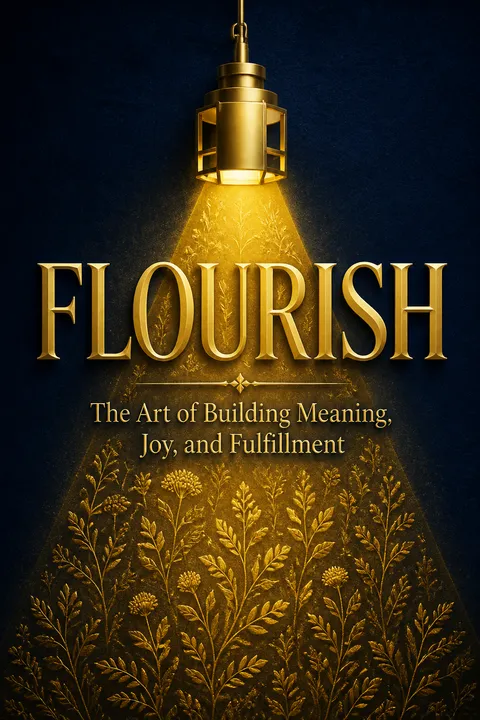
Flourish by Daniel Coyle defines flourishing as "joyful, meaningful growth, shared with others." Reviewers praise its accessible storytelling, practical tools like "awakening cues" and Peter Block's deep questions, and insights on shifting from narrow control to expansive connection. The book's two parts—making meaning and building community—emphasize presence, vulnerability, and embracing disorder as a doorway to possibility. Readers appreciate real-world examples spanning Chilean miners to small-town Alaska, finding immediate applications for leadership, teams, and personal life. At under 200 pages, it's a quick, thought-provoking read that challenges productivity culture and champions relational, community-based growth.
People Also Read







Glossary
Awakening cues
Prompts for meaningful connectionMoments or practices that help people pause their ordinary, task-focused attention and notice a connection to others or to something larger than themselves. They can include rituals, open-ended questions, or deliberate stillness. In the book, they are not magic or a fixed formula, but ways of creating conditions in which meaning and connection can arise.
Presence
Felt connection to a wholeAn experience of being attentive and emotionally connected to something beyond the self, such as another person, a community, nature, or a spiritual reality. The book describes presence as involving outward attention, emotional safety, and a sense of being both distinct and part of a larger whole. It is treated as a human capacity that can be renewed.
Controlling attention system
Narrow, task-focused attentionThe book’s term for attention that targets a specific object or task, seeks certainty, and supports rapid problem-solving. It can be valuable for precision and action, but its narrow focus may make surrounding context and relationships less noticeable. The term describes a mode of attention, not a claim that one brain hemisphere performs only this function.
Connective attention system
Broad, context-sensitive attentionThe book’s term for attention that takes in relationships, context, and subtle patterns rather than isolating a single task. It supports receptivity, meaning-making, and awareness of a person’s place within a larger situation. The book presents it as complementary to controlling attention, not as a replacement for focused thought.
Group flow
Shared, energized collaborationA collective state of absorption and vitality that can emerge when people work together toward something meaningful. The book associates it with a common purpose, chances for individuals to make consequential contributions, and freedom to adapt their actions. Group flow is not simply a pleasant atmosphere; it includes shared effort and the possibility of learning through action.
Rule of the Beautiful Mess
Use disorder to enable growthThe book’s principle that productive collaboration often begins with uncertainty and imperfect exploration rather than a fully controlled plan. When people have a common direction and meaningful responsibility, the disorder can help them revise assumptions and discover better ways to work. The phrase does not mean that all confusion is useful or that groups should abandon structure.
Rule of Surprise
Let new patterns emergeThe book’s principle that shared exploration can produce projects and solutions that participants could not have predicted in advance. As people act toward a common possibility, new patterns may form and give the group further direction. Surprise is treated as a feature of collective learning, not a guarantee that every unexpected result will be beneficial.
Attractors
Emergent patterns that organize actionPatterns, projects, or possibilities that arise as people explore together and begin to orient their activity around them. A neighborhood garden, for instance, can become a reason for new people to meet and collaborate on further projects. In the book, attractors help explain how a small initial action can generate a larger stream of collective activity.
Morning pages
Daily unedited free-writingA practice associated with Julia Cameron in which a person fills three pages with unfiltered thoughts, usually at the start of the day. The aim is not to produce polished prose or solve a particular problem, but to create space for thoughts to surface before they are judged. The book presents the practice as a way to reduce creative blockage and cultivate awareness.
Jigsaw method
Interdependent peer teachingA classroom approach developed by psychologist Elliot Aronson in which students in diverse groups each learn a different part of a lesson and then teach it to their group. Because each person holds material the others need, the structure encourages listening and cooperation. The method was used to reduce hostility and improve participation in classrooms undergoing racial integration.
Download PDF
Download EPUB
.epub digital book format is ideal for reading ebooks on phones, tablets, and e-readers.








