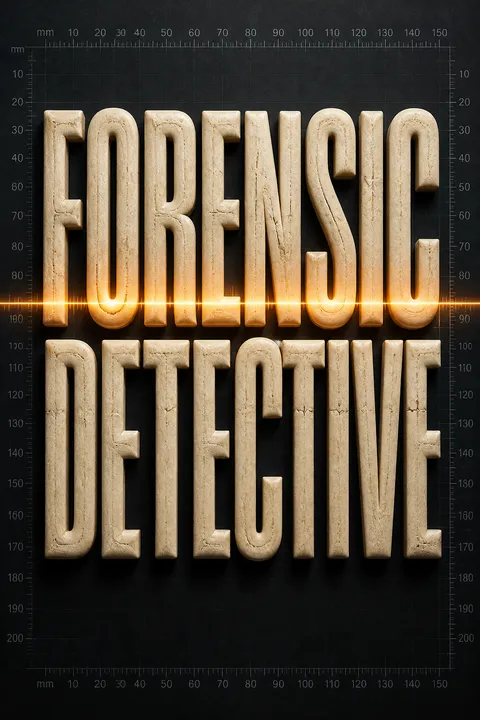


Key Takeaways
Treat every fragment as evidence, not as a failed whole.
Small pieces can speak. Forensic anthropology applies the study of bones to questions of identity, injury, and death. In the Steven Hicks case, Jeffrey Dahmer had smashed and scattered the remains so thoroughly that investigators recovered less than 20 percent of the skeleton, with fragments sometimes only a centimeter long. Smithsonian anthropologists spent nearly a month sorting and rebuilding what they could. Six teeth and one neck bone ultimately supplied crucial matches to Hicks’s dental and medical X-rays, identifying him thirteen years after his murder.
Reconstruction is patient work. A fragment’s size, shape, and surface can reveal which bone it came from, how it broke, and whether it belongs with other pieces. The process resembles assembling a three-dimensional puzzle, except some pieces are missing and the picture is not known in advance.
The case makes a powerful distinction between physical completeness and evidentiary usefulness. A broken object can retain identifying features even after its original form is lost, and bones are no exception. The lesson extends beyond forensics: partial records, damaged archives, and incomplete testimony can still support a strong conclusion when several details converge. The caution is that fragments invite imaginative overreach. Reconstruction must remain tied to observable features and independently verifiable comparisons, rather than to the story investigators hope to prove.
Let bones sketch a life, but keep every estimate provisional.
A skeleton offers probabilities. A biological profile is an estimate of characteristics such as age, sex, stature, and ancestry based on skeletal features. In the Cades Cove case, skull and pelvis traits indicated a woman, while teeth, joint development, and spinal changes suggested an age in her thirties. The estimate aligned with Rosalyn Goodman’s age, but did not identify her by itself. Dental X-rays supplied the stronger confirmation.
Methods can check one another. The team combined visual examination with measurements and formulas. A statistical method using eight skull measurements had an 86 percent accuracy rate for estimating sex. That is useful, but it is not certainty. Bone development, disease, age, and individual variation all affect what can be inferred from remains.
The value of a biological profile lies in narrowing possibilities, not turning a body into a perfectly legible biography. That distinction matters because forensic categories can sound more exact than they are. Population-level traits do not map neatly onto every individual, and ancestry estimates in particular should not be mistaken for simple or definitive racial labels. The strongest practice shown here is methodological triangulation: several indicators support an estimate, while dental records or DNA provide separate routes to identification.
Read the ground around remains as carefully as the remains.
Location preserves a second record. Forensic investigators document where each bone and object is found, often using a grid, photographs, and site sketches. This record, called provenience, helps reconstruct how evidence was arranged and whether it was moved. At Cades Cove, park rangers carefully mapped Rosalyn Goodman’s scattered remains. A hair mass helped show that her body had decomposed at the site and that her hair had been tied back in a ponytail.
The landscape can add a clock. In a Florida hanging case, a botanist estimated that a plant growing around the rope was one to two years old, suggesting how long the body had been there. Soil layers can also show where earth was disturbed to bury a body. None of these clues stands alone, but together they can rebuild a scene after the original events are long past.
This approach treats a crime scene as an interconnected system rather than a container for isolated objects. Soil, plants, insects, and the distribution of remains may preserve relationships that a laboratory specimen cannot. It also explains why careful recovery is not clerical fussiness: a bone without its location has lost part of its meaning. Context can mislead, however, because weather, animals, and later human activity alter a site. The map is essential, but its interpretation still requires competing explanations.
Use real human decay data, not intuition, to estimate time.
Decomposition has conditions. The postmortem interval is the time between death and discovery. Once a body has begun to decompose, ordinary medical examination may not provide a reliable estimate, so investigators draw on research into how bodies change. At the University of Tennessee’s Anthropology Research Facility, known as the Body Farm, researchers study remains exposed to different environments, including burial, water, vehicles, and open ground.
One setting can change everything. Temperature, humidity, insects, rainfall, wounds, and contact with the ground all affect decay. In one experiment, a forty-pound dog skeletonized in three days, far faster than observers expected. A woman’s body became skeletal in seven days during extreme heat and humidity. The findings showed why dog remains cannot simply substitute for human decay data, and why a time estimate must account for local conditions.
The Body Farm illustrates how controlled observation can replace confident guesswork with evidence, while also showing that a universal decay timetable is impossible. This is a useful model for any field where prediction depends on environment: measure the conditions before applying a general rule. The book also reveals an important limit. A postmortem interval is often a range, not a timestamp, because multiple variables interact and the original conditions may be unknown. Precision should reflect the evidence, not the desire for a neat answer.
Separate injuries made in life from damage after death.
A mark needs a timeline. Perimortem trauma means damage occurring around the time of death, when bone still has properties different from dry, long-dead bone. In the Hicks case, cuts on ribs and vertebrae came from Dahmer’s dismemberment after death, not necessarily from the killing itself. The distinction mattered: a cut in bone can record an attack, but it can also record what happened to a body afterward.
Other agents complicate the picture. In a Florida hanging investigation, broken ribs supported the possibility that the victim had been beaten. Yet research filmed at the Body Farm showed raccoons pulling and chewing ribs from a corpse. That does not explain every fracture, but it adds a plausible alternative. Investigators compare fracture patterns, signs of healing, animal marks, and scene evidence before assigning a cause.
The central discipline here is resisting the first plausible interpretation. A mark is an observation; its cause is an inference. Keeping those steps separate protects an investigation from turning suggestive evidence into a settled narrative. The raccoon example is especially useful because it shows how new observations can revise professional habits without making expertise worthless. The goal is not to treat every explanation as equally likely, but to test whether the evidence actually distinguishes among them.
Build an identification from independent clues, not one compelling match.
Convergence strengthens identity. In the Tomb of the Unknown Soldier case, early estimates of age, height, and blood type did not fit Lieutenant Michael Blassie cleanly. Years later, scientists compared mitochondrial DNA, or mtDNA, from the remains with a sample from Blassie’s sister. Because mtDNA is inherited through the maternal line and occurs in many copies in cells, it can survive in old remains when other DNA is unavailable. The match supported identification alongside the history and physical evidence.
Not every test works. Thomas Hembree’s remains yielded no usable DNA after decades in a sealed grave. Anthropologists instead compared his age, height, healed leg injury, and dental fillings with records. The teeth distinguished him from the other possible sailors. These cases show why no single technique is sufficient for every set of remains.
Identification is strongest when evidence comes from methods with different failure modes. A DNA result, a dental comparison, and a historical account do not all depend on the same assumptions, so agreement among them is more persuasive than repeating one test. At the same time, mtDNA is not uniquely identifying in the way a complete nuclear DNA profile can be. It links someone to a maternal lineage, making context and corroboration essential rather than optional.
Make uncertainty part of the conclusion, not a footnote.
Evidence has boundaries. In a Florida park, the position of a neck bone trapped in a noose and its fractures supported a conclusion that a man had been dropped and hanged, not that he had hanged himself. Investigators could explain the evidence, but prosecutors never obtained an indictment against the suspects. A scientifically persuasive reconstruction does not guarantee a legal resolution.
Some puzzles stay open. A leg found underwater near Oahu carried shark tooth marks and showed an old fracture and surgical alteration. Those details narrowed the search, but the book ends without identifying the person. The distinction between what is known, what is likely, and what remains unknown is central to responsible forensic work. A conclusion should state the strength of the evidence without pretending it answers questions the evidence cannot reach.
This is the book’s most important check on the glamour of detective stories. Scientific analysis can reconstruct events, identify a victim, or exclude a suspect, but it cannot manufacture missing witnesses, records, or remains. The unresolved cases are not failed science; they are evidence of science respecting its limits. That said, uncertainty is not a reason to treat every account as equally plausible. Clear reasoning distinguishes a strong inference from a guess, even when neither can close the case.
Forensic breakthroughs depend on teams, records, and unbroken evidence custody.
The work is collective. A difficult case may involve anthropologists, dentists, pathologists, police, botanists, DNA analysts, and local recovery teams. During the 9/11 identification effort, remains passed through a carefully ordered process of imaging, fingerprinting, dental examination, pathology, anthropology, and documentation. Specialists contributed different skills, while a tracking system helped keep each set of remains associated with the correct case.
Custody protects credibility. Chain of custody is the documented record of who handled evidence and when. In the Blassie disinterment, samples were sealed, labeled, independently examined, and kept under controlled access. These safeguards matter because even sound scientific work can be challenged if evidence handling is careless. The cases also show why recovery teams map and photograph remains before transport: later laboratory analysis cannot restore lost context.
The popular image of a lone expert solving a case misses the institutional structure that makes conclusions trustworthy. Expertise is distributed, and procedures allow one specialist’s work to be checked by another. This resembles quality control in engineering: a correct component is not enough if the system cannot show where it came from or how it was handled. Procedures do not eliminate error, but they make error easier to detect and make reliable findings easier to defend.
Keep searching even when a missing person is only one bone.
Identification restores a name. Marine Corporal Dennis Hammond died as a prisoner in Vietnam, and search teams repeatedly failed to find his grave. In 1995, Mann joined a search with Hammond’s former fellow prisoner, Thomas Davis. They found no remains. Years later, a DNA search produced a match to bones already held at the Central Identification Laboratory. Those remains had been recovered in 1989 but could not be identified with the tools then available. Hammond returned home after thirty-six years.
The purpose is personal. Apprentice Seaman Thomas Hembree, killed at Pearl Harbor, was identified through skeletal and dental comparison after DNA testing failed. His family received a proper burial and could correct the uncertainty that had lasted six decades. The laboratory’s work is not only classification. It gives families a name, a history, and a place to grieve.
These stories show that identification is a form of public service whose benefits extend beyond the laboratory. A recovered name can correct a record, restore a family connection, and return a person to the history from which disappearance removed them. The work also requires patience across generations: better technology can make old evidence newly informative. Yet closure is not automatic or uniform. Families may feel relief, grief, anger, or all three, and a scientific answer cannot erase the years spent waiting.
A crooked career can become expertise when curiosity meets discipline.
The path was not straight. Mann describes a childhood shaped by adoption and frequent moves, dropping out of high school, joining the Navy, and drifting through many jobs. Education came later, beginning with a GED and community college. At William and Mary, a lesson in identifying turkey bones sparked his interest in osteology. He went on to study under forensic anthropologist Bill Bass, work at the Smithsonian, and join the military identification laboratory.
Curiosity needs practice. The book connects that personal story to the work itself: noticing small differences, volunteering for field cases, learning from mistakes, and accepting that expertise takes years. Mann’s account does not present hardship as a guaranteed route to success. It shows instead how a persistent interest, mentorship, formal study, and repeated practice can turn an unlikely beginning into a demanding profession.
The memoir gives the technical cases a human frame: the person interpreting bones is also someone shaped by uncertainty about family, loss, and belonging. That connection adds depth without reducing professional skill to biography. Personal experience may motivate a search, but it cannot validate its findings; method and independent review must do that. The more useful lesson is that late starts and detours need not foreclose serious work, provided curiosity is paired with training, humility, and sustained effort.
Analysis
Forensic Detective is both a casebook and a professional memoir. Its structure is episodic, but a consistent argument runs through the cases: bodies preserve information, yet interpreting that information requires restraint, context, and collaboration. The most memorable examples are not simply gruesome puzzles. They demonstrate how apparently minor details, such as a dental filling, a hair tie, a plant root, or a fracture pattern, can connect physical remains to a person’s history.
The book’s strongest contribution is its account of forensic knowledge as cumulative rather than magical. Mann describes sorting, measuring, comparing, and checking. He also shows how research changes practice: decomposition studies challenge intuition, animal activity complicates trauma interpretation, and DNA technology reopens cases that earlier analysts could not resolve. The narrative makes clear that a plausible reconstruction is not the same as a proven identity, and scientific evidence is not the same as a conviction.
The personal material gives the work emotional stakes. Mann’s route from high school dropout to forensic anthropologist makes the profession feel learned rather than innate, while his reflections on adoption and family loss help explain the urgency of identifying the missing. The book is careful to show that this work is not solitary. Police, anthropologists, pathologists, dentists, DNA specialists, local guides, and families all contribute to a case’s outcome.
A modern reader should also notice the limits of skeletal classification. Estimates of sex, age, stature, and ancestry are useful investigative tools, but they are not equivalent to a person’s full identity. The cases themselves support a cautious approach: treat profiles as provisional, state uncertainty, and seek independent confirmation. Ultimately, the book asks readers to see forensic anthropology as disciplined inference in service of the dead and the living, not as an all-knowing shortcut to truth.
Review Summary
Forensic Detective receives mixed reviews, with an average rating of 3.91/5. Readers appreciate Mann's expertise and case descriptions but criticize repetitive content and dry writing. Many found the forensic details fascinating, particularly cases involving identifying soldiers' remains. Some reviewers felt the book lacked depth in scientific explanations and focused too much on background stories. Several praised Mann's personal journey into forensic anthropology, while others found his tone arrogant. Overall, the book appeals to those interested in forensics but may not satisfy readers seeking in-depth scientific analysis.
People Also Read



Glossary
Forensic anthropology
Skeletal evidence analysisThe application of physical anthropology to legal and identification questions involving human remains. Forensic anthropologists examine bones and teeth to estimate characteristics such as age, sex, stature, and ancestry, assess trauma or disease, and help identify individuals. They may also assist with locating and recovering remains, interpreting a burial site, and distinguishing human bones from animal or other material.
biological profile
Estimated skeletal characteristicsA forensic estimate of characteristics that may help identify an unknown person, commonly including age at death, sex, stature, and ancestry. It is built from patterns in bones and teeth, not from a single feature. Because individuals vary and remains may be incomplete or altered, a biological profile narrows possibilities but does not usually establish identity on its own.
Body Farm
Human decomposition research siteThe common name for the University of Tennessee’s Anthropology Research Facility, where donated human remains are studied in different conditions. Researchers observe how temperature, humidity, insects, burial, water, and other factors affect decomposition. The resulting evidence helps forensic specialists estimate the time since death and understand how bodies change after death.
postmortem interval
Time since deathThe period between a person’s death and the discovery or examination of the body. Estimating it can be relatively straightforward soon after death, but becomes more difficult as decomposition progresses. Investigators consider environmental conditions, insect activity, plant growth, and the state of the remains. The estimate is often a range rather than an exact time.
perimortem trauma
Injury near time of deathDamage to bone that occurred around the time of death, while the bone retained characteristics associated with fresh tissue. The term does not, by itself, establish that an injury caused death or was inflicted by another person. Analysts compare fracture patterns, evidence of healing, environmental damage, and other context to distinguish injuries near death from damage occurring much earlier or later.
mitochondrial DNA
Maternal-line genetic evidenceDNA found in the mitochondria, small structures inside cells. It is inherited through the maternal line and occurs in many copies per cell, which can make it useful when working with old or degraded remains. A match can connect remains to a maternal relative, but the sequence is not unique to one person and should be interpreted with other evidence.
chain of custody
Documented evidence handlingThe record of who collected, transferred, stored, and examined evidence, and when each action occurred. A clear chain helps show that an item tested in a laboratory is the same item recovered at the scene and that it was protected from loss, substitution, or contamination. Weak documentation can undermine confidence in otherwise sound scientific results.
provenience
Exact evidence locationThe recorded location and context in which an archaeological or forensic item is found. For remains, provenience can include where a bone lay in relation to other bones, objects, soil layers, and the boundaries of a search grid. This information helps investigators reconstruct how a site was formed and whether evidence may have been moved.
blind hit
Unanticipated DNA database matchA DNA match made by comparing a sample from unidentified remains against a broad reference database without first knowing whose remains are being tested. In the book, a mitochondrial DNA sequence from unidentified bones matched a sequence associated with Dennis Hammond. The result prompted further examination and comparison with his known biological profile.
FAQ
1. What is Forensic Detective: How I Cracked the World's Toughest Cases by Robert Mann about?
- Career and Cases: The book chronicles Dr. Robert Mann’s career as a forensic anthropologist, highlighting his work on high-profile cases involving human remains, from serial killers to missing soldiers.
- Science and Storytelling: It blends true crime, forensic science, and memoir, offering insight into the methods and challenges of identifying unknown remains.
- Broader Impact: Mann explores the societal importance of forensic anthropology in criminal justice, military recovery, disaster victim identification, and human rights.
- Personal Journey: The narrative also delves into Mann’s personal motivations and emotional experiences throughout his career.
2. Why should I read Forensic Detective by Robert Mann?
- Insider Perspective: Mann provides a rare, firsthand look at forensic anthropology, sharing detailed case studies and scientific methods.
- Humanizing Science: The book balances technical detail with stories of loss, hope, and justice, making forensic science accessible and emotionally resonant.
- Educational Value: It serves as a valuable resource for students, professionals, and anyone interested in true crime, forensic science, or history.
- Broad Appeal: The diverse range of cases and topics ensures relevance for readers interested in crime, military history, or advances in forensic technology.
3. What are the key takeaways from Forensic Detective by Robert Mann?
- Meticulous Science: The importance of attention to detail, evidence collection, and interdisciplinary collaboration in solving complex cases.
- Technological Advances: How innovations like mitochondrial DNA testing have revolutionized the identification of remains.
- Ethical Responsibility: Forensic anthropologists serve both science and humanity, providing closure to families and upholding justice.
- Emotional Impact: The work is deeply connected to human stories, requiring empathy, resilience, and respect for the dead.
4. What are the most memorable quotes from Forensic Detective by Robert Mann and what do they mean?
- “You can smash a blue-and-white china plate into a hundred pieces, but you’ll still be able to recognize that it’s a broken blue-and-white plate.” —Robert Mann: This metaphor highlights the resilience of bone evidence and the skill required to reconstruct identities from fragments.
- “The true mystery of the world is the visible, not the invisible.” —Oscar Wilde: Used in the 9/11 chapter, it underscores the challenge of uncovering hidden truths in what is seen.
- “Every great mistake has a halfway moment, a split second when it can be recalled and perhaps remedied.” —Pearl S. Buck: This quote, in the context of war, reflects on the fragility of life and the importance of remembrance.
- “Appearances are deceptive.” —Aesop’s Fables: Emphasizes the need for scientific rigor in forensic investigations, as initial impressions can be misleading.
5. What are the main forensic anthropology methods explained in Forensic Detective by Robert Mann?
- Bone and Tooth Analysis: Determining age, sex, ancestry, and stature from skeletal features, such as skull shape and dental records.
- Skeletal Reconstruction: Piecing together fragmented or mixed remains, often likened to solving a three-dimensional jigsaw puzzle.
- Mitochondrial DNA (mtDNA) Testing: Using maternal lineage DNA to identify degraded or old remains, especially when nuclear DNA is unavailable.
- Trauma and Injury Analysis: Interpreting fracture patterns, cut marks, and ballistic evidence to reconstruct cause and manner of death.
6. How does Robert Mann describe the role of the Body Farm in forensic science in Forensic Detective?
- Unique Research Facility: The Body Farm, founded by Dr. Bill Bass, is an outdoor lab for studying human decomposition under various conditions.
- Practical Applications: Data from the Body Farm help estimate postmortem intervals, crucial for criminal investigations.
- Educational Importance: Mann recounts learning to interpret decay stages, insect activity, and environmental effects, skills not replicable elsewhere.
- Scientific Foundation: The Body Farm is respected for advancing the science of death, decay, and decomposition in forensic anthropology.
7. How does Forensic Detective by Robert Mann explain the process of skeletal reconstruction and identification?
- Sorting and Reassociating Bones: Identifying which bones belong to which individual, especially in cases of mixed or dismembered remains.
- Biological Profiling: Estimating age, sex, ancestry, and stature from skeletal markers like growth plate fusion and joint size.
- Use of Technology: Integrating DNA analysis, radiography, and cut-mark analysis to confirm identities and understand trauma.
- Complex Puzzle: The process is likened to solving a challenging jigsaw puzzle, requiring patience and expertise.
8. What are some notable cases featured in Forensic Detective by Robert Mann and why are they significant?
- Michael Blassie and the Vietnam Unknown Soldier: The identification of Blassie’s remains using mtDNA ended decades of uncertainty and changed military protocols.
- Jeffrey Dahmer’s First Victim: Mann’s reconstruction of highly fragmented remains demonstrated the power of forensic anthropology in criminal justice.
- Kendall Francois Serial Killer Case: The reassociation of mixed remains was critical for victim identification and prosecution.
- 9/11 Pentagon Victim Identification: Showcased the challenges and importance of forensic work in mass disasters.
9. How does Forensic Detective by Robert Mann portray the emotional and personal aspects of working with human remains?
- Respect for the Dead: Mann emphasizes treating remains with dignity and recognizing their personal stories.
- Personal Motivation: His own search for identity as an adoptee resonates with his professional quest to uncover the stories in bones.
- Emotional Challenges: The book candidly discusses the psychological demands of working with decomposed and fragmented remains.
- Closure for Families: Mann highlights the privilege and responsibility of returning loved ones to their families, bringing peace and honor.
10. How does Forensic Detective by Robert Mann explain the identification of remains from war zones and mass disasters?
- Military Forensic Efforts: Describes missions to recover and identify missing service members from conflicts like Vietnam, Korea, and WWII.
- Field and Lab Work: Combines field investigation, local knowledge, and advanced DNA analysis to identify remains decades after death.
- Mass Disaster Response: Details the process of sorting and identifying victims from events like the 9/11 Pentagon attack, using multidisciplinary teams.
- Technological Advances: Highlights the role of mtDNA and forensic odontology in identifying remains once considered unidentifiable.
11. What challenges in forensic anthropology are highlighted in Forensic Detective by Robert Mann?
- Degraded and Fragmented Remains: Many cases involve incomplete, mixed, or decomposed skeletons, complicating identification.
- Contamination Risks: Handling bones without gloves can transfer DNA, and environmental factors affect preservation.
- Legal and Ethical Issues: Discusses laws like NAGPRA, the illegal trade in human remains, and the importance of cultural sensitivity.
- Emotional and Logistical Difficulties: Working in war zones and mass disasters requires resilience, adaptability, and coordination with multiple agencies.
12. What insights does Forensic Detective by Robert Mann provide about the illegal trade in human remains and cultural considerations?
- Bone Trading in Vietnam: Exposes grave robbing and the sale of human remains, often driven by poverty and misinformation.
- Scientific Verification: Forensic experts distinguish between indigenous and foreign remains using skeletal features and dental work.
- Cultural Respect and Legal Protections: Discusses laws like NAGPRA and the importance of returning remains to rightful communities.
- Ethical Practice: Emphasizes the need for cultural sensitivity and scientific rigor to prevent wrongful repatriation and honor the dead.
Download PDF
Download EPUB
.epub digital book format is ideal for reading ebooks on phones, tablets, and e-readers.








