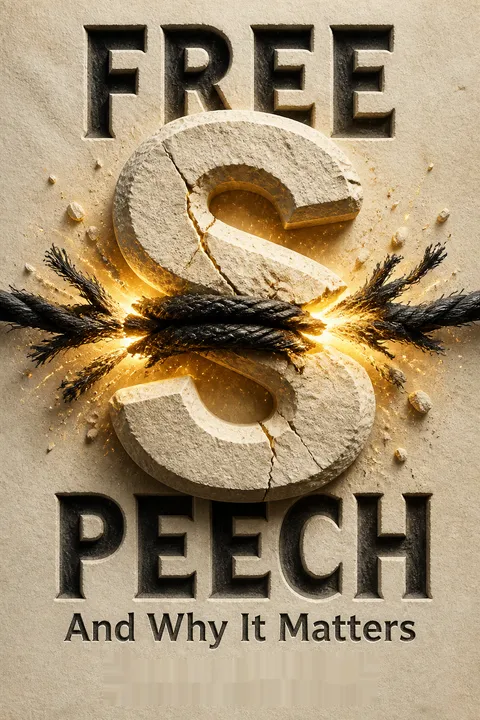


Key Takeaways
Treat free speech as democracy's safeguard, not a reward for acceptable views.
A warning in miniature. In 2019, British police contacted Harry Miller after he shared a poem online. Although no crime had been committed, the post was recorded as a non-crime hate incident, and an officer told Miller that police needed to examine his thinking. Between 2014 and 2019, police in England and Wales recorded almost 120,000 such incidents. Doyle sees the case as a sign that officials can begin policing expression even without criminal charges.
A right protects disagreement. The book's central claim is that free speech enables democratic scrutiny, scientific correction, and challenges to prevailing opinion. Galileo's treatment by authorities who rejected his astronomy illustrates the danger of mistaking current certainty for permanent truth. Protecting a right does not endorse every use of it; it preserves the ability to question those who hold power.
What's striking is how a seemingly minor record-keeping practice can alter the relationship between citizens and the state. Even without prosecution, an official investigation can chill speech if people fear professional or reputational consequences. The distinction between criminal punishment and informal state pressure therefore matters. At the same time, one case or a large count of recorded incidents does not by itself show how often records caused harm. The principle is stronger when paired with transparent procedures, evidence of impact, and safeguards against both abusive speech and unjustified state attention.
Keep social disapproval separate from state punishment.
Two kinds of limits. Doyle uses the social contract to describe the informal rules people accept to live together, such as ordinary expectations of politeness. Those rules can be challenged through criticism, mockery, or refusal to engage. Legal rules are different: they can impose state penalties and therefore require a much stronger justification. The book distinguishes speech used to commit crimes, such as fraud or perjury, from speech that is merely disliked.
A famous analogy misleads. The familiar crowded-theatre example came from a 1919 US Supreme Court case against anti-conscription pamphlets. Justice Oliver Wendell Holmes referred to falsely raising a fire alarm, but the phrase was later detached from its context and treated as a general rule against dangerous speech. The decision was overturned in 1969. Doyle argues that a vivid metaphor cannot settle where legal boundaries belong.
The distinction clarifies a common confusion: protecting speech from government punishment does not protect speakers from criticism or social consequences. Yet informal pressure can also become coercive, especially when employers, institutions, or online crowds can threaten a livelihood. The book is most persuasive when it asks who may impose a penalty and under what rules, rather than treating every social sanction as censorship. A workable liberal norm must protect room for dissent while recognizing that threats, fraud, and targeted harassment are not simply unpopular opinions.
Defend the right to speak without endorsing the speaker's beliefs.
The hardest test is an enemy. In 1977, the American Civil Liberties Union defended a group of neo-Nazis seeking to march in Skokie, Illinois, a community with many Jewish residents, including Holocaust survivors. The ACLU's argument was not that the marchers were right. It was that making speech rights depend on whether authorities approve of the message would weaken the principle for everyone. Aryeh Neier, a Jewish refugee from Nazi Germany and then a senior ACLU leader, supported the decision.
Speech can also persuade. Musician Daryl Davis has spoken with members of the Ku Klux Klan and helped some abandon the group. His example does not prove that conversation can change every bigot, but it shows that dialogue can create a path that suppression closes. Defending an opponent's right to speak is not the same as defending the content of the speech.
The Skokie case makes a useful distinction between a principle and its application: a person can condemn a message while defending its legal protection. This is a demanding test because moral disgust makes exceptions feel obvious. The counter-speech argument adds a practical benefit, since open debate can expose falsehood and offer a route out of extremist groups. Still, dialogue is not a universal remedy, and people facing credible threats should not be required to debate their tormentors. A strong speech norm protects both the right to answer and the right to disengage.
Answer bad ideas publicly; censorship can make them seem forbidden and true.
Suppression can advertise. Doyle argues that censorship may strengthen the very ideas it aims to contain by giving their advocates a story of persecution. In the Weimar Republic, anti-Semitic publishers and speakers were prosecuted, yet those cases could provide publicity and make the accused appear to be dissidents. The book also recalls the ACLU's defense of the Skokie march as a way to resist Nazism without handing officials a power that might be used against others.
Debate tests conviction. A university protest that prevents a speaker from explaining an unpopular view also prevents students from challenging it in public. Doyle's point is not that every idea deserves equal respect or unlimited attention. It is that silencing an argument does not refute it, and can leave its supporters to circulate it in closed communities. Public rebuttal keeps claims available for scrutiny.
The account connects censorship to a familiar political feedback loop: punishment can lend a movement visibility and a grievance narrative. It also treats debate as a method of testing ideas, not as a ritual that automatically produces truth. That distinction matters. Open discussion works best when participants can access evidence, respond without intimidation, and distinguish a factual claim from a provocation. Some platforms or classrooms may reasonably limit disruptive conduct. The challenge is to regulate behavior and credible danger without treating a viewpoint's offensiveness as proof that it must be hidden.
Do not confuse feeling offended with being physically threatened.
Meaning is often misread. As a boarding-school teacher, Doyle once taught a German pupil whose blunt English made him sound rude. The boy might issue a command where a more natural phrasing would have been a polite request. Once Doyle understood the translation gap, he saw that classmates were reacting to an unintended version of the pupil's personality. The episode supports a rule of generous interpretation before assuming malice.
Discomfort is unavoidable. People can choose not to listen, block someone online, criticize a remark, or leave a conversation. Doyle argues that the possibility of offense cannot be eliminated without withdrawing from ordinary social life. Feeling upset can matter, and can prompt a response, but it is not automatically equivalent to physical danger or grounds for state censorship. Intent, context, and the kind of harm should be examined rather than collapsed into one category.
The translation story shows how quickly listeners can mistake a communication failure for a character flaw. Generous interpretation can lower conflict and create room for correction, especially across languages or unfamiliar social norms. But intent is not the only relevant factor: repeated, targeted conduct can exclude people even when a speaker denies wishing harm. The useful distinction is not that emotional injury never matters, but that different harms call for different responses. A rude remark, persistent harassment, and a credible threat should not be treated as interchangeable cases.
Demand evidence before treating speech as the cause of violence.
Influence is not a simple chain. The Rwandan genocide is often cited as evidence that hate speech causes mass violence. Radio broadcasts used dehumanizing language about the Tutsi minority and urged Hutu listeners toward violence. Doyle accepts that propaganda can intensify hatred, but argues that influence depends on the conditions already present. He cites research suggesting propaganda is more effective where recipients already hold beliefs aligned with its message.
Separate incitement from inspiration. A speaker who directly urges a crowd to attack a named person presents a different case from a criminal who once read a book or heard a political speech. The first may involve an intentional, immediate call to violence; the second offers no clear proof that the speech caused the crime. The book argues that legal rules should not treat every possible influence as shared responsibility.
This section usefully resists the comforting idea that a terrible act has one identifiable verbal trigger. Violence usually emerges from interacting conditions, including ideology, institutions, opportunity, and personal choice. That complexity does not mean rhetoric is harmless: leaders can legitimize violence or signal that attackers will be tolerated. The legal question is how to identify a sufficiently direct and provable connection without criminalizing remote influence. A careful standard can take incitement seriously while avoiding the assumption that audiences are passive instruments of whatever they hear.
Make room for dissent before institutions teach people to self-censor.
Silence can become normal. Doyle describes a phenomenon called preference falsification: people hide their actual views and repeat opinions they believe will be socially acceptable. He links this to shy voters, who may conceal their political preferences, and to academics who fear career consequences for expressing dissenting views. One study cited in the book found that one in three conservative scholars reported self-censoring for professional reasons.
Universities show the stakes. At Yale in 2015, lecturer Erika Christakis questioned a proposed ban on potentially offensive Halloween costumes. Students confronted her husband, a college master, and some colleagues reportedly hesitated to defend the couple publicly. Doyle argues that such pressure can weaken academic inquiry. The same climate can affect artists, who may avoid material that risks complaints, lost work, or public shaming.
The idea of hidden preferences helps explain why public consensus can be misleading: people may conform because disagreement appears costly, not because they have changed their minds. In a university, that can damage learning by making contested claims seem settled before they are examined. Still, viewpoint diversity is not a substitute for expertise, and psychological safety can help students participate rather than suppress them. The key distinction is between protecting people from intimidation and protecting them from exposure to any unsettling argument. Institutions need both respectful conduct and intellectual risk.
Treat dominant online platforms as civic infrastructure, not neutral private clubs.
Power has shifted online. The First Amendment restrains government, but it does not directly govern how private companies moderate speech. Doyle argues that this leaves a gap as a small number of technology firms control major channels of public discussion. He points to platforms that present themselves as places for users to speak while also removing content, and to Section 230, a US law that generally shields platforms from legal responsibility for user posts they leave online.
Private power still deserves scrutiny. A company may have the legal right to set its own rules, but that does not make every rule fair or politically neutral. Doyle worries that concentrated control, weak democratic accountability, and partisan pressure can narrow public discussion. The central question is how to protect expression without pretending that private platforms are government agencies or that every user is entitled to a particular platform.
The public-square comparison captures a real tension: formal speech rights may be intact while access to influential channels depends on private decisions. But calling a platform civic infrastructure does not erase its editorial responsibilities or make every moderation choice censorship. The more productive question is what obligations follow from scale and dependence. Clear policies, consistent enforcement, meaningful appeals, and competition can constrain arbitrary power without requiring companies to host everything. The book's concern is strongest when it focuses on concentrated gatekeeping, rather than assuming that corporate moderation is inherently illegitimate.
Keep political labels precise, or censorship rules can outgrow their targets.
Definitions shape enforcement. The Overton Window describes the range of political views considered acceptable at a given time and place. Doyle argues that expanding labels such as racist or fascist to cover a widening range of disputed views can make those words less useful and broaden calls for exclusion. He calls this concept creep: a term's meaning stretches beyond its earlier boundaries.
Power can change hands. After the 1936 Battle of Cable Street, British lawmakers introduced Public Order measures to curb far-right marches. Doyle says those measures were later used mostly against left-wing activism, including action against striking miners in the 1980s. The lesson is not that every restriction is unjust, but that a power created for one target can be redirected. Precise terms and narrow rules make it harder to suppress dissent under the banner of stopping extremism.
The argument links language to institutional design: broad labels make it easier to justify broad powers, and broad powers can be redirected when political control changes. That is a durable warning for any democracy. Precision also helps people identify genuine threats instead of treating serious allegations as routine insults. Yet political vocabulary can legitimately evolve as societies recognize harms they once overlooked. The test is whether a changed definition clarifies a real pattern of conduct or merely turns disagreement into evidence of guilt. Narrow, publicly contestable standards help preserve that distinction.
Analysis
Doyle's central argument is less that every expression is harmless than that censorship creates a dangerous allocation of authority. His recurring question is practical: who decides which speech is unacceptable, by what standard, and with what protection against future misuse? The historical examples, from Galileo to the Skokie march, make the case that today's confident gatekeepers may be tomorrow's cautionary tale. The strongest conceptual contribution is the distinction between legal coercion and social response. A society can criticize, boycott, rebut, or ignore speech without asking the state to punish it.
The argument also exposes an important gap between formal liberty and lived access. A person may be legally free to speak yet fear losing work, status, or a platform. Doyle recognizes that private companies and online crowds can shape public discourse, but his preferred remedy remains less fully developed than his critique of state regulation. Concentrated platform power is not identical to government power, yet its reach can affect who is heard. Transparency, due process, appeal, and competition may be needed alongside constitutional protections.
The book's examples are vivid, but case studies do not by themselves establish the frequency or scale of a broader crisis. Nor does showing that censorship can backfire prove that open debate always reduces prejudice. Some audiences are receptive to counterargument; others may use public visibility to recruit or intimidate. The more defensible position is procedural rather than absolute: protect dissent, distinguish threats and direct incitement from offense, demand evidence for restrictions, and scrutinize both public and private gatekeepers.
Free speech matters here as a condition for correcting mistakes, including mistakes made in the name of justice. That does not make every speech rule illegitimate or every social consequence oppressive. It makes the burden of justification especially high when a powerful institution seeks to silence a view. The book's enduring challenge is to resist moral certainty without becoming indifferent to real harm.
Review Summary
Free Speech And Why It Matters receives mostly positive reviews for its concise defense of free speech in the modern era. Readers appreciate Doyle's clear arguments and contemporary examples, though some criticize his focus on left-wing censorship. The book is praised for its accessibility and importance in current debates. Critics note a lack of nuance in some arguments and question the author's stance on social media moderation. Overall, reviewers consider it a timely and thought-provoking read, even if they don't agree with all of Doyle's points.
People Also Read

Glossary
parrhesia
Candor in public speechAn ancient Greek idea commonly translated as freedom of speech, but understood more specifically as speaking candidly, including when a view is unpopular. Doyle connects it to Athenian political life and the testing of arguments through open discussion.
negative liberty
Freedom from interferenceA form of liberty that protects people from interference by government or another authority. Doyle uses the term to describe constitutional speech protections such as the US First Amendment. It does not guarantee a person an audience, agreement, or freedom from criticism.
social contract
Informal rules for cooperationDoyle's shorthand for the cooperative expectations that allow people with different interests to live together, including conventions of politeness and decorum. These norms can be challenged through social responses, but he distinguishes them from legal rules backed by state punishment.
Overton Window
Range of acceptable opinionsThe range of political positions that people at a particular time and place consider acceptable to discuss or support. The window can shift as public norms change. Doyle uses it to show that views treated as settled in one era may once have been unpopular, and that boundaries of acceptable debate are not fixed.
cancel culture
Public shaming and exclusionA form of public denunciation and boycotting, often amplified by social media, that Doyle associates with disproportionate penalties for perceived offenses or unpopular opinions. It may involve demands to employers or institutions to remove a person's livelihood or opportunities. The term does not mean that criticism or disagreement alone is censorship.
preference falsification
Hiding one's actual viewsA term associated with economist Timur Kuran for concealing a private opinion and publicly expressing a more socially acceptable one. Doyle applies it to political and institutional settings where people may fear unpopularity or professional consequences, making apparent consensus unreliable.
concept creep
A term's expanding meaningThe gradual extension of a concept to cover more cases than it originally described. Doyle applies the term to labels such as racist or fascist when they are used so broadly that they can encompass disputed opinions outside their earlier meanings. He argues that imprecise use can weaken the labels' value.
identity quakes
Disruption of core beliefsAn emotional reaction that follows when new information or an argument unsettles a person's core values or sense of identity. Doyle treats such moments as potentially painful but also important opportunities for reflection and intellectual change.
Safetyism
Prioritizing emotional protectionA term used by Greg Lukianoff and Jonathan Haidt for a culture that treats protection from emotional or intellectual discomfort as a central requirement of safety. Doyle uses it to describe campus practices that can blur the distinction between distressing ideas and physical danger.
non-crime hate incident
Recorded noncriminal conductA UK police category for an incident that is not a crime but is perceived by a victim or another person as motivated by hostility or prejudice toward a protected characteristic. Doyle objects to the recording and potential consequences of such incidents when criminal conduct has not been established.
FAQ
1. What is "Free Speech And Why It Matters" by Andrew Doyle about?
- Core Argument: The book is a passionate defense of free speech as the foundational principle of liberal democracy and a necessary condition for all other freedoms.
- Contemporary Context: Doyle examines the current cultural climate, including cancel culture, identity politics, and the rise of new forms of censorship, both state-imposed and social.
- Historical Perspective: The author traces the history of free speech from Ancient Greece through the Enlightenment to the present, showing its evolution and the recurring threats it faces.
- Practical Implications: The book discusses real-world examples, legal cases, and social trends to illustrate how free speech is being challenged and why its defense is urgent.
2. Why should I read "Free Speech And Why It Matters" by Andrew Doyle?
- Timely Relevance: The book addresses pressing issues like cancel culture, online censorship, and the erosion of civil liberties, making it highly relevant to current debates.
- Balanced Perspective: Doyle offers a nuanced view, acknowledging the complexities and potential harms of free speech while arguing persuasively for its preservation.
- Accessible and Engaging: The writing is clear, engaging, and filled with historical anecdotes, making complex legal and philosophical ideas accessible to a broad audience.
- Empowering Message: Readers are encouraged to think critically about their own views on speech, tolerance, and the responsibilities of living in a free society.
3. What are the key takeaways from "Free Speech And Why It Matters" by Andrew Doyle?
- Free Speech as Keystone: Free speech is the essential foundation of all other rights and liberties in a democratic society.
- Threats from All Sides: Censorship can come from the state, corporations, or social movements, and is often justified by well-intentioned but ultimately dangerous reasoning.
- Cancel Culture's Impact: The rise of cancel culture and self-censorship has a chilling effect on open debate, creativity, and social progress.
- Defending Unpopular Speech: True commitment to free speech means defending the rights of those whose views we find objectionable, as this protects everyone’s liberty.
4. How does Andrew Doyle define and defend free speech in "Free Speech And Why It Matters"?
- Definition: Free speech is the right to express one’s thoughts and opinions without fear of government or social retribution, within the bounds of the law.
- Moral and Practical Defense: Doyle argues that free speech is not just a legal right but a moral imperative, necessary for truth-seeking, innovation, and social progress.
- Universal Principle: He insists that free speech transcends political divides and should be defended for all, regardless of ideology or popularity.
- Limits and Misconceptions: The book clarifies common misunderstandings, such as the difference between criticism and censorship, and the distinction between speech that is criminal (e.g., incitement) and speech that is merely offensive.
5. What is cancel culture, and how does "Free Speech And Why It Matters" by Andrew Doyle address it?
- Definition and Mechanism: Cancel culture is described as a form of public shaming and ostracism, often via social media, where individuals are punished for perceived transgressions or unpopular opinions.
- Disproportionate Consequences: Doyle highlights how the consequences of cancel culture are often severe and out of proportion to the original offense, affecting ordinary people as well as public figures.
- Self-Censorship: The fear of being "canceled" leads to widespread self-censorship, stifling open discussion and creativity.
- Critique of Denial: The book challenges those who deny the existence or impact of cancel culture, providing numerous examples and data to support its reality.
6. How does "Free Speech And Why It Matters" by Andrew Doyle explore the relationship between free speech and social justice?
- Perceived Conflict: Doyle examines the belief that free speech and social justice are in conflict, particularly among younger generations who may favor speech restrictions for inclusivity.
- Argument for Compatibility: He contends that free speech is essential for marginalized groups to be heard and for injustices to be challenged and corrected.
- Dangers of Censorship: The book warns that restricting speech in the name of social justice can backfire, empowering the state or powerful groups to silence dissent.
- Equality Under the Law: Doyle argues that true equality requires the same speech rights for all, without special protections or prohibitions based on identity.
7. What are the main misconceptions about free speech addressed in "Free Speech And Why It Matters" by Andrew Doyle?
- "You Can't Say Anything Anymore": Doyle refutes the idea that free speech advocates claim total silencing, clarifying that the issue is about incremental restrictions and chilling effects.
- Criticism vs. Censorship: He distinguishes between legitimate criticism and actual censorship, noting that the right to speak does not guarantee a platform or freedom from rebuttal.
- Free Speech and Bigotry: The book challenges the notion that defending free speech is a cover for racism or bigotry, emphasizing that the principle protects everyone, especially minorities.
- Slippery Slope Fallacy: Doyle addresses the accusation that concerns about censorship are exaggerated, providing historical and contemporary evidence of gradual erosions of liberty.
8. How does "Free Speech And Why It Matters" by Andrew Doyle discuss the role of offence and harm in debates about free speech?
- Subjectivity of Offence: Doyle argues that offence is inherently subjective and unavoidable in any diverse society.
- Distinction from Harm: He makes a clear distinction between feeling offended and actual harm, cautioning against equating the two.
- Social Contract: The book explains that while social norms and politeness are important, legal restrictions on speech should be minimal and carefully justified.
- Resilience and Dialogue: Doyle encourages resilience in the face of offensive ideas and advocates for open dialogue as the best response to speech we dislike.
9. What does "Free Speech And Why It Matters" by Andrew Doyle say about hate speech and incitement?
- Problems with Definition: The book highlights the vagueness and subjectivity of "hate speech" definitions, making them difficult to legislate fairly.
- Legal Distinctions: Doyle distinguishes between hate speech (often protected) and direct incitement to violence (which is and should be illegal).
- Historical Lessons: He provides examples where hate speech laws have been misapplied or used to suppress legitimate dissent, warning of the dangers of empowering authorities to police thought.
- Personal Responsibility: The book questions the extent to which individuals can be held responsible for the actions of others inspired by their words, emphasizing the importance of personal agency.
10. How does "Free Speech And Why It Matters" by Andrew Doyle address self-censorship and conformity?
- Rise of Self-Censorship: Doyle documents how fear of social or professional repercussions leads many to withhold their true opinions, especially in academia and the arts.
- Preference Falsification: He discusses the concept of "preference falsification," where people publicly conform while privately disagreeing, leading to a distorted public discourse.
- Impact on Innovation: The book argues that self-censorship stifles creativity, academic progress, and the development of new ideas.
- Moral and Social Costs: Doyle warns that widespread conformity erodes individual dignity and the health of democratic society.
11. What solutions or advice does Andrew Doyle offer in "Free Speech And Why It Matters" for defending free speech today?
- Defend Speech for All: Doyle urges consistent defense of free speech, even for those with whom we strongly disagree, to protect the principle itself.
- Promote Open Debate: He advocates for more speech, not less, as the best way to counter bad ideas and misinformation.
- Resist Authoritarianism: The book calls for vigilance against both state and social forms of censorship, emphasizing the need for legal and cultural safeguards.
- Encourage Resilience: Doyle suggests fostering resilience and critical thinking, rather than seeking protection from offensive or challenging ideas.
12. What are the best quotes from "Free Speech And Why It Matters" by Andrew Doyle, and what do they mean?
- "Free speech is nothing less than the keystone of our civilisation." – Emphasizes the foundational role of free speech in supporting all other freedoms.
- "Defending free speech means defending the rights of those whose speech we despise." – Highlights the importance of upholding the principle universally, not selectively.
- "The price we pay for a free society is that bad people will say bad things." – Acknowledges the unavoidable downside of free speech, but argues it is a necessary trade-off.
- "Debate is not, as some have asserted, a ‘fetish’. It is the means by which we forestall the closing of our minds." – Stresses the value of open debate for intellectual growth and societal progress.
- "We surrender these freedoms at our peril." – A warning that complacency about free speech can lead to the loss of all other liberties.
Download PDF
Download EPUB
.epub digital book format is ideal for reading ebooks on phones, tablets, and e-readers.








