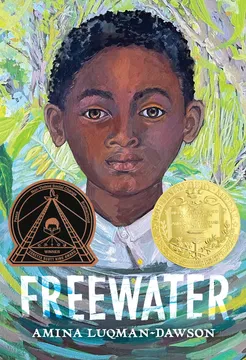


Plot Summary
Prologue
Twelve-year-old Sanzi, born free in a hidden swamp village, slips beyond the boundary her mother has forbidden her to cross. She climbs a tree to glimpse the plantation lands, but fog hides them.
Curious about the world beyond her home, she loads a stone into her sling and sends it into the mist. Her small act of defiance introduces the danger outside Freewater and Sanzi’s longing to prove herself.
Sanzi’s first rebellion is a choice to look, not yet to leave. The fog gives her imagination room to turn the unknown into adventure, while her mother’s boundary embodies a protection Sanzi experiences as confinement. The stone vanishing into the mist quietly links curiosity with consequence: Sanzi can act beyond the village, but she cannot see where her actions will land. That tension becomes the shape of her coming-of-age story.
The River's Teeth
Homer and his seven-year-old sister, Ada, flee Southerland Plantation after their mother sends them toward the river. Homer had wanted to return for Anna, their friend, and his mother went back in his place; now the children are alone, with overseer Stokes and his dogs closing in. A dog bites Homer's ankle as they reach the bank.
With the pack behind them and violent water ahead, Homer grabs Ada and jumps, although neither sibling can swim. The current drags them through a fall and separates them. Homer finds Ada clinging to the bank, and the two crawl out injured, exhausted, and stranded in a swamp they do not know.
The escape begins with a choice made under coercion, not a clean break into freedom. Homer’s attempt to save Anna has helped leave his mother behind, so his rescue of Ada is already shadowed by guilt. The river gives the children a chance to escape the dogs, but its violence strips away the idea that bravery guarantees control. Homer’s reliance on Ada, despite his role as her protector, makes survival a shared act rather than a solitary heroic feat.
Suleman's Firelit Refuge
As Homer and Ada push through mud and vines, a snake coils around Homer's leg. A stranger named Suleman kills it with an arrow, then uses flaming arrows to start a swamp fire that drives Stokes and the dogs away. He leads the children through hidden waterways, a hollow tree shelter, and a route known only to swamp dwellers.
Suleman explains that he escaped enslavement and now takes supplies from plantations to support people living free. He brings Homer and Ada to David, Daria, and their hidden community. For the first time, the children meet people who do not belong to a plantation, though Homer still worries that his mother cannot find them.
Suleman’s rescue turns the swamp from a frightening wilderness into a place with knowledge, routes, and residents. His fire is both defense and warning: the plantation’s authority does not extend everywhere. Yet Homer’s fear persists because physical escape has not reunited him with the person who made escape possible. The scene distinguishes freedom from mere distance. Suleman can guide the children to safety, but Homer must still learn what safety means when his family remains divided.
Freewater Has a Name
The siblings descend from a sky bridge into Freewater, a community built among trees and elevated swamp ground. Mrs. Light treats their injuries, and villagers welcome them with food and a ritual mark on Big Tree, which records the community’s survival. Homer recognizes Turner, the quiet man he knew as Two Shoes on the plantation.
Turner now uses a new name, but Homer senses that he is keeping secrets. Meanwhile, Anna discovers the siblings are gone and hopes they reach freedom. She also remembers Homer’s lesson about becoming unnoticed. Nora, the plantation owner’s silent daughter, witnesses Rose’s brutal whipping and learns that her father permits the violence. The children have escaped, but Southerland’s danger remains close.
Freewater offers more than refuge: its communal welcome gives the siblings a place in a history that predates them. Big Tree’s marks replace plantation accounting with a record of people enduring together. The parallel plantation scenes complicate any simple escape narrative. Anna’s friendship with Homer and Nora’s witnessing of Rose’s injury connect the hidden village to those still trapped outside it. Turner’s presence also unsettles the welcome, reminding Homer that old relationships do not become safe simply because the setting changes.
Sanzi Wants the Swamp
Sanzi, Mrs. Light’s adventurous daughter, longs to be like Suleman, whose raids bring needed supplies to Freewater. On Remembering Day, she dresses like him and persuades the anxious Billy to help hunt a wild pig, but her mother calls her back before she can prove herself. The celebration teaches the village children how its founders escaped and built their home.
Sanzi chafes at rules that keep her inside the community, while her older sister Juna dutifully helps prepare the ceremony. When patrols report tree cutters marking land near Freewater, the adults consider moving a sky bridge farther into the swamp. Sanzi sees the danger as a chance for adventure; Mrs. Light sees how one exposed person could endanger everyone.
Sanzi’s admiration of Suleman is partly a hunger for agency. She sees the goods he brings and the daring of his raids, but not yet the violence and risk that make them necessary. Remembering Day offers a counterweight: the village’s origin is not a legend of one exceptional hero but a story of collective work and mutual dependence. The approaching tree cutters make the adults’ caution concrete, even as Sanzi experiences that caution as a refusal to trust her.
A Pig Beyond the Stakes
Sanzi’s impatience spills into conflict when she fires an arrow that cuts Ferdinand’s hand during an argument. Her parents confiscate her bow, and Mrs. Light later reveals why she fears losing a child: her first baby, Moonlight, died during the founders’ escape through the swamp. Sanzi begins to understand that her mother’s rules are rooted in grief.
Later, when Homer sends Ada away in the cornfields and she disappears, he panics. Three wild pigs have cornered Ada near the village boundary. Sanzi and Ferdinand drive them off, and the children work together to haul one trapped pig from a pit of defensive stakes. Their catch feeds the community, but Daria reprimands them for crossing the boundary and risking Freewater’s safety.
This episode draws a sharp line between courage and judgment. Sanzi’s injury of Ferdinand shows how easily the wish to be admired can reproduce the harm she hopes to oppose. Mrs. Light’s account of Moonlight gives her caution an intimate history, not merely a political rationale. The pig rescue then lets the children act effectively together, but Daria’s rebuke preserves the cost of their success. Freewater needs initiative, yet an individual’s adventure can expose a whole community.
The Map Beneath Two Shoes
As DismaI Swamp Shingle and Lumber cutters move nearer, Freewater builds a replacement sky bridge toward a safer lake. Homer volunteers despite his fear of heights, and Turner, known as Two Shoes in Southerland, works beside him. During the journey, Homer finds a map hidden in Turner's shoe, showing the route between the plantation and Freewater.
Suleman also brings word from Old Joe: Rose has not been sold and is preparing for the Crumb family wedding. Homer learns that she is alive, but the news raises the stakes rather than easing his worry. After the bridge is completed, Sanzi accidentally sends a flaming arrow into Freewater’s cornfield. The fire destroys crops and damages cabins, and Turner disappears during the emergency.
The bridge embodies the community’s answer to encroachment: not retreat into isolation, but shared construction and another route to survival. Homer’s discovery of the map turns that same infrastructure into a possible path back toward the plantation, where love and danger remain entangled. News of Rose gives him a concrete hope to act on. Sanzi’s accidental fire then exposes the cost of pursuing skill without responsibility, while Turner’s disappearance turns suspicion into an urgent unanswered question.
The Cornfield Catches Fire
The fire has started because Sanzi’s arrow drifted into the corn, though the villagers first assume lightning caused it. When Ferdinand’s missing knife may be lost in the flames, Sanzi searches the burning field and Billy follows. Homer and Ferdinand help them escape; Sanzi confesses that she had hidden the knife and caused the fire.
The community survives, but its harvest and homes are badly damaged. At the meeting afterward, Homer finds that Turner is gone and studies the map he stole. He suspects Turner may lead plantation men to Freewater. Rather than reveal the map, Homer tells Sanzi, Juna, Billy, and Ada that he will return to Southerland for Rose and Anna, then bring back supplies. The others decide to go with him.
Sanzi’s confession changes her relationship to heroism: she cannot accept praise for warning the village while concealing that she caused the danger. Homer faces a parallel choice. His knowledge could protect Freewater if shared, but it could also close the one route he sees to his mother. The children’s decision to accompany him is not simply adventurous solidarity; it is a collective response to threatened food stores and an uncertain ally. Their loyalty grows alongside their capacity for secrecy and risk.
The Dog Man's Paper
Homer leads the group through the route he and Ada once survived, while Sanzi uses her swamp knowledge and Billy remembers the hidden water gate. Their cramped canoe capsizes repeatedly before they balance it well enough to pass through.
A white militia man and his dogs intercept them. Ferdinand presents the paper he found with the map and pretends he is delivering captured runaways to Southerland, claiming his shoes were lost. The man lets them continue, warning that he will seize them if he sees them again.
At the plantation, Nora secretly forges a freedom paper for Rose and packs supplies, but Rose refuses to leave without her children. Anna, meanwhile, prepares a sedative from maypop flowers for the wedding whiskey, hoping to escape north.
The group survives by combining knowledge that each child has acquired in a different environment. Ferdinand’s performance uses the plantation’s own paperwork and assumptions against a patrolman, a brief reversal of who controls the story. Yet the danger is not undone; the threat of capture remains explicit. Nora and Anna’s plans reveal two different definitions of freedom. Nora imagines saving Rose by granting her a document, while Rose insists that separation from her children would make escape incomplete.
The Wedding Tent Falls
At Viola’s wedding, Crumb announces that Rose will be given to his daughter, and Homer realizes he has arrived too late to prevent the sale. Stokes recognizes Homer and knocks him down. Sanzi’s flaming arrows, meant to imitate Suleman, ignite the tent; Anna’s drugged whiskey adds confusion as guests grow delirious.
Homer escapes Stokes in the panicked crowd, then returns into the burning tent and frees Rose from beneath fallen tables. Suleman cuts an opening through the canvas. Nearby, Nora tackles Stokes when he grabs Anna, allowing Anna to take her supplies and run. Nora stays behind as the others flee. The fire turns the wedding into an opening through which enslaved people from Southerland and a neighboring plantation begin to escape.
The climax converges the children’s separate skills with the adults’ separate plans, but none works as intended. Sanzi’s imitation of Suleman creates real danger; Anna’s sedative first produces disorder rather than quiet escape; Nora’s forged paper cannot persuade Rose to abandon her children. Homer’s return into the fire is the decisive act because he chooses relationship over concealment. The scene’s liberation is therefore neither clean nor solitary: it depends on improvised cooperation amid the collapse of the plantation’s public celebration.
Home Across the Bridge
Homer reunites with Ada and Rose outside the burning tent, while Anna escapes toward the North carrying Nora’s freedom paper. The group raids the plantation outbuildings for tools, food, clothes, and other supplies. Suleman helps guide ten additional people fleeing the fire. In the woods, Homer finds Turner with his wife Sally and daughter Minnie; Turner has come back for his family rather than lead the militia to Freewater.
The children lead the growing group through the swamp, using the hidden door, traps, and sky bridges they once had to learn for themselves. Billy gives Juna the wooden bracelet he has kept for her. Suleman gives Sanzi his bow, and Sanzi answers her parents’ call before the whole party reaches Freewater.
The return resolves the opening separation without pretending that every wound is repaired. Homer brings Rose back to the refuge he once feared his mother could never find, while Anna chooses a different route toward freedom and Nora remains behind. Turner’s reunion with his family reframes his betrayal as a desperate attempt to recover what enslavement took, without erasing the danger he created. The children’s new role as guides shows that survival knowledge has become communal inheritance, not merely a means of escape.
Analysis
Freewater treats freedom as a practice of preserving relationships, knowledge, and choice under pressure. Homer’s first instinct is invisibility, a survival strategy learned at Southerland; his development does not require him to discard caution, but to risk being seen when Ada, Rose, and the wider community need him. Sanzi’s parallel growth runs in the opposite direction. Born into safety, she must learn that courage without judgment can endanger the very people she wants to protect. Her accidental fire makes that lesson material rather than abstract.
The novel also distinguishes safety from freedom without pretending the two can be cleanly separated. Mrs. Light’s rules are shaped by the death of Moonlight and by her knowledge that one captured person can threaten a whole village. Yet the children’s journey shows that protection cannot mean permanent stillness. Freewater survives because residents build bridges, patrol, share food, teach newcomers, and respond to danger together. Its security is collective work, not a sealed refuge.
The plantation plot broadens that argument through characters whose attachments complicate escape. Rose refuses a freedom paper without her children. Turner’s longing for his son makes him vulnerable to Crumb’s bargain, while Anna’s imagined reunion with her mother pulls her north and Nora’s awakening makes her question the household that raised her. None of these choices is interchangeable. The children’s rescue succeeds because their different skills and loyalties meet at a particular moment, not because one hero can solve every problem.
The book’s most consequential inheritance is therefore practical: a route remembered, a call recognized, a hand offered on a bridge. By the end, Homer, Sanzi, Billy, Juna, Ada, and Ferdinand can guide others through the same dangers that once frightened them. Their freedom becomes meaningful when it helps make escape possible for someone else.
People Also Read


Characters
Homer
The watchful older brotherHomer is a twelve-year-old boy raised to survive by staying unnoticed. He studies people and places carefully, learning practical skills from Old Joe, but his caution often turns inward as guilt: he blames himself for the choices that leave his mother behind. His fierce bond with Ada pulls him into responsibility even when he would rather disappear. In Freewater, he must learn to speak, lead, and trust others without losing the attentiveness that kept him alive.
Ada
The fearless little sisterAda is seven, inquisitive, physically affectionate, and steadfast in her belief that impossible things might be possible. Her questions and talk unsettle Homer’s guarded habits, but her optimism also helps her endure frightening circumstances. She notices details others overlook and quickly makes connections with people around her. Her closeness to Homer is the emotional center of his choices, while her capacity to adapt gives the siblings a way to imagine life beyond the plantation.
Sanzi
The restless freeborn archerSanzi is a twelve-year-old born in Freewater, where safety and belonging are ordinary parts of childhood. She longs to imitate Suleman and prove that she can contribute beyond the village, often mistaking risk for courage. Her mother’s caution frustrates her, and comparison with her composed older sister Juna sharpens that frustration. Sanzi is energetic, inventive, and quick to act; she also has to confront the difference between being admired and taking responsibility for what her actions cause.
Rose
The siblings' determined motherRose is Homer and Ada’s mother, a skilled plantation cook who loves flowers and knows how to find what her children need. Her care is practical and searching, shaped by a world that repeatedly threatens to separate families. She tries to lead her children toward safety while holding fast to the people she loves. Rose’s bond with Homer and Ada gives the story its central measure of what freedom must make possible: not only escape, but the chance to remain a family.
Anna
Homer's searching friendAnna is a sharp-eyed girl who has been sold between households and expects to find her mother in the North. She and Homer become friends through patience and recognition rather than easy conversation. Anna interprets the scar on her arm as a guide toward the family she has lost, and she keeps her hopes alive even while plantation labor narrows her choices. Her imagination is not escapism alone; it helps her picture a future and devise practical steps toward it.
Nora
The silent owner's daughterNora is an eleven-year-old who rarely speaks and feels more at home in books and Rose’s kitchen than in her own family’s rooms. Her strawberry mark and her mother’s efforts to conceal it have made her conscious of being judged. Nora is observant and inventive, often using secrecy to move through a household where her voice is not expected. Her growing awareness of the people her family controls forces her to reconsider what it means to be kind while benefiting from cruelty.
Suleman
The swamp's solitary rescuerSuleman is a skilled archer and survivor who knows the swamp’s waterways, shelters, and hidden paths. He escaped enslavement and now raids plantations for supplies that help sustain Freewater and other runaways. His calm, spare manner can seem mysterious to the children, especially to Sanzi, who turns him into a model of fearless heroism. Suleman’s work is less glamorous than she imagines: it requires knowledge, discipline, and a willingness to act in a dangerous world.
Billy
The careful young woodcarverBilly is a tall, shy teenager whose stutter and fear make him wary of leaving Freewater. He carves and polishes wood with patience, and he has a quiet devotion to Juna that he struggles to express. His history includes plantation violence and a painful separation from his mother, which helps explain his fear of being hunted. Billy’s caution is not weakness; it reflects what his body remembers, even when he wants to be braver.
Juna
The village's steady caretakerJuna is Sanzi’s older sister and the first child born in Freewater. She helps her mother with medicines, food, and village responsibilities, and she welcomes newcomers with practical warmth. Her steadiness can make her seem content with a narrow role, though she privately wants to know what lies beyond it. Juna is affectionate but not indulgent: she challenges Sanzi’s recklessness while learning that care for the community can require her to step beyond familiar duties.
Mrs. Light
Freewater's protective healerMrs. Light is Sanzi and Juna’s mother, a healer who knows the swamp’s plants and teaches her children how to take from it without exhausting it. She establishes rules because she understands how quickly one capture could expose the entire community. Her protectiveness is shaped by grief and experience, not a desire to control her daughters for its own sake.
David
Freewater's patient builderDavid is Sanzi and Juna’s father, a builder and leader who helps maintain Freewater’s defenses and routes. Plantation scars mark his past, but he approaches his daughters with tenderness and patience. He tries to teach Sanzi the knowledge behind his skills while reminding her that courage is not measured by spectacle.
Ibra
Billy's hopeful fatherIbra is Billy’s father, a warm and generous man who believes each person has something useful to contribute. He tracks Freewater’s tools and stores and helps organize work. His history includes acts he was forced to perform under slavery, which complicates his son’s understanding of him.
Daria
The sharp-eyed patrol leaderDaria is a vigilant Freewater patrol member who detects danger and insists that the village’s boundaries matter. She is direct, watchful, and difficult to impress, qualities that protect the community but can make her seem severe to children eager for adventure. Her relationship with Ibra brings warmth into her otherwise guarded public role.
Ferdinand
The knife-carrying runawayFerdinand is a teenager who escaped forced ditch work and arrived in Freewater with a knife he treats as proof of his independence. He is useful, sharp-tongued, and quick to turn insecurity into teasing. His attachment to the knife reflects the trauma and instability of his escape. Beneath his swagger is a boy still afraid of losing the little control he has gained.
Turner
The guarded former escapeeTurner, called Two Shoes at Southerland, is a quiet former plantation worker who tries to make himself useful in Freewater. His polished shoes and reserve distinguish him, but he remains emotionally tied to the family he left behind. He carries the painful conflict of someone whose hope for reunion can be used against him.
Stokes
Southerland's brutal overseerStokes oversees labor at Southerland and trains dogs to pursue people who escape. He treats fear as a tool of control and expects others to obey his authority. His pursuit of Homer, Ada, and Rose makes him the most immediate human threat in their plantation world.
Mr. Crumb
Southerland's enslaverMr. Crumb owns Southerland Plantation and makes decisions that treat enslaved people as property and labor. He is concerned with profit, status, and the smooth appearance of family celebrations. His ordinary paternal affection for Nora exists beside his participation in the plantation system, forcing her to confront the gap between private tenderness and public cruelty.
Old Joe
The plantation's quiet teacherOld Joe is an elderly enslaved man who makes wooden toys and teaches younger people practical skills. He has lived through decades at Southerland and knows how to observe without drawing attention. His quiet acts of care connect the plantation children to knowledge and hope beyond their immediate circumstances.
Viola
The plantation owner's brideViola is Mr. and Mrs. Crumb’s older daughter, whose wedding becomes a major event at Southerland. She is accustomed to being served and protected from inconvenience. Her expectations help reveal how the plantation’s comforts depend on the labor and vulnerability of others.
Plot Devices
The swamp's hidden routes
A refuge with dangerous pathsThe swamp is both barrier and shelter. Its mud, sinkholes, snakes, waterways, and dense growth make pursuit difficult, while hidden channels and elevated ground allow Freewater’s residents to travel unseen. Homer and Ada initially experience the landscape as hostile, then learn that its dangers can be understood and navigated. The same terrain gives the children a route back to Southerland and makes their journey possible.
Sky bridges
A hidden road above dangerRope bridges connect trees above the swamp canopy and help Freewater conceal movement from patrols. They require climbing, balance, and trust between travelers. Homer’s first crossing forces him to act despite fear; later, the children use the bridges to carry a canoe toward Southerland. The bridges turn communal labor into both defense and escape route.
Big Tree and its marks
A communal record of survivalBig Tree anchors Freewater’s yearly Remembering Day and bears a mark for each day the community has endured. Children recount how the founders escaped, found food, and began building a village. The ritual gives newcomers a place in a history that predates them, while reminding the children that the community was made through shared labor rather than a single person’s rescue.
Calls, disguises, and traps
Warnings that travel through natureFreewater residents use swamp sounds as signals, blend into trees with mud and leaves, and protect approaches with concealed stakes. These methods let patrols warn the village and make it harder for outsiders to recognize people or paths. The children gradually learn to use this knowledge themselves. During the return journey, a newly chosen whistle helps them coordinate without drawing attention.
Map and maypop mixture
A route and a risky distractionA map hidden in Turner’s shoe shows the route between Southerland and Freewater, giving Homer a way to return for Rose and Anna. Its presence also raises the possibility that Turner could expose the village. Separately, Anna steeps maypop flowers in whiskey to make a sedative for her escape plan. The mixture affects the wedding guests unpredictably at first, adding confusion to the fire and making the night less controllable for everyone involved.
Download PDF
Download EPUB
.epub digital book format is ideal for reading ebooks on phones, tablets, and e-readers.








