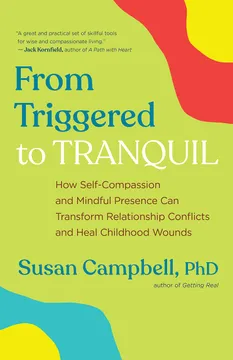


Key Takeaways
Treat a trigger as an alarm to investigate, not proof of another person's intent
An old alarm in a new moment. A trigger is a present-day cue that revives the bodily and emotional responses associated with an earlier painful experience. A sharp tone, a delayed reply, or a disagreement can register as danger even when no immediate threat is present. The nervous system may shift into fight, flight, or freeze, narrowing attention and making quick, defensive reactions feel necessary. Campbell argues that the alarm often responds to perceived threats to belonging, approval, competence, or connection, not just physical danger.
Pause before deciding what it means. A partner's silence might mean disapproval, but it might also mean distraction. The trigger is real as an experience; the explanation attached to it may not be. Investigating the difference helps recover options before responding.
This distinction resembles the difference between a sensor reading and an interpretation of the reading. An alarm can be useful without being accurate about the source of danger. Treating it as information rather than a verdict preserves both self-respect and curiosity. The important qualification is that an old wound does not make every present concern imaginary. If someone repeatedly violates agreements or behaves threateningly, calming down should clarify the evidence, not talk a person out of seeing it.
Track your signature across body, thought, feeling, and behavior
Find your early cues. A trigger signature is a person's familiar pattern of sensations, emotions, thoughts, and actions when emotional safety feels threatened. Campbell recommends reviewing several upsetting episodes to find what repeats. One person may get hot, angry, and argumentative; another may go quiet, feel numb, and silently assume they do not matter. Either pattern can be easy to miss if only loud outbursts count as reactivity.
Karen's argument carried a fear. After her husband let his daughter stay out despite a homework agreement, Karen focused on the rule and made a logical case. Underneath, she felt excluded from family decisions and unimportant. The argument might have been valid, but mapping her reaction showed what else was at stake. Noticing even one familiar cue can be enough to recognize a trigger.
The value of this map is practical: a bodily cue or recurring thought can provide earlier notice than a full-blown argument. It also makes self-observation more precise than labeling someone simply anxious or avoidant. Such patterns are tendencies, not fixed identities, and the same person can respond differently in different relationships. A useful map should expand choices, not become another label used to explain away behavior.
Pause while choice is possible, not after the argument has taken over
Interrupt the automatic sequence. Campbell's pause practice begins when someone notices a familiar warning sign and stops speaking or acting. A neutral signal can be agreed upon in advance. The book recommends taking ten slow breaths, then deciding how much time is needed before checking in again. For couples, suggested pause windows range from 10 to 15 minutes, one to three hours, or three to eight hours. The point is to return at an agreed time, not to disappear from the issue.
Calm the body first. Slow breathing, attention to the body's support from a chair, walking, or another familiar practice can help settle activation. If the other person cannot pause, a person may take a unilateral break and state when they intend to return. Practicing pauses during ordinary conversations makes the skill easier to access under stress.
A pause is a form of state management: reasoning and listening are harder when the body is preparing to defend or flee. The agreement also solves a relational problem, since a break without a return plan can feel like abandonment, while continuing to argue can deepen the rupture. The pause should not become a tool for silencing a partner or avoiding accountability. Its test is whether it supports a safer, more deliberate return.
Meet the hurt beneath the reaction before arguing with its story
Witness without surrendering to the story. Compassionate Self-Inquiry is Campbell's practice of calming down, recalling what happened, and noticing sensations, feelings, and thoughts with openness. The person takes two perspectives at once: experiencing the feeling and observing it. Instead of debating whether a fear is true, the practice asks what the hurt part needs and gives it attention. If the exercise becomes overwhelming, the book advises grounding in the present and stopping; people with complex trauma or PTSD should be especially cautious about doing memory work alone.
Emily found the need she had hidden. As a child, she spent time with her father on activities he preferred and did not ask for the connection she wanted. Remembering this helped her recognize that she also avoided directly asking her husband for closeness, partly to avoid hearing no. Self-compassion made the need visible, not automatically fulfilled.
The observer stance can create distance from an emotion without requiring denial, a useful balance between being swept away and shutting down. Emily's example also shows how a need can hide inside a strategy: asking about another person's day may be safer than asking to be seen. This kind of reflection is not a substitute for trauma treatment when memories are intense or destabilizing. The book's emphasis on going slowly and returning to present-day safety is essential.
Take responsibility for your reaction without excusing harmful conduct
Separate origin from impact. Campbell asks readers to own their emotional reactions rather than making another person responsible for their entire inner state. A sensitivity may have formed long before the current interaction, and recognizing that can reduce blame and shame. It does not mean the reaction is foolish, or that the other person's behavior was acceptable. The work is to distinguish the old fear from the present facts, then decide what boundary or conversation the facts call for.
Acceptance is not self-condemnation. The author describes shame, mistrust, and loyalty to one's parents as common obstacles to acknowledging childhood pain. Grieving what was missing can be part of accepting one's history without declaring that one's parents were wholly bad. The practical shift is from asking who is at fault to asking what is happening inside, what is happening between people, and what response is responsible now.
This approach is strongest when responsibility is understood as agency, not blame. A person may not have chosen the original wound or the first surge of fear, yet can learn how to respond and seek support. That distinction is also important in relationships with unequal power: mutual contribution to a conflict does not imply equal responsibility for coercion, intimidation, or repeated harm. Self-reflection should sharpen boundaries and accountability, not weaken them.
Repair with a short apology, an honest fear, and a clear need
Return after regulation. Repair means reconnecting after a reaction has disrupted safety or trust. Campbell advises waiting until both people can listen without rehearsing accusations. Each person can name the behavior, the fear or story underneath it, its impact, and what they wish they had done instead. They can apologize and ask for reassurance or help without demanding that the other person manage every feeling. A brief, specific statement is less likely to turn into a second argument than a long defense of good intentions.
Reassurance answers the exposed need. If a partner's late work hours stir up a fear of being unimportant, the repair can acknowledge that fear and ask for a sign of connection. The partner can respond to the need directly if able. If either person starts repeating, defending, or blaming, the repair is not working yet; pause again rather than force closure.
Repair is more than saying sorry. It combines accountability for an action with disclosure about what was emotionally at stake, which can make future conflict easier to interpret. In organizational life, similar practices help teams restore trust after mistakes by naming harm and describing a concrete correction. Reassurance, however, should not replace changed behavior where a real agreement has been broken. A useful repair joins emotional recognition with an honest account of what can and cannot change.
Interrupt the couple's cycle instead of litigating who began it
Two alarms can reinforce each other. Campbell calls the spread of emotional activation between closely connected people cotriggering. One person's pursuit may provoke the other's withdrawal; that withdrawal may then intensify the pursuit. The partners can end up repeating a familiar argument while believing the dispute is only about the immediate topic. Earlier hurts that were never repaired can add fuel, making it difficult to identify a single starting point.
Name the pattern, not a culprit. In the book's example, John wants detailed reports from Mia because silence raises his fear of abandonment. Mia experiences his questions as judgment and pressure, so she becomes guarded. Her guardedness confirms his suspicions, and his questioning confirms her sense of being scrutinized. Recognizing the loop gives either person a chance to pause. It does not require deciding who reacted first.
The useful unit of analysis here is the interaction, not a verdict about either personality. Systems thinking helps explain why a small change in one response can alter the whole exchange. Still, calling a pattern mutual must not blur important differences in power or harm. In ordinary cycles, shared responsibility can open a route out; in abusive dynamics, the priority is safety, not symmetrical self-examination.
Make parenting and groups safer through boundaries, pauses, and repair
Children need reconnection, not a perfect parent. Parents may be triggered by exhaustion, unmet needs, or a child's behavior that resembles a trait they fear in themselves. After yelling, freezing, or withdrawing, Campbell recommends that a parent calm down, apologize plainly, and reassure the child that the relationship remains loving. A child should not be made responsible for soothing the parent. Repeated repair teaches that conflict can be followed by renewed connection.
Groups need room for different limits. A meeting leader can normalize pauses, notice when someone is overwhelmed, and offer a chance to step away or speak later. Friends can also decide how much emotional work a relationship can safely hold. Campbell explicitly allows disengaging when repeated interactions overwhelm or retraumatize someone. Treating a relationship as a place to learn does not mean every relationship must be endured.
These applications share a central design principle: safety is partly created by predictable responses to rupture. A parent's apology models accountability without asking the child to carry adult emotions; a group's pause gives members a low-cost way to regain attention. The boundary on this ideal matters. Psychological openness depends on consent and context. A friendship, workplace, or family may not be safe enough for deep disclosure, and a brief boundary can be wiser than an elaborate repair.
Turn public outrage into clearer action after calming your alarm
Personal pain can reveal a public value. Rita, a Mexican American client, was overwhelmed by political name-calling that recalled racial insults from childhood. As she worked with the hurt rather than shutting down, she became more able to object to demeaning language and ask people to describe specific actions instead of using labels. Her past helped explain why the issue mattered, while clearer speech made her intervention more constructive.
Regulation is not neutrality. Jim's anger at perceived economic unfairness connected with childhood memories of violence and helplessness. He recognized that he tended to dominate or shut down when conflict arose. Campbell argues that calming the nervous system can help people distinguish reactive habits from the injustice they want to address. She cites 2020 reports of widespread distress, but her larger point is practical: action is more effective when it is informed by facts, values, and a wider view than a fear-driven impulse.
The distinction between reducing reactivity and reducing conviction is crucial. Calm can improve attention, language, and strategic judgment without making an injustice less serious. In civic life, anger can identify a violated value, but anger alone cannot establish the facts or choose an effective tactic. Rita's example is powerful because self-understanding strengthens her willingness to speak, rather than turning inner work into retreat from public responsibility.
Analysis
Campbell's central proposal is that emotional reactivity can serve as both a disruption and a source of information. The book moves from recognition to regulation, self-compassion, and relational repair, then applies the same logic to couples, parenting, groups, and public conflict. Its strongest contribution is procedural: it gives readers concrete ways to notice cues, pause, and return to conversation with less blame. The stories make hidden reactions legible. Karen's apparently reasonable argument contains a fear of exclusion; Emily's careful avoidance of asking reveals a fear of refusal; Jim's strong public posture masks an old sense of helplessness.
The model is also deliberately relational. A person is not treated as an isolated mind but as a nervous system responding within a couple, family, or group. That view helps explain why one person's withdrawal can intensify another person's pursuit, and why repair can affect more than the two people who directly argued. Its most useful ethical distinction is that a reaction may have an understandable history without becoming harmless or excused.
Some claims need careful handling. The book's contrast between primitive alarm systems and higher reasoning is a helpful shorthand, but human emotion and decision-making are not neatly divided into an old brain and a rational brain. The clinical stories illustrate possibilities, not proof that every conflict originates in childhood wounds. Nor should the principle of taking ownership of one's reaction be applied to make someone tolerate abuse or ignore present evidence. Campbell's own emphasis on boundaries and disengagement helps guard against that misuse.
The practices are best understood as skills, not a promise to eliminate triggers. Their success is not measured by never feeling fear or anger, but by gaining enough space to tell a past alarm from a present problem, protect oneself when needed, and communicate with greater intention. The larger promise is modest and meaningful: distress can become a cue for inquiry and choice, rather than an automatic script.
People Also Read










Glossary
Five Steps of Trigger Work
A trigger recovery sequenceCampbell's five-part process for responding to emotional reactivity: accept that insecurity and triggering occur, learn one's recurring cues, pause to regulate the nervous system, attend compassionately to sensations and feelings, and repair the disruption with another person when appropriate. The steps reinforce one another and are skills to practice, not a guarantee that triggers will disappear.
trigger signature
A person's recurring trigger cuesThe familiar combination of thoughts, emotions, bodily sensations, and behaviors that tends to appear when a person feels emotionally unsafe. Examples include a tight throat, suspicion, anger, argument, withdrawal, or going blank. Mapping repeated episodes helps someone notice activation early enough to pause. Campbell treats attachment styles as tendencies, not fixed categories.
Cotriggering
Connected people activating togetherThe process by which one person's triggered state affects the emotional safety of someone closely connected to them, who may then react from their own protective pattern. In a couple, questioning can prompt withdrawal, which can intensify questioning. The term emphasizes that reactions interact, while not implying equal responsibility in every relationship.
reactive story
A fear-shaped interpretationThe meaning a person gives to another's behavior while emotionally activated, often through a core insecurity. A delayed response might become evidence of rejection, or a question might feel like proof of judgment. A reactive story may contain accurate observations, but it should not be treated as established fact until the person is calmer and can consider other explanations.
Compassionate Self-Inquiry
Mindful attention to inner distressA practice of settling the body, recalling an upsetting interaction, and observing the associated sensations, emotions, memories, and thoughts with curiosity and care. The person tries to experience the feeling while also witnessing it, rather than suppressing it or immediately acting on its story. Campbell advises grounding or stopping if the process becomes overwhelming.
Attachment trauma
Disrupted early relational securityCampbell's term for experiences of neglect, abuse, or disorganized caregiving that interfere with a child's sense of safety and trust in caregivers. Such experiences can shape later fears about whether needs matter, whether feelings can be expressed safely, and whether support will be available. The book also stresses that degrees of unmet need vary.
whole-making
Integrating rejected inner partsCampbell's description of becoming more psychologically integrated by recognizing and accepting aspects of oneself that have been denied, abandoned, or pushed out of awareness. Trigger reactions can point toward these disowned needs, fears, and protective habits. Whole-making means bringing them into a more supportive relationship with the rest of the self, rather than trying to eliminate them.
cotriggering lite and cotriggering dark
Milder and more severe conflictCampbell's distinction between less threatening reactive exchanges and episodes involving more severe behavior. Cotriggering lite may include defensiveness, suspicion, or repeated arguing. Cotriggering dark involves conduct such as threats, humiliation, extreme aggression, or cold disregard. The distinction helps indicate how much repair may be needed, though the impact depends on the people and context.
Download PDF
Download EPUB
.epub digital book format is ideal for reading ebooks on phones, tablets, and e-readers.








