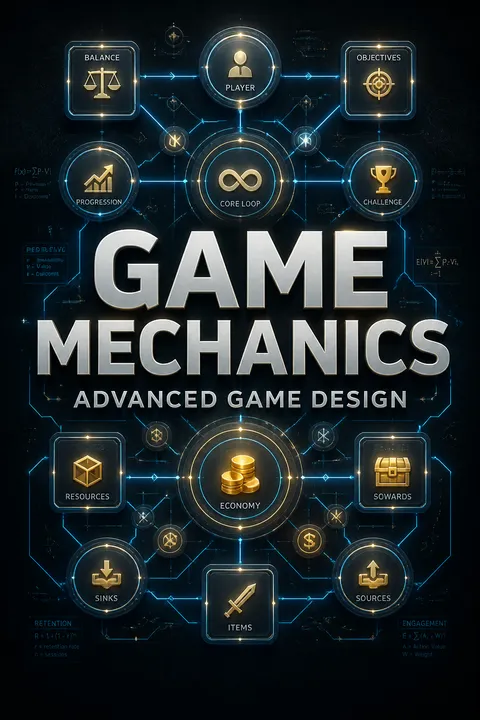


Key Takeaways
Build the toy before its world, because mechanics create the play
Rules generate experience. Game mechanics are the precise rules, processes, and data that determine what players can do and how the game responds. They can govern physics, resources, movement through levels, tactical positioning, or social interaction. The same mechanics can work in a board game, a video game, or a physical game, which makes early experiments possible without committing to expensive software.
Test the central promise. Start a working prototype once the intended play is clear. During early concept work, rough experiments can test assumptions, but the main mechanics belong in the elaboration stage, where short build-test cycles expose what is actually fun. The authors recommend making the interactive toy first, before investing heavily in art or content. Tuning can consume one-third to one-half of development time, so late feature additions risk undoing a system that already works.
The useful shift is from describing a game by its fiction to asking what repeated decisions its rules produce. This resembles product prototyping: a paper sketch can test whether a service solves the right problem before a polished interface exists. The caveat is that a toy is not yet a game experience. Context, sound, accessibility, and social setting can change how the same interaction feels, so the prototype should isolate mechanics first, then be tested again in a representative experience.
Use emergence for possibility, progression for carefully authored experience
Two routes to play. Emergence describes games where relatively simple rules combine to create varied situations. Chess has a small rule set, but piece interactions produce a vast range of positions and strategies. Progression describes games built from challenges designed and ordered in advance, often to guide the player through a level or story. A text adventure and a Zelda dungeon use this structure to control what the player encounters and when.
Most games mix both. Civilization generates strategic phases such as expansion, development, and conflict through its interacting systems, while its historical eras are separately triggered by the design. StarCraft II keeps familiar strategy mechanics but varies missions with hazards and objectives, making the experience feel less repetitive. Emergence gives players room to improvise; progression gives designers control over sequence, difficulty, and narrative.
This distinction is valuable because it treats openness and authorial control as design choices rather than rival ideologies. It echoes the difference between generative systems and curated sequences in fields such as interactive fiction. Each has a cost: emergent systems can produce incoherent or frustrating outcomes, while tightly authored sequences can make player agency feel cosmetic. A hybrid succeeds when its scripted structure creates meaningful situations without prescribing every solution.
Connect simple rules to produce complexity players cannot predict
Interaction creates depth. A complex system contains many parts whose local behavior may be easy to understand, while their combined effects are difficult to foresee. The book points to cellular automata, where simple rules applied to black and white cells create intricate patterns, and to Pac-Man, where four ghosts follow distinct, limited targeting rules. Together, the ghosts can seem to coordinate even though they do not share a plan.
Tune between stillness and chaos. Emergent play needs active parts, connections among them, and feedback across different scales. Negative feedback pushes a system toward balance, as food limits city growth in Civilization. Positive feedback amplifies change, as gaining an advantage in chess can make further captures easier. Too little activity creates predictable play; too much can make outcomes feel arbitrary. Prototype the system to discover where its interesting behavior lies.
The model has a strong connection to complex-systems thinking: global patterns can arise without any component representing the whole. That is why designers should study interactions, not just inspect individual rules. Yet emergence is not automatically good design. A system can surprise players in ways that feel unfair, and apparent intelligence can come from juxtaposed simple behaviors, as in the ghosts. The practical test is whether players can learn enough about the pattern to make informed choices without being able to predict every outcome.
Map resources and flows before tuning the game's economy
Economy means more than money. An internal economy is any system that produces, consumes, or exchanges measurable resources. Health, ammunition, time, units, experience, and access can all count. A resource is a general quantity; an entity is where a particular amount is stored, such as the cash in a Monopoly player's account.
Trace what changes. Four functions describe common resource flows: sources create resources, drains remove them, converters change one kind into another, and traders exchange resources between entities. Warcraft turns harvestable trees into abstract lumber; firing a weapon drains ammunition. Graphing resources over time reveals the shape of play. In chess, pieces tend to disappear while strategic advantage rises and falls. That high-level economic view can illuminate a game even when it is not explicitly about commerce.
Resource accounting makes invisible design assumptions inspectable. It is similar to stock-and-flow modeling in ecology or operations research: the important question is not only how much exists, but where it comes from, where it goes, and what changes its rate. The abstraction is powerful, but it can flatten experience. Chess pieces can be counted, while the threat of a discovered attack is harder to reduce to a quantity. A model should clarify the game, not claim to contain everything players value.
Draw the hidden economy so feedback becomes visible and testable
Model the flow. Machinations is a visual language for representing and simulating game economies. Pools store resources, arrows show resource movement, and dotted connections show how a change in one part affects another. A diagram can be as broad or as detailed as a design question requires. Its purpose is not to recreate every line of code, but to expose the structure that drives behavior.
Pac-Man shows the method. The book models dots, power pills, fruit, ghosts, lives, points, and an invented threat measure. Eating dots turns them into points; ghosts build threat; a power pill temporarily suppresses that threat and enables ghost-eating. The model simplifies the maze and ghost behavior, yet still reveals the player's competing priorities. Designers can run the diagram, change assumptions, and observe the consequences before implementation.
A diagram externalizes a designer's mental model, making disagreement more concrete: a team can debate a flow or threshold rather than argue from intuition alone. This resembles causal modeling, where a simplified representation helps test what depends on what. The tool's limits matter. A Pac-Man economy diagram cannot reproduce spatial navigation or timing skill, and an inaccurate model can give false confidence. Its best use is as a focused instrument for a specific question, followed by play with people.
Pair growth with friction before a winning lead becomes inevitable
Growth compounds. A dynamic engine lets players invest resources to increase future production. In StarCraft, workers gather minerals that can fund more workers, creating a positive feedback loop. Such loops reward planning, but can also amplify an early lead or make one strategy dominant. Friction counters production or reduces its effectiveness. It may be fixed, tied to the player's progress, or caused by opponents.
Patterns are reusable diagnoses. The authors collect recurring structures such as engines, friction, escalation, trade, and worker placement. Monopoly's property income behaves like a growing engine. In the book's simplified model, adding a property tax reduces the advantage of the player with more property and cuts down stalemates. In SimWar, scripted turtling beat rushing in about 92 percent of simulations; changing production and combat values brought the two strategies to an even split. Patterns help locate a problem, but tests determine whether a proposed fix works.
Thinking in feedback profiles is more precise than labeling a mechanic simply positive or negative. Speed, duration, investment, and return all affect whether an advantage stabilizes or explodes. This has a clear relation to control theory, where feedback can correct deviation or amplify it depending on its direction and timing. However, a mathematically balanced model is not necessarily a socially satisfying game. A tax can equalize outcomes while removing an earned sense of mastery, so the desired emotional arc must be part of the balance target.
Use randomness to prompt adaptation, not to erase player agency
Uncertainty has different sources. Dice are only one way to make outcomes unpredictable. Player choices, skill differences, and complex rule interactions also create uncertainty. Games that rely too heavily on chance can make players feel their decisions do not matter. Frequent, lower-impact randomness is often easier to integrate than rare, high-impact swings because repeated outcomes tend to soften luck's influence.
Use chance deliberately. Random maps in Civilization force players to adapt to new terrain, while shuffled cards in Magic: The Gathering test both preparation and improvisation. Randomness can also expose a dominant strategy. In the book's energy-harvesting example, a deterministic version consistently favored one investment plan; changing production to probabilistic yields gave the alternative plan a 15 percent chance to win. Simulation can compare strategies, but it cannot replace human playtests or capture every social and spatial factor.
Randomness is most defensible when it creates a problem for players to interpret, rather than deciding the result on their behalf. This parallels robust planning: a strategy is valuable when it survives several plausible conditions, not only the ideal one. The authors' advice to remove chance when diagnosing dominant strategies is particularly useful because noise can hide structural imbalance. Still, low-impact randomness is not universally superior. A deliberate, dramatic swing may be exactly what a short, social game needs.
Teach through staged challenges, and keep mission separate from space
Design two structures. A mission is the sequence of tasks a player must complete; game space is the physical layout those tasks occupy. Keeping them conceptually separate helps designers avoid confusing a maze with a compelling challenge. Locks and keys connect the two: a newly earned ability may open an area, while a hub-and-spoke dungeon lets players choose among several tasks and return to a central room.
Teach by doing. Daniel Cook's skill atom describes a loop of player action, game response, feedback, and revised understanding. The book also adapts martial-arts training into a learning sequence: practice a basic move, repeat it, combine it with other moves, then use it under pressure. In Zelda's Forest Temple, players first learn how a new tool works, practice its uses, and then apply it against the boss. Each stage prepares for the next.
This approach treats tutorials as part of level design rather than as an instruction manual pasted onto play. It aligns with scaffolded learning: a learner first encounters a manageable task, then reuses the skill in more demanding contexts. The separation of mission and space is equally practical, since the same room can support different tasks and a linear task sequence need not require a straight corridor. Designers should also watch for hidden assumptions: a player who misses one essential skill can be locked out of the entire learning path.
Treat progress as a resource when a journey is too rigid
Progress need not mean distance. Games can measure it through completed tasks, closeness to a numerical goal, character growth, or the player's own skill. A progression game often maps progress onto travel through a designed world. Emergent games can instead treat progress as a changing state or resource, allowing advancement to interact with difficulty and other mechanics.
Indirect progress creates choices. In The Settlers of Catan, players earn points through settlements, cities, roads, and cards, all of which depend on resource flows and available building sites. The visible score is only part of the story: a player who seems close to victory may lack the resources or locations needed to finish. Emergent systems can also move through gameplay phases. A real-time strategy game may shift from building to exploration to attack, while chess moves from opening to middle game to endgame without changing its rules.
Progress as a state variable offers designers more ways to connect advancement with difficulty, resources, and player choice. It also makes progress less legible, which can create strategic uncertainty but may frustrate players who cannot tell whether effort is paying off. Narrative games face a different constraint: a story depends on coherence, novelty, and characters that seem psychologically credible. A dynamic economy can produce surprising events, but surprise alone does not create drama. The right representation of progress depends on whether the game promises optimization, exploration, or a story.
Let the rules express the message players learn by trying to win
Mechanics make arguments. In a serious game, players infer meaning from the actions that are rewarded, punished, or made necessary. SimCity can be read as favoring balance because both excessive taxation and neglect of public services harm the city. PeaceMaker makes constructive engagement necessary for achieving peace, while also requiring leaders to maintain support at home. These are messages delivered through the conditions for success, not merely through dialogue.
Simplicity can sharpen meaning. The game September 12 looks like a cartoon shooter, yet its mechanics show that attacks causing civilian deaths create more enemies. Its contrast between expected play and actual consequences invites reconsideration of brute force. But a game's model is always selective. What it leaves out can distort its subject, as the book's discussion of the recruiting game America's Army illustrates. Serious designers must decide which simplifications preserve the lesson and which mislead.
Games communicate through agency: players do not merely receive a claim, they test a system by acting within it. That can make a lesson memorable, but it also makes the designer accountable for the strategies the rules enable, not just the message intended in a script. A persuasive game should make its causal assumptions visible enough to examine. Otherwise, a simplified system can masquerade as a neutral account of reality, when its rewards and omissions encode a particular point of view.
Analysis
The book's central contribution is a practical bridge between intuitive design and formal systems thinking. Instead of treating mechanics as a list of rules, it treats them as interacting flows of resources whose structure produces the experience. That move makes design discussable: teams can trace a feedback loop, name a dominant strategy, model a progression gate, or test a balance change before production hardens it into code. Machinations is less important as a particular software tool than as a discipline of making assumptions explicit.
The argument is strongest when it connects design patterns to actual behavior. Monopoly's compounding property advantage, StarCraft's worker economy, and SimWar's simulated strategy results show how small rule changes can alter a game's trajectory. The distinction between emergence and progression also avoids a false choice. Open systems generate variety; authored sequences shape learning and narrative. Strong designs often combine them rather than pledge allegiance to either.
The method also has boundaries. A resource diagram can expose economic structure but struggles to represent embodiment, interface legibility, social negotiation, aesthetic tone, or the emotional meaning of failure. A thousand automated runs can reveal a dominant strategy in a simplified model, but cannot tell whether players understand the system, enjoy its pace, or exploit an interaction the model omitted. Formalization is therefore diagnostic, not a substitute for design judgment or human testing.
The book's most durable lesson is methodological: abstract enough to see the pattern, but not so far that the model loses contact with play. Designers should identify the central experience, model the mechanisms most responsible for it, test competing strategies, and return to players to check whether the designed system produces the intended experience. This cycle makes creativity more accountable without pretending it can be reduced to equations.
Review Summary
Game Mechanics receives strong praise (4.12/5) for its systematic approach to game design, particularly the Machinations framework for analyzing feedback loops and economic systems. Reviewers appreciate its practical depth and formal language for design discussions, serving well as a reference guide. The book focuses intensively on mechanics over other design aspects. Common criticisms include excessive focus on the Machinations tool, limited coverage of real-time mechanics, and the Flash-based tool becoming obsolete. Most readers find it essential for understanding emergent systems and recommend it for practicing designers seeking practical knowledge.
People Also Read






Glossary
Game mechanics
Rules that generate playThe specified rules, processes, and data that determine how a game changes state, what actions are possible, and how those actions affect the game world. Mechanics can govern physical movement, resource exchange, progression, tactical positioning, or social interaction. They may be implemented in software, physical objects, or a combination of media.
Emergence
Complex behavior from interactionsGameplay that arises from interactions among relatively simple rules and elements rather than from a complete sequence of predesigned events. The resulting situations can be difficult to predict from any one rule alone. In games, emergence supports varied strategies and play trajectories, though it still requires testing to determine whether its outcomes are interesting and fair.
Games of progression
Predesigned ordered challengesGames organized around challenges prepared by the designer and presented in a fixed or mostly fixed sequence. Progression lets designers control which tasks players encounter, how skills are introduced, and how a story unfolds. Unlike leveling up in a character system, this term describes the structure of authored challenges, not character advancement.
Internal economy
A system of resource flowsThe resources in a game and the rules that produce, consume, convert, or exchange them. Resources include obvious items such as money and ammunition, as well as abstract quantities such as health, experience, time, or access. Studying an internal economy helps explain strategic choices and the changing fortunes of players.
Machinations
Visual economy modeling languageA visual language and simulation framework for representing a game's internal economy. Diagrams use pools to store resources, connections to show flows, and state relationships to modify or trigger mechanics. Designers can adjust a model and simulate its behavior. Machinations is intended to make structures such as feedback loops visible, not to reproduce every aspect of a finished game.
Probability space
Reachable game statesThe set of game states that can be reached from a given state through possible play. Its shape reflects the breadth and depth of player options: a broad space offers many immediate choices, while a deep one permits many sequences of choices over time. A large probability space can support varied play, but size alone does not guarantee meaningful choices.
Dynamic engine
Investment increases future productionA game structure in which players spend resources to improve the rate at which they produce resources in the future. This creates positive feedback and a choice between investing for later gains and spending on immediate needs. Because growth can compound and create dominant strategies, dynamic engines often require friction or other balancing mechanisms.
Dynamic friction
Progress-scaled resource drainA mechanism that consumes resources or reduces production at a rate affected by another part of the game state, such as a player's growth or accumulated power. It can counterbalance a growing engine and adapt automatically as the player advances. Its timing and strength determine whether it stabilizes the system or merely delays an imbalance.
Skill atom
A loop for learning an actionA small unit of game learning consisting of a player's action, the game's simulation response, feedback that reveals the result, and the player's update to their understanding. Skill atoms can be linked into chains or trees. Level design can introduce a basic skill safely, then require practice and increasingly complex application.
Intertextual irony
Meaning through contrastAn effect created when a game's style or setting evokes familiar genres or cultural references while another layer of the game contradicts or complicates those expectations. The contrast can prompt players to reconsider what they are doing or what the game represents. It depends on players recognizing the reference and noticing how the mechanics or story undercut it.
Download PDF
Download EPUB
.epub digital book format is ideal for reading ebooks on phones, tablets, and e-readers.








