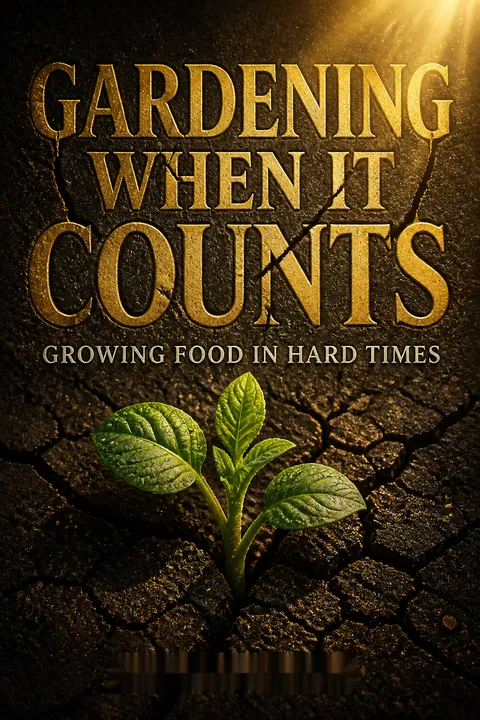


Key Takeaways
Prepare for scarcity by growing food with less water, fertilizer, and machinery
Gardening for hard times. Steve Solomon argues that a dependable food garden should not rely on intensive beds that demand frequent irrigation, heavy compost use, and purchased inputs. His own practice changed after variety trials showed that well-spaced plants often grew larger, tasted better, and needed less water than crowded ones. The book responds to a future he feared in 2005: costly oil, water, and fertilizer could make standard gardening harder to sustain. The aim is practical resilience, not a picturesque backyard.
A different garden model. Solomon favors simple tools, adaptable crops, careful spacing, and soil fertility built without excess. His advice is rooted in decades of growing food and testing varieties, but the central promise is broader: a garden should keep producing even when money, water, or commercial supplies are limited.
What's striking is that the book treats gardening as infrastructure, not decoration. Its strongest insight is systems thinking: water access, seed quality, soil, storage, diet, and available land all affect one another. That makes the advice useful beyond any single technique. The book's 2005 predictions should be read as the author's scenario, not as a timetable that proved correct. Its more durable lesson is to reduce dependence on inputs whose cost or availability a household cannot control.
Treat garden space as part of your food plan, not a hobby corner
Land changes the calculation. Solomon warns that a few small beds may be enjoyable but cannot reliably replace a meaningful share of a family's food. He estimates that his 2,000 square feet of growing beds supplied about half the calories for two adults, with extra land needed for rotation and paths. In wartime Britain, an allotment plot of about 2,700 square feet helped families produce vegetables and potatoes when supplies were scarce. He also cites Cuba's urban gardens, which he says supplied 60 percent of the country's vegetables and about half of Havana's produce.
Let diet follow harvest. Solomon calls his flexible, mostly vegetable-based eating “vegetableatarianism.” His own household shifted toward vegetables as they became abundant, rather than requiring a strict vegetarian identity. Potatoes, beans, and stored produce can make the harvest more substantial than salads and summer fruit alone.
The useful connection here is between land use and household economics: a garden's value depends not only on yield per square foot, but on how much of the diet it can replace. That reframes the familiar question, “What can I grow in this bed?” as “What foods make this plot genuinely useful?” The examples also show that access to land can be collective as well as private. The figures Solomon cites are historical examples, not universal production guarantees; local climate, soil, skill, and diet all change the result.
Give roots room, and trade a little peak yield for resilience
Space is drought insurance. Solomon argues that dense plantings can create impressive yields per square foot while leaving crops dependent on frequent watering. Wider spacing gives roots more soil to explore, reduces competition, and makes hoeing easier. In his comparison, a moderately spaced garden can produce about 90 percent of an intensively planted garden's harvest while requiring less than half the work. With ample irrigation, beds still make sense. Without reliable water, he recommends wider rows, hills for sprawling crops, and more distance between plants.
Match spacing to rainfall. He advises gardeners to expect dry spells rather than design only for a good year. If drought appears, thinning some plants can help the remaining crops access more water. He also describes capillary flow, the upward movement of water through connected soil pores, as a way deep moisture can help plants when the surface dries.
This is a clear example of optimizing for reliability rather than maximum output under ideal conditions. In risk management, spare capacity is valuable because it absorbs shocks; extra soil volume around roots plays a similar role in a garden. The tradeoff is context-dependent, though. Where land is scarce and irrigation is dependable, intensive beds may be rational. Solomon's more general contribution is to make the constraint explicit: plant density should reflect the water budget, not simply a desire to pack more crops into a small area.
Feed the soil's biology, but correct mineral gaps instead of dumping manure
More manure is not always better. Solomon separates soil structure from plant nutrition. Compost and manure add organic matter that supports soil life and improves tilth, the crumbly structure that lets air and water move. But their mineral balance depends on what grew nearby and what animals ate. Large additions can therefore amplify local nutrient imbalances. A plant grows only as well as its most limiting essential nutrient allows, an idea illustrated by his barrel analogy: raising one short stave simply exposes the next-shortest one.
Use a complete amendment. His Complete Organic Fertilizer, or COF, combines seedmeal with calcium and magnesium sources, plus phosphorus and trace minerals when available. The blend is meant to supplement modest compost additions, not replace them. Solomon says it favors nutritional quality over maximum bulk yield, and advises measured, cautious applications rather than indiscriminate fertilizing.
The distinction between building soil structure and supplying nutrients is especially useful because gardeners often treat compost as an all-purpose cure. The limiting-nutrient model is also a practical diagnostic: adding more of an abundant nutrient cannot fix a different deficiency. At the same time, the book's confidence in a broadly suitable homemade blend exceeds what can be assumed for every soil. Local testing and careful observation can help prevent both deficiencies and excesses, particularly where mineral content or acidity varies substantially.
A sharp shovel and hoe can outperform expensive garden machinery
Sharp tools change the work. Solomon says the tools most gardeners need are a combination shovel, a hoe, a bow rake, and a file. New tools are often blunt, making digging and weeding unnecessarily exhausting. A properly sharpened hoe slices small weeds just below the surface, while regular weekly hoeing prevents them from becoming laborious, established weeds. For a new garden, he prefers digging soil about a foot deep by hand. A rototiller may quickly loosen the surface, but it often leaves compacted soil beneath its working depth.
Make a fine seedbed. Slightly raised beds, without retaining walls, let the gardener rake clods into the paths, leaving a finer surface for small seeds. Solomon says only the top inch needs to be made especially crumbly for many seeds to emerge. A thin layer of fine compost raked into that surface can help prevent crusting.
The argument is not simply anti-machine. It is a reminder that tool maintenance changes labor requirements, while repeated shallow cultivation may solve problems a powerful machine creates. The seedbed advice is similarly efficient: improve the small zone where germination happens instead of hauling enough compost to transform an entire plot. Physical capacity and accessibility matter, however. For gardeners who cannot dig or hoe safely, raised beds, mulch, or mechanical help may be the sensible choice, even if Solomon prefers other methods.
Buy proven seed, sow directly, and let thinning secure the stand
Seed quality is hidden risk. Solomon's years in the seed business convinced him that germination alone does not guarantee a good crop. Seeds must also be vigorous, true to their variety, and suited to the region. He describes variety trials as a way to test maturity, flavor, uniformity, and performance rather than trust a catalog description. He also distrusts many mass-market transplants: some are pot-bound, poorly hardened, or varieties selected for commercial harvest rather than home use.
Direct seeding often wins. Carrots, beets, lettuce, corn, and cucurbits are among the crops he generally prefers to sow where they will grow, avoiding transplant shock and preserving taproots. He recommends sowing extra seed, then thinning in stages so pests or weak emergence do not leave gaps. Chitting means starting seeds germinating under controlled, moist conditions before planting them, especially useful for beans, peas, and heat-loving cucurbits.
This takeaway makes supply-chain quality visible at the point where most gardeners are least able to judge it. A seed packet can look identical to another while producing markedly different crops, so trials and reliable germination standards act as quality assurance. Direct sowing also avoids an often invisible cost, disrupted roots. The strongest caveat is that transplanting can be valuable where the frost-free season is short, especially for tomatoes, peppers, and eggplants. The best method depends on crop and climate, not a blanket rule.
Make compost deliberately, because a heap is not automatically fertilizer
Compost quality varies. Solomon explains that carbon-to-nitrogen ratio, or C:N, helps predict how organic material decomposes. Woody matter and straw contain much carbon and can temporarily tie up nutrients; fresh, nitrogen-rich material breaks down faster. He distinguishes low-grade compost, useful mainly for soil structure, from richer material capable of feeding vegetables. His once-a-year method layers dried garden waste with soil, water, and a nitrogen-rich material such as seedmeal or manure, then turns and moistens the heap as it decomposes.
Avoid the closed-system fantasy. A garden's own residues rarely provide enough organic matter to maintain its soil indefinitely, especially when food leaves the plot. Solomon estimates that his garden needed imported material in addition to its own compost. He also warns that cover crops can cause delays if they become woody, are difficult to dig in, or decompose too slowly before planting.
The book's insistence on compost quality counters the appealing idea that any organic matter is immediately beneficial. It encourages a useful process question: what will this material do before it becomes stable humus? That is more informative than simply labeling an amendment organic. The resource-accounting point is equally important: harvesting exports nutrients, so recycling kitchen and garden waste does not automatically close the loop. Solomon's specific temperature and nutrient targets are practitioner guidance; actual outcomes vary with material, moisture, aeration, and climate.
Grow staples and store them, not just summer vegetables
Calories matter in a food garden. Solomon gives potatoes unusual importance because they can produce substantial food on a relatively small area. He reports yields above 300 bushels per acre in general production and describes harvesting about 25 pounds of potatoes per pound of disease-free seed in his own garden. He recommends growing on fresh ground where possible, using certified disease-free seed, and hilling soil around the vines as they grow. Wider spacing can help crops tolerate dry conditions.
Plan beyond harvest day. In cold-winter regions, root cellaring can preserve fresh vegetables for months without refrigeration. Potatoes need cool, stable storage, while carrots and beets keep well in moist sand. Solomon also recommends growing crops suited to storage, such as winter squash and rutabagas, and considers sweet potatoes an excellent staple where warm seasons and light soils allow them to thrive.
A garden designed around calories and storage behaves differently from one designed around novelty or peak-season abundance. Staple crops can stabilize a household's food supply, while root cellaring extends the harvest without requiring electricity. This is a strong resilience framework because it links crop choice to preservation capacity. It also has limits: potatoes alone do not provide a varied diet, and storage infrastructure, disease pressure, and climate affect their usefulness. The sound principle is diversification across fresh greens, calorie crops, and foods that keep.
Prevent pest crises with healthy plants, timing, and tolerable imperfection
Stress invites trouble. Solomon argues that weak, slow-growing plants are more vulnerable to insects and disease. Healthy soil and locally adapted varieties can help, but they do not make crops invulnerable: weather, pest outbreaks, and unsuitable growing conditions can still overwhelm them. Before spraying, he suggests checking whether poor growth comes from cold soil, inadequate fertility, crowding, or planting too early. A later sowing may grow faster and escape the worst of a pest's cycle.
Use proportionate controls. Handpicking, floating row covers, and Bacillus thuringiensis, or Bt, are among the remedies he discusses for particular pests. He argues that minor leaf damage need not justify a pesticide response, and recommends planting more than the minimum needed so a bad season does not erase the whole harvest. Crop diversity spreads risk across plants with different weather preferences.
This is a practical form of integrated pest management: diagnose first, prevent where possible, and use targeted controls when damage warrants them. The emphasis on timing is especially strong because plant development and insect life cycles both respond to seasonal conditions. The book's claim that healthy plants resist pests should not be treated as a universal law; outbreaks can affect vigorous crops, too. Its more defensible version is that good growing conditions improve a plant's ability to recover, while diversified planting reduces the consequences of failure.
Water by soil capacity, not by habit or sprinkler convenience
Measure before watering. Frequent, shallow watering can leave the surface wet while deeper soil dries out, limiting root growth. Solomon recommends checking moisture several inches below the surface and learning how quickly a particular soil absorbs water. A simple test uses straight-sided cans placed around a sprinkler; measuring their collected water reveals both application rate and uneven coverage. Watering too heavily can move soluble nutrients below the root zone, a process called leaching.
Put water where roots need it. Where irrigation is available, he recommends replacing moisture lost without repeatedly saturating the surface. His fertigation bucket delivers water and dissolved nutrients slowly near a plant's roots. In an Oregon experiment, he reports that squash vines given 20 gallons of fertigation over four applications produced about 50 pounds of squash, compared with 20 pounds from unfertigated plants. In dry gardens, wider spacing can reduce the need for irrigation.
The central insight is measurement: a sprinkler's appearance or duration says little about how much water reaches the soil uniformly. This turns irrigation from habit into a feedback process involving soil texture, crop stage, and recent weather. Solomon's experiment is a useful illustration, but a single crop and site cannot establish a universal water-to-yield ratio. The larger lesson holds: small, well-placed additions can outperform broad, poorly timed watering, especially when water and nutrients are both scarce.
Analysis
Gardening When It Counts is a practical manual organized around a distinctive reversal: the fashionable garden is not necessarily the resilient garden. Solomon challenges the assumption that tightly packed, deeply enriched beds are always more productive. He argues that a useful garden should be judged by labor, water, nutrition, reliability, and the share of household food it can supply, not by yield per square foot alone. His own evolution from intensive methods to wider spacing gives that argument a narrative backbone. Variety trials, seed-business experience, and hard years on a homestead turn abstract advice into field-tested skepticism about glossy claims. The book's most transferable framework is constraint matching. Plant density should reflect water; crop choice should reflect climate and soil; fertility should distinguish organic matter from mineral nutrition; and preservation should shape what gets planted. These connections make it more than a how-to guide. They describe a small-scale food system in which seeds, labor, soil, water, storage, and diet are linked. The book is also unusually candid about failure: compost can be poor, pests can overwhelm plants, and a garden can require more land than a hobby plot provides.
Its limitations are inseparable from its strength. Solomon writes with confidence from specific regions and decades of experience, but advice about soil chemistry, fertilizer balance, nutrition, and pest resistance can sound more universal than the evidence presented warrants. Some claims are best treated as hypotheses to test locally, not settled rules. His impatience with intensive gardening and routine soil testing also risks underweighting situations where compact land, disability, or local soil conditions demand different tools and methods.
The best way to use the book is as a challenge to observe and compare. Test seed lots, record watering, inspect roots, trial varieties, and adjust spacing to local conditions. Its enduring message is not that one gardening system wins everywhere. It is that self-reliance grows from understanding the actual costs and limits of the garden in front of you.
Review Summary
Gardening When It Counts receives mixed reviews, with an average rating of 4.04/5. Many praise its detailed, scientific approach and practical advice on sustainable gardening. Readers appreciate Solomon's expertise and unconventional methods, particularly his focus on wide plant spacing and organic fertilizers. However, some find his writing style abrasive and his techniques unsuitable for small urban gardens. The book is lauded for its in-depth information on soil management, tool maintenance, and seed selection, but criticized for dismissing other gardening methods.
People Also Read






Glossary
vegetableatarianism
Mostly eating homegrown vegetablesSolomon's informal word for a flexible diet in which vegetables make up most of what a person eats most of the time. It does not require strict vegetarianism or veganism. The term reflects the author's aim to make homegrown food a large share of his diet while still buying or eating some animal products.
Complete Organic Fertilizer
Balanced organic nutrient blendSolomon's abbreviation is COF. It is a dry fertilizer blend made mainly from seedmeal and calcium and magnesium sources, with phosphorus and trace-mineral materials such as rock phosphate, bone meal, guano, kelpmeal, or basalt dust. The book presents it as a concentrated nutrient supplement to modest compost additions, rather than as a substitute for organic matter.
capillarity flow
Water movement through soil poresThe upward movement of moisture through connected spaces between soil particles. Solomon argues that plants spaced far enough apart can draw on water held deeper in the soil as it moves toward their root zones. Recently dug soil has disrupted these connections, so he recommends allowing it to settle before sowing some small seeds.
fertigation
Watering with dissolved nutrientsA method of delivering water and fertilizer together, usually slowly and close to a plant's roots. Solomon describes using a bucket with a small drain hole to let water soak downward rather than spread broadly across the soil surface. The method is especially suggested for large plants and during dry spells.
chitting
Starting seeds before plantingChitting is the controlled presprouting of seeds before they are placed in the garden. Seeds are kept warm and moist until a root begins to emerge, then planted before that root grows long and becomes easy to break. Solomon recommends it particularly for early sowings and for crops that need warmth to germinate.
C/N
Carbon-to-nitrogen ratioThe proportion of carbon-rich material to nitrogen-rich material in organic matter. Solomon uses the ratio to explain how compost materials decompose and affect soil. High-carbon materials such as woody waste break down slowly and may temporarily tie up nutrients; nitrogen-rich materials decompose more quickly. Mature soil humus, in his account, has a C/N near 12:1.
ley
Temporary grassland soil restA period of several years when garden ground is taken out of vegetable production and allowed to grow grass and clover. Solomon mows the vegetation and leaves the clippings in place. He uses leys to rebuild organic matter and interrupt the decline in crop performance and rise in disease or soil-pest problems associated with repeatedly cropping the same ground.
dust mulch
Loose surface soil that limits evaporationA shallow layer of loose, cultivated soil maintained on the surface of a garden. Solomon argues that it slows water loss from bare ground and helps rain soak in rather than run off. It requires repeated shallow hoeing, especially after rain, and is proposed mainly for dry gardens where weeds must also be controlled.
Download PDF
Download EPUB
.epub digital book format is ideal for reading ebooks on phones, tablets, and e-readers.








