

Key Takeaways
Build a consulting practice around the life you want, not industry folklore
Choose the terms yourself. After Alan Weiss was fired from a company he led, he started a solo consulting practice from home. He rejects the idea that success requires endless hours, constant travel, or a large staff. Consulting, in his definition, means applying expertise and experience to improve a client’s condition. It can offer independence and strong earnings, but only when the work fits the consultant’s abilities and ambitions.
Test your fit honestly. The work calls for confidence, active listening, persuasive communication, quick understanding of a client’s problem, and reliable follow-through. Resilience matters because rejection is routine. Time management, meanwhile, is a matter of priorities: business goals and family life belong on the same plan. Consulting full time and consulting on the side are different choices, with different risks and expectations.
The book’s strongest opening move is to frame self-employment as a design choice, not a test of toughness. That connects to person-environment fit: people tend to thrive when a role matches their motives, habits, and constraints. The advice to assess temperament is useful, though treating traits as fixed can be limiting. Listening, persuasion, and follow-through can be practiced. A better test than asking whether someone is born for consulting is whether they can build support, tolerate uncertainty, and improve the behaviors the work demands.
Buy yourself a year of runway before asking the market to support you
Fund the launch, not just the office. Weiss identifies inadequate personal capital as a major reason new consultants fail. The business may be inexpensive to establish, but rent, food, insurance, and family obligations continue while clients are being found. He recommends setting aside a full year of reasonable living expenses, using money actually available rather than hoped-for contracts.
Expect a slow build. The book suggests that initial work may take about six months to arrive and that a dependable pipeline may take roughly a year to form. For someone spending $7,000 a month, the proposed baseline is $84,000. Possible sources include savings, family investment, or a home-equity line, each with different costs and risks. The point is not to borrow recklessly. It is to avoid making desperate business decisions because bills are due.
A cash reserve changes the psychology of selling: it gives a consultant room to reject bad-fit work, learn from early attempts, and avoid treating every lead as a lifeline. This resembles the option value of savings, since liquidity preserves future choices. Still, a year of expenses is an ambitious threshold and can exclude capable people without substantial assets. A staged transition, bridge contract, or lower-cost lifestyle may provide some of the same protection, provided the consultant is honest about the time available for business development.
Keep overhead low until client work proves what you actually need
Build a professional base, not a monument. Because consultants usually travel to clients, Weiss argues that a costly external office often serves ego more than business. He worked from home and estimated that rent, utilities, equipment, and staff would have cost his firm about $30,000 a year. A dedicated, private room can provide the focus and confidentiality needed without that expense. Shared offices are another option when support or separation from home is important.
Buy time with expertise. Set up dependable communications, suitable equipment, and fast response habits. Hire a lawyer, accountant, designer, or bookkeeper when their skills save time or reduce risk. The book recommends formal legal and insurance arrangements, but those choices should be tailored with qualified advisers. A polished appearance matters; unnecessary fixed costs do not.
This is a practical application of lean operations: keep irreversible costs small while the business model is still being tested. A home office can preserve cash, but the essential asset is a protected workspace and professional responsiveness, not a particular address. There is an important qualification: incorporation, insurance, and tax arrangements differ by jurisdiction and business type. The book’s categorical legal advice should not substitute for current professional guidance. Its more durable lesson is to separate personal and business decisions carefully and buy specialist help where the downside of error is high.
Sell measurable business improvement, not a list of consulting activities
Translate expertise into outcomes. A client rarely needs a survey, workshop, or coaching session for its own sake. Those are activities, or inputs. The reason to hire a consultant is an improved result: better retention, faster customer response, higher sales, or a more effective management structure. Weiss urges consultants to listen closely, summarize the client’s problem in plain language, and connect abstract ideas to visible workplace changes.
Look beyond the stated request. A buyer might ask for sales training but actually need to shorten the time required to win business or address excessive customer losses. Exploring that difference can reveal more useful work and clarify the consultant’s contribution. The consultant should help the buyer define desired outcomes rather than prescribe a familiar package before understanding the situation.
Outcome language makes professional services easier to evaluate because it connects specialist work to decisions executives already make. It also disciplines the consultant: a workshop is not evidence of value merely because it happened. But measurable outcomes are not always attributable to one intervention. Sales may rise because of market changes, while collaboration may improve without a clean numerical indicator. Good agreements therefore combine plausible metrics with context, and distinguish contribution from sole causation. Clear outcomes should focus attention, not pretend that complex organizations behave like controlled experiments.
Create marketing gravity by publishing useful ideas and building real relationships
Make expertise visible. Weiss calls the cumulative pull of a consultant’s useful work and reputation marketing gravity. It can include a concise press kit, position papers, speaking, published articles, referrals, and pro bono work. These activities give potential clients evidence of the consultant’s thinking before a formal engagement. Networking is not simply collecting business cards. It means learning what matters to someone, offering relevant help, and following through promptly.
Use the web for credibility. The book treats a website primarily as a place where people who have heard of a consultant can check expertise and results, not as a substitute for relationships. It cautions against spending excessive time on social platforms without access to likely buyers. The practical aim is a steady stream of useful, consistent contact, rather than a burst of promotion followed by silence.
The emphasis on visible generosity has a strong connection to social capital: trust grows through repeated, useful exchanges, not through claims of expertise alone. Publishing also creates reusable evidence of how a consultant thinks. The book’s skepticism about online networks reflects its 2009 setting, however. Digital channels now can support discovery, referrals, and reputation as well as credibility checks. The underlying distinction still holds: activity is not reach, and reach is not buyer access. A platform is useful when it helps the right people recognize expertise or begin a substantive relationship.
Reach the person who controls the budget before investing in a proposal
Find the economic buyer. The economic buyer is the person who can authorize the expenditure, not merely someone who likes the idea or gathers information. Human resources staff, event planners, and committees may help, but often cannot approve the work. Weiss recommends asking who owns the budget, who is accountable for the result, and who can decide to begin. A gatekeeper can be a valuable guide, but should not be mistaken for the buyer.
Build a peer relationship. The book recounts an event planner who invited Weiss to submit materials for a bank meeting. He asked to speak with the executive who owned the meeting, won a short conversation, and secured consulting and speaking work. The point is to reach the person whose support matters, establish trust, and agree on the problem before offering a solution.
This buyer-centered approach resembles stakeholder mapping in negotiation: identify who has authority, who bears consequences, and who can block implementation. It prevents a common waste of effort, building a warm relationship with someone unable to buy. Yet gatekeepers are not simply obstacles. They often know internal processes, risks, and language that an outside consultant lacks. The best approach treats them as informed partners while remaining clear about decision rights. Direct access matters, but so does understanding the network through which a decision becomes workable.
Agree on results, proof, and value before drafting any proposal
Create conceptual agreement. This is the shared understanding between consultant and buyer about three things: the outcomes sought, how progress and success will be assessed, and what the improvement is worth to the organization. Establishing those points first prevents confusion about what the project is meant to accomplish and makes fees intelligible as an investment.
Use the proposal to record, not discover. A clear proposal can briefly describe the situation, objectives, measures, expected value, possible approaches, timing, responsibilities, payment terms, and acceptance. Options let the buyer select among levels of support rather than make a simple yes-or-no choice. Weiss favors concise, conversational proposals and prompt follow-up. The document should reflect real prior discussion, not try to create trust or sell a project to someone the consultant has never met.
This sequence is a form of decision architecture: it makes assumptions explicit before money and methods dominate the conversation. The value is not just a higher chance of acceptance. Shared measures can prevent later conflict over whether the work succeeded. Still, a short proposal is not always an adequate contract. High-risk, regulated, or multi-party work may need legal review and detailed protections. The useful principle is to keep the commercial proposal readable while matching the legal formality to the actual exposure, rather than assuming one document must do both jobs.
Price the improvement, not the hours it takes to deliver it
Tie fees to contribution. Time-based billing puts a ceiling on income and can reward delay, even when the client benefits from a quick resolution. Weiss instead recommends a project fee based on the value of the expected improvement. In his illustrative sales-training case, 60 employees each generate $300,000 in new business. A 5 percent increase would mean $900,000 in additional sales, making a $90,000 investment a 10-to-1 return if the increase is achieved.
Let the buyer choose value. A proposal can offer distinct options, each with a clear fee and corresponding scope. If the budget is too small, the consultant can reduce the work or value rather than discounting the same contribution automatically. This approach requires prior agreement about objectives and value, and confidence in explaining why the investment makes sense for the client.
Value-based fees align incentives better than hourly billing when speed and results matter, and they let expertise scale beyond the consultant’s available hours. The sales example is persuasive precisely because it shows the size of the possible return. It is still a projection, not proof that training caused a 5 percent lift. Consultants should avoid claiming control over outcomes shaped by competition, product quality, or management decisions. A defensible fee rests on a credible estimate of contribution, transparent uncertainty, and a scope the consultant can actually deliver.
Keep marketing active while delivering, or every project resets your pipeline
Avoid feast and famine. Consultants often stop marketing when a project begins, then discover they have no next assignment when it ends. Weiss argues that outreach must continue during delivery. He describes a mature practice as drawing much of its work from repeat clients while continuing to bring in new ones, and gives 75 percent repeat business as a useful target, not a guarantee.
Grow without copying a corporation. A solo consultant can use contractors for specialized or temporary tasks rather than building a permanent staff by default. Published materials, audio products, retainers, teaching, and international work can extend a practice beyond on-site delivery. These are options, not obligations. The test for hiring or expanding is whether it creates meaningful leverage or value, rather than simply making the firm look larger.
A pipeline is a portfolio of future possibilities, and maintaining it reduces dependence on the timing of any single client. Repeat work lowers the cost of finding business, but excessive reliance on a few clients creates concentration risk. The stated 75 percent mix is therefore best read as a practical aspiration, not a universal benchmark. Selective subcontracting and reusable products can increase capacity, but each adds coordination or distribution demands. Growth is valuable only when the additional complexity produces returns the consultant actually wants.
Treat consulting income as a route to freedom, not a new employer
Define success beyond revenue. Weiss describes a healthy practice as one that supports retirement saving, planned time off, professional learning, and personal relationships, rather than demanding constant attention. A consultant should keep developing expertise, choose projects more selectively as options grow, and contribute to the profession through mentoring, teaching, or association work.
Protect the life the business is meant to fund. The book warns that a successful practice can still become a trap if every new opportunity means more work and less control. Products, retainers, and international assignments may suit some consultants, while others may prefer a smaller, simpler practice. The point is not to maximize the firm indefinitely. It is to make the business serve chosen goals and preserve the ability to decide how much work to accept.
This is a useful corrective to the assumption that entrepreneurship should always scale. A business can be judged by autonomy, learning, and time as well as revenue. That resembles the distinction between income and wealth: money matters, but so does control over how time is spent. The challenge is that client demand, caregiving, health, and economic shocks can limit that control. Life balance is not a reward that arrives automatically after success. It needs explicit boundaries, financial preparation, and periodic choices about which work no longer fits.
Analysis
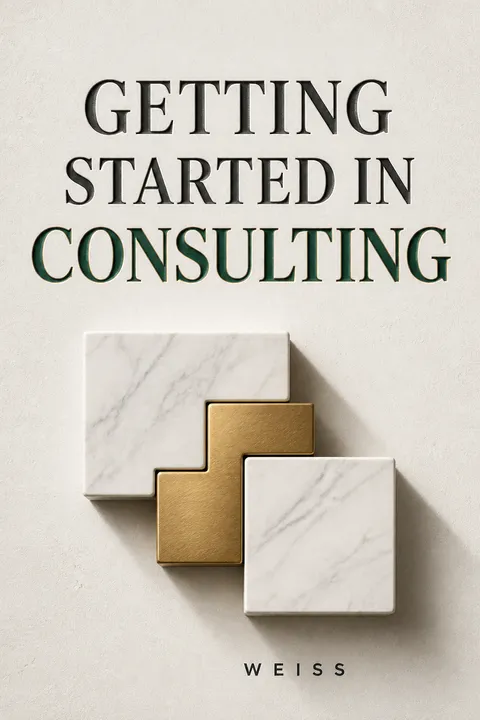
Getting Started in Consulting is a practical, thesis-driven guide arranged along the path from deciding to enter the profession to building a durable practice. Its central argument is that consulting is not mainly about possessing expertise. It is about converting expertise into client-valued outcomes, reaching people who can authorize investment, and organizing the business so it supports the consultant’s chosen life. The book links seemingly separate topics, such as office equipment, marketing, proposals, and fees, through that commercial logic.
The most valuable sequence is relational and economic: identify the buyer, understand the desired change, agree on evidence of progress and organizational value, then propose options and a fee. This sequence counters the common urge to lead with credentials or methods. The proposal becomes a record of shared understanding, while value-based pricing follows from the client’s expected improvement rather than the consultant’s hours. The result is a coherent operating model, not merely a collection of promotional tactics.
Its concrete strengths are the operational detail and the insistence that marketing continues during delivery. The reader gets a practical vocabulary for distinguishing decision makers from intermediaries, outcomes from activities, and a professional practice from a costly display of corporate trappings. The examples make the advice memorable, although many are practitioner anecdotes and hypothetical calculations rather than systematic evidence. Claims about typical success, repeat-business proportions, or the superiority of particular business structures should therefore be treated as guidance, not universal findings.
The book also reflects its publication era. Its judgments about websites and social media, and some of its legal, tax, and equipment recommendations, require updating. Its strongest ideas survive those changes: secure adequate runway, keep fixed costs proportionate, build trust with buyers, define outcomes, and protect the purpose of the business. A modern reader should preserve the commercial logic while checking legal and financial details locally and adapting marketing channels to current buyer behavior. The underlying test remains clear: does each investment of time, money, or attention improve the client’s condition or the consultant’s ability to keep doing valuable work?
Review Summary
Getting Started in Consulting receives mixed reviews, with an average rating of 3.91 out of 5. Many readers find it valuable for aspiring consultants, offering practical advice on starting and running a consulting business. The book covers topics like marketing, pricing, and client management. Some praise its comprehensive coverage and actionable insights, while others note outdated technology references. Readers appreciate the author's clear writing style and real-world examples. Despite some criticism, many consider it a must-read for those entering the consulting field or looking to enhance their practice.
People Also Read









Glossary
Marketing gravity
Cumulative pull of visibilityThe combined effect of activities that make potential clients aware of a consultant, recognize the consultant’s expertise, and feel inclined to initiate contact. Weiss includes publishing, speaking, referrals, networking, useful materials, and other forms of visibility. The aim is not merely to advertise, but to build enough credibility and relevance that suitable buyers are drawn toward a conversation.
economic buyer
Person who authorizes spendingThe person able to approve the expenditure for a consulting project without needing another party’s permission. The economic buyer may not have the most senior title and is not necessarily the first person a consultant meets. Identifying this person matters because friendly contacts, committees, and support departments may influence a decision without being able to fund or authorize the work.
conceptual agreement
Shared project-value understandingThe consultant and buyer’s shared understanding of the project’s intended outcomes, how progress and success will be measured, and the value of the improvement to the organization. It is established through conversation before the proposal is written. This agreement creates a basis for choosing methods, setting fees, and determining whether the project has achieved what the buyer needs.
scope seep
Unplanned consultant-added workA consultant’s own tendency to add tasks or promises beyond the agreed project, often from insecurity or a desire to justify the fee. Unlike scope creep, which commonly describes a client requesting additional work, scope seep originates with the consultant. It can quietly reduce profitability and blur responsibilities even when the client has not asked for more.
scope creep
Unplanned expansion of workThe gradual addition of tasks or responsibilities beyond the project’s original agreement. As requests accumulate, the consultant may continue working to avoid displeasing the client, even though the added work was not included in the fee. Clear objectives and written boundaries make it easier to address new requests through a revised scope and fee.
choice of yeses
Options for different investmentsA proposal structure that offers several distinct approaches, each intended to achieve the agreed objectives but providing different levels of value or support. Rather than leaving the buyer with a simple accept-or-reject decision, it lets the buyer choose how to engage the consultant. Each option should be independently understandable and priced in relation to its scope.
small yeses
Incremental agreement stepsThe series of limited commitments that move a prospective client toward a working relationship. These may include agreeing to exchange information, meet, clarify objectives, discuss measures, or review a proposal. The idea is to avoid demanding a major decision before trust and understanding exist, while ensuring each conversation has a clear next step.
Target 12
Focused prospecting methodA marketing technique in which a consultant selects a manageable group of roughly twelve organizations that appear to need the consultant’s services. The consultant researches likely buyers, sends each a tailored message containing relevant value, and follows up at a specific time. The method favors deliberate, personalized outreach over large, undifferentiated prospect lists.
press kit
Packaged credibility materialsA presentation folder containing concise materials that explain a consultant’s expertise and likely client results. It may include a biographical sketch, position papers, references, testimonials, articles, and information about the firm’s work. The kit can support introductions, media inquiries, speaking opportunities, and prospective-client conversations, and can be updated as the consultant gains experience.
value-based fees
Fees tied to client improvementA fee approach based on the consultant’s expected contribution to the client’s improved condition, rather than the number of hours or days worked. The consultant and buyer first clarify outcomes, measures, and organizational value, then agree on a project fee. The approach aims to align the consultant’s reward with useful results while giving the client a known investment.
FAQ
What's Getting Started in Consulting by Alan Weiss about?
- Consulting Career Guidance: The book is a comprehensive guide for those looking to enter the consulting profession, focusing on establishing a solid foundation.
- Practical Steps: It covers essential topics like setting goals, understanding financial needs, and creating a professional image.
- Expert Insights: Alan Weiss shares his extensive experience, making it valuable for both new and seasoned consultants.
Why should I read Getting Started in Consulting by Alan Weiss?
- Proven Success: It's a best-seller in the "Getting Started in..." series, indicating its popularity and effectiveness.
- Actionable Advice: Offers practical strategies and techniques that can be implemented immediately to enhance your consulting practice.
- Expert Author: Written by renowned consultant Alan Weiss, providing insights from someone who has successfully navigated the consulting landscape.
What are the key takeaways of Getting Started in Consulting by Alan Weiss?
- Establishing Goals: Emphasizes the importance of setting clear, achievable goals for your consulting career.
- Building Relationships: Stresses that consulting is about creating relationships, not just making sales, crucial for long-term success.
- Value Proposition: Understanding and articulating your unique value to clients helps you stand out in a competitive market.
What are the best quotes from Getting Started in Consulting by Alan Weiss and what do they mean?
- "You Will Be What You Decide to Be": Highlights the power of self-determination in shaping your consulting career.
- "If You Bill by the Hour, You Cheat Your Client and Yourself": Encourages value-based pricing over time-based billing, focusing on the value provided.
- "The Nature of Excellent Proposals": Stresses the importance of crafting proposals that clearly communicate value and align with client needs.
What is the significance of value-based fees in consulting according to Alan Weiss?
- Higher Earnings: Allows consultants to charge based on results, leading to higher earnings compared to hourly rates.
- Client Satisfaction: Clients view fees as an investment, fostering long-term relationships and repeat business.
- Flexibility in Services: Enables offering a range of services tailored to client needs, enhancing appeal and marketability.
How does Getting Started in Consulting by Alan Weiss suggest managing time effectively?
- Prioritization: Emphasizes prioritizing tasks rather than merely managing resources.
- Creating Lists: Recommends using lists to track personal and professional goals, maintaining focus.
- Integration of Life: Advises integrating personal and professional life for greater overall success.
What are the financial considerations mentioned in Getting Started in Consulting by Alan Weiss?
- Starting Capital: Discusses the importance of having financial reserves to support yourself initially.
- Expense Management: Advises reducing monthly expenses to create a sustainable financial base.
- Funding Sources: Explores various funding sources like home equity lines and personal savings for financial management.
How does Alan Weiss suggest building client relationships in Getting Started in Consulting?
- Trust and Candor: Emphasizes establishing trust and open communication with clients.
- Engagement in Diagnosis: Advises involving clients in the diagnostic process for better investment in outcomes.
- Follow-Up: Regular follow-up is crucial for maintaining relationships and ensuring satisfaction.
What is the role of marketing in consulting according to Getting Started in Consulting by Alan Weiss?
- Creating Need: Describes marketing as creating and accentuating the need for your services.
- Building Gravity: Introduces "marketing gravity," attracting clients rather than chasing them.
- Networking: Highlights networking as crucial, emphasizing building relationships and providing value.
What is the role of proposals in consulting according to Getting Started in Consulting by Alan Weiss?
- Summation of Agreement: Proposals should outline objectives, success measures, and value to the organization.
- Not a Negotiation Tool: Should reflect prior discussions and agreements, not be used for negotiation.
- Clarity and Brevity: Effective proposals are clear and concise, facilitating quicker client approvals.
How can I effectively market my consulting services according to Alan Weiss?
- Leverage Existing Networks: Reach out to former colleagues, friends, and contacts for referrals.
- Targeted Prospecting: Use the "Target 12" approach to identify and reach out to ideal client organizations.
- Consistent Follow-Up: Regular follow-up with prospects is crucial for converting leads into clients.
What are the common pitfalls to avoid when starting a consulting practice according to Alan Weiss?
- Overestimating Market Need: Conduct thorough market research to understand actual client needs.
- Neglecting Marketing: Consistent marketing is vital for attracting new clients and sustaining growth.
- Undercharging for Services: Establish fees that reflect the value provided to clients to avoid lower earnings.
About the Author
Other books by Alan Weiss


Download PDF
Download EPUB
.epub digital book format is ideal for reading ebooks on phones, tablets, and e-readers.








