

Key Takeaways
Treat uncertainty as the exam's raw material, not proof you're lost.
Recall is only the start. Law exams rarely reward a recital of every doctrine from a course. They test whether a student can use legal knowledge on unfamiliar facts. The book compares this to an engineering test: memorizing material properties does not build the requested device. In a contracts problem, naming the rules for conflicting purchase terms is only a beginning. The student must identify which terms matter, explain how the rules might apply, and show how each path affects the parties.
Maybe is productive. Uncertainty is not the same as having nothing to say. A difficult question often invites competing legal interpretations and factual characterizations. The task is to make those alternatives visible, reason through them, and reach a considered judgment when asked.
What's valuable here is the distinction between knowing information and performing with it. It resembles the difference between factual recall and transfer, the ability to use familiar concepts in an unfamiliar setting. That distinction matters well beyond law school, from clinical diagnosis to engineering. Yet exams measure only a slice of professional competence. A timed hypothetical rewards fast written analysis, while real practice may allow research, collaboration, and client interviews. The book's advice is strongest when treated as preparation for legal reasoning, not as proof that one exam fully captures ability.
Learn rules well enough to see where competing rules change outcomes.
A rule can meet its rival. A fork in the law is a choice between legal rules that would produce different results. One example concerns an offer seeking performance: traditional common law allowed revocation before the work was finished, while a modern Restatement approach protected the offeree once performance began. Another familiar conflict is contributory negligence, which can bar recovery, versus comparative negligence, which reduces it according to each party's share of fault.
Keep both rules in view. Do not assume the newer rule automatically controls, or discard a minority approach simply because it is less common. If a professor taught the contrast and gives facts that make the outcomes diverge, the contrast may be exactly what the exam is testing. Identify the competing rules, explain their consequences, and then use the facts and course emphasis to argue for a path.
This approach turns legal knowledge into a map of decision points rather than a warehouse of rules. It also resembles scenario planning: decision-makers compare plausible governing assumptions before committing resources. The method is especially useful when a rule is unsettled across jurisdictions or changing over time. Its limit is that not every alternative deserves equal space. A real lawyer must identify controlling law, and a student should distinguish a genuine fork from a rule the question clearly stipulates. Treating every doctrine as equally available can become evasion disguised as sophistication.
Interpret statutes and cases through language, purpose, and rationale.
Words do not settle meaning. A rule banning vehicles in a park may cover a tricycle under an ordinary-language reading, yet not under a purpose focused on traffic noise, pollution, or danger to pedestrians. Statutory purpose can be inferred from legislative history, other provisions, official comments, or the problem the law addressed. Purposes may conflict, so one should not stop at the first plausible explanation.
Precedent also has a range. A case can be read narrowly, as governing only similar facts, or broadly, through the principle that explains its result. A home-sale disclosure case might apply only to sellers, or its fairness rationale might support duties for another person who knowingly withholds important information. Good analysis explains why a difference between cases matters, rather than merely pointing it out.
Interpretation is a disciplined form of inference: the text, context, history, and consequences constrain what a rule can plausibly mean, even when they do not dictate one answer. This resembles how historians assess evidence from multiple sources rather than treating one document as self-explanatory. The method also reveals a democratic tension. Legislative history can illuminate purpose, but it may be selective or politically contested. Strong analysis therefore presents purpose as an argument supported by evidence, not as a hidden answer that automatically defeats the words enacted.
Trace how uncertain rules and facts compound into different outcomes.
Facts must fit categories. A fork in the facts arises when the same events can plausibly fit different legal categories. A custom bookbinding contract, for instance, might be a sale of goods under a statute or primarily a service under common law. That classification can determine which legal rule applies. Facts may point both ways, actors may see them differently, and a short or long time frame can change their apparent significance.
One fork can hide another. Twin forks occur when uncertainty about law and uncertainty about facts interact. The sale-or-service question can lead to a second choice between a strict delivery standard and the common-law idea of substantial performance. Linked forks form a chain, concurrent forks connect classification to a governing rule, and competing domains arise when the facts straddle different doctrines. Map the connections instead of stopping at the first issue.
The category problem is central to legal reasoning because rules need boundaries, while lived events rarely arrive neatly labeled. This connects to classification problems in fields such as medicine, where a diagnosis can determine the treatment, yet symptoms may overlap. The useful discipline is to show how a classification changes the result, not to debate labels for their own sake. There is also a risk: calling every factual distinction ambiguous can produce sprawling answers. The strongest analysis prioritizes the boundary that materially changes the parties' rights.
Test every legal choice against consequences, fairness, and enforceability.
Policy is practical reasoning. Ask who benefits, who bears costs, and what behavior a rule is likely to encourage. Then ask whether the rule can be administered: will people know their rights, will courts be able to apply the standard, and will the rule work in practice rather than only on paper? Fairness adds questions of reliance, consistency across groups and jurisdictions, and who can best absorb a loss. The decision-maker's role matters too, as does the argument that government should sometimes leave private choices alone.
Look for a hidden twist. A rule may help tenants immediately but reduce housing investment over time. A policy meant to deter harm may produce unintended effects. These tensions can turn a simple trade-off into a more complex problem. Use the dimensions relevant to the facts, answer the issue actually posed, and explain why one consideration outweighs its strongest rival.
This is a compact model of policy analysis because it connects ideals to mechanisms. A rule's fairness cannot be assessed only by its stated intention; incentives, enforcement, and distribution of costs shape its actual effects. That is a valuable bridge between legal reasoning and economics or public administration. The framework also resists ideological shortcuts: a pro-tenant position still has to consider supply and enforcement, while a property-rights argument must explain who absorbs injury. Still, predictions about social consequences are uncertain, so good answers should present them as reasoned forecasts, not established facts.
Build your outline from class tensions, then rehearse with old exams.
Study what remains unsettled. Attend class prepared and take notes on the competing interpretations, unresolved case conflicts, and policy questions that drive discussion. A conventional outline can list rules, but a useful personal outline also records where rules fail to settle a problem and what arguments support each side. Make up variations on class examples to practice recognizing those pressure points.
Learn the professor's habits. Review prior exams to see which topics, formats, and recurring problems the professor considers worth testing. Work through them with classmates, since explaining an answer exposes gaps that private rereading can hide. Commercial study aids may clarify a general rule, but they cannot replace notes from the actual course or the work of organizing the material yourself. The goal is not to predict the exact question; it is to recognize familiar patterns when the facts change.
The advice makes studying a form of retrieval and practice, not passive exposure. Explaining an issue to classmates forces the student to organize knowledge and confront alternative readings, while old exams provide feedback about the professor's testing style. This is consistent with broad learning principles: practice is more informative when it resembles the task being learned. But prior exams can also encourage overfitting, like preparing only for yesterday's test. The best use of them is pattern recognition, paired with fresh hypotheticals and close attention to the current course.
Plan the answer before writing, and spend time where outcomes turn.
Start with the parties. Map who may claim what against whom, then use the relevant legal elements as a checklist for overlooked disputes. Before writing, group the main issues, put them in a logical order, and give the reader a short roadmap. This prevents the first familiar doctrine from consuming the whole answer while more consequential problems go unnoticed.
Allocate effort by value. Focus on disputed points that can change the outcome, especially those emphasized in class. A fact that easily satisfies a threshold requirement may need only a sentence; a genuine ambiguity deserves analysis on both sides. If an issue seems too easy, retrace the reasoning and ask what the opposing party would challenge. Leave time to review for missed issues, but follow the exam's instructions and credit allocations rather than chasing every imaginable branch.
The roadmap is more than a writing convenience. It externalizes the student's plan, making it easier to detect omissions and helping the reader follow complex reasoning. This resembles decision analysis, where a problem is decomposed before alternatives are compared. The advice to prioritize material disputes is equally important because exhaustive issue spotting can become counterproductive under time limits. The challenge is calibration: a student may misjudge what matters most. A brief outline protects against that risk by preserving a structure that can be revised as the analysis develops.
Argue the strongest case on both sides before choosing a result.
Analysis needs reasons. For each issue, explain what creates the disagreement, what each interpretation would mean for the parties, and why a court might choose either route. A difference between an artist's preparatory sketches and the finished portrait, for example, matters because one side may view the sketches as performance already begun, while the other sees them as preparation only. Naming the dispute is not the same as analyzing it.
Then make a judgment. When the question asks who should prevail, take a position and explain why the best counterargument does not persuade. When it asks only for arguments, do not invent a demand for certainty. Policy considerations can help compare the routes, but they should be tied to the facts and legal rules. The aim is neither one-sided advocacy nor indecision, but a reasoned conclusion that has faced its strongest objection.
Considering opposing arguments is a form of error correction: a claim becomes more reliable when it survives contact with the best available counterclaim. The approach also resembles adversarial testing in science and engineering, where a design is examined for failure modes before adoption. Yet balance is not the same as giving every argument equal weight. Some positions are weaker under controlling law or the stated facts. The student earns credibility by showing that distinction clearly, rather than hiding behind a symmetrical list of pros and cons.
Answer the question asked; a doctrine dump is not analysis.
Use law on these facts. An information dump recites everything a student knows about a topic while avoiding the facts in the exam. Repeating the question's facts or paraphrasing long rules has the same weakness: it uses time without showing what those details mean. A useful answer applies only the relevant rule, identifies uncertainty, and connects the outcome to the named parties.
Treat formulas as tools. IRAC, shorthand for issue, rule, application, and conclusion, can help a beginner organize a simple issue, but it is not a complete method. The rule may itself be disputed, application may require competing factual readings, and the conclusion may open a further question. Read instructions carefully, respect the requested scope, avoid unrelated doctrines, and use common sense when a literal reading produces an implausible result.
This is a warning against substituting visible activity for reasoning. Long answers can look diligent while evading the task, much as a report can accumulate data without answering its decision question. The emphasis on the prompt also protects scarce attention: a student cannot discuss every imaginable issue under exam conditions. At the same time, common sense should be a check, not a license to disregard doctrine. The strongest answer shows why an apparently implausible result follows, or explains through legal reasoning why the rule should not reach those facts.
Analysis
The book's most durable contribution is a change in what students think an exam is asking. A novice expects a hidden answer key. The authors instead describe a designed encounter with uncertainty: legal rules overlap, language carries more than one plausible meaning, and facts resist neat classification. Their central metaphor of branching paths gives this uncertainty a workable structure. The student is not asked to eliminate ambiguity immediately, but to explain how each plausible route changes the parties' positions.
That model joins issue spotting to analysis and advocacy. A good answer identifies the point of disagreement, follows its consequences, offers reasons for each side, and makes a judgment when the prompt requires one. The chapters on policy deepen this process by asking about effects, enforcement, fairness, institutional authority, and the limits of government intervention. This prevents legal reasoning from collapsing into either mechanical rule application or free-floating moral preference.
The practical method is unusually coherent: learn the course, record its unresolved tensions, build a personal outline, study prior exams, organize before writing, and direct time toward disputes that can change outcomes. The critique of information dumping and formulaic IRAC follows naturally. Formulas can organize simple tasks, but they can conceal the very interpretive work an exam tests.
A tension remains. The book treats ambiguity as an opportunity because professors deliberately build it into many exams. That is an effective pedagogical strategy, but it can make skilled performance depend on decoding an examiner's habits. A student may overproduce arguments, mistake a settled rule for an open question, or spend time on elegant distinctions with little practical importance. The authors guard against this by urging attention to the question, the professor's course, and the consequences of each issue. The deeper lesson is disciplined uncertainty: remain open to alternatives, but keep asking which alternatives are legally plausible, factually supported, and consequential. That is not indecision. It is structured judgment under conditions where certainty would be false.
Review Summary
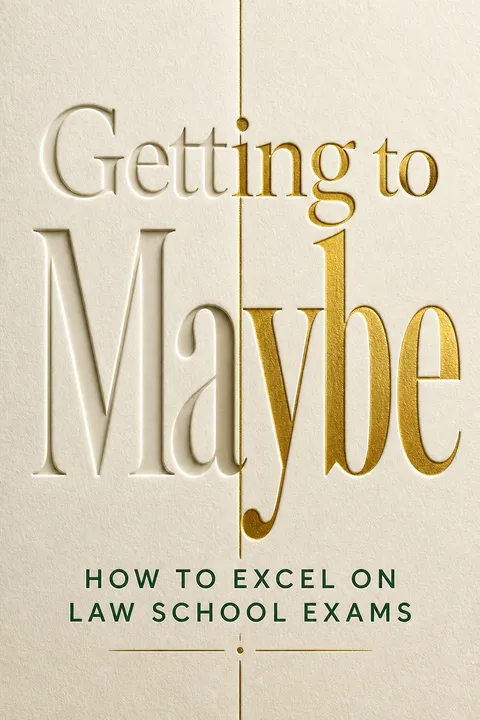
Getting to Maybe receives mixed reviews from law students and prospective law students. Many find it helpful for understanding law school exam strategies, particularly the concept of "getting to maybe" by exploring multiple perspectives. However, some criticize its dense writing and use of unfamiliar legal examples. Readers appreciate the insights into legal analysis but disagree on when it's most beneficial to read - before law school, during first semester, or close to exams. Overall, opinions vary on its effectiveness, with some praising it as essential and others finding it obvious or unhelpful.
People Also Read




Glossary
Forks in the law
Competing legal routesA fork in the law is a disagreement about which rule governs or how a single rule should be interpreted. The alternative routes matter because they can produce different outcomes on the same facts. Examples include competing common-law and statutory rules, or a literal reading of a statute versus an interpretation guided by its purpose.
Forks in the facts
Competing factual characterizationsA fork in the facts occurs when undisputed or partly disputed events can plausibly be described in different ways, with each description fitting a different legal category. A transaction might be characterized as a sale of goods or as a service. The classification matters because it can determine which legal rule applies.
Twin forks
Interacting legal uncertaintiesTwin forks arise when a problem contains both uncertainty about the governing law and uncertainty about how that law fits the facts. The choices interact: selecting one interpretation of a rule may make a particular factual classification decisive. Mapping both dimensions helps show how different combinations lead to different results.
Linked forks
A chain of connected issuesLinked forks describe a sequence in which resolving one issue sends the analysis to another. For example, choosing a rule that protects an offeree after performance begins raises a further question about whether the offeree's preparatory work counts as performance. A first answer may therefore reveal, rather than settle, the next issue.
Competing domains
Overlapping areas of lawCompeting domains occur when a fact pattern plausibly falls under different doctrines, cases, or bodies of law. A worker's status, for example, might determine whether public-sector constitutional protections or private employment rules apply. The analysis compares the competing legal frameworks and explains why one should govern.
Running the Gantlet
Testing every required elementThe book uses this phrase for legal tests that require a party to satisfy every element of a claim or defense. In adverse possession, for instance, several requirements must each be established. An answer should check the facts against each element rather than stopping after finding uncertainty about the first one.
Information dump
Unapplied doctrine recitalAn information dump is an exam answer that recites rules, cases, or course themes without using them to analyze the specific facts asked about. It may display knowledge, but it does not show whether the student can identify the relevant disputes, connect doctrine to the parties, or explain how different resolutions affect the result.
IRAC
Issue-rule-application-conclusionIRAC is a common structure for legal analysis: identify an issue, state a rule, apply it to the facts, and give a conclusion. The book considers it a possible starting aid, not a full method. It can mislead when the rule itself is contested, the facts admit competing readings, or a conclusion opens another question.
FAQ
1. What is Getting to Maybe: How to Excel on Law School Exams by Richard Michael Fischl and Jeremy Paul about?
- Law exam focus: The book is a comprehensive guide for law students on how to excel in law school exams, emphasizing legal reasoning over rote memorization.
- Ambiguity and analysis: It explains that law exams are designed to test students’ ability to navigate ambiguity, spot issues, and construct arguments rather than simply recall rules.
- Bridging theory and practice: The authors provide insights into how professors design exams and what they expect, helping students align their preparation with actual grading criteria.
- Practical strategies: The book offers actionable advice on exam preparation, writing, and argumentation, making it a practical resource for law students.
2. Why should I read Getting to Maybe by Fischl and Paul for law school exam preparation?
- Beyond memorization: The book dispels the myth that memorizing rules is enough, showing that success depends on creative application and handling uncertainty.
- Unique exam insight: It reveals the thought process behind law school exams, helping students identify hidden policy issues and multiple dimensions of legal problems.
- Critical thinking development: The book encourages embracing doubt and paradox, teaching students to argue both sides and reach well-reasoned conclusions.
- Comprehensive resource: It covers everything from issue-spotting to argument construction and test-taking strategies, making it a one-stop guide for law students.
3. What are the key takeaways and core concepts from Getting to Maybe by Fischl and Paul?
- Forks in law and facts: The book introduces the concepts of "forks in the law" (competing legal rules or interpretations) and "forks in the facts" (ambiguous fact patterns), which are central to law exams.
- Arguing both sides: Mastery involves recognizing and presenting strong arguments for opposing positions, not just finding a single "right" answer.
- Policy reasoning: Students are taught to incorporate policy arguments, considering how different outcomes affect society, administration, and fairness.
- Exam strategy: The book emphasizes outlining, organizing answers, and tailoring responses to the professor’s expectations and the specific question asked.
4. How does Getting to Maybe define and use the concepts of "forks in the law" and "forks in the facts"?
- Forks in the law: These are points where the law offers competing rules or interpretations, such as traditional vs. modern rules or statutory vs. common law conflicts.
- Forks in the facts: These involve ambiguities in how facts are categorized or interpreted, affecting the application of legal rules.
- Twin forks: Many exam questions combine both types of forks, creating layered ambiguities that require nuanced analysis.
- Issue-spotting skill: Recognizing these forks is essential for identifying the real issues at stake in law school exams.
5. What is the "arguing both sides" method in Getting to Maybe and why is it important?
- Essential lawyering skill: The book identifies the ability to see and argue both sides of a legal issue as the most important skill developed in law school.
- Responsive argumentation: Students are taught to present the strongest arguments for each side and respond directly to opposing arguments.
- Avoiding simplistic answers: This method helps students avoid one-sided or conclusory answers, demonstrating nuanced understanding.
- Exam performance: Professors reward students who can thoughtfully engage with ambiguity and conflicting perspectives.
6. How does Getting to Maybe recommend law students spot issues and ambiguities on exams?
- Deep study of material: Students should know the course material well enough to recognize recurring patterns of ambiguity and issues emphasized in class.
- Use of classnotes and old exams: Reviewing class discussions and past exams helps identify the kinds of forks professors test repeatedly.
- Mapping party conflicts: Understanding the claims and interests of parties in a hypothetical uncovers underlying legal conflicts.
- Thorough analysis: Students are encouraged to look beyond the first obvious issue and argue the other side to uncover hidden forks.
7. What is the role of policy arguments in Getting to Maybe’s approach to law school exams?
- Central to persuasion: Policy arguments help explain why courts should choose one interpretation or rule over another, especially in ambiguous situations.
- Multiple dimensions: The book introduces perspectives such as SHAPING, ADMINISTERING, FAIRNESS, INSTITUTIONAL ROLE, and NON-INTERFERENCE for analyzing policy questions.
- Beyond explicit policy questions: Policy reasoning is relevant in all exam questions, not just those explicitly framed as policy debates.
- Complexity and depth: Effective answers combine various policy arguments to show a sophisticated understanding of the issues.
8. How does Getting to Maybe critique and expand on the IRAC method for law exam answers?
- IRAC limitations: The book argues that IRAC (Issue-Rule-Application-Conclusion) is too simplistic for the complexity of law school exams.
- Multiple issues and ambiguities: Law exams often require recognizing competing rules, interpretations, and factual ambiguities that IRAC’s linear approach can miss.
- Emphasis on analysis: Students should develop nuanced arguments for each fork, considering policy and competing perspectives, rather than just applying rules.
- Flexible structure: The book encourages a more dynamic and responsive approach to organizing exam answers.
9. What practical exam-taking strategies does Getting to Maybe by Fischl and Paul recommend?
- Prepare all semester: Consistent study, focusing on classnotes and creating personal outlines, is essential for mastering forks and issues.
- Practice with old exams: Reviewing past exams helps identify professors’ favored forks and issue patterns, improving recognition and response.
- Outline and roadmap answers: Begin answers by outlining the issues and planned analysis to guide the grader and organize thoughts.
- Time management: Allocate time according to question value, write concisely, and outline remaining points if time runs short.
10. What common mistakes does Getting to Maybe warn law students to avoid on exams?
- Regurgitating rules or facts: Simply repeating legal rules or facts without analysis fails to show understanding and wastes time.
- Ignoring the question: Writing about irrelevant topics or failing to answer the specific question asked can severely hurt grades.
- Bluffing or B.S.: Professors can spot evasions and will penalize irrelevant generalities or attempts to bluff.
- Overreliance on commercial aids: Depending too much on commercial outlines can mislead students about what professors actually test.
11. How does Getting to Maybe advise students to handle uncertainty and doubt in law exam answers?
- Embrace doubt as strength: The book encourages students to write down their doubts and conflicting arguments, showing awareness of complexity.
- Thoughtful conclusion: After presenting multiple perspectives, students should select the more persuasive outcome and explain their reasoning.
- Avoid conclusory answers: Simple yes/no answers without explanation are discouraged; detailed reasoning and anticipation of counterarguments are key.
- Demonstrate mastery: Acknowledging and analyzing uncertainty demonstrates a higher level of legal reasoning.
12. What are the best quotes from Getting to Maybe by Fischl and Paul, and what do they mean?
- "Knowledge is free for those who seek it..." — Emphasizes the value of active learning and seeking understanding beyond memorization.
- "Not knowing the 'right answer' is very different from having 'no answer.' And sometimes 'maybe' may be the best answer of all." — Highlights the book’s core message that law exams test reasoning through ambiguity, not just finding a single correct answer.
- "If you must choose between our advice and the specific instructions of the professor giving the exam, toss our book out the window every time." — Reminds students to always prioritize their professor’s guidance over general advice.
- "The law school exam is a topic worthy of academic interest." — Reflects the authors’ view that exam-taking involves complex legal reasoning deserving serious study.
Download PDF
Download EPUB
.epub digital book format is ideal for reading ebooks on phones, tablets, and e-readers.








