

Key Takeaways
Earn trust by presenting the strongest facts against your own case
Credibility carries weight. Judges are more likely to accept an argument from counsel they consider trustworthy, especially when the law or facts leave room for judgment. That trust depends on more than avoiding deliberate falsehoods: describe precedent accurately, avoid claims you cannot verify, and do not hide facts that cut against your position. Acknowledging a damaging fact yourself, then explaining why it does not decide the case, shows the court that your judgment is not blinded by advocacy.
Keep the tone steady. The book links trust with professional warmth: avoid accusing opposing counsel, taking cheap shots, or performing outrage. Instead, present the facts that could provoke indignation and let the court draw its own conclusion. Respect for the bench is best shown through useful, candid argument, not flattery.
What's striking is that candor functions as evidence about the advocate, not merely as a courtesy. A lawyer who identifies a genuine weakness helps the judge distinguish between what is known, what is contested, and what the client hopes to prove. That resembles good scientific practice, where disclosing limits makes a claim more assessable. Still, likability should not become a substitute for legal merit, and the book's emphasis on demeanor can sound like advice to perform a personality. Its stronger point is ethical and practical: make it easier for the court to rely on what counsel says.
Confirm the court's power and decision standard before arguing the merits
Check the court's authority. A persuasive argument cannot overcome a court's lack of jurisdiction, meaning its legal power to hear the dispute and grant the requested relief. Subject-matter jurisdiction is especially important in federal court because it generally cannot be waived, and the court may have to raise the problem itself. Be ready to identify the legal and factual basis for the court's authority before the argument begins.
Name the burden of review. Different issues carry different decision standards. An appellant challenging an agency decision, for example, may need to show that the agency's interpretation falls outside a range of reasonable choices, not merely that another reading is better. The advocate should foreground a favorable standard and directly explain how an unfavorable one is met. Research the judge's opinions and the court's practices, while remembering that trial judges and appellate judges focus on different tasks.
The standard of review is more than procedural throat-clearing: it tells the judge what question the law permits the court to answer. This resembles decision theory, where the same evidence can rationally yield different actions depending on the threshold for intervention. The advice to study judicial opinions is similarly useful when it reveals interpretive commitments, but it can tempt advocates to overfit their presentation to a judge's perceived tastes. The sound aim is not personal flattery. It is to make the argument legible within the court's actual authority and role.
Build the case as a rule, a fact, and an unavoidable conclusion
Expose the logic. A syllogism is an argument with a general rule, a case-specific fact, and a conclusion that follows if both premises hold. In legal argument, the rule may come from a statute, precedent, or policy; the facts supply the second premise. For instance, precedent may recognize a claim when prison officials deliberately ignore serious medical needs. If the record shows that guards ignored a prisoner's acute pain for two days before his appendix ruptured, the advocate can connect that rule to those facts and state the resulting claim.
Find the real dispute. Opposing counsel may accept the same facts but propose a different governing rule, or agree on the rule but contest how the facts fit it. Writing the argument in this form reveals where the disagreement actually lies. It also exposes gaps in reasoning before a judge does.
The syllogism is a useful audit tool because it makes an argument's hidden premise visible. Many disputes that sound factual or emotional turn on a quieter question: which description of the rule should govern these facts? This connects legal advocacy to causal reasoning, where a conclusion depends on both a general model and a particular observation. The form does not make the result inevitable in practice, because judges can dispute either premise or the relevance of the comparison. Its value is diagnostic: it shows counsel exactly what must be established.
Set the court's frame with a fair, fact-rich question
State the issue first. Facts can feel like a random sequence until readers know what decision they are meant to inform. Put the central issue before the full narrative, and include enough facts to show what the court must resolve. The book calls a question that contains the path from rule and facts to the desired conclusion a deep issue.
A family-law dispute illustrates the technique. A husband sought repayment of five years of child support after testing showed he was not the child's biological father. State law presumed a husband was the father unless he denied paternity within the child's first year. Framed around that rule and the delayed challenge, the question makes the conflict understandable before the reader encounters the legal analysis. Choose clear names for parties and events, too, but do not use labels that distort what happened.
Framing is powerful because it determines which facts and rules feel central before a reader evaluates the full argument. In cognitive science, this is often described as the effect of a question's frame on attention: different formulations invite different comparisons. The legal advocate therefore has a legitimate duty to present the case in its strongest defensible form. The safeguard is fairness. A loaded question may create a momentary advantage, but a judge who notices the distortion may discount the rest of the brief. A precise issue statement persuades by focusing attention, not by hiding the choice.
Keep your case on defensible ground; abandon arguments that weaken it
Choose, then concentrate. A brief crowded with overlapping or weak points can make strong arguments look less convincing. The authors recommend choosing a few independent reasons to prevail, often no more than three, and developing them carefully. If a leading case points the other way, distinguish it if the facts allow rather than demanding that the court overrule it without need. For a new rule, argue for the narrowest version that fairly resolves the case.
Concede what cannot be defended. If a fact is plainly adverse, acknowledge it and explain its limited significance instead of forcing the court to discover it through opposing counsel. A weak point can damage more than itself because it raises doubts about counsel's judgment. Narrowness is not evasion: the advocate must still tell the court which rule should govern, not offer several incompatible rules and leave the choice to the judges.
This is argument selection as portfolio discipline. Each additional claim consumes scarce attention and creates another opportunity for the opponent to expose an error. The best case is not necessarily the one with the most reasons, but the one whose strongest reasons survive scrutiny. Narrow rules also reduce the number of hypothetical situations a court must assess before ruling. There is a legitimate counterpressure: a client may have an institutional interest in a broader rule. The book's practical test still applies: counsel should explain why that larger step is necessary rather than treating ambition as self-justifying.
Build the brief to lower the court's effort, not display your research
Design for a busy reader. A brief should make the court's task easier. State the issue before the facts, tell the story in chronological order, and use headings that announce both the subject and your position. A heading such as a claim that a limitations period bars a suit tells the reader more than a bare label like statute of limitations. Concrete examples can also make abstract legal rules easier to grasp.
Cut what does no work. One Supreme Court brief discussed in the book took ten pages to reach the critical fact, then another seven to state the governing rule. That delay obscured the heart of the case. Outline before drafting, revise after a break, verify citations, and remove needless repetition. Cite and quote authorities selectively: the court needs a reasoned argument, not a catalogue of everything counsel found.
The brief's structure is a form of information design. Clear headings, chronological facts, and restrained citations reduce the effort needed to locate a claim and test its support. That matters in any high-volume decision environment, where attention is finite. But brevity is not automatically clarity: a compressed brief can omit the explanation needed to assess a difficult point. The useful standard is functional, not numerical. Every paragraph, citation, or example should help the reader understand the issue, verify the rule, or see why the facts satisfy it.
Prepare for questions, then let judges set the conversation's route
Prepare beyond the script. Oral argument is not simply a speech delivered after the briefs. It gives judges a chance to test difficult points, hear answers to new concerns, and see whether counsel knows the record and law. Learn the important record details and cases, organize references so they are easy to find, and practice through moot courts that challenge your position. Know your strongest points, but be ready to change their order when a judge raises one.
Answer what was asked. Listen closely, begin with a direct yes or no when appropriate, then explain any qualification. Do not postpone an answer, evade a hypothetical, or invent certainty when you do not know. Acknowledge uncertainty and offer to provide the information. If a point is going nowhere, move on; if the court has resolved its doubts, do not keep repeating it.
The strongest oral advocate treats questions as information about the court's uncertainty, not as interruptions to a performance. This resembles active listening in negotiation: a direct answer demonstrates that the question has been understood before the speaker tries to redirect attention. The format also reveals a useful asymmetry. Counsel knows the record intimately, while judges may be testing a proposed rule's consequences. Still, not every question signals opposition, and not every concession is harmless. Flexibility should mean responsiveness, not surrendering the legal premise the case depends on.
Tell the court exactly what order should follow from your reasoning
Make the requested action concrete. Judges need to know not only why your client should win, but what the court can properly order. The book urges advocates to formulate the requested relief in precise terms before arguing. In a dispute over a former employee's conduct, that means specifying the actions to be barred, not asking vaguely for an order that the employee stop disrupting business. A workable request makes the court's decision easier to draft and enforce.
End with purpose. A conclusion should restate the case's central reasoning and explain why the requested result is sound, then explicitly name the relief sought. After the ruling, review the argument for mistakes and improvements. A single case may be lost despite good advocacy or won despite poor advocacy, but repeated appearances shape whether judges regard counsel as accurate, prepared, and reliable.
A precise remedy connects persuasion to implementation. In design and public administration, a recommendation is incomplete until someone can translate it into a workable action; judicial advocacy faces the same constraint. Specificity also tests the argument: if counsel cannot describe the order sought, the theory may not be mature enough to present. Yet detail must stay within the court's legal power and the evidentiary record. The lasting-reputation point follows naturally: judges assess not only conclusions but the reliability of the person asking them to act.
Analysis
Making Your Case treats advocacy less as verbal combat than as disciplined assistance to a decision-maker. Its organizing insight is that a judge needs three things: a clear request, confidence that the court has authority to grant it, and reasons to prefer that outcome over alternatives. The book's advice about jurisdiction, issue framing, syllogisms, concise briefs, and responsive oral argument all serve that practical sequence. Its unusually durable contribution is the link between ethical accuracy and persuasive force. Candor is not merely professional virtue; it lets a judge use counsel's account without constantly discounting it for strategic distortion.
The structure also reflects an institutional asymmetry. Counsel knows the record and develops the theory, while judges must decide under limited time and legal constraints. Strong advocacy therefore packages analysis so the court can inspect it: state the issue, identify the governing rule, connect the record to that rule, address the weakness, and specify the order. This is a sophisticated theory of reducing decision costs, not simply polishing prose. The oral-argument guidance follows the same logic by treating questions as the court's live diagnostic process rather than a disruption of a prepared speech.
A tension runs through the advice. Advocates are urged to study judges, choose favorable language, and frame the question to support their position, but also to be scrupulously fair. The book's answer is that strategic framing is legitimate only when the underlying account remains accurate. That boundary is essential: persuasion that wins attention by obscuring a material fact can undermine the trust on which future advocacy depends.
The authors' disagreements over contractions and footnotes reveal that some presentation choices are matters of audience and judgment, not universal law. More broadly, the guidance is rooted in United States litigation practice and was published in 2007. Rules, citation conventions, and courtroom customs vary by jurisdiction and change over time. The durable principles are more general: know the decision-maker's authority, make reasoning inspectable, respect attention, and never ask a court to rely on a claim counsel cannot defend.
Review Summary
Making Your Case is highly regarded by legal professionals and students for its practical advice on written and oral advocacy. Readers appreciate its concise, accessible style and wealth of useful tips from two respected legal experts. Many found it improved their legal writing and argumentation skills. While some felt parts were basic, most considered it an invaluable reference for lawyers at any stage. The book's organization and clarity were frequently praised. Several reviewers noted its applicability beyond just legal contexts to persuasion in general.
People Also Read








Glossary
syllogism
Rule, fact, conclusionA form of reasoning in which a general premise and a case-specific premise support a conclusion. In legal argument, the general premise usually comes from a governing text, precedent, or policy, while the specific premise comes from the facts of the dispute. The advocate must establish both premises and show why the conclusion follows.
deep issue
Fact-rich legal questionA formulation of the question presented that includes the controlling legal premise and the key facts that invoke it. Instead of naming an abstract topic, a deep issue gives the reader enough context to see what decision the court must make and why the advocate's proposed answer follows from the stated rule.
enthymeme
Argument with an implied premiseA syllogistic argument that leaves one premise unstated because the audience is expected to supply it. For example, a lawyer might say that a party gave no consideration and therefore cannot enforce a contract, leaving the general rule about consideration implicit. The form is concise, but the omitted premise must genuinely be clear to the audience.
FAQ
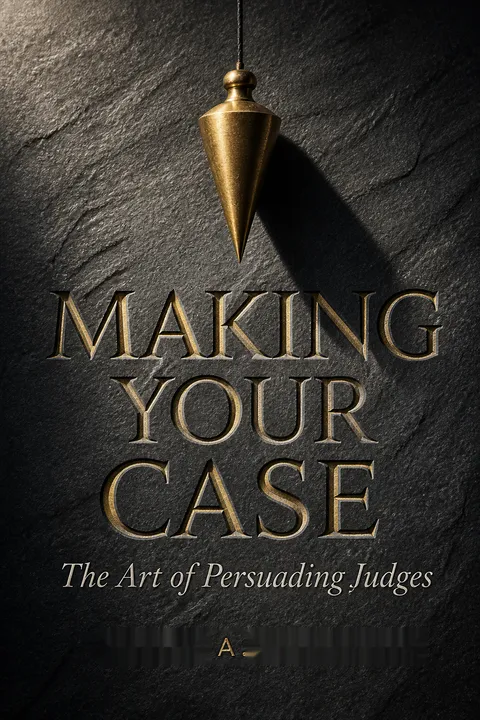
What's "Making Your Case: The Art of Persuading Judges" about?
- Overview: "Making Your Case: The Art of Persuading Judges" by Bryan A. Garner and Antonin Scalia is a comprehensive guide on effective legal advocacy, focusing on both written and oral arguments.
- Purpose: The book aims to equip lawyers with the skills necessary to persuade judges by providing practical advice on legal reasoning, brief writing, and oral argumentation.
- Structure: It is divided into sections covering general principles of argumentation, legal reasoning, briefing, and oral argument, each offering detailed strategies and techniques.
- Audience: While primarily targeted at legal professionals, the book is also valuable for anyone interested in understanding the intricacies of legal persuasion.
Why should I read "Making Your Case: The Art of Persuading Judges"?
- Expert Insights: Co-authored by a Supreme Court Justice and a legal writing expert, the book offers authoritative insights into the art of legal persuasion.
- Practical Advice: It provides actionable strategies for improving both written and oral advocacy, making it a practical resource for lawyers at any stage of their career.
- Comprehensive Coverage: The book covers a wide range of topics, from understanding your audience to mastering courtroom terminology, ensuring a well-rounded approach to legal advocacy.
- Enhance Persuasion Skills: By reading this book, you can enhance your ability to construct compelling arguments and effectively communicate them to judges.
What are the key takeaways of "Making Your Case: The Art of Persuading Judges"?
- Know Your Audience: Understanding the judge's perspective and judicial philosophy is crucial for tailoring your arguments effectively.
- Clarity and Brevity: Clear and concise communication is emphasized throughout the book as essential for persuasive legal writing and speaking.
- Preparation is Key: Thorough preparation, including mastering the record and anticipating questions, is vital for successful oral arguments.
- Ethical Advocacy: The book stresses the importance of honesty and integrity in legal advocacy, advising against overstating cases or misrepresenting facts.
What are the best quotes from "Making Your Case: The Art of Persuading Judges" and what do they mean?
- "Experience is undoubtedly a great teacher, yet it may be counterproductive if what has been cultivated and refined are bad habits." This quote emphasizes the importance of cultivating good habits in legal practice, as experience alone is not enough if it reinforces ineffective methods.
- "No rules in the handbooks are capable in themselves of making brilliant performances out of those who intend to dispense with practice and exercise." It highlights the necessity of practice and preparation in achieving excellence in legal advocacy.
- "The proper role of a judge is to do justice between the parties before him." This quote reflects the book's focus on justice and fairness as central to the judicial process.
- "Persuasive argument neither comes to an abrupt halt nor trails off in a grab-bag of minor points." It underscores the importance of a strong, focused conclusion in legal arguments.
How does "Making Your Case" advise on preparing for oral arguments?
- Know the Record: The book emphasizes the importance of being thoroughly familiar with the case record to respond effectively to questions.
- Anticipate Questions: Preparing for potential questions from the bench is crucial, as it allows for more confident and effective responses.
- Practice Flexibility: Advocates should be ready to adapt their arguments based on the court's questions and focus during the oral presentation.
- Moot Courts: Conducting moot courts is recommended as a way to simulate the argument experience and refine responses to challenging questions.
What does "Making Your Case" say about the importance of knowing your audience?
- Judicial Philosophy: Understanding a judge's judicial philosophy helps tailor arguments to align with their reasoning and decision-making process.
- Courtroom Dynamics: Familiarity with the courtroom's culture and the judge's preferences can influence the presentation style and strategy.
- Personal Background: Knowing a judge's background, such as their previous rulings or interests, can provide insights into their potential biases or inclinations.
- Effective Communication: Tailoring communication to the judge's preferences and expectations enhances the persuasiveness of the argument.
What are the general principles of argumentation in "Making Your Case"?
- Jurisdiction: Ensure that the tribunal has jurisdiction before proceeding with arguments, as this is foundational to any legal case.
- Accuracy: Never overstate your case; be scrupulously accurate in presenting facts and legal precedents.
- Strongest Argument First: When possible, lead with your strongest argument to make a compelling first impression.
- Defensible Terrain: Occupy the most defensible terrain by selecting arguments that are easiest to support and most likely to succeed.
How does "Making Your Case" suggest handling questions during oral arguments?
- Welcome Questions: View questions as opportunities to clarify and strengthen your argument rather than as interruptions.
- Listen Carefully: Pay close attention to the questions to ensure accurate and relevant responses.
- Direct Answers: Begin answers with a clear "yes" or "no" before providing further explanation to maintain clarity.
- Avoid Evasion: Never postpone answering a question; address it directly to maintain credibility and respect.
What does "Making Your Case" recommend for effective brief writing?
- Objective: The primary objective of a brief is to make the court's job easier by presenting clear, concise, and well-organized arguments.
- Clarity and Brevity: Value clarity above all other elements of style, and strive for brevity to maintain the court's attention.
- Structure: Use captioned section headings and a logical structure to guide the reader through the argument.
- Avoid Jargon: Banish legal jargon and hackneyed expressions to enhance readability and comprehension.
How does "Making Your Case" address the use of legal reasoning?
- Syllogistic Thinking: Encourage thinking syllogistically to ensure logical consistency and clarity in legal arguments.
- Textual Interpretation: Know the rules of textual interpretation and begin with the words of the text to establish the major premise.
- Precedent Weight: Master the relative weight of precedents to effectively argue the applicability of case law.
- Policy Considerations: Consider the policy implications of legal arguments to demonstrate their broader impact and fairness.
What are the recommended sources for further reading in "Making Your Case"?
- General Dictionaries: The book recommends several dictionaries, including The American Heritage Dictionary and Merriam-Webster’s Collegiate Dictionary, for precise language use.
- Usage Guides: It suggests usage guides like H.W. Fowler's "A Dictionary of Modern English Usage" and Bryan A. Garner's "Garner’s Modern American Usage" for language refinement.
- Legal Writing Style: For legal writing, the book recommends "The Elements of Legal Style" by Bryan A. Garner and "Plain English for Lawyers" by Richard C. Wydick.
- Oral Argument: It lists resources like "The Winning Oral Argument" by Bryan A. Garner and "Supreme Court and Appellate Advocacy" by David C. Frederick for mastering oral advocacy.
What is the significance of the book's foreword and introduction?
- Historical Context: The foreword places the book within the historical context of legal advocacy, drawing on classical sources like Aristotle and Cicero.
- Purpose: It clarifies that the book aims to adapt the best earlier advice on judicial persuasion to modern American litigation.
- Disagreements: The authors acknowledge that respected authorities on judicial persuasion may disagree, and they present their own recommendations while noting these differences.
- Judicial Motivation: The introduction discusses the motivations of judges, emphasizing the importance of understanding what drives judicial decision-making to craft persuasive arguments.
About the Author
Other books by Bryan A. Garner

Download PDF
Download EPUB
.epub digital book format is ideal for reading ebooks on phones, tablets, and e-readers.








