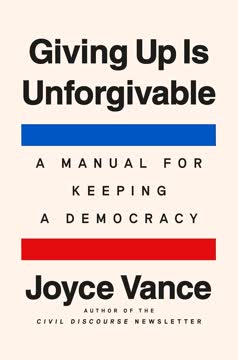
Key Takeaways
1. Recognize the gradual erosion of democracy before it's too late.
By the time the danger is upon it, the frog is immobilized and can be cooked until dead.
Beware complacency. The "boiling frog" metaphor illustrates how gradual, incremental changes can lead to catastrophic outcomes if not recognized and addressed early. In the context of democracy, this means that anti-democratic actions, even seemingly small ones, can accumulate until the system is irrevocably damaged. The book highlights how a hypothetical second Trump administration in 2025 rapidly implemented anti-democratic moves, catching many off guard despite clear prior warnings.
Ignoring warning signs. Many Americans, after Trump's first term, found it easier to pretend the danger wasn't real, distracting themselves or unplugging from the news. This complacency allowed the "pot to get hotter," with actions like firing inspectors general, attempting to remove birthright citizenship by executive order, and creating the Department of Government Efficiency (DOGE) to target federal agencies. These moves, initially dismissed as "just talk," gradually normalized a disregard for constitutional norms and the rule of law.
Constant vigilance. The lesson of the frog is to recognize the rising temperature and act before it's too late. Shock and horror fade, leading to a "new normal" where dangerous actions are accepted. The book emphasizes that constant exposure to threats can desensitize the populace, making it crucial for citizens to remain alert, learn from past mistakes, and resist the temptation to ignore the unfolding crisis.
2. American institutions are resilient bulwarks against authoritarianism.
In significant ways, both big and small, it has subtle advantages when it comes to retaining democracy, chief among them our institutions.
Enduring strength. Despite popular narratives of invincibility surrounding would-be authoritarians, American institutions possess inherent resilience. They have adapted and endured through major national crises such as:
- The Civil War
- Two World Wars
- The Great Depression
- Watergate
- 9/11
These institutions are not easily broken and are populated by individuals deeply committed to democratic principles.
Decentralized power. A key advantage is the decentralized nature of American democracy. For instance, the voting infrastructure involves fifty state elections, not one federal one, making it difficult for a single person to seize control. These elections are often run at the county level by everyday Americans, further embedding democratic processes within communities. The book argues that defeatism about "broken institutions" plays into the hands of those who seek to weaken them.
Protecting the framework. The focus should be on strengthening institutions, not abandoning them. While acknowledging their imperfections and the flaws of individuals within them, the book urges readers to criticize those who cause damage, not the institutional framework itself. Protecting these institutions—from the career civil service to civil society groups, the military, lawyers, unions, students, and teachers—is paramount to preserving democracy.
3. The Rule of Law and an independent judiciary are democracy's essential safeguards.
If there is a magic bullet for preserving democracy, it is this: prevent any one branch of government from holding too much power, especially power that the Constitution specifically gives to another branch of government.
No kings. The rule of law is the principle that no one, including the president, is above the law. It acts as a fundamental barrier against absolute power. The Founding Fathers, wary of monarchy, designed a system of separated powers (legislative, executive, judicial) to prevent the concentration of authority, as articulated by Montesquieu and Madison in the Federalist Papers.
Judicial review. The Supreme Court's power of judicial review, established in Marbury v. Madison (1803), allows courts to declare laws or presidential actions unconstitutional. This power was reaffirmed in Youngstown Sheet & Tube Co. v. Sawyer (1952), where the Court blocked President Truman's seizure of steel mills. These cases demonstrate the judiciary's critical role in reining in executive overreach and ensuring constitutional compliance.
Defending the courts. Attacks on the judiciary, such as attempts to delegitimize judges or "kill all the lawyers" through executive orders targeting law firms, are direct assaults on the rule of law. The book highlights the importance of an independent judiciary, citing the failed impeachment of Justice Samuel Chase (1804) as a precedent against removing judges for political reasons. Citizens must understand and defend the courts' role as a check on power.
4. Voting is the most powerful nonviolent tool to protect the Republic.
The right to vote is precious, almost sacred. It is the most powerful nonviolent tool or instrument in a democratic society. We must use it.
The ultimate power. Voting is the cornerstone of democracy, allowing citizens to shape their government and hold representatives accountable. The book emphasizes that elections, even local ones, have significant consequences and are often decided by small margins. Protecting and exercising the right to vote is paramount, especially when democratic norms are under threat.
Challenges to voting. Despite its importance, voting rights face continuous challenges. The Supreme Court's Shelby County v. Holder (2013) decision weakened the Voting Rights Act, leading to increased state-level restrictions like voter ID laws and voter roll purges. These measures, often justified by unsubstantiated claims of voter fraud, disproportionately suppress the votes of specific groups, particularly Black Americans.
Citizen action. The book urges active participation in the electoral process beyond just casting a ballot. This includes:
- Educating oneself about candidates at all levels
- Helping others register and vote
- Ensuring ballots are counted
- Volunteering as poll workers or watchers
- Advocating for pro-voting policies like automatic registration and early voting
The story of George Sallie, a Selma foot soldier nearly disenfranchised by a voter ID law, underscores the personal struggle and profound importance of each vote.
5. History offers crucial lessons for confronting modern threats to democracy.
History may not repeat, but as Mark Twain is credited with pointing out, it does rhyme.
Learning from the past. American history, particularly instances of insurrection and challenges to democratic principles, provides guidance for navigating current crises. The Civil War, for example, highlights the tension between justice and reconciliation, and the dangers of allowing a "Lost Cause" narrative to obscure truth and accountability. The book notes the lack of accountability for January 6, 2021, allowing a similar "Lost Cause mythology" to emerge.
Founders' foresight. The Founding Fathers, through the Federalist Papers, explicitly warned against "factions" – groups prioritizing self-interest over the common good. Madison believed a large republic, with diverse interests and elected representatives, would naturally dilute the power of any single faction. Their writings serve as both an explanation of the system's design and a cautionary tale against its subversion.
Resisting tyranny. Historical examples like McCarthyism demonstrate that even powerful bullies can be overcome when individuals find the courage to speak out. Senator Joseph McCarthy's reign of fear ended when lawyer Joseph Welch famously asked, "Have you no sense of decency?" This moment of public reckoning shows that collective common sense and persistence can dismantle seemingly invincible threats.
6. Active citizen engagement and civics education are vital for a thriving democracy.
Democracy, by its nature and by the design of the Founding Fathers, requires that its citizens participate in the process.
Informed participation. A functional democracy depends on an engaged and informed citizenry. The book argues for a revitalization of civics education, not just in formal classrooms but also through informal, daily life experiences. This includes:
- Discussing history and current events with family and friends
- Celebrating national holidays with an emphasis on democratic values
- Visiting historical sites or engaging with related media
Beyond the classroom. Civics education should foster a lifelong passion for democracy, making it as natural to celebrate as birthdays. The goal is to instill a cultural understanding and appreciation for how government works, why it matters, and the responsibilities of citizenship. This hands-on experience with democracy is crucial for future generations who may not have witnessed its full promise.
Demanding accountability. Citizens must actively demand good government from their elected officials, regardless of party affiliation. This means holding representatives accountable for their oaths to the Constitution and resisting the temptation to "cop out" by blaming others or accepting poor performance. The book encourages persistent advocacy, whether through calls, letters, protests, or community organizing.
7. Resist disinformation and manipulation to preserve truth.
The simple step of a courageous man is not to take part in the lie.
The autocrat's weapon. Disinformation is a primary tool used by would-be autocrats to mislead the public, exploit fears, and maintain power. It thrives on social media and can be inadvertently spread by well-meaning individuals. The book stresses that resisting manipulation requires developing strong media literacy skills.
Finland's model. Finland's successful approach to combating disinformation involves teaching schoolchildren media literacy across all subjects. Students learn to critically assess information by considering:
- Author's purpose
- Context of creation (how and when)
- Central claims
This systematic approach has made Finland a global leader in resilience against misinformation.
Personal responsibility. While formal programs are ideal, individuals can cultivate their own information literacy by being skeptical, verifying sources, and refusing to share unconfirmed information. This personal commitment to truth is a courageous act against authoritarian tactics that seek to control the flow of information and deny objective reality.
8. We, the citizens, are the ultimate cavalry for defending democracy.
The cavalry isn’t coming. The courts aren’t the cavalry, and there will be no politician swooping in to save us. There are good people in both places who are doing their best, but ultimately, they need our help as much as we need theirs. It’s us. We’re the cavalry.
Collective action. The book asserts that citizens cannot wait for external saviors—be it politicians, courts, or other institutions—to protect democracy. While these entities play a role, their effectiveness ultimately depends on an engaged citizenry. The fight for democracy is a long-haul effort that requires sustained commitment and collective action.
Guidelines for engagement: The book offers practical "Rules for the Cavalry" to guide citizen action:
- Be Smart: Resist disinformation by developing media literacy.
- Be in Community: Share concerns and work with like-minded people to avoid isolation.
- Never Bet against America: Demand good performance from elected officials.
- Protecting Democracy Comes in a Lot of Flavors: Engage through various means, from protests to volunteering.
- Decide Who You Are and Stick to It: Establish personal red lines and uphold integrity.
- Be the Hope: Counter hopelessness by actively working for positive change.
- Take Baby Steps: Recognize that small, individual actions accumulate into significant collective impact.
- Exercise Your Rights: Protest peacefully and frequently, understanding its power.
Inspiring examples. The story of the Marine Band concert, canceled by the administration but resurrected by military retirees and students, demonstrates how creative, collective resistance can turn a suppressive act into a powerful pro-democracy statement. This highlights that even in a constitutional crisis, seemingly small acts of defiance can have a broad impact.
9. Never give up on America's aspirational promise of democracy.
We cannot give up.
Relentless persistence. Despite the challenges and setbacks, giving up is not an option. Democracy is an ongoing experiment, always striving for improvement and expansion of its promise. The book emphasizes that progress is rarely linear, and there will be bad days, but persistence is key to overcoming obstacles.
Hope and resilience. The narrative encourages readers to "be the hope" when things look bleak, supporting others through difficult times. It draws inspiration from figures like Dr. Martin Luther King Jr., who, despite America's historical failures, believed "the bank of justice is not bankrupt" and that the moral arc of the universe bends toward justice with steadfast commitment.
Our generation's legacy. The book concludes with a powerful call to action, framing the current struggle as an opportunity for this generation to revitalize democracy and ensure its survival for future generations. It's about understanding our rights, using our power, and refusing to be overwhelmed by the "endless onslaught of terrible things" that autocrats use to foster helplessness.
Last updated: