

Plot Summary
Finch's Return to Maycomb
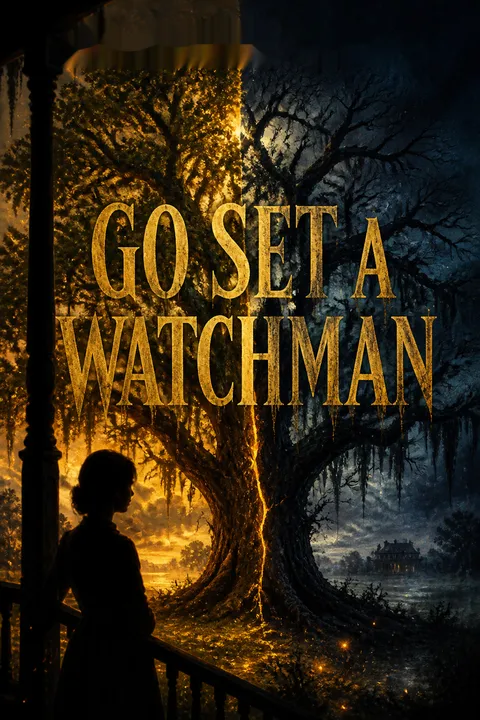
Twenty-six-year-old Jean Louise Finch leaves New York for her annual visit to Maycomb, choosing the train partly to spare her seventy-two-year-old father, Atticus, a punishing drive to meet her.
At the junction, Henry Clinton, her lifelong friend and a lawyer in Atticus's practice, greets her with a kiss and renews his hope that she will marry him. She loves him, but refuses to promise herself to a life she has not chosen freely. Henry reports that Atticus's rheumatoid arthritis has left him struggling to button his clothes and hold a razor.
At home, Aunt Alexandra criticizes Jean Louise's casual clothes and later questions whether Henry's humble origins make him a suitable husband. Jean Louise returns affection for neither the town's rules nor its matchmaking.
A Town Keeps Its Masks
During their first evening together, Henry takes Jean Louise to Finch's Landing, the family property where she feels more at ease than in the changed town. He tells her that Maycomb is shifting and that he may challenge its courthouse political machine, with Atticus's support. Their teasing ends in a swim with their clothes on, but the next morning gossip spreads a false story that they were naked.
Atticus treats the rumor lightly, while Alexandra worries about the family's reputation. At church, Jean Louise hears a minister preach from Isaiah about a watchman who must report what he sees. She is more distracted by a changed hymn than by the sermon, but its image will soon acquire a sharper meaning.
The Council Balcony
On Sunday afternoon, Jean Louise finds a pamphlet attacking Black people among Atticus's papers. Alexandra explains that Atticus serves on the Maycomb County Citizens' Council and Henry is an active member, so Jean Louise walks to the courthouse to see for herself.
From the Colored balcony, she watches Atticus introduce Grady O'Hanlon, who delivers a vicious defense of segregation. Atticus and Henry sit beside him while the room's white leaders listen.
The scene summons Jean Louise's memory of Atticus's earlier defense of a Black defendant, which won an acquittal despite the risk to his standing. She cannot reconcile that lawyer with the man at the council table. Sickened, she leaves the courthouse and walks through town as if Maycomb has turned its familiar face against her.
The Man She Worshiped
Jean Louise stops at an ice cream shop built where her childhood home once stood, but cannot eat; her faith in Atticus has collapsed so abruptly that she vomits behind the shop. The shock summons the history beneath her devotion.
Her mother died when Jean Louise was very young, leaving Atticus and the Finch family's cook, Calpurnia, to raise her and her older brother, Jem. Atticus made room for his children in his work and taught Jean Louise to trust her own judgment by example.
In one childhood crisis, a classmate's crude explanation convinces her that a kiss has made her pregnant. She plans to leap from a water tower, but Henry brings her down, and Calpurnia corrects the terrifying misunderstanding. Jean Louise remembers how completely the adults she loved once protected her.
Calpurnia's Closed Door
The next morning, Zeebo's son Frank, Calpurnia's grandson, is jailed after driving drunk and killing an elderly white man. Henry expects Atticus to refuse the case, but Atticus agrees to represent Frank, arguing that a local lawyer can keep the case out of outside hands. Jean Louise hears his explanation as a calculation about the NAACP, not the instinctive concern for Calpurnia's family she once believed would guide him.
She drives to Calpurnia's home and offers help. Calpurnia receives her with formal distance, insists Frank must answer for what he did, and speaks as if Jean Louise belongs to the white community rather than to her family. The visit leaves Jean Louise grieving a separation she cannot repair by invoking their shared past.
Maycomb's Coffee Circuit
Alexandra's coffee party gathers Maycomb women who trade family news, gossip, and stories about Black people. Hester Sinclair repeats claims that civil rights activists are Communists seeking to destroy the South, while another guest describes interracial contact in New York as a personal affront.
Jean Louise challenges the fear of racial mixing, pointing out that the phrase itself exposes white people's anxieties, but her guests evade the argument. Alexandra, too, dismisses Jean Louise's visit to Calpurnia and says Black residents no longer deserve white help.
The party makes Jean Louise feel like an outsider in the very community that raised her. New York may have taught her independence, but it has not given her a language that can bridge Maycomb's assumptions.
Uncle Jack's Long View
After the coffee party, Jean Louise visits her eccentric uncle, Dr. John Hale Finch, and demands to know what has changed Atticus. Instead of answering directly, he describes Maycomb's interwoven families and the South's fierce sense of collective identity.
He argues that federal pressure, industrial change, and the loss of local control have made many white Southerners feel besieged, and that citizens' councils serve as a weapon chosen in that fear.
His explanation is not an absolution, but it unsettles Jean Louise's assumption that the meeting can be understood only as individual malice. Dr. Finch makes her look at herself and warns that she has not yet learned to understand the people she condemns. He tells her to return when her private conflict becomes unbearable.
Henry's Price of Belonging
Jean Louise seeks Henry at the law office, unable to accept that the man she expected to marry attended the council meeting. At the drugstore, he explains that Maycomb trusts him because he has worked hard to earn a place there, but that the town would judge him more harshly than a Finch for breaking its rules.
He believes that remaining inside its institutions lets him serve the community, even when he must suppress his convictions. Jean Louise hears fear and hypocrisy where Henry sees a practical bargain. She tells him she cannot marry him, then accuses him of being too frightened to oppose the town. Henry asks what she expects him to sacrifice. Their argument ends at the office, where Atticus appears and interrupts their rupture.
Atticus Against His Daughter
In his office, Atticus explains that he joined the council to resist federal power and the NAACP, not to promote O'Hanlon's language. Jean Louise acknowledges that she feared the Supreme Court's method of imposing change, yet believes the ruling was necessary to give Black citizens a chance.
Atticus argues that rapid integration would destabilize the South and portrays Black communities as unprepared for full citizenship. Jean Louise answers that his defense of local control has become a defense of keeping people powerless.
She reminds him of his earlier work for a Black defendant and of the fairness she thought he taught her, then accuses him of confusing abstract justice with justice for actual people. Atticus stays controlled while she lashes out, leaving her more wounded by his restraint than by any counterattack.
The Watchman Must Separate
Jean Louise returns home and packs, determined to leave Maycomb. When she attacks Alexandra in anger, her aunt's unexpected tears make her apologize; the two women briefly see one another beyond their familiar quarrels.
Dr. Finch arrives as Jean Louise tries to drive away and strikes her to stop her retreat. After tending her split lip, he explains that she has treated Atticus as the source of her own conscience, so discovering his flaws felt like losing her moral ground.
Her task is not to imitate him or condemn everyone around him, but to judge with a conscience that belongs to her. She realizes the day's events are painful yet bearable. Dr. Finch also reveals that he loved Jean Louise's mother, helping her see how many private truths her family has kept.
Home Without Idols
Before going to Atticus, Jean Louise sees Henry at the office and agrees to meet him that evening to say goodbye. She understands that their bond is real, but that their ideas of belonging and compromise cannot sustain a marriage. Then she faces her father, afraid that her accusations have destroyed what remains between them.
Atticus tells her he is proud that she stood by her convictions, even against him. His approval does not erase their disagreement; it allows her to see him as a human being rather than the flawless measure of right and wrong. Jean Louise tells him she loves him, and the two leave for home together. She opens the car door for her arthritic father, newly able to love him without surrendering her own judgment.
Analysis
Jean Louise's crisis begins when the virtues she learned at home no longer appear to align with the political choices made by the people who taught them. Her shock is personal, but the novel repeatedly forces it outward: the Citizens' Council, the courthouse machine, the coffee party, and the case against Frank show how Maycomb turns private assumptions into public arrangements. The town's intimacy is not innocence. Everyone knows everyone, yet that familiarity can make unequal treatment feel like custom rather than a decision.
Atticus's position is difficult because the story does not reduce him to a simple fraud. He remains a disciplined lawyer and a loving father, but he also accepts limits on Black citizens in the name of local control and gradual change. Jean Louise's remembered ideal of him cannot contain this contradiction. Her uncle's lesson does not ask her to excuse it; instead, he shows that moral independence requires seeing people as fallible and continuing to judge their actions without making them into gods or monsters. That distinction also indicts Jean Louise when she treats disagreement as proof that a whole community is beyond engagement.
The novel's ending offers reconciliation without political resolution. Jean Louise returns to Atticus as a daughter, not as a disciple, while her understanding of Henry's compromises makes affection insufficient grounds for marriage. The closing movement therefore rejects both blind loyalty and easy exile. Independence means remaining answerable to one's own conscience while accepting that people one loves may act from motives that do not erase the harm they cause. The watchman is not an authority stationed outside the self. It is the capacity to keep looking, especially when the view threatens one's idea of home.
Review Summary
Go Set a Watchman received mixed reviews. Some readers appreciated the insight into Harper Lee's writing process and the complexity it added to beloved characters. Others were disappointed by the portrayal of Atticus Finch as racist and felt the book lacked the polish of To Kill a Mockingbird. Many viewed it as an early draft rather than a true sequel. The controversy surrounding its publication and its impact on Mockingbird's legacy were frequently discussed. Despite criticisms, some found value in its exploration of racial tensions and coming-of-age themes.
People Also Read





Characters
Jean Louise Finch
Restless Moral HeirJean Louise, called Scout in childhood, is a twenty-six-year-old writer who lives in New York and returns to Maycomb for brief annual visits. Quick-witted, physically unselfconscious, and resistant to social performance, she values candor more than approval. Her deepest attachment is to her father, whose example has quietly shaped her sense of fairness. That dependence makes her both morally confident and vulnerable: she has learned to judge by his standards before discovering that he is a complicated man with beliefs she does not share. Her challenge is to keep her capacity for moral judgment while giving other people room to be more than the worst thing she sees them do.
Atticus Finch
Beloved Local PatriarchAtticus is a respected Maycomb lawyer and the widowed father of Jem and Jean Louise. Patient, restrained, and exacting about legal procedure, he treats composure as a form of responsibility and rarely advertises his virtue. His children grew up close to his work and learned from the way he handled clients and neighbors, which gives him unusual moral authority within the family. In old age, rheumatoid arthritis limits his hands but not his appetite for public life. Atticus's loyalty to local institutions and self-government is deeply rooted, and he is inclined to see social change through questions of order, law, and political power. His reserve can protect others, but it can also conceal the assumptions beneath his judgments.
Henry Clinton
Ambitious County LawyerHenry is Jean Louise's lifelong friend, a lawyer in Atticus's practice, and the son of a poor woman who worked hard to educate him. After his mother died, Atticus helped him find work and continue his studies. Henry has built his life through effort, discipline, and an acute awareness of how Maycomb ranks people by family background. He is affectionate and patient with Jean Louise, but he is also ambitious: he hopes to make a name for himself in the county and may enter politics. His practical sense of belonging differs from Jean Louise's habit of speaking freely, and that difference shapes how he weighs private conviction against public influence.
Dr. John Hale Finch
Eccentric Moral TutorJean Louise's uncle is a retired physician, a bachelor, and Maycomb's most conspicuous student of Victorian literature. His mind leaps through history and biography, and his teasing manner can make serious counsel difficult to recognize. He shares with Atticus a close family bond but is less invested in appearing conventional. Jean Louise trusts his intelligence and enjoys his eccentricity, even when she finds his indirect explanations maddening. Dr. Finch's medical experience gives him a sharp eye for emotional dependence, while his love of argument helps him turn family history into a way of thinking about the present. He pushes Jean Louise toward independent judgment rather than offering her a ready-made verdict.
Alexandra Finch Hancock
Keeper of Family StatusAtticus's sister, Alexandra, manages his household and guards the Finch family's standing in Maycomb. She values manners, kinship, and social stability, and often tries to direct Jean Louise toward a life that would be legible to the town. Her advice can feel controlling because she has difficulty recognizing how different her niece's needs are from her own. Beneath her formidable disapproval, however, is a capacity for loyalty and tenderness that she seldom displays openly. Alexandra's perspective shows how social rules can feel like care to the person enforcing them, even when they narrow the choices of the person receiving them.
Calpurnia
Childhood's Steady GuardianCalpurnia worked in the Finch household and helped raise Jem and Jean Louise after their mother died. Practical, observant, and disciplined, she cared for the children without indulging their mistakes, and Jean Louise remembers her as both a source of comfort and a firm authority. Calpurnia has a large family of her own and a life in Maycomb's Black community that Jean Louise only partly understands. Their closeness is real, but it has existed across a profound racial and social divide. Calpurnia's perspective makes visible how affection between individuals can coexist with inequalities that the more privileged person has not learned to see.
Jem Finch
Older Brother and ModelJem is Jean Louise's older brother and childhood companion. He was confident, athletic, and imaginative, often directing the games he played with his sister and their friend Dill. As he grew older, he became one of the first people Jean Louise had to learn to relate to outside their childhood world. His place in the family remains important to her, and memories of him help show the warmth and freedom of the home Atticus created.
Dill Harris
Wandering Summer FriendDill is Jean Louise and Jem's imaginative childhood friend, who spends summers in Maycomb and eventually travels widely. Small, theatrical, and quick to invent elaborate games, he brings mischief and make-believe into the children's otherwise familiar days. Jean Louise remembers him as a close companion who could make ordinary backyards feel like faraway countries.
Zeebo
Calpurnia's SonZeebo is Calpurnia's son and a longtime member of the Finch household's wider community. He is courteous toward Jean Louise and helps her navigate the narrow road to his mother's home. His presence connects the Finch family to a Black community whose daily lives Jean Louise has known only in fragments.
Frank
Young Family DefendantFrank is Calpurnia's grandson, a young man with a talent for plumbing and hopes of attending a trade school. He is not a central viewpoint character, but his situation places the Finch family's talk of justice against the consequences faced by a Black family in Maycomb.
Grady O'Hanlon
Segregation's Loud AdvocateO'Hanlon is an outside speaker invited to address the Maycomb County Citizens' Council. He uses inflammatory racial language and presents segregation as a defense of Southern life. His speech gives Jean Louise a vivid measure of what the council has permitted into its respectable meeting.
William Willoughby
Courthouse Political BossWilloughby is Maycomb's behind-the-scenes political boss, surrounded by officials who owe their positions to his influence. He represents the old courthouse machine that Henry hopes to challenge. His power depends on personal loyalty and dependence rather than an openly stated political program.
Hester Sinclair
Echo of Town PrejudiceHester is a Maycomb woman who repeats the racial and political suspicions circulating among her friends, often relying on what her husband tells her. She is not presented as a political theorist; her importance lies in showing how grand claims about Communism and social upheaval pass into ordinary conversation.
Claudine McDowell
Maycomb's Social MirrorClaudine is a local woman who has visited New York and returns with discomfort about its racial diversity. Her conversation with Jean Louise exposes the distance between the city's everyday contact across racial lines and Maycomb's insistence on separation.
Plot Devices
The Watchman Image
Conscience Made VisibleA Sunday sermon uses the biblical figure of a watchman charged with reporting what he sees. At first Jean Louise treats the sermon as another piece of church routine. After she discovers Atticus at the Citizens' Council, the image becomes a question about moral perception: who is responsible for seeing clearly, and can a daughter borrow her father's judgment forever? The image also structures the eventual lesson that each person must develop an independent conscience rather than rely on a revered authority.
Citizens' Council
Respectability's Political MaskThe Maycomb County Citizens' Council brings the town's leaders together to oppose federal intervention and defend segregation. Its meeting gives Jean Louise a public view of attitudes she had not recognized in her family. The council is also a device for exposing the difference between stated motives and tolerated consequences: some members see it as a tool for local resistance, while its platform can shelter racist speakers such as Grady O'Hanlon. It turns private family loyalty into a conflict over public responsibility.
Finch's Landing
Home as a Changing PlaceThe river landing is a family property and a landscape Jean Louise associates with childhood, reunions, and freedom from Maycomb's social routines. Its sale and the physical changes around it mark the erosion of a world she has treated as permanent. When Henry brings her there, their intimacy briefly seems capable of joining her past to her future. The Landing therefore makes nostalgia concrete: it is a real place whose ownership and use change, not a refuge that can preserve time indefinitely.
The Childhood Memories
A Measure of Lost InnocenceJean Louise's recollections of Atticus, Jem, Calpurnia, and Henry establish the emotional standard against which she judges the present. Her childhood confidence grew from being loved and protected, but that protection also limited what she understood about adult motives, sexuality, and racial life. Memories are not simply comforting pauses: they explain why an adult discovery can feel like a physical injury and why Jean Louise must revise her past without discarding it. The episodes reveal both the generosity of her upbringing and the blind spots it left intact.
Frank's Criminal Case
Justice Put to PracticeFrank's fatal driving accident gives Atticus a concrete legal problem that Jean Louise can compare with the earlier case that defined her image of him. Atticus agrees to represent Frank, but explains his decision through the dangers of outside intervention and the desire to keep the case local. The case tests whether justice is being pursued for the person in trouble or used to preserve a preferred political order. It also gives Jean Louise a reason to visit Calpurnia, where their strained encounter shows that a shared family history cannot by itself overcome racial separation.
FAQ
Basic Details
What is Go Set a Watchman about?
- A homecoming reveals truths: The novel centers on Jean Louise Finch's return to Maycomb, where she confronts unsettling truths about her family and community, challenging her long-held beliefs.
- Clash of values: It explores the conflict between Jean Louise's progressive views and the traditional values of her father, Atticus, and her hometown amidst the backdrop of the civil rights movement.
- Personal and societal change: The story delves into Jean Louise's personal journey of self-discovery as she grapples with disillusionment and the need to forge her own identity separate from her family's influence.
Why should I read Go Set a Watchman?
- Complex character study: The novel offers a deeper, more nuanced look at Atticus Finch, revealing his flaws and complexities, which contrasts with his idealized portrayal in To Kill a Mockingbird.
- Exploration of moral ambiguity: It tackles difficult themes of racism, prejudice, and the struggle for justice, forcing readers to confront uncomfortable truths about the South and human nature.
- A different perspective: It provides a unique perspective on the civil rights era, exploring the internal conflicts and moral dilemmas faced by individuals in a changing society.
What is the background of Go Set a Watchman?
- Mid-1950s South: The novel is set against the backdrop of the mid-1950s South, a time of significant social and political upheaval due to the burgeoning civil rights movement.
- Racial tensions: The story reflects the deep-seated racial tensions and resistance to integration prevalent in the South during this period, highlighting the challenges faced by those advocating for change.
- Personal and political conflict: It explores the intersection of personal beliefs and political ideologies, showing how these forces shape individual actions and relationships within a community.
What are the most memorable quotes in Go Set a Watchman?
- "Love whom you will but marry your own kind": This quote encapsulates the societal pressures and expectations surrounding marriage and social class in Maycomb, highlighting the ingrained prejudices of the time.
- "The only remedy for this is not to let it beat you": Atticus's stoic response to his rheumatoid arthritis reveals his resilience and determination, reflecting his approach to life's challenges.
- "You're gonna see change, you're gonna see Maycomb change its face completely in our lifetime": Henry's observation foreshadows the inevitable social and political transformations that will impact Maycomb, highlighting the theme of change and resistance.
What writing style, narrative choices, and literary techniques does Harper Lee use?
- Nostalgic and reflective tone: Lee employs a reflective narrative style, often using Jean Louise's internal thoughts and memories to explore themes of identity, disillusionment, and the passage of time.
- Sharp dialogue and characterization: The novel features realistic and engaging dialogue that reveals the characters' personalities, motivations, and the complex relationships between them.
- Symbolism and foreshadowing: Lee uses subtle symbolism and foreshadowing to hint at future events and to deepen the thematic exploration of the story, adding layers of meaning to the narrative.
Hidden Details & Subtle Connections
What are some minor details that add significant meaning?
- Cousin Joshua's story: The anecdote about Cousin Joshua, a poet who was institutionalized, foreshadows the theme of nonconformity and the consequences of challenging societal norms, mirroring Jean Louise's own struggles.
- The old putter: The blackened old wooden-shaft putter, used as a poker, symbolizes the blending of the past and present, and the way old objects can hold multiple meanings and purposes.
- The train journey: Jean Louise's decision to travel by train instead of plane highlights her desire to reconnect with her past and her discomfort with modern technology, reflecting her internal conflict.
What are some subtle foreshadowing and callbacks?
- The "Hot-Grease-in-the-Kitchen" game: Jean Louise's inability to remember the game "Hot-Grease-in-the-Kitchen" foreshadows her sense of being disconnected from her past and the changes in Maycomb.
- The river and Finch's Landing: The recurring motif of the river and Finch's Landing symbolizes the passage of time and the enduring connection to the past, while also highlighting the changes that have occurred.
- The Doxology incident: The change in the Doxology at church foreshadows the larger societal changes and challenges to tradition that are occurring in Maycomb, reflecting the theme of resistance to change.
What are some unexpected character connections?
- Atticus and Henry's partnership: The close working relationship between Atticus and Henry, despite their differing backgrounds, reveals the complex dynamics of power and influence in Maycomb.
- Jean Louise and Dill's friendship: The memory of Jean Louise's childhood friendship with Dill, a wanderer, contrasts with her current feelings of isolation and her struggle to find her place in Maycomb.
- Alexandra and Calpurnia's shared concern: Despite their different social positions, Alexandra and Calpurnia share a concern for Jean Louise, highlighting the common bonds of motherhood and caregiving.
Who are the most significant supporting characters?
- Dr. John Hale Finch (Uncle Jack): He serves as a mentor to Jean Louise, offering her a different perspective on her father and the complexities of the world, and helping her navigate her moral dilemmas.
- Alexandra Finch Hancock: She represents the traditional values of Maycomb and the expectations placed on women, highlighting the generational and ideological divides within the Finch family.
- Calpurnia: She embodies the racial tensions in Maycomb and the impact of societal changes on personal relationships, while also serving as a reminder of the deep bonds of loyalty and care.
Psychological, Emotional, & Relational Analysis
What are some unspoken motivations of the characters?
- Atticus's desire for control: Atticus's involvement in the citizens' council stems from a desire to maintain order and control in a rapidly changing society, reflecting his fear of chaos and instability.
- Henry's need for acceptance: Henry's ambition and desire to be seen as a respectable member of Maycomb society drive his actions, revealing his insecurity and need for validation.
- Alexandra's fear of change: Alexandra's resistance to change and her controlling nature stem from a deep-seated fear of losing her place in the world and the traditions she holds dear.
What psychological complexities do the characters exhibit?
- Jean Louise's identity crisis: Jean Louise struggles with an identity crisis as she grapples with her disillusionment with her father and her place in Maycomb, highlighting her internal conflict and search for self.
- Atticus's moral compromises: Atticus's willingness to compromise his principles for the sake of maintaining order reveals the complexities of his character and the moral ambiguities he faces.
- Henry's internal conflict: Henry's internal conflict between his ambition and his moral compass highlights the challenges of navigating a changing society while trying to maintain his place within it.
What are the major emotional turning points?
- The citizens' council meeting: Jean Louise's attendance at the citizens' council meeting is a major emotional turning point, shattering her idealized image of her father and forcing her to confront the harsh realities of her community.
- The confrontation with Atticus: The heated confrontation between Jean Louise and Atticus is a major emotional turning point, revealing the deep-seated tensions and ideological divides within the family.
- The conversation with Uncle Jack: Jean Louise's conversation with Uncle Jack is a major emotional turning point, providing her with a new perspective on her father and helping her to begin her journey of self-discovery.
How do relationship dynamics evolve?
- Jean Louise and Atticus: Their relationship evolves from one of idealized admiration to one of complex understanding, as Jean Louise grapples with her father's flaws and her own need for independence.
- Jean Louise and Henry: Their relationship deteriorates as Jean Louise realizes that their values and beliefs are fundamentally different, highlighting the challenges of maintaining relationships in the face of ideological divides.
- Jean Louise and Alexandra: Their relationship shifts from one of conflict to one of grudging respect, as Jean Louise begins to understand her aunt's motivations and the complexities of her character.
Interpretation & Debate
Which parts of the story remain ambiguous or open-ended?
- Atticus's true motivations: The novel leaves some ambiguity surrounding Atticus's true motivations for joining the citizens' council, prompting readers to question whether he is a racist or a pragmatist.
- The future of Maycomb: The ending leaves the future of Maycomb uncertain, with the reader left to wonder whether the town will embrace change or remain entrenched in its traditional ways.
- Jean Louise's ultimate path: The novel does not fully resolve Jean Louise's personal journey, leaving her future open-ended and prompting readers to consider the challenges of self-discovery and finding one's place in the world.
What are some debatable, controversial scenes or moments in Go Set a Watchman?
- Atticus's defense of segregation: Atticus's arguments in favor of segregation and his belief in states' rights are highly controversial, challenging readers to reconcile his actions with his previous portrayal as a moral icon.
- The citizens' council meeting: The racist rhetoric and discriminatory views expressed at the citizens' council meeting are deeply disturbing, prompting debate about the nature of prejudice and the responsibility of individuals to challenge injustice.
- Jean Louise's reaction to Calpurnia: Jean Louise's emotional response to Calpurnia's perceived distance and her inability to understand her perspective is a controversial moment, highlighting the complexities of race relations and the challenges of empathy.
Go Set a Watchman Ending Explained: How It Ends & What It Means
- Jean Louise's self-discovery: The ending emphasizes Jean Louise's journey of self-discovery, as she learns to accept her father's flaws and to forge her own path, separate from her family's influence.
- Acceptance of complexity: The novel concludes with Jean Louise's acceptance of the complexities of human nature and the moral ambiguities of the world, highlighting the importance of empathy and understanding.
- A call for individual action: The ending suggests that true change comes from individual action and the courage to challenge injustice, rather than relying on external forces or idealized figures.
To Kill a Mockingbird Series


About the Author

Download PDF
Download EPUB
.epub digital book format is ideal for reading ebooks on phones, tablets, and e-readers.








