

Plot Summary
Arlington's Empty Welcome
In November 1858, Robert E. Lee returns from Texas after his father-in-law, George Washington Parke Custis, dies. At Arlington, his daughter Agnes greets him in tears, while his wife Mary remains upstairs, weakened by arthritis and ashamed of her dependence. Lee has only a short leave, but Custis's tangled will makes him executor of a debt-ridden estate whose farms must support the family and eventually free its enslaved workers.
As he studies the accounts, his sons and daughters, the neglected fields, and the mansion's Washington relics all press on him at once. He asks the army for more time, accepting the work as another duty, though it pulls him away from the military career he still hopes will become meaningful.
Lee's homecoming is not a simple return to comfort. Arlington is at once family home, financial crisis, historical shrine, and a place where his absence has accumulated visible costs. Mary has concealed her illness because she feels exposed by dependence, while Lee responds by promising care, a promise he cannot keep for long. The estate also places him inside a moral contradiction: he must administer a slaveholding household whose eventual emancipation is mandated by Custis's will, yet Lee prefers to leave the timing of freedom to Providence. His instinct to solve each burden through duty gives him purpose, but it also makes private obligations seem like temporary interruptions.
The Grave Under the Oak
In 1859, Thomas Jackson leaves Lexington for the remote place where his mother, Julia, was buried when he was a child. A confused shopkeeper sends him to Jacob McLean, who remembers Julia and leads him to the unmarked grave beside the New River.
The visit follows the deaths of Jackson's first wife and infant daughter, losses he has tried to contain through work, strict routines, and religious discipline. Before traveling, he asks minister William White whether God has punished him for loving his family.
White challenges that fearful conclusion and urges him to accept comfort without claiming to know God's reasons. At the grave, Jackson finally recalls his mother's tenderness and leaves feeling less guilty about his grief, though faith remains the structure he uses to endure it.
Jackson's faith begins here as both shelter and pressure. He has converted bereavement into a question of personal fault, treating each loss as possible evidence that he has loved too much or trusted too little. White's intervention does not explain the deaths; it separates the wish for meaning from the presumption that suffering is a verdict. The visit to Julia's grave gives Jackson a form of emotional contact his disciplined life usually suppresses. Remembering his mother lets him feel grief without immediately turning it into an order from God. That distinction matters because his faith can console him, but it can also make tenderness feel dangerous.
The Deer He Wouldn't Shoot
Joshua Lawrence Chamberlain, a Bowdoin professor, goes hunting with his younger brother Tom in the Maine woods, but lets a deer pass because he loves watching more than killing. Later, alone, he finally raises his old musket at a large buck. The gun misfires, and the animal escapes, yet Chamberlain is shaken by the force of his own desire to shoot.
He has a prestigious teaching position, a wife, Fannie, and a young daughter, but success feels strangely airless. His father had wanted him to become a soldier, while his mother hoped he would enter the ministry; Chamberlain has chosen neither path. He returns from the woods to domestic comfort with a growing sense that the life he has built is not the life he can accept.
The failed shot turns an ordinary hunting trip into a private alarm. Chamberlain has spent years resisting other people's definitions of him, from his father's military hopes to his mother's religious expectations, yet his academic achievement has not supplied an independent sense of direction. The gun's misfire leaves him with no action to justify his sudden appetite for violence, so he must confront the appetite itself. His bond with the Maine woods offers genuine peace, but the contrast between that silence and the obligations waiting below reveals that retreat cannot answer his restlessness. He is not yet committed to war; he is discovering that contentment cannot be performed simply because others expect it.
Harper's Ferry in Fog
After John Brown seizes the federal arsenal at Harper's Ferry, President Buchanan sends Lee to restore order. Lee finds a small band holding hostages in the engine house, not the vast slave uprising rumored in Washington.
He surrounds the building, sends J.E.B. Stuart with surrender terms, then orders a Marine assault when Brown refuses. The Marines break in, rescue the hostages, and capture Brown, while two attackers die. Weeks later, Virginia calls on Jackson and VMI's cadets to secure Brown's hanging at Charlestown.
Jackson watches the execution and prays for the condemned man, even as the crowd curses him. The raid is over, but Brown's violence and death deepen the national argument over slavery and show how rumor can turn a local crisis into a national symbol.
The same crisis exposes two different forms of command. Lee distrusts inflated reports, limits force, and makes the hostages' safety the governing priority. Jackson encounters Brown later, not as an opponent to defeat but as a condemned man whose fate unsettles his certainty about judgment. The novel makes the raid consequential beyond its scale: a handful of armed men cannot create the uprising they imagined, yet their seizure of a federal arsenal gives both abolitionists and slaveholders a story that confirms their fears. Rumor magnifies violence, while the public execution turns a failed plan into a lasting moral provocation.
California's One-Man Garrison
In Los Angeles, Captain Winfield Scott Hancock commands little more than a supply depot and his own family. When Spanish residents stage a mounted protest outside his home, he fears the government stores and weapons could be seized.
General Phineas Banning explains that local anger is being fed by election rhetoric and talk of California breaking away if Abraham Lincoln wins. Hancock spreads a false report that cavalry is coming, then keeps watch over the depot with a handful of armed townsmen, including Banning, until actual troops arrive from Fort Tejon.
The threatened raid never comes. Hancock's friendship with Lewis Armistead, a fellow officer and close family friend, sharpens the danger: Armistead is a Virginian, and the election may soon force both men to choose between military oath and home.
Hancock's crisis is small in scale but revealing in its isolation. He is the sole visible agent of federal authority in a place where residents distrust Washington and where supplies could become military power in the wrong hands. His bluff works because he understands that appearances can delay violence, but it also exposes how thin the government's presence really is. Unlike Lee, Hancock is not trapped between family property and national service; he is trapped between a formal oath and the possibility that the nation itself may fracture. Armistead's closeness makes that division intimate before it becomes military.
Oaths Split the Army
Lincoln's election accelerates secession, and the army's officers begin weighing loyalty to the Union against loyalty to their home states. Lee rejects Winfield Scott's offer to lead federal forces against the rebellion, then resigns when Virginia secedes and accepts command of its forces.
Jackson leaves his VMI post to serve Virginia, while Hancock insists that his oath belongs to the United States. In California, Armistead resigns and prepares to return to Virginia, a decision that wounds Hancock more than either man can repair.
Chamberlain watches young Bowdoin students enlist, argues that the Union's survival matters beyond the classroom, and eventually volunteers himself. Their choices are not interchangeable: Lee follows home, Jackson follows religiously framed duty, Hancock follows the nation, and Chamberlain follows a conviction he has not yet tested in battle.
The crisis makes loyalty a competing set of relationships rather than an abstract principle. Lee's decision is not approval of secession; he opposes the break but cannot imagine leading an invasion of Virginia. Hancock sees the same national rupture and concludes that an oath must outlast regional attachment. Armistead chooses Virginia despite the cost to his friendship with Hancock, and Jackson finds certainty less in political argument than in a religious sense of duty. Chamberlain's enlistment emerges from moral urgency and personal dissatisfaction together. The novel resists a single explanation for allegiance, showing how men can act from sincere convictions that point toward opposing armies.
Virginia Builds Its Army
Once Virginia joins the Confederacy, Lee is named to command its provisional forces and begins building defenses at Harper's Ferry and Norfolk. He sorts experienced officers from political appointees, worries over flour and ammunition, and tries to keep the new army supplied.
Jackson arrives with VMI cadets but objects to being appointed an engineer, a role he has not trained for. Lee places him in command near Harper's Ferry instead, where Jackson can gather volunteers and secure the arsenal's machinery.
As Virginia's forces are absorbed into the Confederate Army, Lee assumes he will receive a field command, but Jefferson Davis keeps him close as an adviser and administrator. Lee's labor creates the army's structure, yet he waits while louder or better-positioned generals receive authority over its troops.
The early Confederate army is assembled through a mismatch between military need and political power. Lee's administrative competence gives the force coherence, but the very effectiveness of that work helps keep him away from the command he wants. Jackson, by contrast, resists a title that misrepresents his abilities and gains a field post through Lee's practical judgment. Their contrast establishes two forms of usefulness: Lee makes the institution possible, while Jackson turns a specific assignment into action. Davis's need to control subordinates compounds the problem, since trust is granted less readily than responsibility.
Stonewall at Manassas
In July 1861, Union General Irvin McDowell attacks Confederate positions at Manassas while Lee remains in Richmond, unable to direct the field. As the Confederate line begins to bend, Jackson holds his men on high ground and helps stop the Union advance.
A soldier returning to Richmond later credits Jackson's steady position with saving the day, and the nickname Stonewall begins to follow him. The Federal army retreats in disorder, but Confederate commanders fail to pursue and destroy it.
The victory lifts Southern confidence while revealing the cost of inexperienced leadership on both sides. Lee sees that winning one battle will not end the war, and the men who cheered a quick triumph must now face the reality that the enemy has gone home to rebuild.
Manassas gives the Confederacy a usable legend, but the legend arrives before the army understands what it has won. Jackson's steadiness becomes a symbol because soldiers need a memorable person to attach to a chaotic battlefield. The failure to pursue shows that morale and opportunity are not the same thing: the Confederates can break an army's nerve without knowing how to convert panic into strategic destruction. Lee's absence from the battlefield also establishes his early position as a planner watching others exercise the authority he will later receive. The battle makes the war tangible, replacing political confidence with the sight of mass retreat and unanticipated death.
A Professor Takes Command
After seeing Bowdoin students march away in new uniforms, Chamberlain accepts a lieutenant colonelcy in Maine's Twentieth Regiment. He hides the decision from Fannie until it is settled, and she makes him acknowledge that his choice may burden the family as well as fulfill him.
At Camp Mason, he meets Colonel Adelbert Ames, whose strict drills begin turning a rough collection of farmers, laborers, and students into soldiers. Chamberlain's younger brother Tom enlists too, despite their father's need for help at home.
Chamberlain is proud and frightened by the responsibility of leading him. When the regiment marches south, Chamberlain has learned enough to recognize its disorder, but not enough to feel prepared for battle. His desire to serve has become a commitment with names and faces attached.
Chamberlain's enlistment is an act of self-assertion, but not a clean escape from domestic obligations. By deciding before speaking with Fannie, he repeats the very pattern of unilateral duty that has made her feel excluded from his inner life. Tom's enlistment makes that choice harder: Chamberlain is not simply volunteering his own body, he now feels responsible for his brother's. Ames's drills offer a practical route from ideals to competence, though their discipline cannot erase the regiment's inexperience. The transformation begins not when Chamberlain feels brave, but when he recognizes that command means caring for particular people under conditions he cannot control.
Hancock Finds the Front
Hancock reaches Washington expecting another quartermaster assignment, but George McClellan recognizes his Mexican War experience and recommends him for a brigadier generalship. On the Peninsula, Hancock commands a brigade during the advance toward Williamsburg.
When the main attack stalls, he leads five regiments through woods to an abandoned Confederate earthwork, then presses forward and drives a small enemy force away. General Sumner orders him to withdraw, and reinforcements never arrive, so Hancock pulls back after turning the retreat into a controlled counterattack.
His success earns recognition, but the larger Union army soon repeats its habit of stopping short. Hancock has reached combat command at last, yet he discovers that individual initiative can win ground without persuading a cautious headquarters to exploit it.
Hancock's promotion resolves a career frustration but not the deeper problem that produced it. He has spent years proving himself through supply work, only to fear that competence will imprison him there. McClellan's confidence gives him a chance to command soldiers, and at Williamsburg Hancock demonstrates that disciplined initiative can turn a vulnerable flank into a local success. Sumner's order then places a ceiling on that success. Hancock can read the ground and act decisively, but the army's hierarchy may still withdraw from the opportunity he has created. His emerging identity as a field commander is therefore inseparable from his growing distrust of command decisions made far from the danger.
Lee Takes the Field
At Fair Oaks in May 1862, Lee rides out to discover that Joseph Johnston has been wounded and that the army is confused under Gustavus Smith. Jefferson Davis appoints Lee to command.
Lee first tries to stabilize a force whose divisions have fought as separate commands, then launches the Seven Days' battles against McClellan's Peninsula campaign. The Confederates suffer heavy losses and fail to destroy the Union army, but Lee's attacks convince McClellan to withdraw from Richmond.
The campaign gives Lee the authority he had lacked, while exposing the army's weak coordination and the danger of political appointments. Instead of celebrating a clean victory, Lee reorganizes his commanders, trusts Longstreet's steadiness, and prepares to use Jackson's speed where the Union is vulnerable.
Lee's promotion arrives through crisis rather than political maneuvering, which suits his preference for duty but leaves little time to build command relationships. The Seven Days show that personal courage and aggression cannot substitute for coordination: the Confederates can force McClellan away from Richmond, yet missed timing prevents a decisive destruction of his army. Lee responds by treating organizational structure as a battlefield weapon. His growing reliance on Longstreet and Jackson reflects not simple favoritism but differentiated trust: one offers controlled strength, the other rapid, uncompromising movement. Lee's authority is real now, but every victory still depends on a fragile network of subordinate decisions.
Jackson Turns the Valley
In spring 1862, Lee quietly encourages Jackson to strike Union forces in the Shenandoah Valley, where a small Confederate command can threaten Washington and disrupt McClellan's expected reinforcements. Jackson defeats a series of Union forces, captures supplies, and drives General Banks's troops back across the Potomac.
Lincoln recalls McDowell's men to protect the capital, leaving McClellan without the support he needs. After the Peninsula battles, Jackson joins Lee again for the campaign against John Pope.
At Second Manassas, Lee's army draws Pope forward while Longstreet's fresh troops strike his exposed flank, sending the Union army retreating toward Washington. Lee is dragged by his horse and breaks a hand during the pursuit, but refuses to let the injury interrupt command.
Jackson's Valley campaign works because it manipulates the Union's priorities as much as it defeats troops in the field. Lee understands that a perceived threat to Washington can pull forces away from McClellan, while Jackson's speed supplies the evidence that makes the threat credible. The strategy depends on the enemy reacting to fear, not merely on battlefield strength. At Second Manassas, Lee combines Jackson's ability to hold attention with Longstreet's forceful counterstroke. Yet the sequence also carries a cost: Lee's injury and the exhausted pursuit make victory physically precarious. Strategic ingenuity creates openings, but the army's leaders and soldiers remain vulnerable to the limits of their bodies.
Antietam's Unused Reserve
Lee carries the war into Maryland, hoping to feed his hungry army and persuade neutral residents to support the Confederacy. McClellan learns Lee's divided plan and meets him at Antietam Creek. The battle becomes a brutal series of separate assaults, with neither army able to break the other.
When General Richardson is mortally wounded, McClellan gives Hancock command of the division, placing him near the center of the fighting. Chamberlain's Twentieth Maine remains in reserve, close enough for him to see the guns and the fields filling with dead, but never receives an order to advance.
McClellan declines to renew the attack the next day, and Lee withdraws across the Potomac. Hancock gains command; Chamberlain must reckon with the strange shame of having been spared while others died.
Antietam exposes how an army can possess overwhelming numbers and still fail to act as a unified force. McClellan's piecemeal assaults allow Lee to shift troops between threatened sectors, while the Union reserves, including Chamberlain's regiment, remain unused. Hancock's promotion comes from a vacancy carved by combat, so advancement and grief arrive together. Chamberlain's reserve experience is not passivity; witnessing the aftermath makes him understand that a soldier's moral education may begin before his first shot. The battle also changes Lee's strategic calculation. He can survive the invasion, but he cannot afford to exchange losses indefinitely with a richer, larger opponent.
Fredericksburg's Open Slope
After taking command, Ambrose Burnside plans to cross the Rappahannock at Fredericksburg, but missing pontoon bridges keep the Union army waiting while Lee fortifies the heights. Barksdale's Mississippians fire from the town and repeatedly drive engineers away from the bridges.
Once the Union crosses, Burnside orders frontal assaults against Lee's entrenched line. Hancock leads his division over open ground, through fences and a canal, toward the stone wall at Marye's Heights. His brigades are cut down and fail to reach the position.
Chamberlain's Twentieth Maine goes forward later as a reserve, crosses a canal choked with fallen men, and spends the night pinned near the wall. Lee's defenders hold, but Union soldiers devastate Fredericksburg after entering it, adding civilian ruin to the military slaughter.
Fredericksburg makes command failure visible in the landscape. Burnside's delays give Lee time to turn the heights into a killing ground, and the open approach leaves Hancock's soldiers exposed to defenses that can see and reach them. The canal and stone wall are not incidental obstacles; they convert a flawed plan into repeated, measurable losses. Chamberlain's men encounter battle as bodies blocking the crossing, while Hancock experiences the cost as a commander whose brigades obey an order he believes is ruinous. The destruction of Fredericksburg extends that failure beyond the soldiers. Once combat turns into looting, civilians pay for decisions they did not make.
The Mud Stops Hooker
After Fredericksburg, Burnside tries to regain initiative with a winter march upriver, but rain turns the roads into impassable mud and sends the army back to camp. Lincoln removes Burnside and appoints Fighting Joe Hooker, who improves food, discipline, and morale.
Chamberlain's regiment is kept behind when a contaminated smallpox vaccination serum forces it into quarantine. Colonel Ames transfers to Meade's staff, leaving Chamberlain in command while the rest of the army marches toward another campaign.
His men complain that they will miss the fight, and Chamberlain shares their frustration even as he knows they are safer where they are. For the first time, he has authority without Ames beside him, but the opportunity to prove himself in battle is withheld by an accident of medicine.
The winter's failed march reduces the army's confidence in plans detached from material conditions. Burnside can issue a bold order, but mud defeats the schedule, wagons, and pontoons that make the order possible. Hooker repairs morale through practical measures, yet his later command will test whether better administration can produce better judgment under pressure. Chamberlain's quarantine gives him a different kind of command trial: he must manage resentment and uncertainty without the battlefield proving his worth. His disappointment is psychologically uncomfortable because it contains a wish for danger. He recognizes that he wants another chance, even though the last one left him among the dead.
Hooker's Trap Goes Still
In spring 1863, Hooker moves most of his army across the river and into the Wilderness, intending to strike Lee from behind while Sedgwick threatens from below Fredericksburg. Lee refuses to attack Sedgwick's guns and waits to learn where Hooker's main force has gone.
When Union troops reach the Chancellorsville crossroads, Hooker halts instead of pressing into open ground. Hancock and Couch recognize that the delay gives Lee time, while Oliver Howard's Eleventh Corps treats its exposed western flank as safe.
Lee and Jackson identify the weakness, and Jackson receives permission to take his corps on a long, concealed march around the Union right. The movement strips Lee's front of most of its strength, but Hooker's hesitation keeps him from exploiting it. The opposing armies settle into positions neither side fully understands.
The plan's danger lies in the gap between operational design and the commander who must sustain it. Hooker's crossing is bold and initially successful, but his halt gives Lee time to convert exposure into opportunity. The Wilderness restricts sight and communication, making confidence in reports as important as troop strength. Lee accepts severe risk by weakening his front so Jackson can travel around the Union flank; Hooker, meanwhile, mistakes his own prepared defenses for proof that the enemy must attack him there. Howard's complacency is not merely personal, since it reflects an army whose leaders have begun to treat a predicted retreat as a fact.
Jackson Strikes Howard's Flank
Jackson's thirty-thousand-man column reaches a road behind Howard's Eleventh Corps, whose soldiers are eating and resting with their western flank unfortified. Near dusk, Jackson sends his men through the woods in a sudden attack.
The rebel yell precedes the assault; Howard's troops break, spill through neighboring positions, and stampede past Hancock's lines. Jackson presses forward, hoping to cut off their retreat, but darkness, tangled formations, and fresh Union resistance slow the pursuit.
On the return through the woods, North Carolina soldiers mistake Jackson and his staff for Union cavalry and fire. Jackson is hit in the arm and hand; A. P. Hill takes command, then is wounded too. The flank attack has transformed the battle, but the Confederate command is suddenly without its two leading generals.
The attack succeeds by exploiting not only Howard's exposed position but the emotional vulnerability of soldiers surprised at rest. The sound of the assault does tactical work before the attackers are visible, turning uncertainty into flight. Jackson's strength, relentless forward motion, becomes a liability after dark, when his own troops cannot distinguish friend from enemy. His wounding by Confederate fire is not a betrayal but the brutal consequence of confusion he has pushed past. The episode compresses the novel's central tension: command can create decisive momentum, yet no commander's intention can fully master terrain, darkness, or fear.
Stuart Inherits the Fight
J.E.B. Stuart assumes command of Jackson's corps and leads the exhausted Confederates into another attack on May 3. Their advance pushes Union troops from Hazel Grove, allowing Porter Alexander's guns to bombard Hooker's headquarters and force the Federal line to contract.
Hancock's division holds its trenches against repeated attacks while Hooker's army begins pulling back toward the river. Couch takes command after Hooker is stunned by a blow, then orders a general withdrawal despite protests from Reynolds and Meade, whose troops have scarcely fought.
Hancock protects the retreat, keeps his men in line, and refuses to let a frightened officer abuse them as cowards. Lee also checks Sedgwick near Salem Church, but rain and a firm Union defense prevent him from destroying either Federal force. The Confederates win the field, not the war.
The battle's second day shifts the novel's emphasis from surprise to command under collapse. Stuart must turn Jackson's aggressive momentum into an organized attack with tired, scattered troops, while Hancock must preserve discipline as the Union retreats around him. His refusal to accept the language of cowardice is a judgment about systems: the soldiers are obeying orders, even when those orders reverse a promising advance. Lee's victory remains incomplete because Sedgwick holds and the weather disrupts pursuit. The battle therefore grants the Confederacy a striking tactical success while denying it the decisive outcome that Lee believes is necessary.
Stonewall's Last Campaign
Jackson survives the amputation of his left arm and is moved to the Chandler house at Guiney's Station, where Dr. Hunter McGuire tends him. His wife Anna arrives with their infant daughter, Julia, and Jackson recognizes them during a brief lucid moment. His wound worsens into pneumonia, and he drifts between battlefield visions and the quiet of the sickroom.
On May 10, with Anna and his staff nearby, Jackson dies. The news reaches Lee, who has tried to keep working through the paperwork and reports. Alone in his tent, Lee breaks down and weeps. For the army, Jackson's absence is not simply the loss of a celebrated commander; it removes the officer whose speed and certainty had repeatedly made Lee's plans possible.
Jackson's final days undo the separation he has maintained between military duty and intimate attachment. Anna and Julia bring him into a domestic present that cannot be organized by orders or explained as a strategic necessity. His faith gives shape to his suffering, but it does not spare Anna from the plain fact of widowhood or the child from growing up without him. Lee's grief is equally destabilizing because Jackson has been more than a subordinate: he is the right hand of Lee's command. The scene complicates the novel's language of providence. Belief can sustain action, but it cannot make loss feel less personal.
Pennsylvania Comes Into View
After Chancellorsville, Lee returns to the problem of winning a war that each Confederate victory seems only to prolong. With dwindling manpower and supplies, he argues that the Confederacy must carry the conflict into the North, threatening cities and political confidence rather than continuing to sacrifice Virginia.
Longstreet returns from the unsuccessful effort to secure southern Virginia, bringing Pickett's and Hood's divisions back to Lee. The army is reorganized into three corps under Longstreet, A. P. Hill, and Richard Ewell, while Stuart resumes command of the cavalry.
In June, Lee leads his troops through Maryland and into Pennsylvania, expecting Stuart to scout ahead. Stuart's ride leaves him separated from the main army, and Lee reaches Chambersburg without knowing where the Union force is. The novel closes as the armies approach Gettysburg.
Lee's invasion is a strategic wager shaped by scarcity. He can no longer treat battlefield victories as sufficient, because each campaign consumes men and territory that the Confederacy cannot replace. Moving north is meant to alter the political cost of the war, making Northern civilians experience the danger that has fallen repeatedly on Southern towns. The reorganization after Jackson's death reveals both adaptation and loss: Lee distributes command across three corps, but no appointment can reproduce Jackson's particular speed or rapport with his troops. Stuart's separation leaves Lee without the intelligence he needs at the moment the campaign becomes most consequential. The ending is therefore an approach, not a resolution.
Epilogue
The afterword follows the principal figures beyond the novel's stopping point, recounting the different lives carried forward by war, bereavement, public service, and memory.
It describes Anna Jackson preserving her husband's legacy, Fannie Chamberlain enduring a strained marriage, and the military careers of men who will meet again at Gettysburg. Rather than narrating that battle, it leaves the armies poised to collide, with the characters' private histories already bound to the larger national crisis.
The afterword turns the novel's ending into a threshold rather than a closed conclusion. Its brief biographies resist the idea that a battlefield event ends when the firing stops: the survivors carry injuries, political consequences, public reputations, and family grief into later decades. By naming Gettysburg as the next meeting ground, the book connects its intimate portraits to a larger history without resolving the conflict here. That gesture also sharpens the contrast between memory and experience. The public will preserve some figures as heroes, while spouses and children inherit the less visible costs of military ambition and national fracture.
Analysis
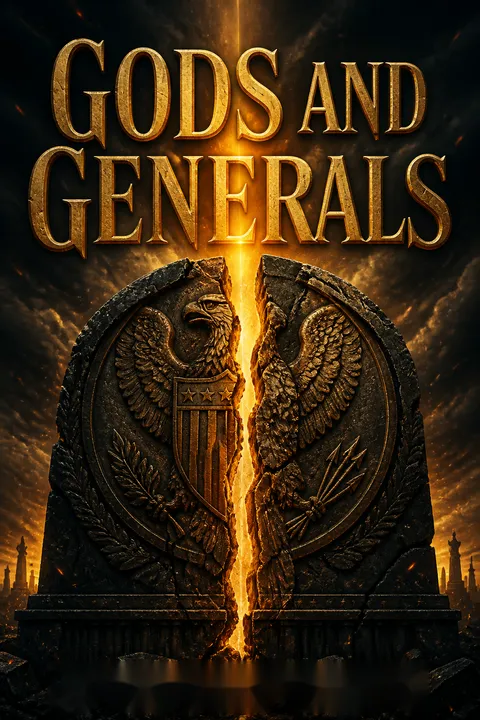
Gods and Generals treats the Civil War as a failure of political imagination that becomes a test of individual conscience. Its four central men do not enter the conflict for identical reasons: Lee follows Virginia despite opposing secession, Jackson converts duty into religious obedience, Hancock stays with the Union because he understands the nation as more than its states, and Chamberlain leaves academic life because he can no longer watch the crisis from safety. The book's structure refuses to make one position psychologically simple. Each man acts from loyalties he considers honorable, and those loyalties make friendship, family, and military service collide.
The novel's strongest recurring question concerns the distance between command and consequence. Generals speak of strategy, morale, and political necessity; soldiers cross canals, wait for missing bridges, and die on exposed slopes. Hancock repeatedly sees opportunities squandered by senior officers, while Chamberlain learns that courage cannot be manufactured by speeches. Lee and Jackson demonstrate how effective command can create victories, but the book also shows that tactical brilliance cannot overcome material scarcity or the Union's larger resources. At Fredericksburg and Chancellorsville, terrain and timing expose the human cost of decisions that look orderly on a map.
Faith deepens rather than resolves this conflict. Lee and Jackson use Providence to endure responsibility for sending men into battle, but the losses of Anna, Longstreet, and the soldiers around them resist easy consolation. Jackson's death makes Lee confront a grief that his military language cannot absorb. His later decision to invade Pennsylvania follows from a strategic problem he cannot solve by winning another defensive battle: the Confederacy must make the North feel the war's cost. The narrative closes before that gamble is tested. Its final movement is therefore not triumph but unresolved pressure, an army moving toward a confrontation whose political meaning and human price remain uncertain.
Review Summary
Gods and Generals receives mixed reviews, averaging 4.09/5. Many praise Shaara's character-driven storytelling, vivid battle descriptions, and humanization of Civil War generals. Positive reviewers highlight the emotional depth and historical accuracy, comparing it favorably to The Killer Angels. Critics argue the book romanticizes Confederate leaders, particularly Jackson and Lee, while neglecting slavery's role in the war. Some find the pacing slow and battle descriptions excessive. Most agree it offers an engaging, personalized perspective on the Civil War, though opinions differ on whether it matches his father's literary standard.
People Also Read

Characters
Robert E. Lee
Duty-bound Virginia commanderLee is a career soldier, husband to Mary, father of seven, and the central Confederate commander in the novel. He approaches nearly every crisis as a question of duty and conscience, relying on religious faith to interpret events he cannot control. His decision to serve Virginia rather than lead a federal invasion of his home is not presented as uncomplicated approval of secession; he opposes disunion but cannot separate military service from attachment to family and place. As a commander, he values capable subordinates, patient preparation, and a personal responsibility for his soldiers. His restraint in private contrasts with the force he must unleash in battle, and his sense of fatherly care extends to an army that increasingly replaces the family life his career has cost him.
Thomas Jackson
Devout battlefield asceticJackson is a former West Point artillery officer, VMI instructor, husband to Anna, and Lee's most aggressive field commander. His difficult childhood, the deaths of his first wife and infant daughter, and later family grief deepen his reliance on Presbyterian faith. He treats routine, discipline, and obedience as ways to keep himself aligned with God's purpose, while his awkward teaching manner and strange habits make him seem remote to many people around him. In battle, the same severity becomes energy: once given a task, he pursues it with little hesitation. His private tenderness appears most clearly around family and children, creating a striking contrast with the relentless soldier his troops follow.
Winfield Scott Hancock
Union line commanderHancock is a Pennsylvania-born West Point officer, husband to Almira, father, and one of the novel's principal Union commanders. His talent for organization repeatedly makes the army depend on him as a quartermaster, although he longs to lead infantry in the field. He is loyal to the Union, but not blind to the failures of its generals; he judges plans by what they demand of soldiers rather than by their political appeal. His command style combines practical attention to formation and supply with a strong emotional identification with the men under him. Hancock's friendship with Lewis Armistead makes the national fracture painfully personal, while his restraint in the face of bad orders reflects a soldier's conflict between judgment and obedience.
Joshua Lawrence Chamberlain
Restless scholar in uniformChamberlain is a Bowdoin professor, husband to Fannie, father, and eventually a lieutenant colonel in Maine's Twentieth Regiment. Brilliant and self-questioning, he has mastered academic subjects without finding the deep vocation his parents imagined for him. The war forces him to connect ideas about the Union and individual responsibility to frightened, fallible bodies. He is not an instinctive soldier; he must learn command from Ames and from the men whose lives depend on his decisions. His growing authority does not erase his reflective temperament, but it teaches him that thought can become a burden when action is required. The presence of his younger brother Tom makes military responsibility inseparable from family love.
Mary Custis Lee
Lee's absent-minded partnerMary is Lee's wife and the daughter of George Washington Parke Custis. Her illness and growing physical limitations expose the cost of Lee's long absences, even as she continues to value her independence. She is not simply a symbol of home: she can tease, resist his overprotectiveness, and make clear that his promises of care are constrained by the army's demands. Her relationship with Lee is tender but marked by years of separation and by the difference between his sense of duty and her need for his daily presence.
Anna Morrison Jackson
Jackson's steadfast wifeAnna is Jackson's second wife, the daughter of a minister, and a source of warmth within his rigidly ordered life. She has endured the loss of a child and worries that Jackson's religious certainty leaves too little room for ordinary grief. Her perspective often recognizes the human consequences of war before he does, especially the loneliness created by his devotion to duty. She supports his service without pretending that faith makes separation or danger painless.
Frances Adams Chamberlain
Chamberlain's candid partnerFannie is Chamberlain's wife and the mother of their surviving children. Moody and emotionally complex, she has known family instability and the grief of losing children. She values the security of their home and challenges Lawrence when he makes a life-changing decision without consulting her. Her support is real, but she refuses to let his idealism disguise the risk and cost his enlistment imposes on the family.
Almira Russell Hancock
Hancock's perceptive partnerAlmira, whom the narrative also calls Mira, is Hancock's wife and a mother who has followed him through military postings. Socially graceful and practical, she understands that her husband's competence can trap him in administrative work even as he longs for combat command. She handles local danger calmly, can shoot when needed, and offers emotional steadiness without simply agreeing with his fears or ambitions.
James Longstreet
Lee's steady secondLongstreet is a West Point veteran and one of Lee's most dependable commanders. His reserved manner and partial deafness can be mistaken for aloofness, while the deaths of his children leave him with a private grief he rarely discusses. He prefers caution to Jackson's headlong aggression and is often willing to challenge Lee's plans on practical grounds. Lee values his ability to hold troops together and deliver force at the moment it matters.
J.E.B. Stuart
Dashing cavalry scoutStuart is a Virginia cavalry officer, Lee's former favorite cadet, and the Confederacy's most conspicuous scout. He relishes ceremony, newspaper attention, and the morale his bold rides create, but his flair sometimes puts display ahead of reliable intelligence. Lee appreciates his energy while trying to direct it toward the army's needs. Stuart's relationship with Jackson is affectionate and teasing, especially when he tries to draw the austere general into a public symbol of command.
Lewis Armistead
Hancock's divided friendArmistead is a Virginia-born officer and a close friend of the Hancock family. His humor and sociability make him a welcome presence at their table, but his attachment to Virginia shapes how he responds to secession. His decision to leave the Union Army places friendship and military oath on opposite sides without making either bond trivial. He treats the choice as a matter of personal honor rather than an opportunity for advancement.
Jefferson Davis
Controlling Confederate presidentDavis is president of the Confederacy and a former West Point contemporary of Lee. He is intensely attentive to military detail and reluctant to trust subordinates, often inserting himself into decisions that commanders need to make in the field. He respects Lee's competence but initially keeps him in administrative work. His need for control springs partly from the fragile political and military position he oversees, yet it can obstruct communication and initiative.
George B. McClellan
Cautious Union commanderMcClellan is a West Point-trained Union general who excels at organizing and equipping a large army. His soldiers admire his care for them, and he gives Hancock the opportunity to enter field command. Yet his habit of imagining the enemy as stronger than available evidence supports repeatedly slows operations. He is neither a fool nor a coward; his caution grows from a commander who feels responsible for preserving the lives and morale of an army he has built.
Joseph Hooker
Confident Union tacticianHooker succeeds Burnside as commander of the Army of the Potomac and initially restores morale through better rations, organization, and leave policies. He designs the broad Chancellorsville maneuver that carries Union troops across the river and around Lee's position. His confidence in the plan weakens once resistance appears, however, and he retreats into defensive caution. His public assurance and private uncertainty make him a study in the gap between commanding presence and decision-making under pressure.
Ambrose Burnside
Well-meaning failed commanderBurnside is a generous, likable officer unexpectedly promoted to command the Army of the Potomac. He plans the Fredericksburg crossing and later attempts a winter advance, but logistical delays and inflexible decisions frustrate both operations. His personal decency does not supply the strategic judgment his position requires. The men under him must live with the consequences of plans he cannot adapt.
Darius Couch
Hancock's candid superiorCouch is a Union corps commander and Hancock's friend. An experienced officer with a keen sense of what battlefield opportunities require, he is increasingly frustrated by commanders who ignore sound advice. He remains disciplined about orders even when he believes them disastrous. His conversations with Hancock give voice to the army's growing concern that loyalty to a commander can become complicity in avoidable loss.
Oliver Howard
Exposed Union corps chiefHoward commands the Union Eleventh Corps at Chancellorsville. Devout and disciplined, he wants the men to respect his authority, but he has not yet earned the trust of a corps with a strong identity of its own. He accepts assurances that the western flank is safe and fails to prepare adequately for a surprise attack. His personal confidence and the army's mistaken assumptions reinforce one another.
Adelbert Ames
Chamberlain's demanding mentorAmes is the young West Point colonel assigned to command the Twentieth Maine. He sees discipline as a matter of survival and drills his inexperienced regiment relentlessly. Chamberlain initially feels out of place beside him, but Ames teaches him the practical foundations of military command. His move to Meade's staff leaves Chamberlain responsible for the regiment.
Tom Chamberlain
Lawrence's eager younger brotherTom is Chamberlain's younger brother, raised in the same Maine family and accustomed to following his older sibling into the woods. He enlists in the Twentieth Maine after Lawrence does, turning the older brother's military duty into a personal responsibility. Tom's humor and confidence contrast with Lawrence's introspection, though he is no less serious about the life they have entered.
John Brown
Militant abolitionist insurgentBrown leads the armed seizure of the Harper's Ferry arsenal in hopes of provoking a wider uprising against slavery. His small force and failed plan nevertheless make him a powerful national symbol. Lee sees a dangerous insurrectionist whose actions endanger hostages; Jackson sees a condemned man whose fate raises questions about judgment and mercy.
William Barksdale
Fredericksburg's river defenderBarksdale commands Mississippi troops defending Fredericksburg during the Union crossing. A former newspaperman and committed secessionist, he uses his brigade's positions in houses and basements to delay the engineers building pontoon bridges. His assignment buys Lee time to strengthen the heights.
John Bell Hood
Hard-charging division leaderHood is a large, forceful Texas commander whose energy inspires his troops. Lee remembers him from the cavalry and trusts him to lead difficult assaults. Hood's battlefield effectiveness stands in contrast to the political maneuvering and administrative confusion that surround the Confederate command.
A. P. Hill
Volatile Confederate commanderHill is a capable division commander whose temper and pride repeatedly bring him into conflict with superiors. Lee needs his fighting ability despite his difficulty accepting discipline. His rivalry with Longstreet and later disputes with Jackson reveal how personal ego can complicate an army already strained by scarce resources.
Sandie Pendleton
Jackson's observant staff officerPendleton serves on Jackson's staff and learns to anticipate the general's habits and silences. He handles reports, messages, and the practical details Jackson dislikes. His careful attention also lets him see the private tenderness Jackson rarely displays to other officers.
Sergeant Kilrain
Veteran soldier's conscienceKilrain is an older Irish veteran serving with Chamberlain's regiment. His experience gives him a blunt, unsentimental understanding of army life, and his early acceptance of Chamberlain helps the professor earn the men's trust. He sees the difference between patriotic speeches and the conduct required under fire.
Plot Devices
Four interwoven viewpoints
Private lives frame battleThe narrative moves among Lee, Jackson, Hancock, and Chamberlain, letting the same national crisis appear through conflicting duties rather than a single authoritative account. Lee experiences the war through command, family separation, and faith. Jackson interprets it through discipline and Providence. Hancock's perspective tests orders against their cost to soldiers, while Chamberlain moves from academic doubt toward direct responsibility. Their paths cross through battles and friendships, but they do not share one ideology. This structure makes military events legible as personal decisions and shows how the same battlefield can look like duty, sacrifice, opportunity, or failure depending on where a man stands.
Providence and faith
Meaning under pressureReligious belief shapes how characters interpret events they cannot control. Jackson turns grief and military service into tests of obedience, while Lee sees victories and losses as parts of a divine plan. Their faith can steady them, but it also risks assigning meaning to suffering before those who endure it can speak for themselves. Anna and Longstreet expose the limits of that certainty through their grief, and Hancock's less theological outlook resists treating battlefield decisions as God's work. Faith is therefore not a simple shared comfort. It is a psychological tool, a language of duty, and at times a source of distance between people who suffer differently.
Terrain and supply
Ground decides possibilityRivers, roads, hills, forests, canals, food, ammunition, and weather repeatedly determine what commanders can accomplish. Lee's defensive positions at Fredericksburg turn open ground into a trap; Burnside's missing pontoons delay an entire army; Virginia mud defeats another advance without a shot. At Chancellorsville, dense woods hide Jackson's flanking march and later make Confederate troops fire on their own commander. Supply scarcity also drives Lee's decision to invade the North. These practical details are not background decoration: they convert plans into consequences and expose the gap between political confidence and the physical labor required to move an army.
Orders and delayed messages
Command through uncertaintyThe novel repeatedly places commanders in situations where information arrives late, distorted, or not at all. Hancock waits for orders while visible opportunities vanish; Lee works around Johnston's silence; Hooker's couriers carry changing instructions across the Wilderness; Jackson's staff must reconstruct battle reports after the fighting. Letters and dispatches give distant leaders a fragile form of control, but the delay between sending and acting often makes that control imaginary. This device ties battlefield failure to communication systems rather than simply to personal courage. It also explains why officers rely on observation, local guides, scouts, and their own judgment, sometimes with disastrous consequences.
Uniforms, lemons, and names
Identity made visibleSmall recurring objects reveal how military identity is performed and privately resisted. Jackson's lemons offer a controlled pleasure and a reminder of the life he tries to discipline; Stuart's gift of a decorated uniform forces Jackson into public visibility he does not seek. Chamberlain's new rank changes how men address Tom, while Hancock's borrowed major's uniform makes his hoped-for promotion tangible. The nickname Stonewall turns Jackson from a person into a symbol his soldiers can rally around, even as he resists claiming it as personal glory. These objects and labels make abstract rank, reputation, and faith audible and visible in the daily life of the camps.
Download PDF
Download EPUB
.epub digital book format is ideal for reading ebooks on phones, tablets, and e-readers.








