Plot Summary
Rain and the Package
On a rainy day, a deliveryman navigates the city, lost in thought, until a mysterious package leads him to an unfamiliar address. The city feels alive, its moods shifting with the weather, and the package—scruffy and unremarkable—demands a signature. The deliveryman, comfortable in his routine, is drawn into a moment of uncertainty and curiosity. The rain, the unfamiliar street, and the odd package all conspire to make this delivery feel different, as if the universe itself is nudging him toward something significant. This is the beginning of a journey that will challenge his assumptions about reality, purpose, and his own role in the world.
The Ancient Avatar
Inside the house, the deliveryman meets an ancient, enigmatic old man wrapped in a red plaid blanket. The old man, later revealed as Avatar, immediately unsettles the deliveryman with philosophical questions about probability and causality. Their conversation quickly shifts from the mundane to the profound, as the old man challenges the deliveryman's understanding of agency and intention. The package, it turns out, is not for the old man but for the deliveryman himself—a metaphorical gesture that blurs the lines between giver and receiver, purpose and accident. The old man's presence is both comforting and disorienting, setting the stage for a series of mind-bending dialogues.
Free Will Paradox
The old man probes the deliveryman's beliefs about God, omnipotence, and free will. Through a series of Socratic questions, he exposes the contradictions in believing both in an all-knowing God and in human free will. If God knows the future, can humans truly choose? If God withholds knowledge, is that for our benefit or his? The conversation reveals how human concepts of love, morality, and divinity are limited by our biology and arrogance. The deliveryman is forced to confront the possibility that much of what he believes is shaped by convenience and delusion, not by evidence or logic.
Science and Its Limits
The old man shifts the discussion to science, highlighting how scientific terms like "field," "dimension," and "infinity" are placeholders for things we do not truly understand. He points out that science, like religion, is built on assumptions and convenient fictions. The deliveryman, initially comforted by the rationality of science, is unsettled by the realization that even scientific knowledge is provisional and often based on collective delusion. The old man's critique is not anti-science but rather a call to humility, reminding us that our understanding of reality is always incomplete.
The Delusion of Belief
The old man argues that few people genuinely believe in God; most believe in the utility of belief. If people truly believed, their lives would be radically different—marked by obsessive devotion and existential urgency. Instead, belief is often a social tool, a way to gain comfort, community, or moral justification. The deliveryman resists this idea, but the old man's logic is relentless: belief that does not transform behavior is not belief in reality, but belief in the usefulness of the idea. This distinction shakes the deliveryman's confidence in the sincerity of his own and others' convictions.
Maps and Meaning
The old man likens religions to road maps—tools created by those who survived the journey, not necessarily by those who understood the terrain. Each religion offers a different path, shaped by history and accident, but all serve the collective good by promoting social cohesion and happiness. The deliveryman challenges the value of religions that have caused wars, but the old man counters that all systems have costs and benefits. The conversation reframes religion as a pragmatic adaptation rather than a repository of absolute truth.
The Delusion Generator
The old man introduces the idea that the human brain is a "delusion generator," constantly simplifying reality into manageable stories. Our sense of importance, morality, and even the distinction between living and non-living things are products of this delusion. The deliveryman is forced to see himself not as the center of the universe, but as one temporary arrangement of matter among countless others. The old man's perspective is humbling, suggesting that our deepest convictions are shaped more by survival needs than by objective truth.
God's Motivation
The old man asks what could possibly motivate an omnipotent being. Human motivations—hunger, curiosity, love—are rooted in lack, but God, by definition, lacks nothing. The only conceivable challenge for God is self-destruction, to experience the unknown of non-existence. The deliveryman is shocked by the suggestion that the universe is the aftermath of God's self-annihilation—a cosmic experiment to answer the only question God could not know: what happens if I cease to exist? This radical idea reframes existence as the debris of divinity.
God's Debris Revealed
The old man explains that all matter and probability are the remnants of God's self-destruction. At the most fundamental level, everything is made of the same "God-dust," and probability is the omnipresent force that shapes reality. The deliveryman struggles to accept this metaphorical God, stripped of personality and desire, but the old man insists that all our perceptions are metaphors—useful fictions that help us navigate an incomprehensible universe. The conversation challenges the very notion of fixed reality, suggesting that all we know are models, not truths.
Probability and Reality
The old man describes how probability governs everything, from coin tosses to the emergence of life. Reality is not a continuous flow but a series of probabilistic events—God-dust disappearing and reappearing according to mathematical likelihoods. Gravity, motion, and even consciousness are explained as outcomes of probability distributions. The deliveryman is both fascinated and overwhelmed, realizing that what we perceive as causality and order are, at their core, products of chance and necessity.
The Physics of Existence
The old man challenges the deliveryman's understanding of time, space, and physical laws. He explains that time is not universal but relative to observers, and that matter itself flickers in and out of existence at the quantum level. Light, gravity, and inertia are reinterpreted as boundaries and probabilities, not as tangible forces. The deliveryman's sense of reality is destabilized, as he is forced to accept that even the most basic features of existence are not as solid as they seem.
Evolution and Coin Flips
The old man critiques the theory of evolution, comparing it to the evolution of dishware—patterns that emerge from use and survival, not from inherent purpose. He points out the gaps and oddities in evolutionary theory, suggesting that probability, not design, drives change. The analogy of the coin flip recurs: the past does not determine the future, and every moment is a new roll of the cosmic dice. The deliveryman is left to ponder the randomness and inevitability of existence.
Levels of Awareness
The old man introduces the concept of five levels of awareness, from basic self-awareness to the Avatar's recognition of all beliefs as delusions. Intelligence is not the same as awareness; true growth comes from unlearning, not accumulating facts. The Avatar's role is to gently disrupt society's delusions when they become dangerous, serving as a catalyst for balance and progress. The deliveryman realizes he is only at the fourth level—skeptical but still trapped by his own assumptions.
Relationships and Delusions
The old man analyzes relationships, explaining that people are either idea-oriented or people-oriented, and that most social interaction is driven by self-interest and the need for validation. He offers practical advice: ask questions, show interest, and understand that trust is built on perceived sacrifice and usefulness. The deliveryman learns that even conversation is a ritual of respect and connection, not just an exchange of information. The old man's insights reveal the delusions underlying love, trust, and communication.
Affirmations and Luck
The old man discusses affirmations, luck, and the subconscious mind. He explains that writing down goals works not by magic, but by tuning the mind to notice opportunities. Luck, ESP, and pattern recognition are all products of probability and the brain's ability to filter and interpret information. The deliveryman is encouraged to see that success is less about willpower and more about clarity of desire and the willingness to act. The illusion of control is powerful, but ultimately, probability rules.
The Fifth Level
The deliveryman confronts the old man about his identity, learning that the Avatar is a fifth-level human—one who sees all beliefs as delusions and serves to maintain balance in society. The Avatar's awareness is not about superiority, but about recognizing the limits of knowledge and the necessity of useful fictions. The deliveryman is humbled by the realization that awareness is about unlearning, not accumulating, and that happiness is possible at every level of delusion.
Returning Home Changed
The deliveryman leaves the Avatar's house transformed. The world appears sharper, more vivid, and interconnected. He feels a sense of expanded consciousness, as if he can perceive the hidden patterns and connections in everything. The package he received contains a simple note: "There is only one Avatar at a time." The experience lingers, leaving him with a sense of awe, humility, and responsibility. He is no longer the same person who began the journey.
After the War
In a future epilogue, a young man asks the now-aged deliveryman about the mysterious end of a great religious war. The deliveryman hints that the war ended not through force, but through a shift in collective understanding—a change sparked by ideas, not violence. The story comes full circle, returning to the metaphor of the coin flip, and suggesting that even the most profound changes in history are governed by probability, awareness, and the quiet influence of those who see beyond delusion.
Characters
The Deliveryman (Narrator)
The deliveryman is an everyman—practical, skeptical, and content with routine. His role as a courier is symbolic: he is a messenger, a conduit for ideas he does not yet understand. Psychologically, he is open-minded but resistant to change, clinging to familiar beliefs even as they are dismantled. His relationship with the Avatar is transformative; he moves from passive recipient to active seeker, forced to confront the limits of his knowledge and the illusions that shape his life. By the end, he is changed—more aware, more humble, and more attuned to the mysteries of existence.
The Avatar (Old Man)
The Avatar is ancient, enigmatic, and profoundly wise. He embodies the fifth level of awareness—one who sees all beliefs as delusions and serves to maintain balance in society. His role is both teacher and disruptor, using Socratic dialogue to challenge assumptions and provoke growth. Psychologically, he is detached from ego and personal desire, motivated only by the need to serve the greater good. His relationship with the deliveryman is both paternal and adversarial, guiding him through discomfort toward enlightenment. The Avatar's presence is a reminder that true wisdom lies in humility and service.
Probability (Conceptual Character)
Probability is personified as the true engine of the universe—the invisible hand that shapes all outcomes, from coin tosses to cosmic events. It is both impersonal and omnipotent, indifferent to human desires but essential to existence. In the narrative, probability replaces traditional notions of divine will, offering a new metaphor for understanding causality, randomness, and inevitability. Its psychological impact is profound, forcing characters to accept uncertainty and embrace humility.
God (Metaphorical Presence)
God is reimagined not as a personal being, but as the sum of all matter and probability—the debris left after self-destruction. This God is devoid of human traits, motivations, or emotions, existing only as the underlying fabric of reality. The narrative uses God as a metaphor for the unknown, the unanswerable, and the limits of human comprehension. The psychological effect is both liberating and unsettling, challenging readers to find meaning without recourse to traditional theology.
Human Brain (Symbolic Character)
The brain is depicted as a machine designed to generate comforting illusions, simplifying reality to ensure survival. It creates stories of importance, morality, and agency, even when these are not objectively true. The brain's limitations are both a source of strength and a barrier to understanding, shaping the way characters perceive themselves and the world. The narrative invites readers to question the reliability of their own minds.
Science (Personified System)
Science is portrayed as a belief system—useful, but ultimately limited by human perception and language. It offers models and metaphors, not absolute truths, and is subject to the same delusions as religion. The narrative respects science's power but warns against arrogance, urging humility and openness to mystery.
Religion (Collective Character)
Religion is depicted as a set of road maps—practical tools for navigating life, shaped by history and accident. It provides comfort, cohesion, and meaning, but is not a repository of absolute truth. The narrative critiques both blind faith and blind skepticism, advocating for a pragmatic approach to belief.
Skeptics
Skeptics are portrayed as rationalists who, through repeated success, become trapped by their own certainty. Their skepticism is both a strength and a weakness, leading to intellectual isolation and cult-like behavior. The narrative warns that skepticism, like faith, can become a delusion when it closes the mind to new possibilities.
Humanity (Collective Character)
Humanity is depicted as both insignificant and essential—temporary arrangements of matter, yet crucial to the reassembly of divine consciousness. The narrative explores the tension between individual agency and collective destiny, urging readers to find meaning in service and connection.
The Young Man (Epilogue)
In the epilogue, the young man represents the next generation—curious, skeptical, and eager to understand the mysteries of the past. His interaction with the now-aged deliveryman suggests the cyclical nature of wisdom, the transmission of ideas, and the enduring power of questions.
Plot Devices
Socratic Dialogue
The narrative is structured around a series of Socratic dialogues between the deliveryman and the Avatar. Each question peels back layers of belief, exposing contradictions and forcing the protagonist—and the reader—to confront uncomfortable truths. This device creates a sense of intellectual suspense, as each answer leads to deeper uncertainty and self-examination.
Metaphor and Analogy
The book relies heavily on metaphor—God as debris, religions as maps, the brain as a delusion generator—to translate abstract philosophical concepts into relatable images. Analogies to coin flips, dishware evolution, and curious bees make the narrative engaging and memorable, allowing readers to grasp difficult ideas through familiar experiences.
Frame Narrative
The deliveryman's journey is both literal and metaphorical, framed by the act of delivering a package. The epilogue, set after a great war, reframes the entire narrative as a catalyst for historical change, suggesting that ideas, not actions, shape the course of history.
Foreshadowing and Recursion
The recurring motif of the coin flip, introduced in the first encounter and echoed in the final scene, serves as a symbol of probability, uncertainty, and the limits of knowledge. The narrative's recursive structure—questions leading to more questions—mirrors the endless search for meaning in a universe governed by chance.
Character as Concept
Characters are often less individuals than embodiments of concepts—Avatar as awareness, the deliveryman as the seeker, probability as divinity. This device allows the narrative to explore abstract ideas through dialogue and interaction, making philosophy personal and immediate.
Analysis
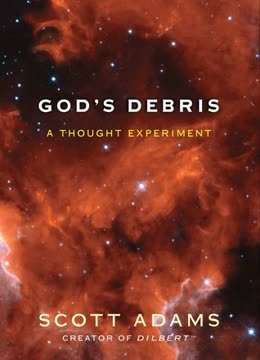
God's Debris is a thought experiment disguised as a story, using the encounter between an ordinary man and an extraordinary thinker to dismantle the comforting illusions that shape our lives. The book challenges readers to question the foundations of belief, science, and self, exposing the brain's tendency to generate delusions for survival. By reimagining God as the debris of self-destruction and probability as the true engine of existence, the narrative offers a radical alternative to both religious and scientific dogma. The lesson is not nihilism, but humility: our models of reality are always provisional, our beliefs always shaped by convenience and necessity. True wisdom lies in recognizing the limits of knowledge, embracing uncertainty, and finding meaning in service, connection, and the relentless pursuit of better questions. In a world increasingly divided by certainty and ideology, God's Debris invites us to live with curiosity, compassion, and the courage to unlearn.
Last updated:
Review Summary
God's Debris received mixed reviews. Some readers found it thought-provoking and praised its philosophical ideas, while others criticized it as pretentious and lacking substance. The book's exploration of God, probability, and human consciousness intrigued many, but its logical inconsistencies and simplistic arguments frustrated others. Some appreciated Adams' attempt to challenge conventional thinking, while others felt it fell short of its ambitious goals. The book's conversational format and brevity were generally well-received, though its content proved divisive among readers.
The Avatar Series
Similar Books