


Key Takeaways
Treat ridiculous questions as invitations to investigate real scientific unknowns.
Confusion is a starting point. The book’s central trick is to take a question nobody is expected to know, then follow it into serious science. A playful calculation asks how much all the electrons in a dolphin weigh. The answer is roughly half a pound, yet the seemingly simpler question of why some materials gain electrons when rubbed together has no complete general explanation. That process is called triboelectric charging, the transfer of electrical charge through contact between materials. It matters in phenomena such as lightning, even though its underlying details remain an active research problem.
Questions can stay open. The point is not to make every oddity useful or pretend every answer is certain. Curiosity makes it acceptable to look things up, state assumptions, and discover that the frontier of knowledge sometimes begins with a balloon and someone’s hair.
What's striking is how the questions lower the social cost of not knowing. In classrooms and workplaces, people often confuse familiarity with understanding, so asking a basic question can feel like admitting incompetence. A deliberately absurd question reverses that pressure: no one is expected to have the answer, making investigation easier to begin. This resembles good scientific practice, where a question is valuable not because it sounds prestigious but because it can be made testable. The caution is that an entertaining calculation can create an illusion of certainty. Here, the strongest answers keep uncertainty visible instead of treating every unknown as a puzzle already solved.
When scale transforms matter, follow the governing physics, not everyday intuition.
Size changes the story. Fill the Solar System with soup out to Jupiter and the sheer mass makes a black hole, with an event horizon extending beyond Uranus. The soup’s recipe no longer matters: the no hair theorem describes how a black hole loses almost all distinctive information about the material that formed it, retaining only a few properties such as mass, spin, and electric charge.
Heat can matter more than weight. Shrink Jupiter to roughly house size and its gravity is no longer extraordinary. But its compressed, extremely hot interior hydrogen is no longer held in by Jupiter’s immense gravity. It expands violently, flattening nearby homes and forming a rising fireball. Both thought experiments overturn intuition by asking what the changed scale does to mass, pressure, and gravity, rather than assuming the object behaves like a larger or smaller everyday version of itself.
This is a vivid lesson in dimensional reasoning: quantities do not all change at the same rate when a system changes size. Mass, surface area, and internal pressure scale differently, so familiar objects can cross into entirely different physical regimes. That makes “just shrink it” or “just add more” unreliable reasoning. The same habit is useful beyond physics, from assessing whether a small team can scale its processes to whether a small dose remains safe when concentrated. The boundary matters, though. These scenarios deliberately hold some properties constant while changing others, so their conclusions answer the specified imaginary setup, not every possible version of it.
Estimate first, then use evidence to test whether your answer is plausible.
Order of magnitude is enough. Fermi estimation is a way to approximate an answer by breaking it into manageable quantities, rounding aggressively, and aiming for the right scale rather than false precision. To ask whether humanity has made enough paint to cover Earth’s land, the book first estimates how much people might have painted in rooms and buildings. Those rough guesses suggest the answer is no.
Check the estimate against data. Global paint production in 2020 was about 41.5 billion liters. Assuming production grew at roughly 3 percent annually, the total produced over time comes to about 1.4 trillion liters, enough to cover around 11 trillion square meters. That is less than Russia’s area, so the rough estimate lands in the right neighborhood. Its value is not perfect accuracy. It helps reveal what information matters and whether a conclusion deserves closer investigation.
A back-of-the-envelope estimate is a practical defense against both paralysis and impressive-looking nonsense. It forces assumptions into view: population, production rate, time, and coverage per volume all have to be specified. In that sense, Fermi estimation is closely related to dimensional analysis, which checks whether the units and magnitudes in a calculation make sense. The paint result also illustrates a useful distinction: an estimate can be informative without being exact. Its weakness is sensitivity to assumptions. If production did not grow at a steady rate, the historical total would shift. The right response is not to abandon estimation, but to identify which assumptions could change the answer.
Check energy and conservation before trusting an ingenious design.
Free concentration has limits. A magnifying glass cannot make moonlight hot enough to start an ordinary fire, regardless of its size. Passive lenses and mirrors cannot make a light source appear brighter than its own surface; they form an image and spread light across an area. The conservation of étendue expresses a related optical limit: a passive system cannot arbitrarily compress light’s area and angular spread at the same time.
Power has consequences. A laser umbrella would need roughly 9 kilowatts per square meter just to vaporize rain falling at a heavy storm’s rate. That is far more intense than sunlight at the ground, so the device would heat its surroundings rather than offer a comfortable dry spot. In both cases, an appealing design runs into a constraint that cannot be talked away: optics limits concentration, and energy has to come from somewhere.
The examples show why conservation laws are more than classroom rules. They act as early filters for proposals that sound clever because they focus on the desired outcome while ignoring the costs. This reasoning connects naturally to engineering design: a system’s efficiency cannot be assessed only by what it accomplishes, but also by where its energy goes and what else it heats. A useful nuance is that a theoretical limit does not automatically make a technology impossible. Better materials or active systems can change what is practical. But they do not erase the underlying accounting, and the laser umbrella’s waste heat remains part of the design.
Find the real bottleneck: human biology and coordination can defeat brute force.
More workers do not compress time indefinitely. The book estimates that eight billion people might supply enough labor to build a city the size of Rome in somewhere from about 15 minutes to two and a half hours, depending on the rough method used. But that calculation excludes the hardest practical problems: gathering people, providing materials, training them, and keeping their work from interfering with everyone else’s.
Bodies impose limits too. In a race around Daytona, a vehicle could be engineered to go much faster than a conventional car. The driver cannot tolerate unlimited sustained acceleration. At a proposed 6 G limit, the imagined race still takes about 80 minutes. The larger lesson is to distinguish raw capacity from usable capacity. Labor, speed, and machinery matter only when coordination and the human body allow them to be used.
These examples anticipate a central idea in operations research: adding resources helps only while the task can be divided efficiently. Once work depends on communication, sequencing, or shared equipment, coordination becomes its own cost. The racing case makes a parallel point about human factors. A vehicle is not successful if its performance exceeds what its passenger can survive. This is why engineering often treats safety and usability as design constraints, not afterthoughts. The estimates are intentionally rough, especially the city-building analogy, but their purpose is diagnostic: they identify where a seemingly simple plan stops being limited by the thing people first notice.
Trace where everyday waste goes after it disappears from sight.
Tires shed more than tread. A tire can lose more than a liter of rubber over its useful life. That material does not simply accumulate on roads. Small particles become airborne or wash away in rain, spreading through soil, waterways, oceans, and the air people breathe. Tire wear is a significant source of microplastics, and research cited in the book linked a tire-derived chemical in stormwater runoff to coho salmon die-offs in the Pacific Northwest.
The boundary of the problem matters. A worn tire looks like a local maintenance issue, but the particles travel beyond the car and roadway. The book notes possible responses such as better stormwater filtration and developing less harmful tire chemicals. Neither is a quick fix. The key shift is to follow a product’s material through its whole life, including the places it ends up when users can no longer see it.
This is a compact example of externalities: costs imposed beyond the person or organization making the immediate choice. A driver sees a tire wear down, while the resulting particles are dispersed across systems that are harder to monitor and govern. Environmental policy often struggles with precisely this mismatch between private convenience and diffuse public consequences. The salmon finding adds a useful caution as well as urgency. Identifying a chemical associated with harm is not the same as solving the full ecological pathway, and the book presents further research as ongoing. Effective action therefore needs both source reduction and better measurement of where pollutants travel.
Know when a calculation has crossed beyond tested physics.
Some thought experiments outrun the evidence. Imagine an Earth made of protons and a Moon made of electrons. The electrons would repel one another so strongly that familiar calculations push their energy far beyond anything tested in particle accelerators. General relativity adds a different result: the total energy could create a black hole with roughly the mass-energy of the observable universe.
The answer still has boundaries. The book consults a string theorist who warns that calculations at such extreme energies cannot be trusted as ordinary predictions. Even if a black hole forms, what happens on the largest scale depends on dark energy, whose nature remains unknown. The value of the scenario is not a confident forecast. It shows how established equations can point toward an answer while also revealing that the answer lies outside their proven range.
Good scientific communication distinguishes mathematical extrapolation from empirical knowledge. An equation can produce a definite number even when the situation lies far beyond the conditions under which the equation has been tested. The electron Moon example models intellectual restraint: it reports what the calculations suggest, then marks the point where confidence should fall. That discipline is useful in public debate, where technical precision can be mistaken for certainty. It also avoids the opposite error of treating uncertainty as ignorance about everything. Some parts of the reasoning are well established, while the ultimate outcome remains speculative.
Make deep time visible by translating it into an ordinary journey.
A walk becomes a geological clock. Suppose each step from Austin toward New York sends the walker 30 days into the past. At a normal pace, the changing world turns into a moving history lesson. Buildings retract, farms give way to older grasslands, and the effects of European settlement reverse. Farther along, the walker encounters vanished large animals and the shifting landscapes of ice ages.
The journey ends about 300,000 years back. The modern New York shoreline is still recognizable as a coastal region, but glaciers and rivers have reshaped the terrain. This imagined route gives a physical rhythm to events that normally appear as dates on a timeline. It also shows how human history occupies only a thin slice of Earth’s past, while geology and climate keep changing on scales that exceed a lifetime.
The device works because it converts an abstract timescale into a sequence of observable changes. Narrative can make chronology memorable where a list of dates cannot. It also invites a useful shift in perspective: cities and landscapes are temporary arrangements, not fixed scenery. Still, a single route is necessarily selective. Austin to New York cannot represent every region’s climate or human history, and the backward motion is a visualization, not a literal account of how historical change unfolds. Its strength is orientation, helping readers imagine the scale of change without pretending to provide a complete account.
Think of human ancestry as an overlapping network, not separate trees.
Family trees eventually overlap. A 2004 simulation estimated that the identical ancestors point, the period when everyone alive shares the same set of ancestors from that point backward, may fall between 5000 and 2000 BCE. Before that point, lineages that leave descendants spread through populations and become shared. Afterward, people still have many different ancestors, but their family trees overlap heavily.
One estimate puts the scale in billions. The book suggests that an individual’s genealogical family tree may include 10 to 15 billion people out of roughly 120 billion humans who have ever lived. Those ancestors are not a neat, non-overlapping list: the same person can appear in many places in a family tree. Genealogical descent also does not mean that every ancestor contributed identifiable DNA to a living descendant.
The network view corrects the misleading picture created by doubling parent counts at every generation. In reality, ancestral lines converge because populations are finite and people share descendants. This can make human connectedness feel less metaphorical and more structural. Yet genealogy and genetics must be kept distinct. A person can be an ancestor in a family tree without leaving detectable genetic material in every descendant. Nor does shared ancestry erase cultural, political, or historical differences. The insight is strongest when it deepens a sense of connection without pretending that biological relatedness settles questions of identity or responsibility.
Analysis
What If? 2 is less a science textbook than a guided tour of scientific reasoning under deliberately absurd conditions. Its structure is an anthology of reader questions, long investigations, quick answers, and especially strange scenarios. That variety makes a conventional chapter-by-chapter summary less useful than a map of the habits underneath the answers: identify the dominant force, choose a tractable model, estimate the scale, and notice where the model stops being trustworthy.
The book’s humor is not decoration laid over scientific facts. It creates permission to ask questions that might otherwise seem too silly to investigate, then uses the answer to expose hidden assumptions. A soup-filled Solar System becomes a gravity problem. A proposed city-scale construction sprint becomes a coordination problem. Rain-stopping lasers become an energy budget. The entertaining reversal often comes from discovering that the intuitive feature of a situation is not its controlling feature.
A strength of the approach is its visible reasoning. Estimates are built from assumptions readers can inspect, and researchers are consulted when a speculative scenario reaches specialist territory. This makes scientific knowledge feel less like a storehouse of finished facts and more like a process of modeling, testing, and revision. The book also shows that “we do not know” can be a precise conclusion when the scenario exceeds established evidence.
The same format creates limits. Many answers depend on simplified conditions, rough estimates, or a single chosen version of the question. The results are best read as demonstrations of physical principles, not predictions for real-world planning. The comedy can also make a dramatic number memorable while leaving its assumptions less memorable. The most useful reading practice is therefore to enjoy the spectacle and ask what was held constant, what was ignored, and which result depends most on those choices. That combination preserves both the wonder and the skepticism that make the book valuable.
Review Summary
What If? 2 delights readers with scientific answers to absurd questions. Fans praise Munroe's humor, creativity, and ability to explain complex concepts. The book covers topics from filling the solar system with soup to calculating pigeons needed to lift a person. Many find it educational and entertaining, with stick-figure illustrations adding charm. Some note shorter answers compared to the first book, but most enjoy the expanded range of topics. A few readers found parts too technical, but overall it's highly recommended for science enthusiasts and curious minds alike.
People Also Read

Glossary
triboelectric charging
contact-driven charge transferThe transfer of electrical charge that can occur when two materials touch and separate. Depending on the materials, electrons may move from one surface to the other, leaving them electrically charged. The book emphasizes that scientists do not have a complete general theory explaining why particular materials gain or lose electrons through contact. The phenomenon is relevant to effects such as static electricity and lightning.
Fermi estimation
rough order-of-magnitude estimateA method for estimating a quantity by dividing a difficult question into simpler parts, making explicit approximations, and accepting an answer accurate only to roughly the right scale. Rather than seeking precision from unreliable inputs, the method tests whether a result is plausible and which assumptions matter most. The book uses it to estimate whether the world has produced enough paint to cover Earth’s land.
conservation of étendue
optical spread is conservedA principle governing passive optical systems. Light entering across a certain area and range of directions cannot be compressed into an arbitrarily smaller area while also remaining tightly confined in direction. A lens or mirror can redirect light and form an image, but it cannot make a source appear brighter than the source itself. The principle helps explain why focusing moonlight cannot produce temperatures beyond those associated with the Moon’s surface.
no hair theorem
black holes lose distinctive detailsA result in black-hole physics stating that, once matter has collapsed into a black hole, the black hole is characterized by only a small set of properties, including mass, spin, and electric charge. It does not preserve ordinary identifying features of the material that formed it. In the book’s Solar System soup scenario, this means the ingredients no longer distinguish the resulting black hole.
identical ancestors point
shared genealogical thresholdThe point in the past before which all people alive today share the same set of genealogical ancestors. A lineage from that period either left no living descendants or spread widely enough to become ancestral to everyone alive now. A cited 2004 simulation places this point somewhere between 5000 and 2000 BCE. It concerns family-tree ancestry, not identical genetic inheritance.
FAQ
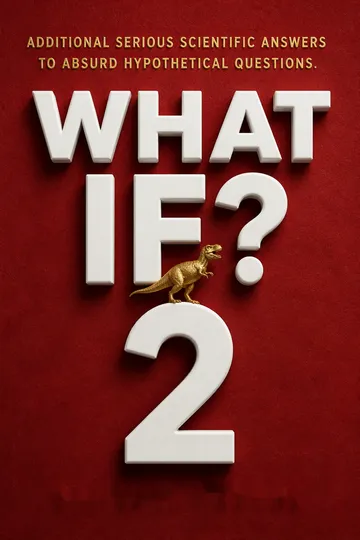
What’s What If? 2: Additional Serious Scientific Answers to Absurd Hypothetical Questions by Randall Munroe about?
- Absurd questions, serious science: The book answers imaginative and ridiculous hypothetical questions using rigorous scientific analysis, blending humor with physics, biology, and engineering.
- Sequel to a bestseller: It continues the tradition of Munroe’s original What If?, providing new scenarios and deeper scientific exploration.
- Accessible and entertaining: Munroe’s background as a physicist and cartoonist makes complex science approachable and fun, using clear explanations and playful commentary.
Why should I read What If? 2 by Randall Munroe?
- Unique humor-science blend: Munroe’s approach makes learning science enjoyable by treating absurd questions with genuine scientific rigor.
- Broad topic range: The book covers everything from cosmic phenomena to everyday curiosities, keeping readers engaged and informed.
- Critical thinking encouraged: Readers are challenged to think deeply about science, estimation, and the limits of human knowledge.
What are the key takeaways from What If? 2 by Randall Munroe?
- Science is everywhere: Even the silliest questions can reveal profound scientific truths and foster curiosity.
- Estimation and problem-solving: The book demonstrates how to break down complex problems and use Fermi estimation to approach answers.
- Embrace confusion: Munroe encourages readers to see confusion as a natural part of learning and scientific discovery.
How does Randall Munroe answer absurd hypothetical questions in What If? 2?
- Scientific method and estimation: Munroe uses physics principles, real-world data, and back-of-the-envelope calculations to provide plausible answers.
- Expert consultation: For complex topics, he consults specialists and references scientific literature to ensure accuracy.
- Balancing rigor and humor: Answers are scientifically grounded but presented with wit and accessible language, making them both accurate and entertaining.
What are some of the most fascinating questions answered in What If? 2 by Randall Munroe?
- Soup-filled Solar System: What happens if the Solar System is filled with soup out to Jupiter? It would form a black hole with an event horizon extending to Uranus.
- Heating a house with toasters: About 20 toasters could heat a typical house, but fire hazards make this impractical.
- Sliding down a fire pole from the Moon: The book explores the physics and dangers of such a journey, including gravity, orbital mechanics, and atmospheric entry.
- Proton Earth and Electron Moon: This scenario leads to discussions of black hole physics and the limits of current scientific theories.
What scientific concepts are explained in detail in What If? 2 by Randall Munroe?
- Black holes and gravity: The book explains black hole formation, event horizons, and tidal forces using imaginative scenarios.
- Heat transfer and energy: Munroe discusses how heat is produced, transferred, and why all electric devices eventually convert energy to heat.
- Optics and thermodynamics: Concepts like conservation of étendue explain why you can’t start a fire with moonlight.
- Biological and environmental science: Topics include the composition of household dust, metabolism, and ecological impacts of hypothetical events.
How does What If? 2 by Randall Munroe balance scientific accuracy and entertainment?
- Clear safety disclaimers: Munroe warns readers not to attempt dangerous experiments, emphasizing responsibility.
- Engaging storytelling: Scientific explanations are woven with humor, anecdotes, and relatable analogies to keep readers interested.
- Visual aids: The book features Munroe’s illustrations and thoughtful design to enhance understanding and enjoyment.
What is triboelectric charging, as defined and discussed in What If? 2 by Randall Munroe?
- Definition and mystery: Triboelectric charging is the transfer of electrons between materials on contact, causing static electricity, but the exact reasons for electron direction are not fully understood.
- Scientific significance: It’s crucial for understanding phenomena like lightning and has practical implications in radiation hazard modeling.
- Curiosity driver: Munroe uses this concept to show how simple, everyday observations can lead to deep scientific questions.
What does What If? 2 by Randall Munroe reveal about the relationship between heat and size?
- Heat scales with size: Larger objects produce and retain heat differently, affecting their physical properties and behavior.
- Examples from stars and buildings: The book discusses how stars cool over time and how building size impacts structural and thermal limits.
- Thermodynamic constraints: Munroe explains that no passive optical system can make something hotter than its light source, illustrating fundamental physical laws.
What practical advice or warnings does What If? 2 by Randall Munroe offer about dangerous hypotheticals?
- Don’t try dangerous stunts: The book explicitly warns against inhaling a person, filling your stomach with ammonia, or heating a house with toasters.
- Scientific explanations for risks: Munroe explains the harmful effects of these actions, using science to debunk myths and prevent harm.
- Appreciation for safety: The book’s disclaimers and explanations foster a respect for scientific boundaries and personal safety.
What does What If? 2 by Randall Munroe say about the scale and complexity of human laws and regulations?
- Vast legal landscape: Reading all applicable laws would take decades, highlighting the overwhelming volume of regulations.
- Most laws are specialized: Many laws don’t apply to everyone, but it’s hard to know which do without expert help.
- Practical legal advice: Munroe suggests using public law libraries and consulting lawyers, emphasizing the importance of professional guidance.
What are the best quotes from What If? 2 by Randall Munroe and what do they mean?
- On confusion and learning: “I like ridiculous questions because nobody is expected to know the answer, which means it’s okay to be confused.” This encourages embracing uncertainty in science.
- On black holes and soup: “It doesn’t matter what kind of ingredients you put into a black hole soup. The recipe always turns out the same in the end.” This refers to the no hair theorem in black hole physics.
- On legal complexity: “Laws give people power. If a law is complicated, it empowers people who can afford lawyers to interpret it.” This highlights the social implications of legal systems.
- On physical limits: “You can’t use lenses and mirrors to make something hotter than the surface of the light source itself.” This debunks common misconceptions about focusing light and explains a fundamental law of thermodynamics.
What If? Series
About the Author
Other books by Randall Munroe
Download PDF
Download EPUB
.epub digital book format is ideal for reading ebooks on phones, tablets, and e-readers.








