

Key Takeaways
Choose the right management culture for the work, not the fashion.
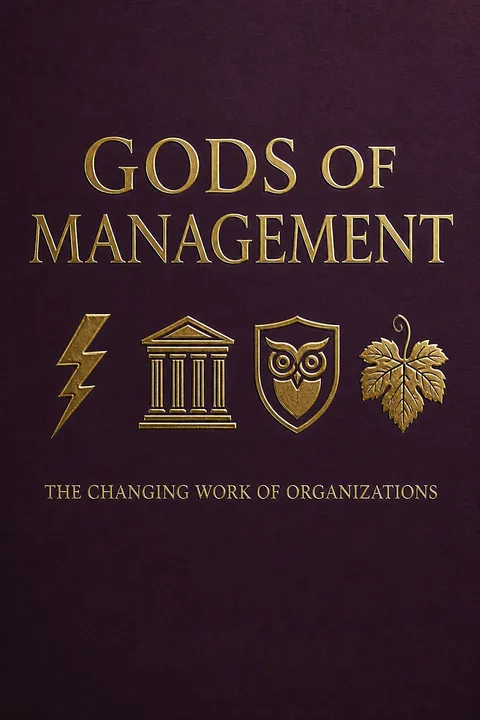
Four distinct approaches. Handy’s Theory of Cultural Propriety says an organisation should use the culture suited to its purpose and circumstances, rather than assume one management style fits all. He gives each approach a Greek god: Zeus represents personal power and fast decisions; Apollo, formal roles and rules; Athena, teams solving problems; and Dionysus, independent professionals working through association. These are patterns to recognise, not precise definitions or rigid personality types. An organisation may contain all four, but different activities call for different approaches.
Fit matters more than taste. A bureaucracy can be highly effective when work is predictable, while a loose professional partnership suits work built around individual expertise. Trouble arises when the culture does not fit the task, or when one culture tries to dominate every part of the organisation. Handy treats the resulting friction as a source of wasted resources, not merely as a matter of clashing personalities.
What's striking is that the four gods function less like personality labels than like a map of organisational design choices. They direct attention to practical questions: Who holds authority? What makes people cooperate? How much variation can the work tolerate? That makes the model useful even when a workplace does not fit neatly into one category. Its limit is the temptation to treat cultures as fixed or mutually exclusive. A team can need clear procedures and room for expert judgment at the same time. The framework works best as a diagnostic lens, not a quiz that assigns an organisation one permanent identity.
Use Zeus-style personal authority where speed outweighs perfect analysis.
Speed through trust. Zeus culture concentrates influence around a leader and a close circle. People act quickly by anticipating what the leader would decide, relying on personal contact, shared experience, and trust rather than extensive paperwork. Handy recalls joining an investment bank after working in a more formal organisation. He brought in a careful system for assessing projects, only to discover that the bank valued fast decisions on obvious opportunities more than elaborate analysis of marginal ones.
A strong centre is vulnerable. This approach can be cheap and nimble when delay costs more than an occasional mistake. But it depends heavily on the judgment and continued attention of the central figure. A poor or disinterested leader can damage the whole network, and the closeness that builds trust can also shut out outsiders. Choosing trusted people and preparing for succession are therefore essential, not optional refinements.
The useful comparison here is with decision-making under uncertainty. Detailed analysis has a cost, and its value depends on whether it can meaningfully improve a decision before the opportunity disappears. Zeus culture makes that trade-off visible. Yet speed can also become a story leaders tell to excuse unchecked intuition. Personal confidence is not evidence of accuracy, and a trusted circle can share the same blind spot. The practical question is not whether to choose instinct or analysis, but which decisions warrant which level of scrutiny, and how quickly errors can be detected and corrected.
Let Apollo standardize repetition, but never mistake routine for resilience.
Rules reward predictability. Apollo culture organises work around defined roles, procedures, and formal authority. It is effective when tomorrow resembles yesterday: a task can be analysed, divided into jobs, and carried out consistently. Handy uses life-insurance companies as a strong example, since their work depends on estimating and processing predictable events. Clear roles can also offer employees security and relief from constant improvisation.
Routine has a boundary. When conditions change, an Apollo organisation may first ignore the change, then intensify the methods it already knows. New committees and procedures can hold the structure together for a while, but they do not necessarily solve the underlying problem. A system designed for stability can become slow and brittle when products, technology, or public needs shift. The danger is not order itself. It is treating order as proof that the organisation is prepared for change.
Standardisation is often mistaken for mere bureaucracy, but it can protect quality, fairness, and reliability when tasks truly recur. The more important test is whether the underlying assumptions still hold. A process that prevents routine errors may become a source of delay when circumstances change. This distinction connects Handy’s argument to a general principle of engineering: dependable systems need both stable operating procedures and ways to detect when conditions have moved outside the design. Apollo is not the enemy of adaptation; a refusal to notice changed conditions is.
Give changing problems to Athena teams, then disband them before routine takes over.
Expertise gathers around problems. Athena culture forms teams to solve a defined challenge, drawing people and resources from across the organisation. Influence comes from relevant skill, not simply seniority. Handy describes American aerospace firms during the space race as strong examples: project teams were repeatedly assembled and reassembled, and many managers held advanced degrees. This culture suits research, consulting, advertising, and other work where the output is a new solution.
Creativity has a cost. Teams need time to talk, experiment, and correct mistakes, so they are expensive. An advertising agency Handy studied shifted toward budgets, controls, and procedures when recession squeezed its market. The change helped control costs, but also reduced room for experimentation. Athena is poorly suited to repetitive production, yet making its teams permanent can turn creative work into routine administration. The culture should change when the work changes.
Project teams are a way to bring knowledge together without forcing every specialist into the same hierarchy. That is especially valuable when the solution is not known in advance. But temporary structures can leave a difficult handoff: the people who invent a solution may not be the ones who must operate it repeatedly. Effective design therefore needs a deliberate transition from exploration to dependable delivery. The challenge is to preserve what the team learned without keeping an expensive, improvisational structure in place after the work becomes predictable.
Protect professional independence without pretending consent makes coordination effortless.
The organisation serves its members. In Dionysus culture, the organisation exists to support individuals pursuing their own professional work. Doctors might share an office and secretary; architects or artists might pool facilities while remaining independent. A professional’s allegiance is primarily to a craft or skill, not to an employer’s hierarchy. Handy calls this an organisation of consent: people may accept coordination, but they do not automatically accept orders or controls imposed without their agreement.
Freedom complicates management. These organisations can be rewarding places for experts, but leaders have few conventional sanctions. Dismissal, promotion, and financial incentives may be weak or unavailable, while each member can resist a shared decision. Professionals may cooperate willingly when their interests align, yet common work can require negotiation at every step. The model fits highly specialised talent particularly well, but independence alone does not guarantee that people will coordinate effectively.
This model distinguishes autonomy over professional judgment from freedom from every shared obligation. That distinction matters: a surgeon or researcher may need discretion in how the work is done while still accepting common standards and responsibilities. Consent can build legitimacy, but it can also give every participant an effective veto. Organisations that prize expertise therefore need clear agreements about which decisions belong to individuals and which require collective commitment. Without that boundary, respect for independence can unintentionally make joint action fragile.
Assign each kind of work its own culture, then build respectful bridges.
Three kinds of work. Handy separates organisational activity into steady-state work, development work, and asterisk situations. Steady-state work is predictable and suited to procedures. Development work tackles new problems and calls for creative teams. Asterisk situations are exceptions where the rules fail and quick personal judgment may matter most. Assigning Apollo, Athena, or Zeus to the wrong kind of work creates avoidable expense. A warehouse manager who fixes every delivery error personally, for example, may keep interrupting a task that needs a reliable routine.
Cultures still need connections. Handy recommends cultural tolerance, bridges between groups, and a shared language about priorities and results. Bridges can take the form of joint teams, shared information systems, or liaison people who connect different parts of the organisation. The right form depends on the work. Too little coordination creates mistakes; too much can feel like distrust and consume time that should be spent doing the work.
The framework is strongest when it treats coordination as a design problem rather than a demand for uniformity. Different teams can work differently while still sharing information about dependencies, standards, and outcomes. This resembles modular design: components retain useful independence but connect through explicit interfaces. Those interfaces deserve attention because coordination work can otherwise become invisible, especially for liaison staff expected to satisfy competing groups. The caution is that no bridge is free. Each one should solve a real dependency, not reassure leaders who are uncomfortable with local autonomy.
Treat slack as evidence of misfit, not as harmless organizational padding.
Buffers conceal poor fit. Handy defines organisational slack as resources used to cushion inefficiency, including extra staff, equipment, time, high margins, or tolerance for errors. Some reserve capacity is useful: it can absorb unexpected demand or prevent a small disruption from stopping all work. But slack becomes costly when it covers for a mismatch between the job and its management culture. A role-based system may add staff to handle backlogs, for instance, rather than question procedures that are creating them.
Find the source, not just the symptom. Different cultures tend to rely on different buffers. A fast-moving club may tolerate mistakes; a bureaucracy may hold extra staffing or elaborate systems; a creative team may need more time and resources to experiment. Cutting a buffer without repairing the underlying mismatch can make performance worse. The goal is not zero slack at any cost, but to know what it is buying and whether a better design could do the same job.
Slack has a double meaning. It can signal waste, but it can also provide resilience, a distinction that matters in any system facing uncertain demand. A workplace stripped of every spare person, minute, or resource may look efficient until something goes wrong. Handy’s argument is most useful as a prompt to identify why a buffer exists: planned flexibility is different from accumulated overhead that hides broken coordination. Eliminating slack by decree may improve a spreadsheet while making the actual operation less able to recover from disruption.
Shrink the operating unit before complexity turns scale into paralysis.
Scale creates its own burden. Larger organisations can gain market reach, resources, and flexibility, but they also need more coordination and formal controls. Handy argues that the resulting complexity can outrun the capacity of managers and make routine systems struggle with unpredictable events. He describes a tightly connected organisation as vulnerable to negative power: the ability of one person or group to disrupt the whole by withholding a crucial contribution. A Turkish airliner crash, linked in the book to a ground mechanic’s failure to secure a baggage door, illustrates how a small point of failure can have enormous consequences.
Resistance has a cost. When people feel powerless or alienated, disruption can be deliberate, as in a strike, or quiet, as in absenteeism. Overstaffing may conceal the problem rather than resolve it. Handy’s warning is not that large organisations are always bad, but that tightly coupled systems can make small failures or refusals disproportionately powerful.
The account points to a systems problem: when many activities depend on one another, a local breakdown can spread. That makes clear procedures and safety checks essential in high-risk operations, even if they constrain individual discretion. In less critical work, however, excessive coupling may create needless vulnerability and give small groups disproportionate leverage. The useful design question is where reliability requires tight integration and where independent units could absorb disruption. Size alone does not determine fragility; the pattern of dependencies does.
Make organizations federations of small units, not giant temples with village names.
Keep work close to people. Handy’s proposed alternative is a federation of small, relatively autonomous units, which he pictures as organisational villages. Units make many of their own decisions, while a centre coordinates shared interests, resources, and broad plans. The purpose is not simply to break a large organisation into pieces, but to retain useful cooperation without making every activity answer to one bureaucracy. Handy suggests that a working unit might need to stay small enough for its members to know one another personally.
Federate rather than isolate. The book points to companies such as Johnson & Johnson, described as having 150 independent divisions, and GEC, whose businesses retained substantial independence. The centre still matters, but its job is limited and explicit. This structure can preserve local initiative and allow comparison between units, while reducing the risk that a single failure or dispute will immobilise the whole organisation.
Federalism offers a way to hold two truths together: organisations need common resources, and local units need room to respond to their own conditions. This is more subtle than simply praising smallness. A centre can still provide financing, shared services, and rules for genuine interdependence without dictating every method. The hard part is deciding which powers belong where. If that boundary is vague, the centre may quietly rebuild the hierarchy, or local units may become isolated and duplicate essential work. Autonomy needs a constitution, not just good intentions.
Plan beyond employment: skills, portable savings, and representation must travel with you.
A working life may fragment. Handy predicts that organisations will rely more on professional cores, contractors, part-time work, and self-employment, weakening the idea of one lifelong job. He estimates that changing patterns could reduce the typical lifetime of employment from roughly 100,000 working hours to around 50,000. This is a forecast, not a measured outcome. His concern is that people may gain flexibility while losing predictable income, pension protection, and a clear occupational identity.
Independence needs support. Credentials can help people prove their skills, but credentials alone do not guarantee work or security. Handy argues for continuing education, better provision for life after employment, and organisations that help people prepare for independent work. He also explores ownership and representation as ways for workers to share in an organisation’s future. Without such protections, a flexible labour market risks dividing secure professionals from less protected workers.
The central tension is between flexibility and security. A short contract can give a skilled person control over time, but it can also transfer risk from an organisation to an individual with little bargaining power. That makes portable pensions, access to retraining, and collective representation part of the infrastructure of independence, not optional benefits. Handy’s forecast is rooted in the pressures he saw in his era, so its exact timetable should not be treated as inevitable. Its enduring question is who bears the cost when organisations become more flexible.
Analysis
Handy’s central contribution is a practical alternative to the search for one best way to manage. His four gods make visible the different assumptions that sit behind authority, coordination, motivation, and control. Their value lies less in classifying an entire organisation than in helping a reader notice when a particular activity is being managed according to the wrong logic. A production routine, an uncertain design problem, and a professional’s independent practice are not interchangeable tasks, so their management should not be interchangeable either.
The framework also connects culture to structure. It explains why misfit is expensive: a routine handled by personal intervention generates avoidable corrections; a creative task buried in procedures loses initiative; a professional treated as a subordinate may resist rather than cooperate. The ideas about bridges, slack, and negative power extend the analysis beyond individual style to dependencies between units. That systems emphasis remains useful, especially when leaders are tempted to interpret organisational failure as a defect in particular employees.
The model is a heuristic, not an empirical law. Four mythic archetypes simplify a range of motives, and national or occupational generalisations can obscure differences within a society or profession. The claim that individualism steadily displaces bureaucracy is also a historical forecast, not a guaranteed destination. Many organisations need both consistency and discretion, and the balance may change by task, risk, and time horizon.
The strongest practical reading is therefore conditional: diagnose the work, identify the assumptions embedded in its current structure, and change the design where those assumptions no longer fit. The book’s proposed federal organisation is compelling because it treats autonomy and shared purpose as compatible, but it depends on clear boundaries and real interdependence. Small units alone are not a solution. The deeper lesson is to make authority, coordination, and accountability match the work people actually do.
Review Summary
The reviews for Gods of Management are generally positive, with readers praising its insightful analysis of management styles and organizational cultures. Many appreciate Handy's use of Greek gods as metaphors for different management approaches. The book is considered a classic that remains relevant today, offering valuable frameworks for understanding corporate cultures. Some readers find it dated in certain aspects, but overall, it's viewed as an engaging and thought-provoking read that appeals to managers and general readers alike.
People Also Read




Glossary
Theory of Cultural Propriety
Culture fitted to purposeHandy’s principle that effective management depends on matching organisational culture to the work, circumstances, and people involved. It rejects the idea of one universally best management style. Different activities may need different cultures, and an organisation must connect those cultures without forcing them into uniformity.
Club Culture
Personal power and trustThe culture associated with Zeus, in which influence gathers around a central leader and a close network. Decisions depend on personal contact, trust, and intuitive judgment more than formal rules. It can move quickly, especially in entrepreneurial or uncertain settings, but relies heavily on the quality of the leader and the people in the inner circle.
Role Culture
Rules built around jobsThe culture associated with Apollo, organised through defined jobs, formal authority, procedures, and systems. Individuals occupy roles whose duties are meant to be clear and repeatable. This approach is suited to stable, predictable work, but it can become slow or brittle when conditions change and personal judgment is needed.
Task Culture
Expert teams solve problemsThe culture associated with Athena, where people and resources are assembled around a problem or project. Authority comes chiefly from relevant expertise, and success is judged by whether the task is completed. It suits development and novel work, but can be expensive and difficult to maintain when the work becomes routine.
Existential Culture
Organisation serves individualsThe culture associated with Dionysus, in which an organisation exists to support the work of independent individuals rather than to pursue a purpose above them. Professionals may share facilities or administrative help while keeping control of their own practice. Coordination depends largely on consent, which protects autonomy but can make shared decisions difficult.
Asterisk situations
Exceptions needing interventionHandy’s term for situations where established rules or routines fail and an immediate, personal response may be more effective than formal analysis or a new problem-solving process. They are distinct from steady-state work and development tasks. Asterisk situations can justify personal intervention, but treating routine work as an exception creates unnecessary cost.
Slack
Resources cushioning inefficiencyResources used to absorb peaks, mistakes, delays, or coordination failures, including spare staff, equipment, time, or financial margin. Slack can provide useful resilience when conditions vary. It becomes organisational waste when it hides a mismatch between the work and the culture or systems used to manage it.
Negative power
Power to disrupt operationsThe capacity of an individual or group to impede an organisation by withholding a contribution on which other activities depend. It may be exercised deliberately through a stoppage or emerge unintentionally when a small failure has large consequences. Handy associates its growth with tightly connected systems and people who feel powerless.
Organisations of consent
Authority accepted by membersOrganisations in which people do not automatically accept authority simply because it comes with a formal position. Leaders can coordinate and decide, but their influence depends on consultation, credibility, and the continuing acceptance of those involved. Professional partnerships and similar groups often work this way, though decision-making can become slow and demanding.
Contractual organisation
Work arranged through agreementsAn organisation that relies on contracts and fees for some of its work instead of employing everyone who performs it. The organisation specifies the expected result, while the contractor retains more control over how the work is done. This can reduce fixed costs and support independence, but raises questions about quality, bargaining power, and security.
Organisational federalism
Autonomous units, shared centreA structure that combines small, relatively independent operating units with a centre responsible for agreed common interests. The centre may coordinate planning, finance, or shared rules, while units retain discretion over much of their work. Its purpose is to preserve cooperation and scale without imposing one detailed system on every part.
FAQ
What's Gods of Management about?
- Cultural Framework: Charles B. Handy uses Greek gods to symbolize different management styles and organizational cultures, providing a unique framework for understanding management.
- Four Archetypes: The book identifies four gods—Zeus, Apollo, Athena, and Dionysus—each representing a distinct management style with its own strengths and weaknesses.
- Cultural Propriety: Handy introduces the Theory of Cultural Propriety, emphasizing the importance of aligning the right culture with the right tasks for effective management.
- Organizational Evolution: The book also explores how organizations must adapt to societal changes, highlighting the need for flexibility and adaptability in management practices.
Why should I read Gods of Management?
- Insightful Analysis: The book offers a memorable framework using mythology to make complex management concepts more relatable and easier to understand.
- Practical Applications: Handy's observations are grounded in real-world examples, providing practical insights applicable in various organizational contexts.
- Relevance to Modern Management: As organizations face rapid changes, the insights remain pertinent, helping readers prepare for future workplace challenges.
- Understanding Dynamics: It provides valuable insights into how different cultures affect organizational behavior and effectiveness, aiding managers in navigating complex environments.
What are the key takeaways of Gods of Management?
- Cultural Fit is Crucial: Success depends on aligning organizational culture with goals and tasks; misalignment can lead to inefficiency and dissatisfaction.
- Diverse Management Styles: Each god represents a management style effective in specific contexts, enhancing decision-making and performance when recognized and leveraged.
- Need for Balance: Organizations must balance different cultures to thrive, mitigating conflicts and improving effectiveness.
- Adaptation to Change: Organizations must adapt to changing societal values and workforce expectations for long-term success.
What are the four gods of management in Gods of Management?
- Zeus (Club Culture): Based on personal relationships and informal networks, with quick decision-making relying on empathy and trust.
- Apollo (Role Culture): Structured and bureaucratic, with clearly defined roles and responsibilities, valuing order and efficiency.
- Athena (Task Culture): Focuses on problem-solving and teamwork, thriving on collaboration and adaptability to change.
- Dionysus (Existential Culture): Values individualism and personal freedom, supporting individual goals with autonomy and self-direction.
How does Handy define the Theory of Cultural Propriety in Gods of Management?
- Cultural Appropriateness: Effectiveness depends on having the right culture for the right task, requiring different cultural approaches for different situations.
- Low-Definition Theory: Provides guidelines rather than strict prescriptions, allowing for flexibility and creativity in management practices.
- Cultural Awareness: Encourages managers to be aware of their own and their organization's cultural preferences for informed decision-making.
What are the implications of cultural confusion in organizations as discussed in Gods of Management?
- Inefficiency and Discontent: Cultural confusion can lead to inefficiency and decreased morale as employees struggle with conflicting expectations.
- Communication Breakdowns: Varying assumptions about communication and authority can lead to misunderstandings and hinder collaboration.
- Need for Cultural Balance: Organizations must balance different cultures to minimize confusion and enhance effectiveness, respecting diverse backgrounds.
How does Handy define the Apollonian culture in Gods of Management?
- Bureaucratic Structure: Focuses on order, rules, and predictability, thriving in large organizations with formal procedures.
- Efficiency Over Individuality: Prioritizes efficiency, often at the expense of creativity and autonomy, leading to alienation.
- Resistance to Change: Rigid structure can resist innovation and adaptability, struggling to respond to evolving demands.
What are the implications of the Dionysian management style?
- Creativity and Flexibility: Emphasizes creativity, spontaneity, and personal expression, fostering innovation and risk-taking.
- Less Hierarchical: Promotes collaboration and open communication with flatter structures, enhancing engagement and satisfaction.
- Challenges in Control: Balancing creativity with organizational goals can be challenging, requiring careful management.
How does Gods of Management address the issue of organizational size?
- Pressure for Bigness: Larger organizations often become less efficient, losing adaptability and innovation.
- Efficiency vs. Complexity: Larger organizations can become bogged down by complexity and bureaucracy, leading to inefficiencies.
- Future Trends: Handy predicts a shift towards smaller, agile units within larger entities, emphasizing flexibility and responsiveness.
How can managers apply the concepts from Gods of Management in their organizations?
- Assess Cultural Fit: Evaluate organizational culture to ensure alignment with goals and tasks, identifying areas for improvement.
- Encourage Cultural Awareness: Promote awareness of cultural preferences to enhance communication and collaboration.
- Foster Flexibility and Adaptability: Adapt management styles to suit team and organizational needs, navigating challenges and opportunities.
What are the best quotes from Gods of Management and what do they mean?
- “Management is more fun, more creative, more personal, more political and more intuitive than any textbook.”: Emphasizes that effective management requires understanding human behavior beyond rigid theories.
- “Cultural confusion is one of the principal ills that plague organizations.”: Highlights the importance of cultural alignment to avoid challenges and inefficiencies.
- “The best way to run an efficient chocolate factory will not be the right way to run an architects’ partnership.”: Illustrates the need for different management styles based on specific contexts, reinforcing cultural propriety.
How does Handy suggest organizations can balance the needs of different management styles?
- Integrating Archetypes: Incorporate elements of all four management styles to create a dynamic and responsive culture.
- Encouraging Collaboration: Leverage strengths of each archetype through collaboration, improving decision-making and innovation.
- Adapting to Change: Remain flexible and open to change, allowing management practices to evolve with societal values.
About the Author
Other books by Charles B. Handy







Download PDF
Download EPUB
.epub digital book format is ideal for reading ebooks on phones, tablets, and e-readers.








