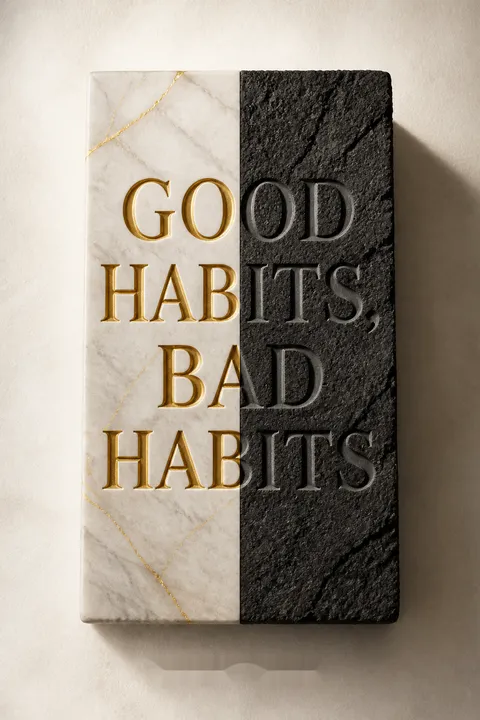


Key Takeaways
A public promise cannot outmuscle the routine that surrounds it.
Resolve starts the story. Wood opens with her cousin, who publicly vowed to lose weight and received enthusiastic encouragement. The post helped her begin: she lost two pounds in two weeks. Then progress stopped, and the public pledge became another source of disappointment. Her experience reflects a broader pattern. Weight-loss programs can produce short-term results, but five years later only about 15 percent of participants have kept off even ten pounds. A sincere promise can start change, but it cannot make daily repetition effortless.
Persistence needs another engine. Willpower-centered advice treats a lapse as evidence of weak character. Wood argues instead that repeated behavior depends on learned routines and the surroundings that cue them. The useful question is not simply whether someone wants change, but what keeps making the old action easier to repeat.
What's compelling is the shift from moral judgment to behavioral diagnosis. A public commitment can create accountability, but accountability cannot remove a kitchen full of tempting food or make a car-centered suburb walkable. The story also cautions against treating social encouragement as a complete intervention. Support matters, yet it works best when paired with practical changes to the conditions of daily life. That distinction preserves personal agency while refusing to mistake difficulty for a character defect.
Turn goals into habits, because persistence runs largely outside awareness.
A habit is learned action. Wood defines a habit as a mental link between a familiar cue and a response, built through repeating that response in a context and receiving some reward. Its automaticity means the action can start with little conscious thought. In experience-sampling studies, people performed about 43 percent of their daily actions habitually. They might shower, work, or exercise while thinking about something else entirely.
The cue matters more than the reason. Frequent runners recognized running quickly when shown words for their usual routes, but not when shown their stated goals, such as fitness or weight control. Repetition had linked the place to the action. The goal may start a routine, but the familiar setting increasingly prompts it without renewed debate.
The concept helps explain why people often misread their own behavior: deliberate thought is vivid, while learned routines are quiet. It also reframes persistence as a property of the person-in-context, not merely a stable personality trait. The 43 percent estimate is striking, but it comes from particular samples and methods, so it should be treated as evidence that habits are pervasive, not as a universal constant. The practical insight remains strong: examine recurring cues, not only stated motives.
Remove temptations before they demand a test of willpower.
Hide the marshmallow. In the famous preschool experiment, children waited longer for a second treat when the first was out of sight than when it sat in front of them. The difference was not a sudden upgrade in character. The situation changed. In a study of everyday desires, people who scored high on self-control reported fewer conflicts with temptation in the first place. They were not constantly resisting; their routines and surroundings helped keep unwanted urges from arising.
Change the setting first. Students reported greater success when they studied in a library or blocked distracting websites than when they relied on sheer restraint. Wood’s experiments also found that a practiced healthy choice could beat a tempting alternative, but only while the familiar cue remained in place.
This account makes self-control a design problem as much as a mental skill. It resonates with choice architecture, the study of how the arrangement of options shapes decisions without eliminating choice. The advice is useful because it reduces repeated exposure to temptation, rather than demanding heroic resistance at every encounter. Still, environmental control is not equally available to everyone. Work schedules, caregiving, housing, and money can constrain which settings a person can choose, so the approach should not become another basis for blame.
Make the wanted action easier than its tempting competitor.
Small barriers matter. Context includes place, time, people, objects, and what happened just before. These surroundings create friction, meaning the effort that makes an action harder or easier. In one food study, participants ate about three times as much popcorn when it was within easy reach as when it required standing up. In another, residents near temporary farm stands bought more produce, without health lectures or advertising.
Design the path. Put useful choices where they are easy to notice and take, and add steps to unwanted ones. The book describes smoking bans as an especially powerful public example: separating smoking from pubs, offices, and restaurants disrupted familiar cues to light up. A new law did not erase desire, but it made the habitual response less convenient.
Friction is a useful bridge between psychology and design. A few extra steps can interrupt an automatic action, while a visible, nearby option can make a better response more likely. The approach also exposes how commercial environments are engineered: convenience often serves the seller, not the consumer. The caution is that friction is not a neutral tool. It can promote health, but it can also exclude people or make essential services harder to reach. Good design asks whose behavior is being made easy.
Repeat in stable contexts; habits take weeks, not a magic 21 days.
Repetition changes effort. The claim that any new behavior becomes a habit in 21 days traces to a guess in an older self-help book, not a firm scientific rule. In a study following people as they adopted simple health behaviors, automaticity increased with repeated practice. On average, the action felt mostly automatic after about 66 days. The time varied: a healthy drink took less repetition than exercise, which involved more steps.
Missing once is not starting over. Participants could miss a day or two without erasing their progress. The hard part was creating enough opportunities to repeat the action, especially when motivation and good intentions were the only support. A consistent time or setting can reduce that burden and help the response come to mind more readily.
The value here is not a replacement countdown, but permission to stop expecting a fixed deadline. Habit strength accumulates gradually, and complex behaviors plausibly require more learning than simple ones. The study also highlights a common research limitation: participants often struggle to maintain the very behavior being measured. Its average should therefore guide expectations, not dictate them. A better measure of progress is whether the same action is becoming easier to initiate in its usual setting.
Reward the new behavior immediately, preferably with pleasure built into it.
The payoff teaches the brain. An unexpected reward can produce a reward prediction error, a difference between what the brain expected and what it received. This signal helps strengthen learning, but it is most useful when the reward follows the action closely. Enjoyment built into an activity, such as pleasure in a story shared with a child, can therefore reinforce repetition more effectively than a distant prize.
Big incentives can miss the target. In one weight-loss study, participants could earn $100 for meeting a monthly weight target. They lost about five pounds on average during the program, then regained much of it after payments stopped. The reward was delayed and attached to the scale, not to a specific repeated behavior. By contrast, making handwashing fun with a toy inside a child’s soap increased washing.
The distinction between an outcome reward and a behavior-linked reward is central. A distant prize may motivate planning, but it offers little immediate feedback for the repeated act that needs to become familiar. Intrinsic enjoyment is especially valuable because it can persist without a payment system. Uncertainty can also heighten engagement, as phone notifications demonstrate, but that same mechanism can be exploited. Reward design should support valued behavior without turning every routine into a slot machine.
Attach new actions to reliable cues already anchored in your day.
Borrow an existing routine. Stacking is the practice of placing a new action beside an established one, so the familiar action cues the new response. In a flossing study, participants who flossed after their regular toothbrushing kept flossing more often months later than those who tried to floss first. Brushing already provided a dependable prompt.
Keep the cue predictable. Time can be a cue as well as a place or object. Studies of medication adherence found that people who took pills at a consistent time were more reliable than those whose timing varied, even when people’s beliefs about the medicine did not predict adherence. A routine is easier to learn when its cue appears repeatedly. The new action should also fit naturally with the existing one, rather than requiring a fresh decision every day.
This is a practical application of associative learning: one reliable event can become a retrieval cue for another. It is more robust than merely writing down an intention because it uses a pattern that already exists. Compatibility matters, though. A new action that makes an established routine unpleasant may weaken both behaviors. The best additions are small enough to fit the old sequence and rewarding enough that the combined routine remains worth repeating.
Use life changes to interrupt bad routines, then choose deliberately.
Disruption opens a window. Habit discontinuity occurs when a changed setting removes familiar cues and forces people to reconsider what they do. During a London Underground strike, more than 18,000 regular commuters had to find new routes. Their journeys took only about 6 percent longer on average, and some discovered faster options. Their old commute had been familiar, not necessarily best.
A reset can cut both ways. Moving can loosen old travel habits and give current values more influence, but disruption can also damage useful routines. A move may interrupt exercise, while a break in regular tax payments can make restarting less likely. When circumstances shift, protect the cues that support good habits and use the open space to reconsider routines that no longer serve you.
Transitions can function like forced experiments: the usual response is unavailable, so alternatives become visible. This helps explain why moves, new jobs, and other major changes can create opportunities for behavior change. But disruption is not automatically liberating. It also removes structure that may have been working well. A useful response is selective continuity: deliberately preserve beneficial cues while questioning routines that survived mainly because they were convenient.
Build useful habits before stress makes improvisation harder.
Stress favors familiar responses. In one experiment, students learned to choose shapes for a reward. When the reward stopped, unstressed students began testing alternatives. Students exposed to a stressful task kept repeating their old response. Stress had made flexible reconsideration harder while leaving practiced behavior available.
The habit itself is neutral. During exam weeks, students were more likely to repeat their established breakfast and newspaper routines. That helped students with useful habits and reinforced less helpful ones, too. Habits can keep a valued behavior going when attention is strained, but they can also preserve a response that no longer fits the moment. That is why the best time to establish a beneficial routine is before a crisis, not during one.
The resilience of habit is a form of cognitive backup: when attention is consumed by a threat, learned actions can continue with less deliberation. This is valuable for health routines and basic responsibilities, yet it also explains why stress can entrench harmful patterns. The implication is not to eliminate automaticity, but to be selective about what becomes automatic. In high-stakes settings, reliable routines should handle known tasks while leaving room for deliberate checks when conditions change.
Repeat unfamiliar good experiences until comfort catches up with intention.
Action can shape preference. In a preschool study, children who initially resisted artichoke puree were offered it repeatedly, about 15 times over two months. They gradually ate much more, and adding sugar or fat did not improve the result. Familiarity itself helped. The mere exposure effect describes how repeated contact can make something feel more familiar and appealing, even when people do not consciously notice their preferences changing.
Rituals use repetition differently. They attach meaning to repeated sequences, often helping people manage uncertainty or anxiety. Experiments found that performing a ritual could reduce distress about losing or anxiety before singing. Rituals do not magically change the external outcome, but their structure can make a person feel more settled and in control.
This insight makes preference less fixed than it feels. Repetition can expand what seems acceptable, which is useful for new foods, skills, and routines. It also has a darker side: familiarity can make an unhealthy pattern feel normal or safe. Rituals show that repeated action can serve emotional needs even without changing external circumstances. The distinction matters. Exposure may cultivate liking, while ritual can provide order; neither guarantees that the resulting preference or belief is accurate.
Treat addiction as a brain condition shaped by surroundings, not will alone.
Context can alter use. During the Vietnam War, many soldiers encountered heroin in an unusually available, stressful setting. Among those who tested positive for narcotics as they left Vietnam, about 5 percent remained addicted during their first year back in the United States. Most did not receive treatment. Returning home changed the cues, access, stress, and rewards around them.
Recovery needs alternatives. Rat studies described in the book likewise found less drug-seeking in enriched, social settings than in isolation. This does not mean addiction is merely a bad habit or that context explains every case. The book recognizes addiction’s neurological and social complexity. Its practical point is that treatment should also make sober life more rewarding and reduce exposure to settings that continually cue use.
This perspective adds a humane environmental dimension to a disorder often framed only as an individual battle. Stable housing, employment, social connection, and distance from cues can alter what actions are available and rewarding. The Vietnam evidence is powerful but not a controlled treatment trial, and its dramatic context limits direct generalization. It should broaden treatment strategies, not replace medical care or minimize craving. Recovery is more plausibly supported when clinical help and life circumstances work together.
Change public defaults so healthy actions stop requiring private heroics.
Information alone is weak. The 5 A Day campaign raised awareness of fruit and vegetable recommendations, but the share of Americans eating five servings daily stayed around 11 percent for years. Knowledge did not reorganize shopping or eating routines. By contrast, policy can alter what people encounter and how much effort an action requires.
Defaults scale behavior change. Smoke-free laws, taxes, and advertising restrictions helped make smoking less convenient and less visible. Automatic enrollment in retirement savings also made saving the default, with opting out requiring extra effort. Such policies do not remove choice. They change the surrounding conditions so that the beneficial option is easier to repeat, rather than asking every person to win the same private struggle alone.
The book’s account of habits scales from kitchens and commutes to institutions. Choice architecture can improve health and financial security by changing defaults, access, and cues. This also reframes unequal outcomes: when sidewalks, fresh food, or treatment are unavailable, motivation cannot compensate reliably. Yet defaults carry political and ethical questions about who defines a good choice and who bears its costs. Effective policy needs evidence, transparency, and room for people to refuse.
Analysis
Wood’s central contribution is to relocate persistence from the heroic conscious self to the interaction between learned responses and everyday settings. The book does not claim that intentions are useless. Intentions help initiate change, identify goals, and decide which routines deserve cultivation. Its narrower and more persuasive claim is that intentions alone do not reliably sustain repeated behavior. Repetition in a stable context builds cue-response links that can continue when attention, motivation, or energy fluctuates.
That framework connects individual psychology to practical design. A kitchen, commute, phone interface, workplace, or neighborhood is not neutral background. Each makes some actions easier to encounter and repeat. This explains both why personal resolutions often fail and why public policies can shift behavior without changing anyone’s beliefs. The account is especially compelling when it contrasts information campaigns with changes to access, timing, visibility, or convenience.
The framework also clarifies why habit is neither inherently virtuous nor inherently harmful. The same learning process can support medication adherence, exercise, smoking, or compulsive checking. Repetition can make good actions resilient, but it can also narrow attention and keep an obsolete response running. Disruptions offer a chance to reconsider, yet they can weaken helpful routines as readily as harmful ones. Deliberation remains essential when the environment changes or consequences require flexible judgment.
The strongest practical lesson is therefore not to surrender agency, but to spend it upstream. Use conscious planning to select the response, arrange the cue, reduce avoidable friction, and make repetition rewarding. Then the routine can carry part of the load. This approach has limits: people do not control every feature of their housing, work, health, or social environment, and addiction cannot be reduced to context alone. Those limits strengthen the book’s wider implication. Durable change is not just an individual achievement. It depends on supportive relationships and systems that make worthwhile actions repeatable.
Review Summary
Good Habits, Bad Habits receives mostly positive reviews, with readers appreciating its scientific approach to habit formation. Many find the book informative and thought-provoking, praising Wood's research-based insights. Some readers note the book's complexity and depth, which may be challenging for casual readers. The practical advice on habit change is generally well-received, though some wish for more concrete steps. Critics mention the book's length and occasional repetitiveness. Overall, readers value the book's fresh perspective on habits and its potential to help make positive life changes.
People Also Read




Glossary
habit
Cue-linked learned responseA habit is a mental association between a recurring context cue and an action. It develops as the action is repeated in that context and has been rewarding. Once learned, the cue can prompt the action with little conscious deliberation, even when the person’s immediate goals or desires have shifted.
second self
Automatic side of behaviorWood’s metaphor for the largely nonconscious processes that store and repeat learned actions. This side of the person works alongside deliberate decision-making, responding to familiar cues without requiring a fresh conscious choice. It is not a separate personality, but a way to describe the habitual mechanisms that conscious introspection often overlooks.
introspection illusion
Overestimating conscious influenceThe tendency to assume that one’s actions are mainly caused by consciously accessible thoughts, feelings, and intentions. Because these inner experiences feel vivid, people can overlook cues, routines, and other nonconscious influences. They may then invent plausible explanations for choices that were partly guided by habit or context.
habit discontinuity
Context change interrupts habitsA disruption in familiar surroundings that removes or changes cues normally linked to a response. Moving, changing jobs, or losing a usual transit route can make an automatic action difficult to repeat. The person must reconsider what to do, creating an opportunity to alter a routine, but also risking the loss of useful habits.
reward prediction error
Difference between expected and received rewardA learning signal that occurs when an outcome differs from what was expected. A reward that is unexpectedly better can strengthen the association between a context and an action. A disappointing or absent reward can weaken that learning. Wood emphasizes that rewards are most useful for habit formation when experienced soon after the behavior.
mere exposure
Familiarity can increase likingA psychological effect in which repeated exposure to a person, object, or experience can make it feel more familiar and appealing. People may prefer what they recognize without being aware that repetition shaped the preference. This can encourage new tastes and routines, but can also make unhelpful patterns feel comfortable.
double law of habit
Repetition strengthens, sensation fadesA concept attributed to philosopher Félix Ravaisson: repeated action increases a person’s tendency to perform it while reducing the felt intensity or novelty of the experience. This helps explain why practice makes actions easier, but also why familiar activities and relationships can lose their vividness even as they become more automatic.
mise en place
Prepare the setting beforehandA professional kitchen practice of arranging tools, ingredients, and steps before cooking begins. Wood uses it as a model for behavior change: prepare the environment so the desired action is easy to start and complete, with fewer missing materials, distractions, and decisions. The planning takes effort up front but can support smoother repetition.
nudge
Choice design that shifts behaviorA change to the way options are presented or arranged that predictably influences behavior without banning alternatives or greatly changing financial incentives. Examples discussed in the book include automatic enrollment in retirement savings and opt-out organ donation systems. Nudges work by shaping defaults and effort, rather than relying only on people to deliberate.
FAQ
What's Good Habits, Bad Habits about?
- Focus on Habit Formation: The book delves into the science of how habits are formed, maintained, and changed, emphasizing the automatic nature of habits.
- Dual Nature of Self: Wendy Wood introduces the concept of a "second self" that operates on automaticity, explaining why intentions often fail to lead to lasting change.
- Role of Context: The importance of context and repetition in habit formation is highlighted, with stable environments being crucial for developing new habits.
Why should I read Good Habits, Bad Habits?
- Practical Insights: The book offers actionable insights into creating and maintaining good habits while breaking bad ones, using scientific research and relatable examples.
- Understanding Human Behavior: Readers gain a deeper understanding of the psychological and neurological underpinnings of behaviors, empowering informed daily choices.
- Long-Term Change: It provides a framework for sustainable change, focusing on habit formation rather than quick fixes.
What are the key takeaways of Good Habits, Bad Habits?
- Habits Are Automatic: Habits operate outside of conscious thought, making them powerful drivers of behavior that can be leveraged to one's advantage.
- Context Matters: The context in which behaviors occur significantly influences habit formation, with stable environments facilitating good habits.
- Repetition Is Essential: Repetition is crucial for habit formation, with an average of 66 days needed to form a new habit, highlighting persistence and consistency.
How does Good Habits, Bad Habits define a habit?
- Mental Association: A habit is a mental association between a context cue and a response developed through repetition.
- Automaticity: Habits are characterized by automaticity, allowing actions to be performed without conscious thought, aiding efficiency in daily tasks.
- Influence of Rewards: Habit formation is closely tied to rewards, which reinforce behavior and strengthen mental associations.
What role does context play in habit formation according to Good Habits, Bad Habits?
- Stable Environments: Stable contexts are crucial for habit formation, as consistent environments make it easier to trigger habitual responses.
- Cues and Triggers: Context cues, like time or location, serve as triggers for habitual behaviors, facilitating automatic execution of desired habits.
- Disruption of Habits: Changes in context can disrupt existing habits, offering opportunities for new habits but also risks of reverting to old behaviors.
How does repetition contribute to habit formation in Good Habits, Bad Habits?
- Building Automaticity: Repetition strengthens mental associations between cues and responses, making behaviors more automatic.
- Timeframe for Habits: It typically takes about 66 days of consistent repetition for a new behavior to feel automatic, emphasizing persistence.
- Reducing Decision Fatigue: As behaviors become habitual, they require less cognitive effort, conserving mental energy for other tasks.
What strategies does Good Habits, Bad Habits suggest for breaking bad habits?
- Identify Triggers: Identify specific cues that trigger bad habits to eliminate or alter them in your environment.
- Create Friction: Increase friction for bad habits by making them more difficult to engage in, such as removing temptations.
- Replace with Good Habits: Instead of eliminating a bad habit, replace it with a positive one to redirect behavior and create healthier patterns.
What are some practical methods for changing habits mentioned in Good Habits, Bad Habits?
- Remove Cues: Eliminate cues that trigger unwanted habits, like leaving your phone in another room to reduce usage.
- Add Friction: Increase effort required for bad habits, such as storing junk food out of reach to reduce consumption.
- Stack New Habits: Pair a new behavior with an existing habit to reinforce it through habit stacking.
How does Good Habits, Bad Habits address the concept of willpower?
- Willpower is Limited: Relying solely on willpower to change habits is often ineffective, as habits are more powerful than conscious intentions.
- Focus on Context: Modify the environment to support desired behaviors, reducing reliance on willpower.
- Building Automaticity: Create supportive contexts and routines to develop habits that require less conscious effort, allowing sustainable change.
What role do rewards play in habit formation according to Good Habits, Bad Habits?
- Immediate Feedback: Rewards provide immediate feedback for desired behaviors, reinforcing the connection between action and positive outcome.
- Dopamine Release: Unexpected rewards trigger dopamine release, strengthening habit associations and driving motivation.
- Balancing Rewards and Effort: For a habit to stick, rewards must outweigh the effort required, maintaining motivation and consistency.
How can understanding habits improve personal well-being as discussed in Good Habits, Bad Habits?
- Aligning Habits with Values: Assess habits to ensure they align with personal values and goals, leading to greater satisfaction and fulfillment.
- Reducing Stress through Routines: Positive habits create stability and predictability, reducing stress and aiding time management.
- Empowerment through Knowledge: Understanding the science of habits empowers individuals to take control of behaviors and make informed choices.
What are the best quotes from Good Habits, Bad Habits and what do they mean?
- "Habit is, as it were, a second nature.": Habits become ingrained, operating without conscious awareness, as fundamental as innate characteristics.
- "We need to stop overestimating our rational selves.": Highlights the misconception of rational decision-making, advocating for better environments for habit formation.
- "Repetition strengthens our tendency to act, but it also weakens our sensation of that act.": Reflects the double law of habit, where repetition solidifies habits but can dull awareness, leading to complacency.
Download PDF
Download EPUB
.epub digital book format is ideal for reading ebooks on phones, tablets, and e-readers.








