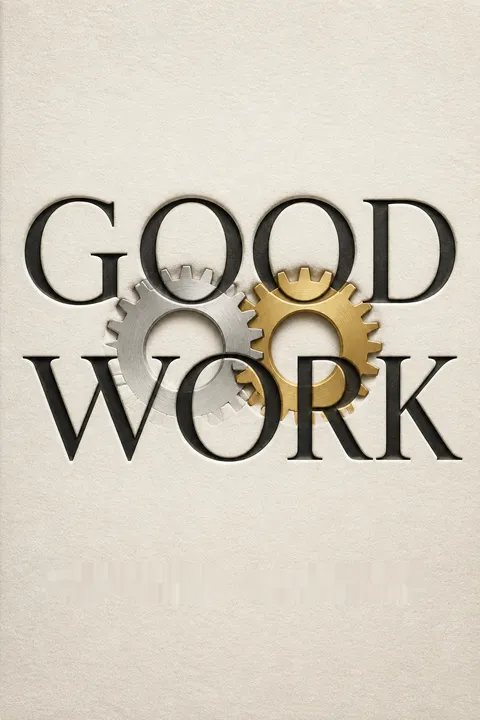


Key Takeaways
Good work joins expert skill to responsibility for consequences
Two tests, not one. Good work combines excellent performance with responsibility to the people affected by it. A journalist may report skillfully, for instance, yet fail the ethical test by exaggerating a rare danger to attract viewers. The book follows geneticists and journalists to show why professional pride alone cannot define success: the work must meet the standards of its craft and serve a wider human purpose.
Enjoyment is a clue. The authors use flow experiences to describe deep engagement when a task’s demands fit a worker’s abilities, goals are clear, and feedback is immediate. Such concentration often makes work fulfilling. But it is not a moral certificate: a person can be absorbed in harmful work, and responsible work can be frustrating. Quality, ethics, and personal engagement must be considered together.
The distinction between doing something well and doing something worthwhile is essential wherever skill gives people power over others. It also guards against a common mistake in organizations: treating enthusiasm or productivity as proof of public value. Deep engagement can support learning and craftsmanship, but it can also make workers less likely to question a harmful goal. A useful extension is to ask not only whether a worker is thriving, but who benefits, who bears risk, and who gets to judge the result.
When orders conflict with your calling, test mission, standards, and identity
Three questions clarify conflict. The authors advise workers to examine the profession’s mission, its established standards, and their own identity. Mission asks what social need the profession exists to meet. Standards ask what its best practitioners consider sound practice. Identity asks which actions fit the person’s core values. A worker can use these questions when an employer’s instructions pull against professional judgment.
Suarez’s test case. In commercial television, journalist Ray Suarez was told to present a story about video games and seizures in a way he believed would exaggerate a rare risk. He objected, but management prevailed. The book’s mirror test asks whether a person can live with the action taken. A broader version asks what the world would be like if everyone acted that way. Suarez eventually left for public broadcasting.
This framework usefully separates competing sources of obligation instead of reducing every dilemma to personal courage. It resembles professional decision tools in medicine and law, where duties to clients, institutions, and the public can collide. The mirror test adds an accessible check on self-deception, though private conscience is not infallible: people can feel clean while harming others. Pairing self-scrutiny with peer review and transparent standards makes the test harder to manipulate.
Map who shapes a profession before blaming individual workers
Four parts make a profession. The book’s model includes practitioners, a domain of shared knowledge and ethical rules, a field of working professionals and institutions, and other stakeholders. These stakeholders include corporate owners and the public. Professions also rely on gatekeepers, such as journal editors or medical school leaders, who influence which work is recognized and rewarded. The arrangement is a social contract: professionals provide needed services, and society grants them authority and status.
Pressure travels through the system. A physician may know the right treatment yet work for a managed-care organization that restricts time or payment. A reporter may value investigative work while an owner rewards ratings. Focusing only on the worker misses how institutions and incentives define which choices are realistic, which conduct is rewarded, and which voices have influence.
This systems view helps explain why ethical advice to individuals often has limited effect. A worker’s choices are shaped by training, professional norms, supervisors, funding, and public demand. In organizational analysis, this resembles a principal-agent problem: people assigned to serve one purpose answer to actors who may reward another. Still, systems do not absolve individuals of responsibility. The model is strongest when it shows both how incentives constrain action and where practitioners can exercise judgment or organize with colleagues.
A calm profession can hide dangerous misalignment
Alignment is a temporary fit. The authors call a profession authentically aligned when practitioners’ aims, the domain’s values, the field’s institutions, and stakeholder expectations broadly support one another. In the study, geneticists often saw their work as advancing health while attracting public interest and investment. Journalists, by contrast, described conflict between the mission of informing the public, corporate demands for profit, and audience appetite for sensational stories.
Harmony can mislead. Geneticists’ apparent consensus did not mean every incentive was safe. Commercial ties could encourage secrecy or blur public service with private gain. Journalism’s visible disorder could, in turn, make its threats easier to identify and resist. The authors also distinguish breakdown of shared norms, called anomie, from rigid norms that make people unwilling to do their work, called alienation. Neither alignment nor conflict lasts forever.
The comparison challenges the assumption that a smoothly functioning institution is necessarily healthy. A system can appear harmonious because dissent is costly or because harms have not yet become visible. Conversely, conflict can expose neglected problems and create pressure for reform. This resembles the value of dissent in scientific communities: disagreement can improve error detection when people have protected ways to raise it. The caution is that conflict alone does not produce change; workers also need authority, allies, and channels for action.
Protect truth by giving facts context, verification, and breathing room
News is more than data. The book treats information as material that changes what people understand or do, not merely a pile of facts. It uses the term memes for units of learned information that people transmit and that can shape how they think. Journalism therefore has special power: its reports help form the public’s picture of events. Truthful reporting requires verification and context, not just accurate fragments arranged for attention.
The costs of speed. Journalists interviewed in the study said faster deadlines and budget cuts reduced time for checking, reflection, and foreign reporting. They also described pressure to favor dramatic, easy-to-follow stories over complex public issues. A Los Angeles Times magazine partnership with the Staples Center blurred advertising and editorial work, damaging trust. The authors argue that the press needs editorial independence precisely because it serves both an audience and owners with commercial interests.
This account treats trustworthy journalism as civic infrastructure, not simply a product competing for attention. Context helps readers distinguish an isolated event from a meaningful pattern, while verification makes correction possible before rumor hardens into belief. The same principle applies to science communication and online information: distribution is not the same as understanding. Yet “context” is itself a judgment, not a neutral container. Transparency about evidence, uncertainty, and editorial choices can make that judgment more accountable.
Treat genetic breakthroughs as public responsibilities, not merely scientific wins
Discovery creates obligations. Geneticists in the study described a thrilling period of rapid progress, from the identification of DNA’s structure to genome mapping and new therapeutic possibilities. In 1975, researchers met at Asilomar and voluntarily paused some recombinant DNA experiments while considering risks. The episode showed that scientists could scrutinize their own work and accept limits rather than treating every technical possibility as an automatic good.
Commercial incentives complicate trust. The authors found that many geneticists expressed little concern about patenting discoveries or licensing them for profit, even when research was publicly funded. Yet the death of Jesse Gelsinger during a gene therapy trial exposed risks in experimental oversight and conflicts of interest involving the investigator and university. Commercial funding can bring resources and speed, but it can also reward secrecy, narrow research toward profitable conditions, and weaken independent scrutiny.
The chapter’s strongest lesson is not that commercial science is inherently corrupt, but that financial ties can distort judgment in ways that are difficult for insiders to see. Independent oversight, disclosure, and public access to results function as safeguards against both misconduct and sincere overconfidence. The comparison with journalism is instructive: each field mediates information that the public cannot easily verify alone. Still, caution must be proportionate. Excessive restriction can also delay valuable research, so governance must distinguish preventable conflicts from legitimate scientific risk.
Use voice, allies, exit, or institution-building to defend good work
Workers have choices, but not equal costs. When Ray Suarez lost his argument with a television executive, he left commercial news for public broadcasting, where he could continue practicing journalism. The authors describe a wider range of responses: comply, keep arguing, organize with colleagues, resign, or seek to create a workplace better suited to one’s values. The right move depends on a worker’s resources, responsibilities, and the chance of changing the institution.
Exit is not a cure-all. Journalist Carol Marin resigned after her station added Jerry Springer to its news program, believing the move degraded the news. She later led an investigative newscast, but it was canceled after eight months. Her case shows that personal integrity can be preserved without securing institutional change. Building alternatives, as public broadcasting and independent news ventures attempted, can offer a more durable path, though new institutions still need audiences and financial support.
The available choices echo Albert Hirschman’s account of voice, loyalty, and exit: people can challenge an organization, remain committed while seeking change, or leave. The book adds institution-building as a way to make a better destination rather than merely abandon a bad one. That option is powerful but unequally available. Workers with savings, status, or portable skills can exit more safely than those with fewer resources. Collective action and protections for dissent help distribute the burden beyond the lone principled employee.
Teach character alongside technique, because ethical judgment is learned socially
Competence needs character. Professional training teaches the skills required to perform a job, but workers also need values to guide decisions when rules do not settle the question. The authors describe development as both individual competence and moral character, joined to participation in a community. A geneticist learns careful data practices partly by watching a mentor; a journalist learns how to verify a story through newsroom habits and experienced colleagues.
Lineages transmit standards. The book argues that role models and professional mentors can make ethical commitments concrete. Young workers see not only what a field claims to value, but what senior people actually reward, tolerate, or challenge. This matters especially when new technologies and business arrangements create dilemmas that older codes did not anticipate. Training should therefore include examples, discussion of hard cases, and repeated practice in explaining why a choice meets the profession’s standards.
Ethical conduct is not installed by a code alone. It is reinforced by local culture: what gets praised, what is quietly ignored, and whether novices can question senior colleagues without retaliation. This connects to research on psychological safety, the shared belief that a group can raise concerns without punishment. The book’s emphasis on mentorship is persuasive, but role models can transmit blind spots as readily as virtues. Strong training therefore pairs apprenticeship with explicit reflection and independent channels for reporting problems.
Make the public a stakeholder in the rules governing professional power
Experts cannot decide alone. Geneticists interviewed by the authors generally accepted that society should help decide how genetic knowledge is used, while acknowledging that most citizens lack the technical background to judge every application. Journalists face a parallel responsibility: their work shapes the information people use to understand public life. In both fields, public discussion requires experts to explain what is known, what remains uncertain, and who may benefit or be harmed.
Citizens can influence the field. The authors urge people to support outlets that preserve serious reporting, challenge deceptive practices, and participate in democratic debate about science and professional standards. They also warn against leaving decisions to markets alone. Consumer demand matters, but it cannot reliably protect people who lack purchasing power or cannot assess technical risks. Public oversight is not a substitute for professional expertise; it is a way to make powerful professions answerable to the society that grants them authority.
This is a defense of democratic oversight without pretending that every technical question can be settled by a popular vote. Expert knowledge and public legitimacy solve different problems: specialists can estimate consequences, while citizens and institutions deliberate about which consequences are acceptable and how benefits should be shared. The difficulty is designing participation that is informed, representative, and resistant to capture by money or organized interests. Public engagement works best when professionals make uncertainty legible rather than using complexity to shut discussion down.
Analysis
Good Work is both a professional ethics argument and a comparative study of institutional change. Its distinctive move is to treat ethical labor not as a private virtue alone, but as an achievement produced by relationships among practitioners, professional knowledge, institutions, owners, and the public. This makes the contrast between genetics and journalism more than a comparison of optimistic and pessimistic workers. It shows how the same market pressures can appear compatible with a field’s mission in one moment and corrosive in another.
The framework’s strength is its refusal of two easy explanations. Workers are neither wholly free agents who can simply choose integrity, nor helpless products of economic forces. They interpret constraints, recruit allies, and sometimes build alternatives, but their room to act depends on institutional power. The authors’ emphasis on mission, standards, and identity gives individuals a practical vocabulary for judgment, while their alignment model explains why personal resolve alone cannot repair a profession.
The evidence also has clear limits. The core research relies on long interviews with selected, often prominent American practitioners in the late 1990s. Such testimony can reveal how professionals understand their obligations, but cannot establish how representative those views are or directly verify every account of conduct. The study’s historical setting matters too: internet journalism, biotechnology, and corporate ownership were changing rapidly, so its forecasts should not be mistaken for timeless descriptions of current conditions. Its strongest enduring contribution is diagnostic rather than predictive.
The book’s argument also implies a useful institutional test: do rewards track the service a profession claims to provide, and can insiders challenge that mismatch without losing their livelihood? When rewards favor speed over verification, secrecy over shared knowledge, or profit over access, exhortations to be ethical are insufficient. Good work requires protected dissent, credible accountability, public understanding, and training that joins technical mastery to judgment. The central tension is productive when it keeps professions answerable, not when it becomes an excuse for paralysis.
Review Summary
Good Work receives mixed reviews, with an average rating of 3.74 out of 5. Some readers find it thought-provoking and insightful, particularly regarding ethics in genetics and journalism. Others criticize it as outdated, biased, and overly long. The book explores the concept of "good work" - excellent and socially responsible - in rapidly changing fields. While some appreciate its ideas on professional ethics, others find it boring and lacking actionable insights. Several reviewers suggest reading only specific chapters or sections for the most valuable content.
People Also Read








Glossary
Good work
Excellent and socially responsible workWork that meets high standards of professional quality while also serving society responsibly. It requires practitioners to think beyond money, status, or simple obedience, and to consider their obligations to the profession’s mission, colleagues, institutions, affected people, and the wider community.
Authentic alignment
A fit among professional interestsA condition in which practitioners’ aims, a profession’s knowledge and ethical values, its institutions, and the expectations of stakeholders broadly support one another. The authors stress that alignment is temporary and can be superficial: apparent harmony may conceal conflicts, unexamined risks, or incentives that undermine the profession’s mission.
Domain
A profession’s knowledge and standardsThe organized knowledge, skills, procedures, rules, and values that make up a professional area. A domain includes both practical knowledge and an ethical dimension, which helps establish that practitioners will use their expertise in ways the community can trust.
Field
People and institutions practicing a domainThe people and organizations that put a domain’s knowledge into practice. A field includes gatekeepers who influence standards and recognition, established practitioners who do the work, and apprentices or students who sustain the profession. Its structure and incentives affect which kinds of work are rewarded.
Flow experiences
Deep engagement in challenging workStates of intense concentration in which a person’s skills meet a meaningful level of challenge, goals are clear, and feedback is available. The authors describe flow as a frequent source of enjoyment at work, but caution that it does not prove an activity is ethical or socially beneficial.
Mirror test
A check on personal integrityA way to examine whether a person can feel at peace with their conduct when reflecting on it. The authors also propose a broader version: consider what kind of society would result if everyone behaved in the same way. The test is a prompt for judgment, not a guarantee that personal conscience is correct.
Memes
Transmitted units of cultural informationUnits of information, such as ideas, beliefs, songs, or practices, that people learn and pass to others. In the book, memes help explain how media and culture shape thought and behavior. They are compared to genes as replicating information, though memes are transmitted through learning and imitation rather than biological inheritance.
Anomie
Breakdown of shared normsA condition in which norms weaken or become unclear, leaving people unsure what conduct is expected or right. The authors use the term to describe one way a professional realm can fail when its shared standards no longer guide practitioners.
Alienation
Estrangement from rigid work normsA condition in which rules and expectations become so rigid or oppressive that people no longer want to perform the work required of them. The authors contrast alienation with anomie: one involves constraining norms, while the other involves norms breaking down.
About the Author
Other books by Howard Gardner






Download PDF
Download EPUB
.epub digital book format is ideal for reading ebooks on phones, tablets, and e-readers.








